| Content | 100% Tube to 100% Solid State — a Variable Tone Blending Mic Preamp & DI
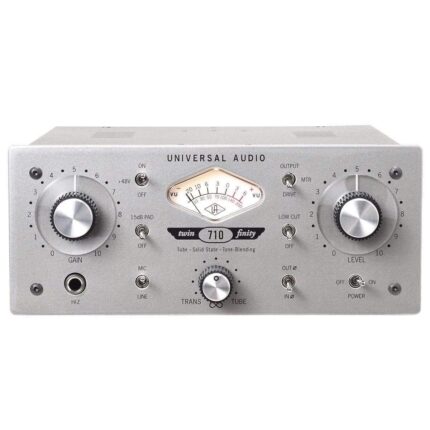
The award-winning 710 Twin-Finity™ is a radically new UA mic preamp design that combines both the classic retro warmth of tubes with the transient bite of solid-state, all in a 2U, half-rack unit. The 710 was created specifically to add the tonal versatility and sonic inspiration missing from generic audio interface preamps. Tone blending is continually variable between 100% tube and 100% solid-state, offering a practically infinite range of unique preamp tones, plus the ability to easily dial-in your own signature sound. There are lots of sensibly priced solid-state and tube preamplifiers out there, but the 710 is the only one that offers the best of both worlds — as well as everything in-between — all in one box, and within reach of any serious project studio’s budget.
- Twin-Finity™ Tone-Blending Mic/Line Preamp & Hi-Z Instrument DI
- Dual-Path 310 volt Class-A Tube and Transimpedance Solid State Preamp
- Phase-Aligned "Tone-Blending" of Tube and Solid State sounds
- Dual Gain Stages: Wire with Gain to Creamy to Crunchy
- Discrete JFET DI with 2.2M ohm Ultra Hi-Z impedance
The key to its sonic flexibility lies in its innovative circuit design, featuring a solid-state transimpedance input amp simultaneously driving separate, phase-aligned tube and solid-state gain stages, which are then summed to a single output.. The mix between the 310 volt single-ended class-A triode tube stage and solid-state transimpedance stage is controlled via the "Blend Knob" labeled "∞". Blending is continually variable between 100% tube and 100% solid-state offering a practically infinite range of unique pre-amp tones and the ability to easily dial-in your own signature sound.
Like all our other preamp designs, the 710 features dual gain-stage controls (Gain/Level) which can radically vary the amount of coloration and distortion by allowing you to crank up the input gain like a guitar amp. The VU meter features a unique "Drive" mode allowing you to see how hard you are driving the input stage.
Versatility makes the 710 the perfect preamp partner for any mic collection. Plus, the discrete JFET DI input circuit can also easily handle any electric instrument. Guitar and bass players will especially appreciate the 710s ability to bring out the best of both active and passive pickups. The 710 Twin-Finity includes a 19" rack-kit for mounting one or two units.
- Inputs: Microphone (Female XLR), Balanced Line (Female XLR) , Unbalanced Instrument (1/4" jack) (D.I.)
- Outputs: Balanced Line (Male XLR)
- Type: Tube & Solid-State Phase-Aligned Tone-Blending Mic Pre & DI
- Tube Complement: 12ax7
- Pad: -15dB
- High Pass Filter: 75Hz
- Maximum Power Consumption: 160mA @120VAC 20W
- Power Requirements: 100-240VAC
- Mic Input Impedance:2K ohms
- Line Input Impedance: 10K ohms
- Hi-Z Input Impedance: 2.2M ohms
- Internal Output Impedance: 600 ohms
- Dimensions: 8.45" W x 3.5" H x 10.25" D
- Weight: 5.25 lb
| Firmly rooted in six decades of console design experience, the 5057 Orbit gives your mixes the legendary tonality, power, and wide-open soundstage that only Rupert Neve’s class-A analog summing can provide. Coupled with Rupert’s famous custom audio transformers and Silk Red & Blue circuitry for variable harmonic saturation, the Orbit launches sterile in-the-box mixes to new heights of tone, depth and clarity – without compromising the recallable convenience and repeatability of your DAW-based workflow.
When you push a mix buss and output transformers towards saturation, the non-linear, musical harmonics that occur are what truly glue a recording together and bring it to life.
Rather than using an external summing solution that offers little more than an ultra-clean representation of the in-the-box experience, the Orbit provides the extraordinary richness, harmonic complexity and depth that only a Rupert Neve console can bring to your mixes.
The Orbit utilizes a highly custom output transformer configuration originally developed for the acclaimed Shelford Channel, which provides both a Main Output and a -6dB Output – the latter of which enables you to fully drive the Orbit to achieve more transformer harmonics without clipping the next device in the chain. This unique transformer drive is a hallmark of the sound of Rupert Neve throughout the years – and the sound of countless classic hit records.
Classic Sounds on Demand
Every mix demands its own treatment. In addition to the choice of outputs, the continuously variable Texture control with Silk Red and Silk Blue modes gives you complete control over the harmonic density and tonality of your mix – or lets you keep it utterly pristine and uncolored.
The Silk Red mode accentuates transformer saturation in the high and high-mid frequencies to amplify the vibrant midrange harmonics associated with Rupert’s vintage equipment, while Silk Blue accentuates saturation of the lows and low-mids to add thickness and weight to any source – especially useful for “thin-sounding” mixes. Unlike EQ, these Silk & Texture controls saturate the output transformers, and add highly musical harmonics to the source material according to the amount of Texture applied.
Drive the mix buss hard, choose your Silk flavor, and crank the Texture knob for a rich, saturated, vintage vibe – or disengage Silk entirely for clear, wide-open sonic beauty. The choice is yours.
Build your Dream
While the Orbit is an extremely effective tool on its own, multiple units can be combined through the Buss Link for a higher channel count. The 5057 Orbit can also be used as a building block in an expandable summing system utilizing the 5059 Satellite for flexible summing & routing, and the 5060 Centerpiece for additional mixing and monitoring features.
These units create the core of a world-class analog modular console system rivaling any traditional large-scale studio setup.
Channel Separation and Accuracy
With precisely fixed channel levels and accurate mix buss attenuation via high-quality stepped switching, the Orbit’s purist signal path has vanishingly low crosstalk, and channels matched to within +/-0.1dB. This provides your mixes with the widest and most accurate stereo image, the greatest depth, and the most direct signal path, allowing you to hear every single detail of your mixes.
DAW Based Recall without Compromise
Frequent recalls can be a challenge for modern mix engineers. The Orbit’s elegant simplicity and fixed level accuracy provides rapid, repeatable DAW-based recall from mix to mix, while adding the rich, unrivaled sound quality of Mr. Neve’s class-A transformer-coupled mix buss.
INPUT IMPEDANCE
16K Ohm
FREQUENCY RESPONSE
- 10 Hz to 50 kHz: +/- 0.1 dB
- 150 kHz: -3 dB
NOISE
- From 22 Hz - 22 kHz.
- -90 dBu typical
MAXIMUM INPUT LEVEL
@ 1 kHz: +26 dBu
MAXIMUM OUTPUT LEVEL
@ 1 kHz: +26 dBu
THD+N%
- From 22 Hz - 22 kHz.
- 0 dBu @ 1 kHz: 0.003%
- +20 dBu @ 1 kHz: 0.0006%
CROSSTALK
- 1 kHz: -103 dBu
- 10 kHz: -93 dBu
PRODUCT DIMENSIONS
19” W (48.3 cm) x 9” D (22.9 cm) x 1.75” H (4.4 cm)
SHIPPING DIMENSIONS
24” L (61 cm) x 13” W (33 cm) x 4” H (10.2 cm)
SHIPPING WEIGHT
10 lbs (4.5 kg) | In today’s modern age of digital recorders, DAWs and software plug-ins, Mike-E is the ultimate solution for getting a clean and strong, yet warm and musical signal into the box…and it couldn’t be easier to work – its front panel layout is so straight ahead that even inexperienced engineers will have no problem moving around on it right away.
When the engineering team at Empirical Labs sets out to build a microphone preamp, you can be sure it’ll deliver spectacular sound, be effortless to work, and will provide features unlike any other device in its class. To that end, we proudly present Mike-E, a high performance transformer-coupled mic preamp with a noise floor far below any microphone’s self noise, combined with a one-of-a-kind compressor/saturator circuit that delivers classic knee compression as well as versatile tonal ‘coloring’ that can replicate many of the best characteristics of vintage analog recording equipment.
Mic Preamp
The Mike-E features a super low noise transformer input amplifier section with the gain under precise digital control. The signal to noise far exceeds any microphone in existence. Having used many mic preamps over the years, we’ve implemented a unique stepped gain control that should be impervious to the normal flakiness that age causes to pots and detented switches. A “Bad!” LED indicates when the input signal is overloading the circuit.
CompSat
The CompSat’s unique circuitry sets the Mike-E apart from all other mic preamps.
- SATURATOR – a multi stage soft-clipping circuit. At lower levels, a triode-type saturation affects the signal. As the level increases, a second unique clip circuit starts to more severely flatten out the peaks.
- COMPRESSOR – based on ELI’s world famous Distressor, but with other characteristics (including a much longer attack time). Preset ratios include: 2:1, 4:1, 8:1…and, of course, Nuke.
- EMPHASIS – a two-stage circuit that boosts and soft clips high frequencies before the CompSat™ circuit, and then cuts the frequencies after it. Emphasis has the added perk of improving signal to noise, and is the reason analog tape decks used emphasis to begin with.
Frequency Response: 3 Hz to 200 kHz on (No CompSat). CompSat is 3Hz – 150Khz. Optional Transformer output is 6Hz–80kHz.
Signal to Noise: 130 dB signal to Noise.at 40dB gain. Maximum output is +28dBu.
Distortion: Ranges between .0006% and 15% depending on mode and settings.
I/O: Transformer coupled Input, Active and Transformer Outputs available. High quality audio caps used internally.
Impedance: Input Impedance is above 600 Ohms at all frequencies, transformer coupled. Output impedance is less than 38 ohms. Instrument In Impedance is 332K Ohms.
Attack/Decay Range: .9 – 70mS attack. .15 – 1 Sec.
Power Consumption: 15 Watts Max.
Metal Chassis: single height 1.75″ high, 10″ deep, 19″ wide. |
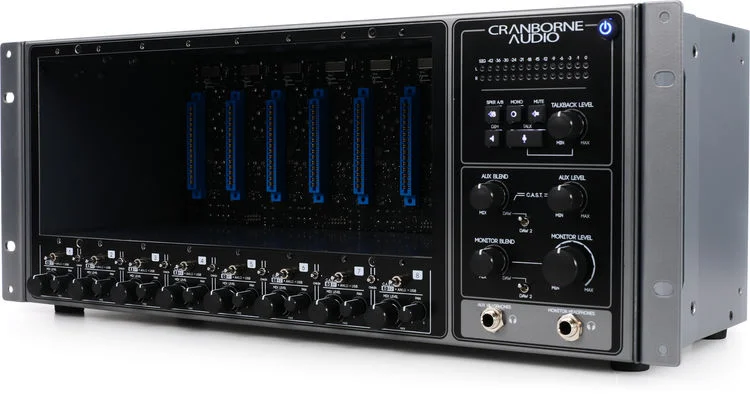
The Cranborne Audio 500R8 is, essentially, a studio in a rack. It’s an 8-slot high-current 500 Series chassis, a 28-in/30-out USB interface, an analog summing mixer, a zero-latency artist mixer, and a monitor controller — everything you need to build your dream hybrid analog/digital studio. The 500R8 is fitted with high-performance AD-DA conversion, reference-grade headphone amplifiers, a reference-quality master clock, and more. In fact, there’s very little you can’t do with the Cranborne Audio 500R8. Configure it to suit your preferred analog flavoring for any source. Pack it with vintage-style 500 Series preamps for recording drums; clean, pristine preamps for vocals; and EQ, compression, and saturation modules when it’s time for mixdown.
USB audio interface
Connect the 500R8 directly to your Mac or PC via USB and utilize the 500R8’s onboard 28-in/30-out USB audio interface for recording and playback directly to and from your digital audio workstation of choice.
Discrete summing mixer
Give your mix the crowning touch of analog character by sending submixes and stems back through your 500 Series modules, into the 500R8’s discrete analog summing mixer, and back into your DAW.
Monitor controller
Use the 500R8’s onboard high-headroom monitor controller to switch between two sets of speakers, toggle mono sum, mute, dim, and talkback facilities while monitoring the peak level of your mix on the high-resolution 28-segment LED meter.
 Shown with optional 500 Series modules Shown with optional 500 Series modules

Audiophile headphone amps and zero-latency artist mixer
Drive any headphones with 500R8’s two reference-grade headphone amplifiers — they have enough power to drive low-impedance ’phones with gobs of headroom and a linear frequency response to below 1Hz! Use the 500R8’s two aux buses to create pristine analog cue mixes that you can blend with DAW playback and send to the talent with zero latency.
World-class conversion and clocking
For the musician who wants to get down to business, it may be hard to get excited about conversion and clocking. But engineers at Sweetwater get to check out the best of them — and we’re amped about these converters. They’re touted as best-in-class and flaunt truly impressive specs such as under .5 picoseconds of jitter. But none of that really matters when you hear the fullness of your stereo image bloom with jaw-dropping sonic clarity.
Connect the 500R8 to your macOS or Windows computer and capture every nuance of your sources with reference-grade AD/DA conversion and world-class internal clocking. Effortlessly pass audio between analog and digital worlds without the digital artifacts that color, cloud, and degrade your recordings. The only coloration you will hear is intentional — your microphone placements, mixing decisions, and the 500 Series modules you’ve chosen to use. And with word clock I/O, you can even share the 500R8’s world-class clocking with the rest of your digital gear.
Ample I/O and configurable front end
The 500R8 has generous I/O to integrate with all of your analog and digital hardware, so you can mix and match your 500 Series modules and find the best combinations during recording and mixing to help create your own signature analog sound. You can even integrate your 19" rack units via the 500R8 s dedicated per-slot TRS insert jacks.
C.A.S.T. away
Spec’d with Cranborne’s innovative C.A.S.T. system, the 500R8 does away with excess cable spaghetti, delivering a cost-effective, low-maintenance, plug-and-play solution by transmitting four channels of balanced analog audio over shielded Cat 5 Ethernet cable directly to the destination of your choice.
Handy source select
Re-patch your 500R8 at a flick of a switch. Dedicated source select switches for each 500 Series slot adjusts signal routing to send analog, C.A.S.T., or USB sources through each of your modules. Unused 500 Series slots? Bypass them using the 500R8’s dedicated slot-bypass switch.
 Shown with optional modules and Cranborne 500ADAT Shown with optional modules and Cranborne 500ADAT
Expandable, in the studio or on the road
When you’re ready for additional 500 Series connectivity, connect your 500R8 with Cranborne Audio’s 500ADAT via ADAT for 16 channels of 500 Series modules. Housed in a 19" 4U rack-mountable rugged steel frame, the 500R8 makes an ideal 500 Series chassis for mobile recording setups. Packed with cool, useful features, the Cranborne Audio 500R8 is one of the more innovative pieces of pro audio gear we’ve seen at Sweetwater. Trust us — you will be impressed.
Cranborne Audio 500R8 8-slot 500 Series Chassis and USB Audio Interface Features:
- 28-in/30-out USB interface, summing mixer, artist mixer, and monitor controller
- Low-latency USB 2.0 interface:
- Compatible with macOS and Windows computers
- ADAT I/O (16x16 channels @ 44.1/48kHz, 8x8 channels @ 88.2/96kHz)
- S/PDIF I/O; 5-pin MIDI I/O
- High-performance A/D conversion:
- Dynamic range: 121dB A-weighted dynamic range, 20Hz–20kHz
- Frequency response: 2.2Hz to >80kHz (-1dB)
- THD+N: <0.00032% (-110dB) @ -4dBFS, 20Hz–40kHz (1kHz, A-weighted)
- Max input level: +24dBu
- High-performance D/A conversion:
- Dynamic range: 121dB A-weighted, 20Hz–20kHz
- Frequency response: <1Hz to >61kHz (-1dB)
- THD+N: <0.0003% (-110.5dB) @ -4dBFS, 20Hz–40kHz (1kHz, A-weighted)
- Max Output Level: +24dBu
- Reference-quality internal master clock:
- Sample rates: 44.1, 48, 88.2, 96, 176.4, and 192kHz; <0.5ps jitter
- Dedicated word clock I/O via BNC
- External sync options using word clock BNC, S/PDIF, or ADAT
- Monitor controller with talkback:
- Speaker A/B switching, mono check, dim, mute, and 28-segment peak meter
- Dedicated talkback input with phantom power, push-to-talk activation, and automatic routing to all headphone and C.A.S.T. facilities
- Easy-access illuminated front panel controls for all monitor controller functions
- Analog summing mixer:
- 8x2 analog summing mixer with +26.5dBu of headroom and dedicated ADC
- Balanced 1/4" jack outputs
- C.A.S.T. link port for increasing Summing Mixer to 16x2 using Cranborne Audio 500ADAT
- Zero-latency Artist Mixer:
- Analog Artist Mixer with per-channel physical level/pan controls and DAW return blend controls
- 2 high-power headphone outputs with independent blend and level controls
- Reference-grade headphone amplifier:
- THD+N: <0.0006% (-104.4dB) @ 20dBu, 1kHz A-weighted, 300 ohm load
- Output wattage (1kHz): 250mW x 2 @ 600 ohms, 650mW x 2 @ 220 ohms, 1.21W x 2 @ 100 ohms, 500mW x 2 @ 32 ohms
- Frequency Response: <1Hz to >70kHz (1dB)
- High-current 8-slot 500 Series rack:
- Per-slot current: 250mA , 2A total for all slots
- XLR inputs, XLR line outputs, and TRS Inserts (pre-ADC) per 500 Series slot
- Module source switching options to send Analog, USB or external C.A.S.T. signals through 500 Series modules
- Per-slot module bypass switches allowing 500R8 to be used without 500 Series modules installed
- C.A.S.T. compatible:
- C.A.S.T. ports per channel for routing analog I/O using passive or active C.A.S.T. breakout boxes via standard Cat 5 cable
- External power supply:
- 24V, 5A external locking power supply for improved analog audio performance and heat dissipation
- Designed and engineered in the UK:
- Each 500R8 is extensively tested by a team of dedicated engineers to ensure reliability and consistency.
| This item is in excellent working condition and barely used.
The ZHA-4 splits a single stereo headphone output into four separate powered 1/8” headphone jacks, each with their own volume and mute control. Perfect for bands, podcasts, productions, and more.
Two AA batteries provide hours of portable power. For longer sessions, connect the USB-C port to a portable battery or plug directly into the wall.
What’s in the Box?
- ZHA-4 Handy Headphone Amplifier
- AA Batteries (x2)
- Stereo Mini Audio Cable (19” / 50cm)
- Quick Guide
Please Note: The item displayed in the images may not be the actual item you receive. | The Suhr Reactive Load delivers a simple solution to capture all of the warmth, and dynamics of your sound, without the hassle of miking a speaker cabinet during a live or recorded performance.
The Reactive Load takes the place of your speaker cabinet in your signal chain. It provides an 8Ω load for your tube amplifier (maximum 100 watts), and produces a balanced and unbalanced signal that interfaces with recording devices, effects, and power amplifiers.
The Suhr Reactive Load is the perfect link between your amplifier and computer audio recording interface. You can use the Reactive Load with your existing library of speaker impulse responses (IR) for the most realistic direct recording experience possible.
Traditional resistive load boxes will safely load your amplifier, but they also alter the tone, dynamics, and response of your amplifier. Real speakers do not have a fixed resistance across the entire frequency spectrum. Real speakers are reactive.
The impedance curve of the Reactive Load has been painstakingly tuned to react like a speaker. Your amp will never know the difference.
The Reactive Load is dedicated to being the absolute best load box possible with zero compromises, and therefore does not include speaker emulation. You can use the Reactive Load with your speaker-sim or impulse response of choice, and benefit from the natural response, dynamics, and touch sensitivity of your amp.
The Suhr Reactive Load features a balanced or unbalanced line level output. The INPUT is optimized for the 8 ohm output of your amplifier and the THRU jack can be connected to a physical speaker cabinet. If a physical cabinet is connected to the THRU jack, the Reactive Load’s internal load is bypassed and the amp will see the load of the physical cabinet.
SPEAKER INPUT IMPEDANCE: 8 Ohm
DI / LINE OUT LEVEL: +4 dBu at 7 watts input, maximum level setting
BALANCED LINE OUTPUT IMPEDANCE: Less than 6KΩ
UNBALANCED LINE OUTPUT IMPEDANCE: Less than 6KΩ
MAXIMUM RECOMMENDED INPUT POWER: 100 Watts RMS
ROHS COMPLIANT: Yes
DIMENSIONS: 8.8" (W) x 8.9" (D) x 3.6" (H)
WEIGHT: 6.6lb |




Reviews
There are no reviews yet.