| Content | Now in its second generation, the ISA 428 Mk II incorporates four of Focusrite's renowned mic pres in a simple-to-operate 2U enclosure, placing four mic preamps, instrument inputs and line ins at your fingertips. The original Focusrite mic pre was designed to suit the microphones of the time; today's model makes one small change, adding three additional input impedances to the classic ISA110 setting, allowing you to match any microphone, old or new, and access a wide range of sounds, from the character and warmth of a vintage mic to the clear transparency of a modern design. Or you can experiment and bring out just the qualities you want.In addition to the mic inputs, there are four front-panel instrument inputs making the ISA428 Mk II ideal for overdubs in the control room with no need for a DI box. On the back: four line inputs and switchable insert points on each channel to allow routing via external signal processors. There's also a versatile, vintage design variable high-pass filter to control what's going on at the bass end. And finally… accurate, 6-LED meters to tell you exactly what's going down. Optionally available for the ISA428 Mk II is a precision eight-channel A-D converter with 122dB dynamic range and superb jitter performance – ideal for simple interfacing with your DAW.
Four ISA series transformer-based preamps
ISA series mic preamps have been the producers' choice on countless hit records over the last two decades.
Eight-channel optional A-D converter
Four additional A-D converter inputs allow eight channels of high quality conversion, with a dynamic range of 122dB and jitter performance below 250 picoseconds.
Selectable impedance
Ideal for mic matching or extended microphone creativity. Settings include the 'Vintage ISA110' setting, providing the original focusrite signature sound.
Four front panel instrument inputs
Instant access on the front fascia - no separate DI box required.
Dedicated analogue insert points
Switchable insert points are featured on every channel, allowing routing (between preamp and output) through additional external processing.
Accurate LED meters for every channel
Clear metering designed to catch even the fastest and most elusive of transients.
Mic Inputs
- Frequency response at minimum gain (0dB): -0.35dB at 20Hz and –3dB at 122kHz
- Frequency response at maximum gain (60dB): –2.5dB at 20Hz and –3dB 103kHz
- Gain range: 0dB to +60dB in 10dB steps, plus 0dB to +20dB continuously variable trim
- Maximum headroom: +7.4dBu
- THD+N: 0.0009% (measured at 1kHz -20dBu input signal, at 30dB gain setting, with a 20Hz/22kHz bandpass filter)
- Noise EIN: -126dB (measured at 60dB of gain with 150Ω termination and 20Hz/22kHz bandpass filter)
- Noise at main output with unity gain: -98dBu (measured with a 20Hz/22kHz bandpass filter)
- SNR: 123dB (relative to max output 25dBu)
- SNR: 120dB (relative to 0dBFS (+22dBu)
- CMRR: 88dB.
- Input Impedance, variable: 600Ω, 1400Ω, 2400Ω, 6800Ω
Line Inputs
- Frequency Response at unity gain (0dB): -0.3dB at 20Hz and –3dB at 94kHz
- Gain range: -20dB to +10dB in 10dB steps, plus 0dB to +20dB continuously variable trim
- Maximum headroom: +25.4dBu
- THD+N: 0.002% (measured with +4dBu input signal, 0dB gain setting, with a 20Hz/22kHz bandpass filter)
- Noise at main output with unity gain: -91dBu (measured with a 20Hz/22kHz bandpass filter)
- SNR: 116dB (relative to max output 25dBu)
- SNR: 113dB (relative to 0dBFS +22dBu). Input Impedance: 10kΩ
Instrument Inputs
- Frequency Response at +10dB gain: -0.2dB at 20Hz and 0dB at 200kHz
- Frequency Response at +40dB gain: -3dB at 20Hz and –3dB at 38.4kHz
- Gain range: +10dB to +40dB continuously variable
- Maximum headroom: +11.5dBu
- THD+N: 0.006% (measured with –20dBu input signal, at minimum gain (+10dB), with a 20Hz/22kHz bandpass filter)
- Noise at main output with minimum gain (+10dB): -95dBu (measured with a 20Hz/22kHz bandpass filter)
- Input Impedance = >1MΩ
High Pass Filter
- Roll off = 18dB per octave 3 pole filter
- Frequency range: 16Hz to 420Hz (continuously variable, measured at the 3dB down point)
Meters
- 6 LED meter is calibrated 0dBFS = +22dBu (the maximum level which can be correctly converted by the optional internal A/D converter before overload occurs). The meter calibration points are as follows:
- Meter panel calibration value in dBFS / Equivalent dBu value
- 0dBFS / +22dBu
- -2dBFS / +20dBu
- -6dBFS / +16dBu
- -12dBFS / +10dBu
- -18dBFS / +4dBu
- -42dBFS / -20dBu
Analogue Channel Inputs (Inputs 1-4)
- 4 instrument 1⁄4" TS jack inputs on front panel
- 4 microphone XLR inputs on rear panel
- 4 line 1⁄4" TRS jacks on rear panel
- 4 insert return 1⁄4" TRS jacks on rear panel
- 4 ADC XLR inputs on rear panel
Analogue Audio Outputs (Outputs 1-4)
- 4 line XLR outputs on rear panel
- 4 insert send 1⁄4" TRS jacks on rear panel
Other I/O
- IEC power input connector 100Vac – 240Vac
Front Panel Indicators
- 8 output meters, 6 segment
- 4 30-60 mic gain range selection indicator
- 4 +48V phantom power indicator
- 4 Phase indicator
- 4 Insert In indicator
- 4 Filter In indicator
- 4 Input selection indicators (Mic, Line, Inst)
- 4 Z In microphone input impedance selection indicators (Low, ISA110, Med, High) Clock select indicators (44.1, 48, 88.2, 96, 176.4, 192)
- Ext clock indicators (Lock, Word clock, 256X)
Weight
Dimensions (W x H x D)
- 480mm (W) x 88mm (H) x 280mm (D)
- 19" (W) x 3.5" (H) x 11" (D)
| Condition: Item is subject to minor cosmetic imperfections. Packaging may be in poor shape. The item displayed in the images may not be the actual item you receive.
- Converts balanced line level signals to unbalanced
- Stereo signal path with set & forget level control
- Transformer isolated to eliminate hum & buzz
- J-Iso features Jensen™ transformers for optimal signal path
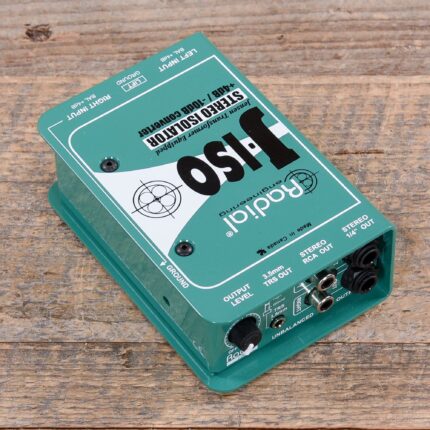
The Radial J-Iso and Pro-Iso are stereo line isolators designed to convert a professional +4dB line level balanced signal to an unbalanced -10dB consumer level device. This enables you to take the balanced output of a mixer and feed a consumer level recorder or audio input on a computer.
J-Iso Part # R800-1025: The J-Iso employs a premium Jensen transformer for optimal signal transfer to minimize distortion and artefact. Full bandwidth performance makes the J-Iso ideal for music production.
The passive design begins with 100% discrete components throughout. A set & forget level control lets you attenuate the input signal to prevent it from overloading the destination device. Output connections include a stereo pair of ¼" connectors, a set of RCAs and a mini 3.5mm (1/8") for interfacing to a mini recorder or lap-top computer. Transformer isolation helps eliminate hum and buzz caused by ground loops while eliminating stray DC currents from flowing.
Construction begins with 14 gauge steel throughout utilizing Radial's unique bookend construction. This creates a protective zone around the connectors and controls for added durability. The steel construction also assists by shielding the transformers from outside magnetic fields. Inside, the J-Iso features an innovative I-beam skeletal insert that makes it virtually impossible to torque the PC board. This reduces potential stress which could cause premature solder joint failure.
Designed for full range applications, the J-Iso combines exceptional signal handling with the type of durability that has made Radial famous. Signal Processors | In today’s modern age of digital recorders, DAWs and software plug-ins, Mike-E is the ultimate solution for getting a clean and strong, yet warm and musical signal into the box…and it couldn’t be easier to work – its front panel layout is so straight ahead that even inexperienced engineers will have no problem moving around on it right away.
When the engineering team at Empirical Labs sets out to build a microphone preamp, you can be sure it’ll deliver spectacular sound, be effortless to work, and will provide features unlike any other device in its class. To that end, we proudly present Mike-E, a high performance transformer-coupled mic preamp with a noise floor far below any microphone’s self noise, combined with a one-of-a-kind compressor/saturator circuit that delivers classic knee compression as well as versatile tonal ‘coloring’ that can replicate many of the best characteristics of vintage analog recording equipment.
Mic Preamp
The Mike-E features a super low noise transformer input amplifier section with the gain under precise digital control. The signal to noise far exceeds any microphone in existence. Having used many mic preamps over the years, we’ve implemented a unique stepped gain control that should be impervious to the normal flakiness that age causes to pots and detented switches. A “Bad!” LED indicates when the input signal is overloading the circuit.
CompSat
The CompSat’s unique circuitry sets the Mike-E apart from all other mic preamps.
- SATURATOR – a multi stage soft-clipping circuit. At lower levels, a triode-type saturation affects the signal. As the level increases, a second unique clip circuit starts to more severely flatten out the peaks.
- COMPRESSOR – based on ELI’s world famous Distressor, but with other characteristics (including a much longer attack time). Preset ratios include: 2:1, 4:1, 8:1…and, of course, Nuke.
- EMPHASIS – a two-stage circuit that boosts and soft clips high frequencies before the CompSat™ circuit, and then cuts the frequencies after it. Emphasis has the added perk of improving signal to noise, and is the reason analog tape decks used emphasis to begin with.
Frequency Response: 3 Hz to 200 kHz on (No CompSat). CompSat is 3Hz – 150Khz. Optional Transformer output is 6Hz–80kHz.
Signal to Noise: 130 dB signal to Noise.at 40dB gain. Maximum output is +28dBu.
Distortion: Ranges between .0006% and 15% depending on mode and settings.
I/O: Transformer coupled Input, Active and Transformer Outputs available. High quality audio caps used internally.
Impedance: Input Impedance is above 600 Ohms at all frequencies, transformer coupled. Output impedance is less than 38 ohms. Instrument In Impedance is 332K Ohms.
Attack/Decay Range: .9 – 70mS attack. .15 – 1 Sec.
Power Consumption: 15 Watts Max.
Metal Chassis: single height 1.75″ high, 10″ deep, 19″ wide. | FEATURES
- World-class, transformer-coupled preamp, compressor, and DI
- Gain: 0 - 66dB in 6dB increments
- Compressor: Single-knob opto-coupler compressor with 2:1 ratio
- Blend: Determines balance of mic and DI inputs
- Instrument gain: 0 - 30dB on instrument input
- 48V phantom power
- Silk: Adds nostalgic warmth and presence when engaged
- Instrument input: Front-panel TRS input and passive-through for Hi-Z sources
- Polarity reverse
- Threshold: When signals exceed threshold level, gain is reduced at a controlled 2:1 ratio with fixed attack and release time constants
- Indicators: Signal presence and clipping on both mic and DI signals, as well as compressor activation.
TECHNICAL SPECIFICATION
Rupert Neve Designs Portico 517: 500 Series Mic Pre / DI / Comp
- Frequency Response: Main Output, no load, -0.2dB @ 10Hz -3dB @ 160kHz
- Noise measured at main output, unweighted, 22Hz - 22kHz, terminated 150 ohm: Gain at unity: better than -100dBu; gain at 66dB: better than -62dBu Equivalent Input Noise: better than -128dBu, noise factor 1.5dB
- Maximum output level from 20Hz to 40kHz: +23dBu
- Total Harmonic Distortion and Noise: @ 1kHz, +20 dBu output: Main Output: Better than 0.001% @ 20Hz, +20 dBu output: Main Output: Better than 0.002% Silk Engaged: Better than 0.2% Second harmonic
- Crosstalk: Measured channel to channel: Better than -90dB @ 15kHz.
- Phantom Power: +48 Volts DC +/- 1%
|
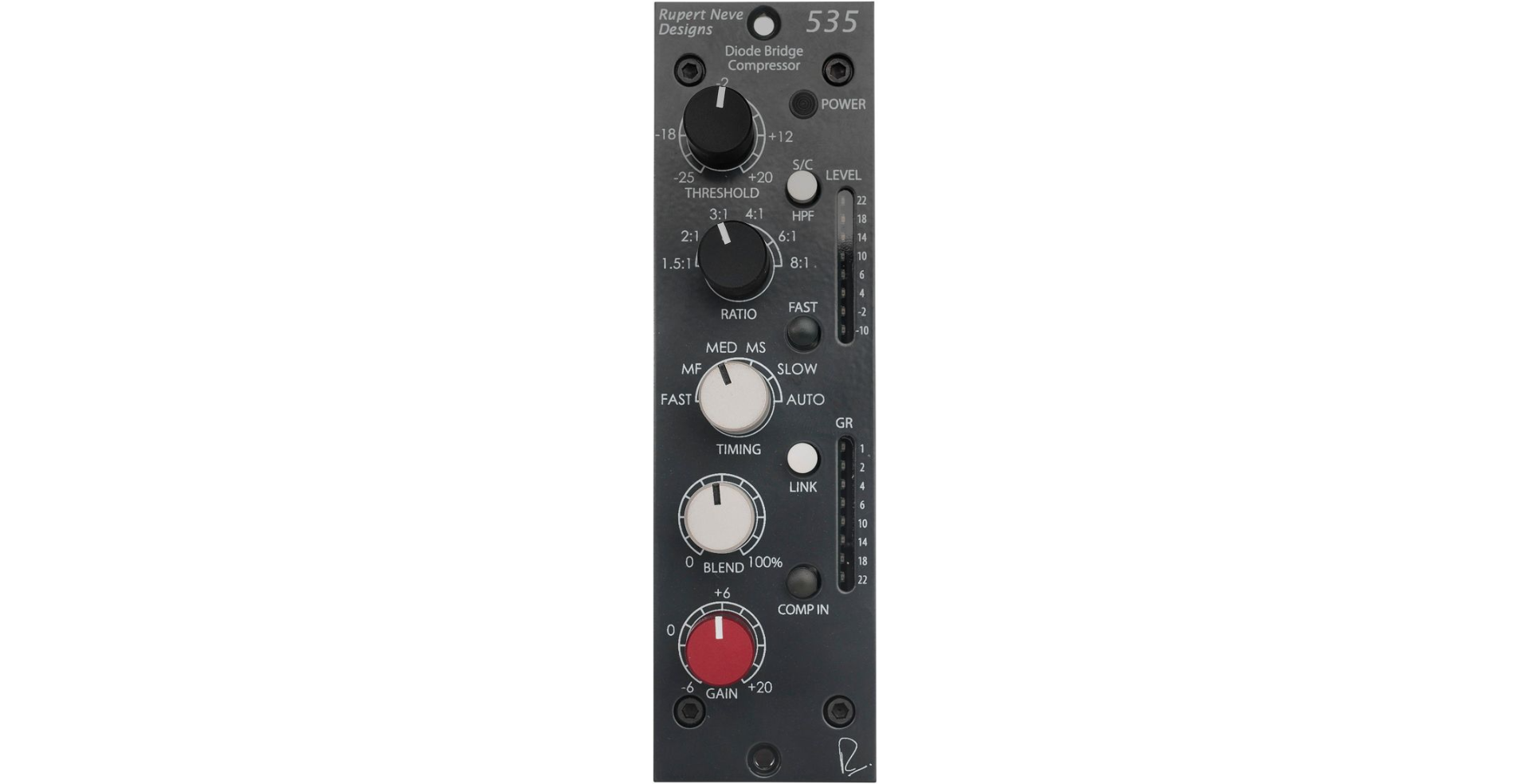
- FAST – Fast Attack (750us), Fast Release (130ms)
- MF – Medium Attack (2.25ms), Fast Release (130ms)
- MED – Medium Attack (2.25ms), Medium Release (400ms)
- MS – Medium Attack (4ms), Slow Release (725ms)
- SLOW – Slow Attack (10ms), Slow Release (1S)
- AUTO – Medium Attack (5ms), Dual Decay Release (T1 500ms, T2 1s)The LINK switch allows the compressor to be linked to another 535 compressor module via a sidechain control voltage. In link mode, the compressor generating the greater sidechain voltage (resulting in higher amounts of compression) will control the compression of both audio signal paths to maintain proper stereo center image while compressing. Note: it is advisable to always audition the unlinked sound as well, to decide if the benefit of a constant stereo center image is worth the potential trade-off of reduced left / right independence in the stereo field.
-
SIDECHAIN HPF
- The S/C HPF switch allows the user to insert a 12dB/octave 150Hz high-pass filter in the compressor sidechain. When this filter is engaged, the compressor will be considerably less responsive to information below 150Hz. For example: if used on a drum kit, the low end of the kick drum would have less proportional effect on the compression than a snare drum or cymbals, since a significant portion of the kick drum’s dynamic energy is focused below 150Hz.
LEVEL AND GAIN REDUCTION METERING
- These two LED meters provide accurate representations of both the output level of the compressor and the amount of gain reduction being applied to the input signal.
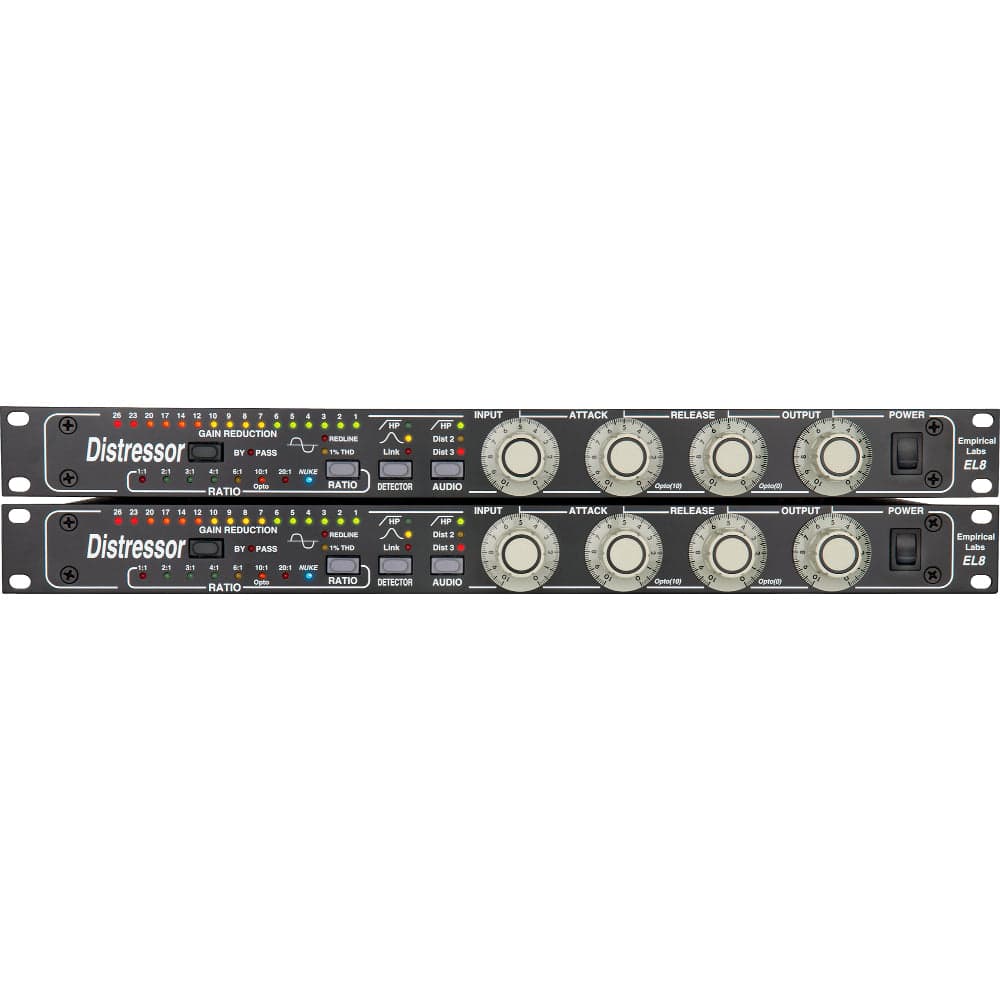
| The product that started it all for Empirical Labs. Born of founder Dave Derr’s love of classic compressors like the 1176, LA-2A and Gain Brain (among others), the Distressor incorporates his favorite sonic characteristics of these, along with other unique and interesting features that have made it a staple for audio engineers all over the world. With over 28,000 units in the field, it’s safe to say that the Distressor is one of the best selling high end compressors of all time… if not THE best selling. A prominent recording engineer recently wagered that there probably was not a top 40 record made in the last five years that didn’t have at least one Distressor on it.
Besides providing a wide range of control and a unique feature set, the Distressor offers a warm, vintage sound by using a custom designed gain control circuit. This “warmth” or “vintage sound” has become a major issue in the last few decades, as the super clear and linear digital technology does next to nothing to soften “harsh” sounds, nor emphasize the bass frequencies in music sources. Conversely, older analog tape, vinyl records and tube equipment could not be prevented from coloring the sound, often to the frustration of recording engineers. However, many people now realize that this coloring can be extremely pleasant and musical. Digital technology is often referred to as “cold” and “brittle” among other terms (although we prefer “unforgiving”).
Unique Compression Curves
All eight of the Distressor’s curves are unique and distinctive, from the 1:1 mode that simply warms up signal with low order harmonics without intentional compression, to the “Nuke” setting – a brick wall limiting curve that shines on live drum room mics. Each curve has its own personality and several actually use different circuitry, and are effectively different compressors. Most exceptional is the 10:1 “Opto” ratio which uses separate detector circuitry to emulate the oldest (and valued) “light controlled” devices, such as the LA-2A.
Distortion (Color) Modes
Another large part of the Distressor’s personality and power derive from three modes that color the signal, even without compression. These extended audio modes were designed to allow emulation of some very old and expensive vintage compressors & limiters, and let the Distressor deliver a classic “knee” sound all its own by providing user programmable, warm harmonic distortion. In addition to the basic distortion mode, Distort 2 emphasizes tube-like 2nd order harmonics, while in Distort 3 setting the distortion becomes dominated by 3rd harmonics more closely resembling tape. Two HP filters – one in the audio path, one in the detector path – are also available to help with low frequencies that can cause pumping and breathing.
Go Stereo
For many Distressor owners, one is never enough – in fact, one extremely successful engineer has twelve of them! For those who want (at least) a stereo pair, ELI offers the EL8-S, a pair of Distressors that are matched at the factory, and come with the cables you need to lock them together.
- Frequency Response – 2 Hz to 160 kHz in clean audio mode (+0, -3 dB). Response is shaped in distortion modes (Dist 2, Dist 3).
- Dynamic Range – 110 dB from max. output to min. output in 1:1 mode. Greater than 100 dB signal to noise in distort 3 mode.
- Distortion – ranges between .02% and 20% depending on distortion mode and release times set on front panel.
- I/O – DC Coupled input and outputs.
- Time Constants – Attack range 50uS – 50mS. Release range .05 sec to 3.5 seconds, normal modes and up to 20 seconds in 10:1 opto mode. Time constants are dependent on ratio.
- Power Consumption – 15 Watts Max.
- Metal Chassis – single height 1.75″ high, 10″ deep, 19″ wide.
- Shipping info – 24.2 lbs Stereo pair. Stereo Pair box dimensions 22.5″ x 18.5″ x 6 1/4.
|






Reviews
There are no reviews yet.