| Content | Now in its second generation, the ISA 428 Mk II incorporates four of Focusrite's renowned mic pres in a simple-to-operate 2U enclosure, placing four mic preamps, instrument inputs and line ins at your fingertips. The original Focusrite mic pre was designed to suit the microphones of the time; today's model makes one small change, adding three additional input impedances to the classic ISA110 setting, allowing you to match any microphone, old or new, and access a wide range of sounds, from the character and warmth of a vintage mic to the clear transparency of a modern design. Or you can experiment and bring out just the qualities you want.In addition to the mic inputs, there are four front-panel instrument inputs making the ISA428 Mk II ideal for overdubs in the control room with no need for a DI box. On the back: four line inputs and switchable insert points on each channel to allow routing via external signal processors. There's also a versatile, vintage design variable high-pass filter to control what's going on at the bass end. And finally… accurate, 6-LED meters to tell you exactly what's going down. Optionally available for the ISA428 Mk II is a precision eight-channel A-D converter with 122dB dynamic range and superb jitter performance – ideal for simple interfacing with your DAW.
Four ISA series transformer-based preamps
ISA series mic preamps have been the producers' choice on countless hit records over the last two decades.
Eight-channel optional A-D converter
Four additional A-D converter inputs allow eight channels of high quality conversion, with a dynamic range of 122dB and jitter performance below 250 picoseconds.
Selectable impedance
Ideal for mic matching or extended microphone creativity. Settings include the 'Vintage ISA110' setting, providing the original focusrite signature sound.
Four front panel instrument inputs
Instant access on the front fascia - no separate DI box required.
Dedicated analogue insert points
Switchable insert points are featured on every channel, allowing routing (between preamp and output) through additional external processing.
Accurate LED meters for every channel
Clear metering designed to catch even the fastest and most elusive of transients.
Mic Inputs
- Frequency response at minimum gain (0dB): -0.35dB at 20Hz and –3dB at 122kHz
- Frequency response at maximum gain (60dB): –2.5dB at 20Hz and –3dB 103kHz
- Gain range: 0dB to +60dB in 10dB steps, plus 0dB to +20dB continuously variable trim
- Maximum headroom: +7.4dBu
- THD+N: 0.0009% (measured at 1kHz -20dBu input signal, at 30dB gain setting, with a 20Hz/22kHz bandpass filter)
- Noise EIN: -126dB (measured at 60dB of gain with 150Ω termination and 20Hz/22kHz bandpass filter)
- Noise at main output with unity gain: -98dBu (measured with a 20Hz/22kHz bandpass filter)
- SNR: 123dB (relative to max output 25dBu)
- SNR: 120dB (relative to 0dBFS (+22dBu)
- CMRR: 88dB.
- Input Impedance, variable: 600Ω, 1400Ω, 2400Ω, 6800Ω
Line Inputs
- Frequency Response at unity gain (0dB): -0.3dB at 20Hz and –3dB at 94kHz
- Gain range: -20dB to +10dB in 10dB steps, plus 0dB to +20dB continuously variable trim
- Maximum headroom: +25.4dBu
- THD+N: 0.002% (measured with +4dBu input signal, 0dB gain setting, with a 20Hz/22kHz bandpass filter)
- Noise at main output with unity gain: -91dBu (measured with a 20Hz/22kHz bandpass filter)
- SNR: 116dB (relative to max output 25dBu)
- SNR: 113dB (relative to 0dBFS +22dBu). Input Impedance: 10kΩ
Instrument Inputs
- Frequency Response at +10dB gain: -0.2dB at 20Hz and 0dB at 200kHz
- Frequency Response at +40dB gain: -3dB at 20Hz and –3dB at 38.4kHz
- Gain range: +10dB to +40dB continuously variable
- Maximum headroom: +11.5dBu
- THD+N: 0.006% (measured with –20dBu input signal, at minimum gain (+10dB), with a 20Hz/22kHz bandpass filter)
- Noise at main output with minimum gain (+10dB): -95dBu (measured with a 20Hz/22kHz bandpass filter)
- Input Impedance = >1MΩ
High Pass Filter
- Roll off = 18dB per octave 3 pole filter
- Frequency range: 16Hz to 420Hz (continuously variable, measured at the 3dB down point)
Meters
- 6 LED meter is calibrated 0dBFS = +22dBu (the maximum level which can be correctly converted by the optional internal A/D converter before overload occurs). The meter calibration points are as follows:
- Meter panel calibration value in dBFS / Equivalent dBu value
- 0dBFS / +22dBu
- -2dBFS / +20dBu
- -6dBFS / +16dBu
- -12dBFS / +10dBu
- -18dBFS / +4dBu
- -42dBFS / -20dBu
Analogue Channel Inputs (Inputs 1-4)
- 4 instrument 1⁄4" TS jack inputs on front panel
- 4 microphone XLR inputs on rear panel
- 4 line 1⁄4" TRS jacks on rear panel
- 4 insert return 1⁄4" TRS jacks on rear panel
- 4 ADC XLR inputs on rear panel
Analogue Audio Outputs (Outputs 1-4)
- 4 line XLR outputs on rear panel
- 4 insert send 1⁄4" TRS jacks on rear panel
Other I/O
- IEC power input connector 100Vac – 240Vac
Front Panel Indicators
- 8 output meters, 6 segment
- 4 30-60 mic gain range selection indicator
- 4 +48V phantom power indicator
- 4 Phase indicator
- 4 Insert In indicator
- 4 Filter In indicator
- 4 Input selection indicators (Mic, Line, Inst)
- 4 Z In microphone input impedance selection indicators (Low, ISA110, Med, High) Clock select indicators (44.1, 48, 88.2, 96, 176.4, 192)
- Ext clock indicators (Lock, Word clock, 256X)
Weight
Dimensions (W x H x D)
- 480mm (W) x 88mm (H) x 280mm (D)
- 19" (W) x 3.5" (H) x 11" (D)
| There’s no doubt that when it comes to power, musicians have it bad. Whether it’s modern modeling amplifiers, or vintage synthesizers, bad power is gonna be heard throughout your signal. And it’s everywhere — in homes, on stages, and especially in many rehearsal rooms.
Black Lion Audio has been trusted for years for modifying the best gear and making it even better, and that’s what it took to create the PG-P: taking industry-standard designs, and improving them to the point of peak performance.
After creating an entire lineup of industry-best power conditioners, Black Lion Audio felt it was time to give the world proper portable power. The PG-P might look like a run-of-the-mill surge protector, but in reality it’s a studio-class power conditioner — PG-P doesn’t just provide more noise filtering than other portable conditioners, it provides the same noise filtering found in the majority of the world’s rack-mount power conditioners!
Your gear deserves the best power, and Black Lion Audio took great care in making sure the PG-P delivers just that — thanks to it’s PG-P Filtering Technology. The PG-P is built using premium Panasonic capacitors, due to their superior execution in eliminating high frequency noise that robs equipment of its peak performance. In testing, this has provided an average of 3x the noise filtering of other portable power conditioners at the same price point. Six wall-wart spaced outlets provide studio-grade power on the go; perfect for any musician’s rig!
- PG-P Filtering Technology for an average of 3x the noise reduction of other portable power conditioners
- The same noise filtering found in the majority of rack-mount power conditioners
- 6 wall-wart spaced outlet power conditioner
- Status LEDs for quick power analysis
- High-end Panasonic capacitors to filter out performance-robbing high-frequency noise
- Tour-grade 9ft power cable
- Proper safeguard protection with a power absorption rating of 540 joules
- Recessed feet keep the PG-P from sliding, while still providing mounting options (screw mount, velcro, etc.)
- Rounded corners make for a gentle surface area for smaller power cords.
| FEATURES
- The industry-standard tabletop looper, updated and enhanced
- Class-leading sound quality with 32-bit AD/DA and 32-bit floating-point processing
- Five simultaneous stereo phrase tracks with dedicated controls and independent volume faders
- Input FX and Track FX sections, each with four simultaneous effects and four quick-access banks
- Customizable FX and Track buttons for each phrase track
- Massive onboard effects selection with 49 Input FX types and 53 Track FX types, including new Harmony, Electric FX and many others
- Ultra-durable faders with longer throw for more precise adjustment
- Mark Back function provides enhanced undo/redo flexibility while performing
- Two XLR mic inputs with phantom power, two stereo line input pairs, and three stereo line output pairs
- 99 memories, each containing five phrase tracks, custom effects and playback settings, control assignments and more
- Synchronize your loops with over 200 onboard rhythm patterns and 16 drum kits
- Deep MIDI control support
- Two external control jacks, each with support for up to two footswitches or an expression pedal
- USB for data backup, phrase import/export with BOSS Tone Studio and pattern import with the RC Rhythm Converter
TECHNICAL SPECIFICATION
Boss RC-505MK2 Tabletop Loop Station
- Sampling Frequency: 44.1 kHz
- AD/DA Conversion: 32 bits
- Processing: 32-bit floating point
RECORDING/PLAYBACK
- Number of Tracks: 5
- Data Format: WAV (44.1 kHz, 32-bit float, stereo)
- Maximum Recording Time: Approx. 1.5 hours (1 track), Approx.13 hours (total of All memories)
- Rhythm Type: 200 types or greater
- Rhythm Kit: 16 types
EFFECTS
- INPUT FX: 49 types
- TRACK FX: 53 types
- MASTER FX: 2 types
- Memory: 99
- Display: Graphic LCD (128 x 64 dots, backlit LCD)
CONNECTORS
- MIC IN 1, 2 jack: XLR type (balanced, phantom power: DC 48 V, 10 mA Max
- INST IN 1, 2 jacks, MAIN OUT jacks, SUB OUT 1, 2 jacks: 1/4-inch phone type
- PHONES jack: Stereo 1/4-inch phone type
- CTL1,2/EXP1 jack, CTL3,4/EXP2 jack: 1/4-inch TRS phone type
- USB port: USB B type
- MIDI (IN, OUT) connectors
- DC IN jack
- Power Supply: AC adaptor
CURRENT DRAW
- 1.0 A (with phantom power)
- 0.9 A (without phantom power)
- Dimensions: 16-9/16" W x 9-1/4" D x 2-11/16" H
- Weight: 4 lb.
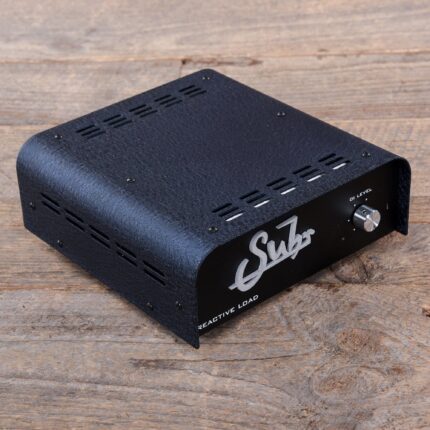
| The Suhr Reactive Load delivers a simple solution to capture all of the warmth, and dynamics of your sound, without the hassle of miking a speaker cabinet during a live or recorded performance.
The Reactive Load takes the place of your speaker cabinet in your signal chain. It provides an 8Ω load for your tube amplifier (maximum 100 watts), and produces a balanced and unbalanced signal that interfaces with recording devices, effects, and power amplifiers.
The Suhr Reactive Load is the perfect link between your amplifier and computer audio recording interface. You can use the Reactive Load with your existing library of speaker impulse responses (IR) for the most realistic direct recording experience possible.
Traditional resistive load boxes will safely load your amplifier, but they also alter the tone, dynamics, and response of your amplifier. Real speakers do not have a fixed resistance across the entire frequency spectrum. Real speakers are reactive.
The impedance curve of the Reactive Load has been painstakingly tuned to react like a speaker. Your amp will never know the difference.
The Reactive Load is dedicated to being the absolute best load box possible with zero compromises, and therefore does not include speaker emulation. You can use the Reactive Load with your speaker-sim or impulse response of choice, and benefit from the natural response, dynamics, and touch sensitivity of your amp.
The Suhr Reactive Load features a balanced or unbalanced line level output. The INPUT is optimized for the 8 ohm output of your amplifier and the THRU jack can be connected to a physical speaker cabinet. If a physical cabinet is connected to the THRU jack, the Reactive Load’s internal load is bypassed and the amp will see the load of the physical cabinet.
SPEAKER INPUT IMPEDANCE: 8 Ohm
DI / LINE OUT LEVEL: +4 dBu at 7 watts input, maximum level setting
BALANCED LINE OUTPUT IMPEDANCE: Less than 6KΩ
UNBALANCED LINE OUTPUT IMPEDANCE: Less than 6KΩ
MAXIMUM RECOMMENDED INPUT POWER: 100 Watts RMS
ROHS COMPLIANT: Yes
DIMENSIONS: 8.8" (W) x 8.9" (D) x 3.6" (H)
WEIGHT: 6.6lb | As with ELI’s other signal processors, the Lil FrEQ Equalizer takes a somewhat unique approach to its job. Instead of daisy chaining several equalizers and frequency processors, we combined most of the sound sculpting tools an engineer needs into a compact single rack space box, while still offering the highest performance of any design in its class.
Eight Sections of Processing
There are eight sections of processing – what other EQ offers that? Even better – in addition to a master bypass, each of the Lil FrEQ’s sections features its own dedicated bypass switch, letting you instantly A/B the effect of each section as you adjust and fine-tune them.
HIGH PASS – The High Pass section is a really easy to use sharp filter that cuts all content below one of eight preset frequencies from 30-330 Hz. This filter is very steep and has a special shape that prevents frequencies from thinning out just above the cutoff point. The corner frequency is selected using up/down buttons, and indicated by LEDs that glow softly when the section is bypassed, and brightly when the section is engaged.
HIGH & LOW SHELVING – These two knobs function similarly to the familiar “bass and treble” tone controls found on many consumer audio playback systems; however, these are designed to a much higher performance standard, providing exceptionally smooth and musical boost and cut on the high and low frequencies.
PARAMETRIC EQ – The Lil FrEQ has four sections of fully parametric EQ (LF, Lo Mid, Hi Mid and HF), with each section featuring individual gain, bandwidth (Q) and frequency controls. It may be the cleanest parametric EQ section ever produced, operating below .0007% THD (Total Harmonic Distortion) even at extremely high audio levels. Try finding those specs anywhere else!
DS (DYNAMIC EQ) – The DS section provides the highest performance, easiest to use, and possibly most natural sounding “De-esser” ever built. This powerful tool combines tunable filters with a compressor-like circuit that can help contain and control excessive high frequency content such as sibilants or other sharp transients, especially in the absence of other lower frequency content. It can also function as a one of a kind soft knee High Frequency limiter, which is one of the main things responsible for the Lil FrEQ becoming the go-to vocal EQ for engineers everywhere. It has been used on many acclaimed albums and major live performances all over the world, becoming the “go to” EQ for key tracks like lead vocals, snares, and bass. There are now dozens of hit record vocals that were processed thru the Lil FrEQ.
Frequency Response: 5 Hz to 140 kHz on transformerless inputs and outputs. Transformer output 10Hz to 110 kHz.
Dynamic Range: 120 dB from maximum output (.1% clipping) to minimum output. Greater than 110 dB signal to noise.
Distortion: Ranges between .00056% and .005% depending on mode and settings. DS section has THD < .005%.
I/O: DC coupled inputs and outputs and one transformer coupled output.
Dynamic Time Constraints: Attack is approximately .5 ms. Release .04 sec fixed internally.
Power Consumption: 15 Watts Max.
Metal Chassis: single height 1.75″ high, 10″ deep, 19″ wide. | Rupert Neve Designs Portico 542 500 Series Tape FX Standard
FEATURES
- Add depth and character to your sound
- Control the mix of pre and post tape signals
- Send signals through "True Tape" circuitry
- Silk circuit, reduces negative feedback, adding harmonic content as needed
- Red Silk accentuates the saturation in the mid and high frequencies
- Use soft clip to tame overly transient material like drums
- Provides +/- 12dB adjustment of level on incoming signal levels
TECHNICAL SPECIFICATION
Rupert Neve Designs Portico 542 500 Series Tape FX
- Line Amp Specifications (Measurements with tape circuit disengaged)
- Noise: Measured at Main Output, un-weighted, 20Hz-22kHz, Input Terminated 40 Ohms.
- Unity Gain Better than -100dBu
- Frequency Response
- Measured at +10dBu, trim at unity.
- Main Output +/- 0.25dB from 5Hz to 60Khz -2dB @ 120KHz
- Maximum Output Level 23.25dBu
- Total Harmonic Distortion and Noise:
- @ 1kHz, +20dBu output level Better than 0.0025% @ 20Hz, +20dBu output level 0.07% Typical (2nd and 3rd harmonic)
- Tape FX Specifications
- Noise:
- Measured at Main Output, un-weighted, 20Hz-22kHz, Input Terminated 40 Ohms.
- Saturation @ minimum Better than -100dBu Saturation @ maximum Better than -100dBu
- Frequency Response:
- 15 IPS, Input @ -0 dBu -3dBu @ 28kHz Saturation @ minimum 0dBu @ 10Hz +5dBu Peak @ 60Hz
- Saturation @ maximum -3dBu @ 20kHz -3dBu @ 12.5Hz +2.4dBu Peak @ 60Hz
- 30 IPS, Input @ -0 dBu -3dBu @ 120kHz Saturation @ minimum -3dBu @ 10Hz +3.15dBu Peak @ 125Hz
- Saturation @ maximum -3dBu @ 100kHz -3dBu @ 12.5Hz
- +1.3dBu Peak @ 110Hz
- Total Harmonic Distortion and Noise
- Refer to sweeps on page10 15 IPS, Input @ -0 dBu 0.4% @ 3kHz to 1% @ 175Hz typical
- Saturation @ minimum Greater than 1% below 175Hz typical
- Saturation @ maximum 1% at 6kHz typical 0.3% @ 1kHz to 3% @ 50Hz typical
- 30 IPS, Input @ -0 dBu 1% at 1kHz typical
- Saturation @ minimum 0.6% @ 400Hz 5% @ 20Hz typical
- Saturation @ maximum 1.5% @ 20kHz to 0.4% @ 1kHz typical 0.4% @ 1kHz to 2 %@ 50Hz typical
- Power requirements:
- Supplied by 500 series rack with 110-125 mA @ +/- 16V DC
|




Reviews
There are no reviews yet.