| Content | It takes more than a few rack-mounted outlets to inspire true confidence in your power conditioner, and that’s where the PG-2 delivers! The PG-2 features a suite of status and alert capabilities: a voltage meter and amperage meter for real-time analysis, LED status for grounding/polarity/noise filtering/ abnormal voltage/surge protection, and an audio alarm for unsafe voltage. Even in the worse power scenarios, the PG-2 has your gear’s safety in mind.
There’s nothing worse than scoring that “must-have” piece of gear, only to find that it’s noisier than should be expected, missing high frequency detail, or even worse — having it fried by power surges!
Black Lion Audio has been trusted for years for modifying the best gear and making it even better, and that’s what it took to create the PG-2: taking industry-standard designs, and improving them to the point of peak performance.
High-end filtering.
Your gear deserves the best power, and we took great care in making sure the PG-2 delivers just that, thanks to PG- 99 Filtering Technology. The PG-2 is built using premium Panasonic and Wima capacitors, due to their superior execution in eliminating high frequency noise that robs equipment of its peak performance. In testing, this has provided an average of 99.7% of noise filtering, as opposed to the typical average of 85% found in other power conditioners at the same price point. Combine that superior power filtration with an impressive power absorption rating of 2775 joules, and your gear isn’t just getting quality power, but it’s protected from the most unsafe of scenarios that can happen!
The PG-2 features a bank of 12 switched, filtered and surge protected outlets on the back panel — combined into four groups (Digital Audio x2, Analog Audio, and High Current). The Analog Audio and High Current outlets are time delayed, always ensuring that your speakers and power amplifiers are the last to turn on, and the first to turn off — this prevents the dreaded “pop” that can occur if speakers receive power at the same time as your sound sources. The PG-2 also features 2 filtered convenience outlets, and a USB charger on the front panel, as well as XLR lamp connectors on both the front and back panels.
Professional features for professional power.
It takes more than a few rack-mounted outlets to inspire true confidence in your power conditioner, and that’s where the PG-2 delivers! The PG-2 features a suite of status and alert capabilities: a voltage meter and amperage meter for real-time analysis, LED status for grounding/polarity/noise filtering/abnormal voltage/surge protection, and an audio alarm for unsafe voltage. Even in the worse power scenarios, the PG-2 has your gear’s safety in mind.
- 14 outlet power conditioner
- PG-99 Filtering Technology for an average of 99.7% noise reduction
- Front and back panel XLR lamp connectors for lighting
- Voltage meter helps show current voltage in real time
- Status LEDs and audio siren help alert for dangerous power scenarios
- Panasonic and Wima capacitors to filter out performance-robbing high-frequency noise
- Proper safeguard protection with a power absorption rating of 2775 joules
- 12 switched back-panel outlets and 2 unswitched front-panel outlets
- 4 sets of optimized outlets for digital audio x2, analog audio, and high current devices
- Time delayed outlets for high current devices help protect speakers and amplifiers
- 2-stage power up/power down system
|
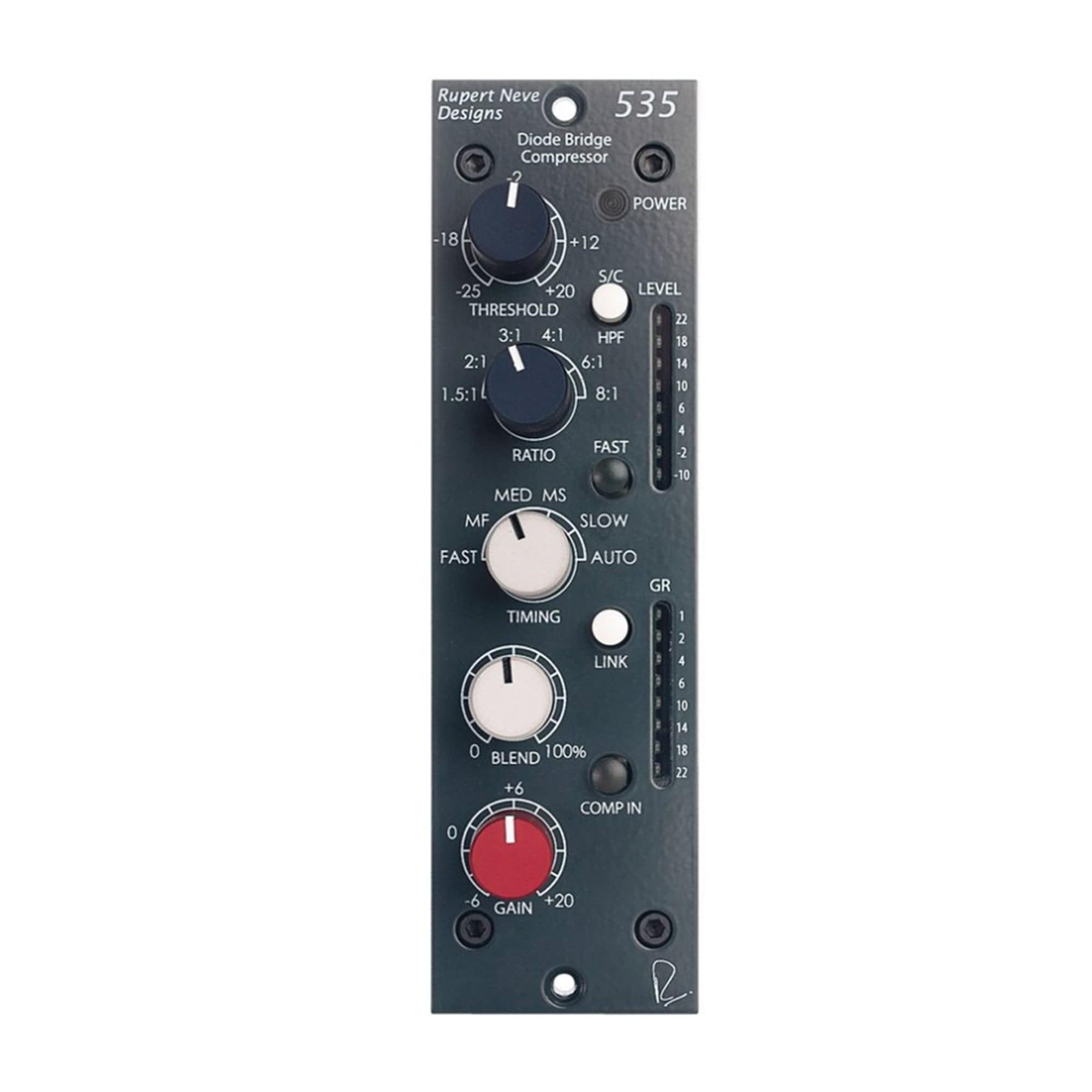
- FAST – Fast Attack (750us), Fast Release (130ms)
- MF – Medium Attack (2.25ms), Fast Release (130ms)
- MED – Medium Attack (2.25ms), Medium Release (400ms)
- MS – Medium Attack (4ms), Slow Release (725ms)
- SLOW – Slow Attack (10ms), Slow Release (1S)
- AUTO – Medium Attack (5ms), Dual Decay Release (T1 500ms, T2 1s)The LINK switch allows the compressor to be linked to another 535 compressor module via a sidechain control voltage. In link mode, the compressor generating the greater sidechain voltage (resulting in higher amounts of compression) will control the compression of both audio signal paths to maintain proper stereo center image while compressing. Note: it is advisable to always audition the unlinked sound as well, to decide if the benefit of a constant stereo center image is worth the potential trade-off of reduced left / right independence in the stereo field.
-
SIDECHAIN HPF
- The S/C HPF switch allows the user to insert a 12dB/octave 150Hz high-pass filter in the compressor sidechain. When this filter is engaged, the compressor will be considerably less responsive to information below 150Hz. For example: if used on a drum kit, the low end of the kick drum would have less proportional effect on the compression than a snare drum or cymbals, since a significant portion of the kick drum’s dynamic energy is focused below 150Hz.
LEVEL AND GAIN REDUCTION METERING
- These two LED meters provide accurate representations of both the output level of the compressor and the amount of gain reduction being applied to the input signal.
| Rupert Neve Designs Portico 542 500 Series Tape FX Standard
FEATURES
- Add depth and character to your sound
- Control the mix of pre and post tape signals
- Send signals through "True Tape" circuitry
- Silk circuit, reduces negative feedback, adding harmonic content as needed
- Red Silk accentuates the saturation in the mid and high frequencies
- Use soft clip to tame overly transient material like drums
- Provides +/- 12dB adjustment of level on incoming signal levels
TECHNICAL SPECIFICATION
Rupert Neve Designs Portico 542 500 Series Tape FX
- Line Amp Specifications (Measurements with tape circuit disengaged)
- Noise: Measured at Main Output, un-weighted, 20Hz-22kHz, Input Terminated 40 Ohms.
- Unity Gain Better than -100dBu
- Frequency Response
- Measured at +10dBu, trim at unity.
- Main Output +/- 0.25dB from 5Hz to 60Khz -2dB @ 120KHz
- Maximum Output Level 23.25dBu
- Total Harmonic Distortion and Noise:
- @ 1kHz, +20dBu output level Better than 0.0025% @ 20Hz, +20dBu output level 0.07% Typical (2nd and 3rd harmonic)
- Tape FX Specifications
- Noise:
- Measured at Main Output, un-weighted, 20Hz-22kHz, Input Terminated 40 Ohms.
- Saturation @ minimum Better than -100dBu Saturation @ maximum Better than -100dBu
- Frequency Response:
- 15 IPS, Input @ -0 dBu -3dBu @ 28kHz Saturation @ minimum 0dBu @ 10Hz +5dBu Peak @ 60Hz
- Saturation @ maximum -3dBu @ 20kHz -3dBu @ 12.5Hz +2.4dBu Peak @ 60Hz
- 30 IPS, Input @ -0 dBu -3dBu @ 120kHz Saturation @ minimum -3dBu @ 10Hz +3.15dBu Peak @ 125Hz
- Saturation @ maximum -3dBu @ 100kHz -3dBu @ 12.5Hz
- +1.3dBu Peak @ 110Hz
- Total Harmonic Distortion and Noise
- Refer to sweeps on page10 15 IPS, Input @ -0 dBu 0.4% @ 3kHz to 1% @ 175Hz typical
- Saturation @ minimum Greater than 1% below 175Hz typical
- Saturation @ maximum 1% at 6kHz typical 0.3% @ 1kHz to 3% @ 50Hz typical
- 30 IPS, Input @ -0 dBu 1% at 1kHz typical
- Saturation @ minimum 0.6% @ 400Hz 5% @ 20Hz typical
- Saturation @ maximum 1.5% @ 20kHz to 0.4% @ 1kHz typical 0.4% @ 1kHz to 2 %@ 50Hz typical
- Power requirements:
- Supplied by 500 series rack with 110-125 mA @ +/- 16V DC
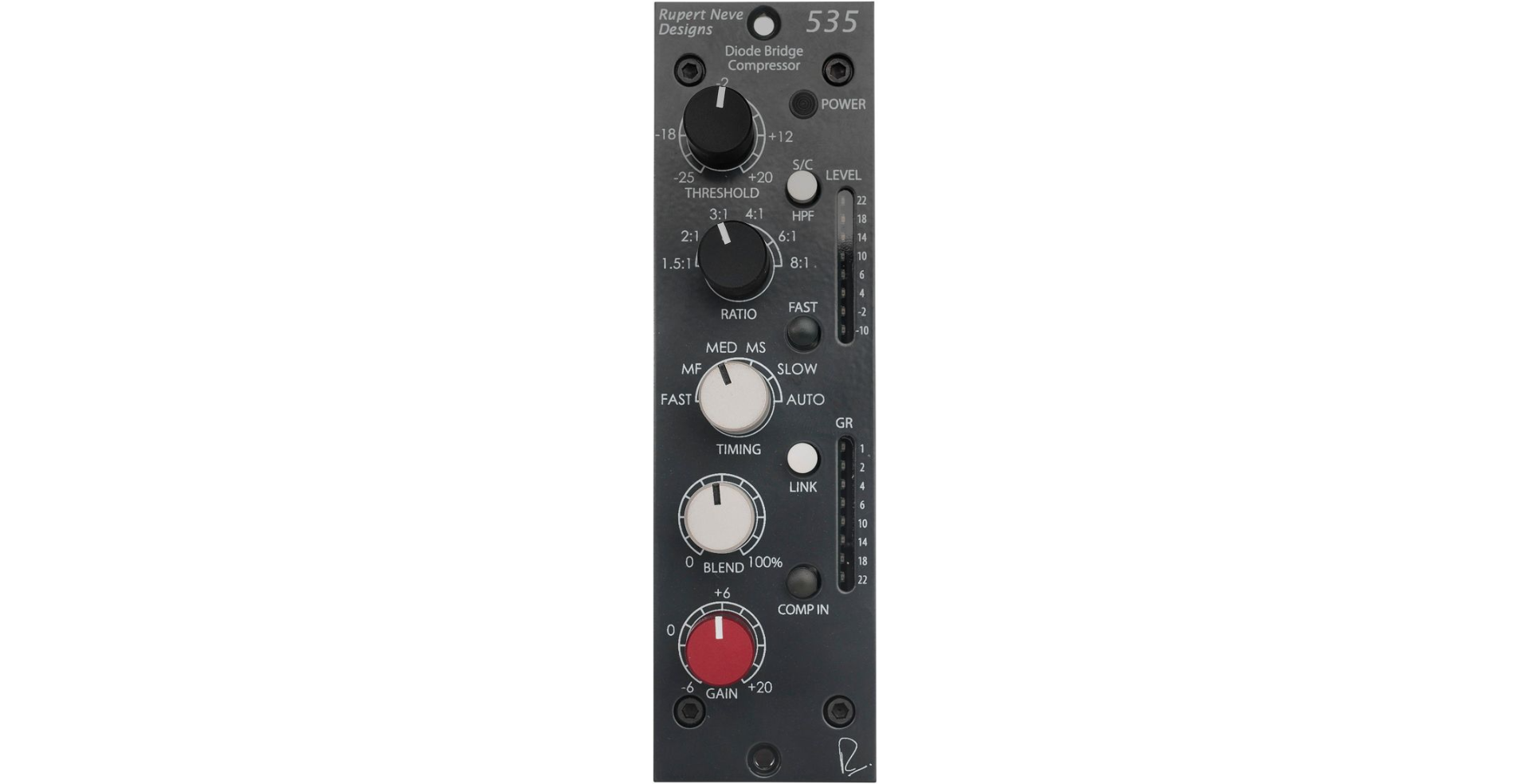
| Originally developed for the dynamics circuit of the acclaimed Shelford Channel, the 535 Diode Bridge Compressor captures the soul of Rupert Neve’s original 2254 compressor while providing modern updates including advanced timing control, significantly lower noise, fully stepped controls throughout, and internal parallel processing capabilities.
What is diode bridge compression?
Where the VCA compressor found in the Master Buss Processor provides unmatched clarity, the weighty, harmonically rich tonality of diode bridge compression can be essential in pushing key sources like vocals, electric guitars, bass and drums to the forefront of a mix.
By understanding the limitations of vintage units like the legendary 2254, painstaking effort was taken to reproduce the unique tone of these classics while improving the noise floor & accuracy, expanding inflexible time constants, adding full wave sidechain detection for improved dynamic response, and widening the range of threshold and ratio controls.
Delivering the powerful sound of these iconic designs with enhanced flexibility for the modern age, the 535 Diode Bridge Compressor is a dynamic tool equipped to make a bold statement on virtually any mix or track.
LINE INPUT TO LINE OUTPUT
- Compressor Bypassed.
- Z source = 40 Ohm Balanced
INPUT IMPEDANCE
10K Ohm
OUTPUT IMPEDANCE
40 Ohm
MAXIMUM INPUT LEVEL
+23.5 dBu
MAXIMUM OUTPUT LEVEL
+23.5 dBu
NOISE
- 22 Hz - 22 kHz BW.
- -101 dBu
FREQUENCY RESPONSE
- 10 Hz - 120 kHz, 30ft Output XLR Cable.
- +/- 0.25 dB
THD+N
- @ 1 kHz @ Maximum Output Level, 22 Hz - 22 kHz BW.
- 0.001%
| FEATURES
- World-class, transformer-coupled preamp, compressor, and DI
- Gain: 0 - 66dB in 6dB increments
- Compressor: Single-knob opto-coupler compressor with 2:1 ratio
- Blend: Determines balance of mic and DI inputs
- Instrument gain: 0 - 30dB on instrument input
- 48V phantom power
- Silk: Adds nostalgic warmth and presence when engaged
- Instrument input: Front-panel TRS input and passive-through for Hi-Z sources
- Polarity reverse
- Threshold: When signals exceed threshold level, gain is reduced at a controlled 2:1 ratio with fixed attack and release time constants
- Indicators: Signal presence and clipping on both mic and DI signals, as well as compressor activation.
TECHNICAL SPECIFICATION
Rupert Neve Designs Portico 517: 500 Series Mic Pre / DI / Comp
- Frequency Response: Main Output, no load, -0.2dB @ 10Hz -3dB @ 160kHz
- Noise measured at main output, unweighted, 22Hz - 22kHz, terminated 150 ohm: Gain at unity: better than -100dBu; gain at 66dB: better than -62dBu Equivalent Input Noise: better than -128dBu, noise factor 1.5dB
- Maximum output level from 20Hz to 40kHz: +23dBu
- Total Harmonic Distortion and Noise: @ 1kHz, +20 dBu output: Main Output: Better than 0.001% @ 20Hz, +20 dBu output: Main Output: Better than 0.002% Silk Engaged: Better than 0.2% Second harmonic
- Crosstalk: Measured channel to channel: Better than -90dB @ 15kHz.
- Phantom Power: +48 Volts DC +/- 1%
| Proven reverberation classic for the future
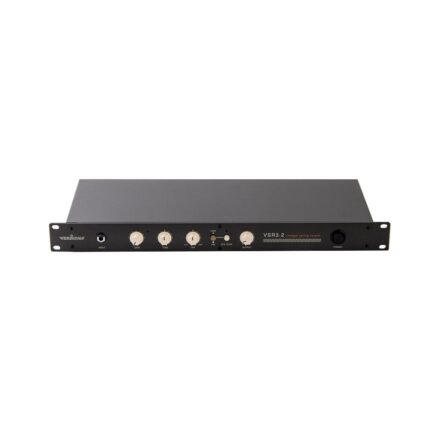
With the VSR 3.2, we happily rely on the proven old mechanical way to create reverberation. Rightly, because the used reverberation spring by AccuBell (formerly Accutronics) creates that magic 60's reverb which is slightly metallic and dense at the same time.
Just like it predecessors, VSR 3.2 has a straight-forward and honest approach: signal in - spring reverb - vintage sound out.
VSR 3.2 is equipped with an equalizer that is exactly adapted to the springs' frequency response. In addition, there are controls to mix the dry and effect signal as well as controls for the input and output level. This way, VSR 3.2 simply exactly does what it was designed to do.
Designed for every situation
Although using a large spring (type 9), VSR 3.2 fits in a 19" housing with one rack unit – minimal space requirements. Thanks to its extremely solid chassis, VSR 3.2 is a reliable vintage-effect that cannot only be used in a controlled studio environment. On the contrary, it also serves fine when being used in straining live situations.
VSR 3.2 grants your sound an elegant touch of "good old times". Its simplicity makes it an unbelievable versatile companion.
Inputs
- 1/4"-jack input front
- unbalanced
- max. input sensitivity: –40 dBu
- impedance: 1 MΩ
- 1/4"-jack input rear (1)
- unbalanced
- max. input sensitivity: 0 dBu
- impedance: 100 kΩ
- 1/4"-jack input rear (2)
- unbalanced
- max. input sensitivity: –20 dBu
- impedance: 10 kΩ
Outputs
- 1/4"-jack output (1)
- unbalanced
- max. output level: 0 dBu
- 1/4"-jack output (2)
- unbalanced
- max. output level: - 20 dBu
Signal-to-Noise Ratio
- direct: > 80 dBu
- effect: > 70 dBu
THD + Noise
Miscellaneous
- power supply: external DC-adapter with 12 V/1000 mA
- dimensions: 19“, 1 HE, ca. 190 mm deep
- weight: 2.5 kg
|









Reviews
There are no reviews yet.