| Content | FEATURES
- The industry-standard tabletop looper, updated and enhanced
- Class-leading sound quality with 32-bit AD/DA and 32-bit floating-point processing
- Five simultaneous stereo phrase tracks with dedicated controls and independent volume faders
- Input FX and Track FX sections, each with four simultaneous effects and four quick-access banks
- Customizable FX and Track buttons for each phrase track
- Massive onboard effects selection with 49 Input FX types and 53 Track FX types, including new Harmony, Electric FX and many others
- Ultra-durable faders with longer throw for more precise adjustment
- Mark Back function provides enhanced undo/redo flexibility while performing
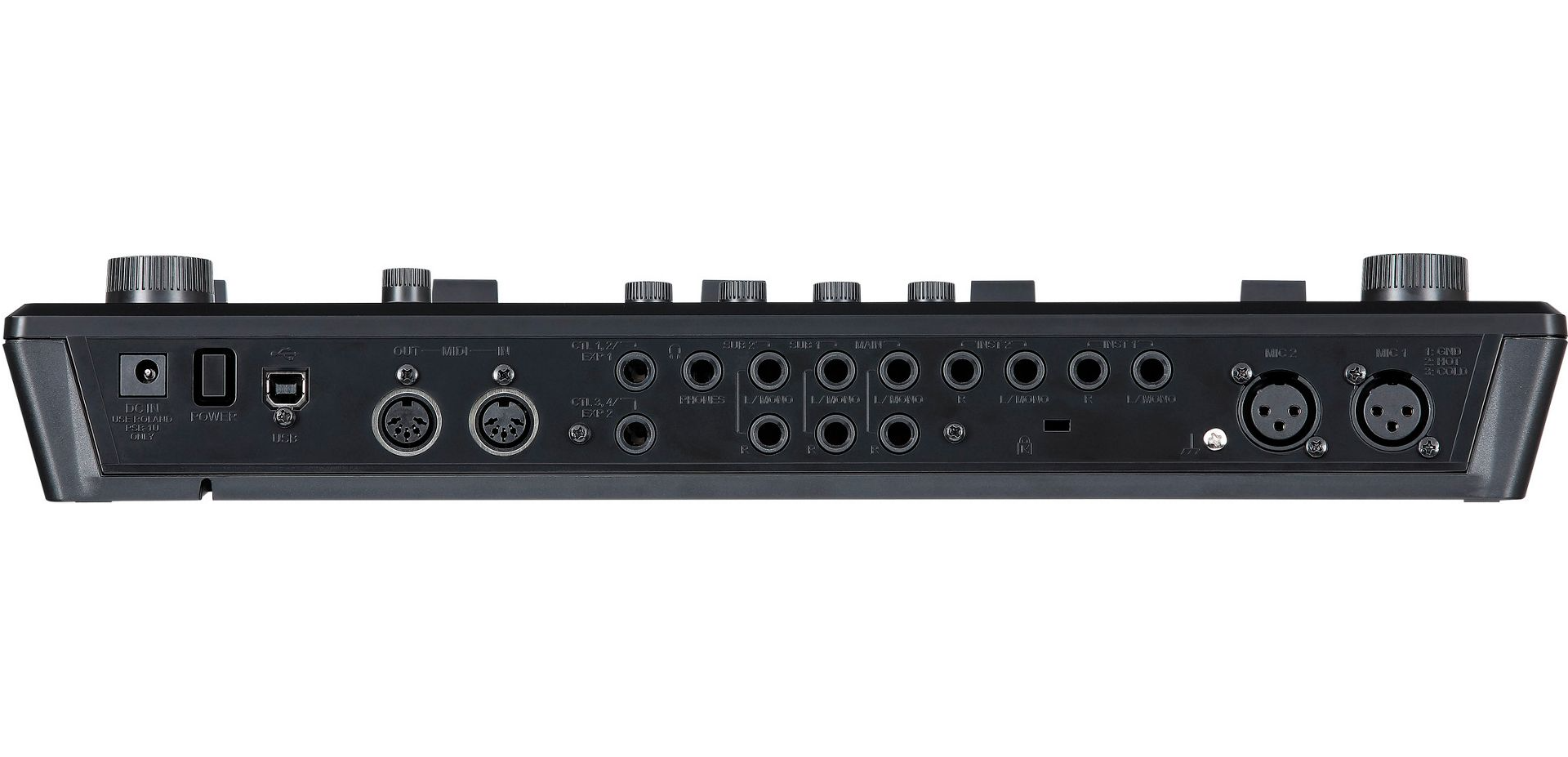
- Two XLR mic inputs with phantom power, two stereo line input pairs, and three stereo line output pairs
- 99 memories, each containing five phrase tracks, custom effects and playback settings, control assignments and more
- Synchronize your loops with over 200 onboard rhythm patterns and 16 drum kits
- Deep MIDI control support
- Two external control jacks, each with support for up to two footswitches or an expression pedal
- USB for data backup, phrase import/export with BOSS Tone Studio and pattern import with the RC Rhythm Converter
TECHNICAL SPECIFICATION
Boss RC-505MK2 Tabletop Loop Station
- Sampling Frequency: 44.1 kHz
- AD/DA Conversion: 32 bits
- Processing: 32-bit floating point
RECORDING/PLAYBACK
- Number of Tracks: 5
- Data Format: WAV (44.1 kHz, 32-bit float, stereo)
- Maximum Recording Time: Approx. 1.5 hours (1 track), Approx.13 hours (total of All memories)
- Rhythm Type: 200 types or greater
- Rhythm Kit: 16 types
EFFECTS
- INPUT FX: 49 types
- TRACK FX: 53 types
- MASTER FX: 2 types
- Memory: 99
- Display: Graphic LCD (128 x 64 dots, backlit LCD)
CONNECTORS
- MIC IN 1, 2 jack: XLR type (balanced, phantom power: DC 48 V, 10 mA Max
- INST IN 1, 2 jacks, MAIN OUT jacks, SUB OUT 1, 2 jacks: 1/4-inch phone type
- PHONES jack: Stereo 1/4-inch phone type
- CTL1,2/EXP1 jack, CTL3,4/EXP2 jack: 1/4-inch TRS phone type
- USB port: USB B type
- MIDI (IN, OUT) connectors
- DC IN jack
- Power Supply: AC adaptor
CURRENT DRAW
- 1.0 A (with phantom power)
- 0.9 A (without phantom power)
- Dimensions: 16-9/16" W x 9-1/4" D x 2-11/16" H
- Weight: 4 lb.
| Arguably the coolest and most unique device in the Empirical Labs arsenal, the FATSO (Full Analog Tape Simulator and Optimizer) is a digitally controlled analog device that gives musicians and engineers easy access to many of the desirable characteristics exhibited by older tube and Class A electronics and magnetic tape mediums. This two channel audio processor musically integrates frequencies and transients, increasing the apparent volume while keeping tight control over peak levels.
With the FATSO, recording studios and audio production facilities can enhance and soften the sound of Hardware Digital Recorders (HDRs) and Digital Audio Workstations (DAWs). Mix engineers will have the option not to have to use bulky, expensive analog tape recorders to get the warmth and sweet high end they’ve come to rely on for so many decades. Owners of DAWs and HDRs can finally put a stop to complaints about the coldness and brittle edge of their mixes and instruments. Even audiophiles can benefit from the FATSO, bringing back the warmth and ambience of LP’s and tapes to their CD players and other digital reproduction mediums.
The FATSO Goes to Eleven
ELEVEN is a new compressor for the FATSO, replacing the old GP Ratio, and emulates the famous UREI 1176LN in 20:1, with the slowest attack, and fastest release. This 1176 setting has been used on countless hit records through the decades. With the slower “1176” attack, the transients keep the dynamics present, while the high ratio, can radically limit the dynamic range of any source, making it present and sitting in a nice little place in your mix. One can slam it, or just touch it with a few dB of compression. You will find it great on Vocals, Bass, acoustic guitars, drum room mikes, pianos etc. Click here to find out how to upgrade your EL7 to an EL7X.
Four Types of Processing
- Harmonic Generation and Soft Clipper (Distortion Generation) – this class A circuit gently rounds the peaks like saturated tubes or tape.
- High Frequency Saturation (Warmth) – a one-of-a-kind dynamic low pass filter which softens high frequencies when they “pile up” on a source.
- Transformer & Tape Head Emulation – a simulation of the effect of input and output transformers of older devices, which adds the low frequency harmonics that characterize them, as well as analog tape..
- Classic Knee Compression – your typical automatic leveling device found on just about every instrument and vocal track as well as on the overall buss, done Empirical Labs compression – smooth and sweet, but in your face!
Universal Audio's FATSO Emulation
Endorsed and scrutinized for accuracy by designer Dave Derr of Empirical Labs, Universal Audio has painstakingly recreated the FATSO Jr. in this highly anticipated UAD Powered Plugin, capturing the sonic nuances of the original hardware. As part of the FATSO Powered Plugin, UA has also worked closely with Dave Derr to model the original concept of the FATSO, the FATSO Sr., with attack, release, and threshold compressor controls, among other features not available elsewhere.
Frequency Response: 2 Hz to 60 kHz in clean audio mode (+0, -3 dB).
Dynamic Range: 110 dB from maximum output (20 %THD soft clipping) to minimum output. Greater than 100 dB signal to noise.
Distortion: Ranges between .06% and 20% depending on mode and settings.
I/O: DC Coupled input and outputs.
Compressor Time Constants: Attack range 1ms – 60ms. Release range .05sec – 3.5 seconds. Attack and Releases are fixed by the compression type selected.
Power Consumption: 15 Watts Max.
Metal Chassis: single height 1.75″ high, 10″ deep, 19″ wide. | The vintage EQ tones you know & love.
The 551 is the only equalizer for the 500 Series actually designed by Rupert Neve. Featuring 3 bands of EQ inspired by Mr. Neve’s most prized vintage designs, along with custom-wound inductors, transformers and class-A gain blocks, the 551 brings the thick, powerful lows and sweet highs of Rupert’s classics to the 500-Series format.
The “Best-Of” EQ
The 551’s 3-band, custom-tapped inductor EQ was inspired by our favorite elements of Rupert’s vintage EQ designs. The low frequency band is designed to produce a creamy, resonant bass response similar to a vintage 1064 – but unlike the vintage modules, the LF band on the 551 can be used as either a shelf or a peak filter, adding punch, dimension, and control to your low end.
The midrange band is based on that of the 1073, ideal for sweetening vocals and instruments while bringing them forward in a mix, and its proportional “Q” response makes it well-suited for minimizing problematic frequencies. The high frequency band is a hybrid vintage / modern design, blending inductor circuitry with capacitor-based topologies to achieve vintage tones with enhanced control. The High Pass filter is a 12dB/octave design with a fixed 80Hz frequency, and can be used in tandem with the low frequency EQ to add low-end presence without clouding the source material.
As with Rupert’s most prized classic designs, each EQ section uses low-feedback, class-A discrete electronics to prevent low-level artifacts and harshness from detracting from the tonal shaping. However, this new circuit is a decidedly modern design with updated techniques and components that were simply not available 50 years ago, and is definitely not a “clone”.
What Are Inductors?
Inductors are wires wound around a coil that provide a form of frequency-dependant resistance. When they saturate, they bring out beautifully musical harmonics that give your tracks the smooth, polished sound that has made Rupert’s consoles and equipment so desirable for over fifty years. This is what makes them different from capacitor-based EQ designs, which do a great job at surgical equalization. But inductors provide the tone.
While it is certainly possible to create a functioning EQ using off-the-shelf inductors, we choose to use our own custom inductors for the 551. This attention to detail in controlling variables such as the winding and core materials in relation to the surrounding circuitry allows the 551 to capture the vitality and personality of Rupert’s classic designs.
NOISE
- Measured at Main Output, un-weighted, 22Hz-22kHz, source impedance 40 Ohm balanced.
- Better than -102 dBV
FREQUENCY RESPONSE
Main output, no load: +/- 0.1 dBu from 20 Hz to 31.5 kHz, -1 dB @ 120 kHz
MAXIMUM OUTPUT LEVEL
23.25 dBu
TOTAL HARMONIC DISTORTION AND NOISE
- @ 1 kHz, +20 dBu output level, no load: Better than 0.0025%
- @ 20 Hz, +20 dBu output level, no load: 0.13% Typical (2nd and 3rd harmonic)
HIGH PASS FILTER
- -2.7 dB @ 80 Hz
- Slope: 12 dB/Octave
NOISE
- Measured at Main Output, un-weighted, 22 Hz - 22 kHz, source impedance 40 Ohm balanced.
- Better than -94 dBV
FREQUENCY RESPONSE
Main output, no load: +/- 0.25 dBu from 20 Hz to 45 kHz, -2 dB @ 120 kHz
MAXIMUM OUTPUT LEVEL
23 dBu
TOTAL HARMONIC DISTORTION AND NOISE
- @ 1 kHz, +20 dBu output level, no load: Better than 0.009%
- @ 20 Hz, +20 dBu output level, no load: 0.13% Typical (2nd and 3rd harmonic)
POWER REQUIREMENTS
- 120mA on +16VDC
- 110ma on -16VD
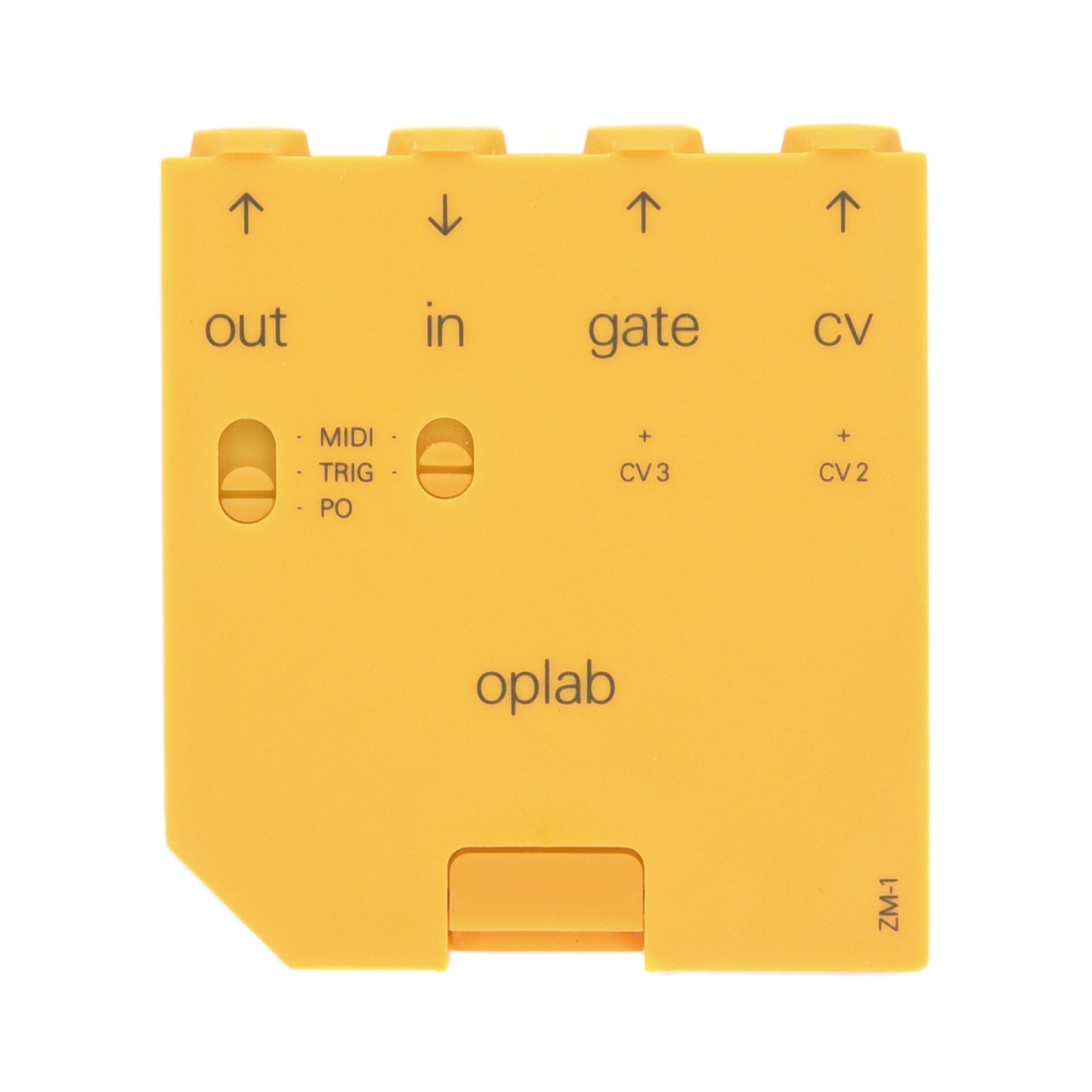
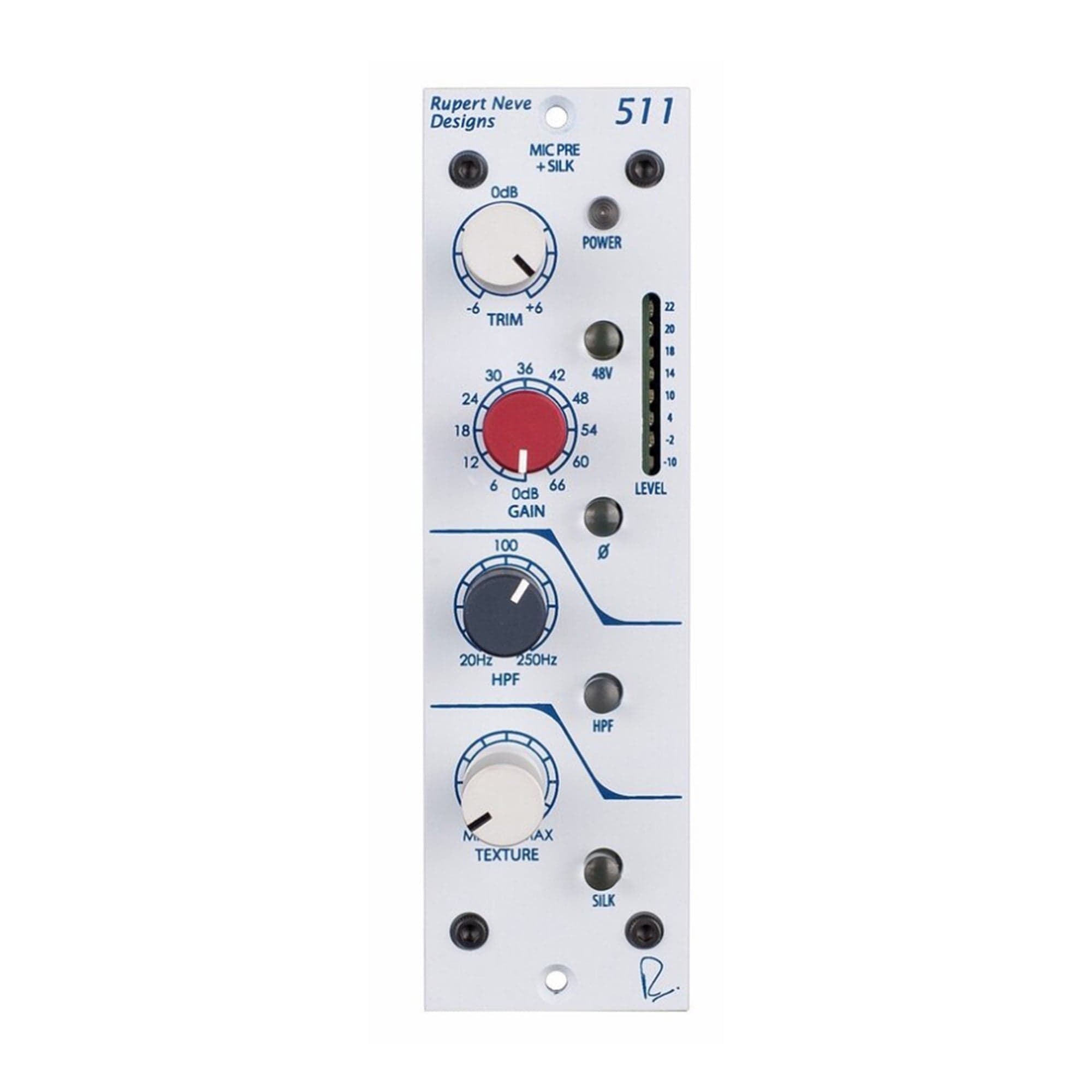
| Imagine having the power and flexibility of the OP-Z sequencer available to any other music equipment. Now you can, with the new oplab module - the magic link between OP-Z and the rest of the world. The oplab module is the first hardware expansion module for OP-Z. once mounted in the back of your OP-Z, you can use it to connect to any equipment using standard cv and gate, such as the pocket operator modular or any other modular system. It features three cv outs and one gate out, all programmable and playable from OP-Z. have your wall of modules sequenced from the palm of your hands. Use the po sync out to unleash the power of your regular pocket operators and have them play in sync with the rest of your setup. Even connect standard midi devices, using midi over 3.5 mm jack or the included midi over din adapter cable. Oplab features both midi in and out ports as well as trig in and out for other synthesizers and sequencers. | With a big, bold preamp, a swept high-pass filter and the powerful saturation control of variable Silk, the 511 combines legendary Rupert Neve tone with 500 Series value.
What is Silk?
One of the key features of the 511 is the Silk / Texture control. The Silk circuit was initially developed for the original Portico series mic preamplifiers, and was only a single switch – on or off – that added a specified amount of musical, pleasing harmonic saturation to the unit’s output stage.
Taking this concept one step further, the Texture knob is designed to adjust the actual amount of harmonic content from the source material.
So how does it work? By reducing negative feedback across the output transformer and adjusting this feedback’s frequency response, the Silk / Texture circuit provides the sweet, musical saturation found in Rupert’s legendary vintage designs – but with complete & precise control over the amount of classic tone you want.
NOISE
- Measured at Main Output, un-weighted, 22 Hz - 22 kHz, source impedance 150 Ohm balanced. Noise performance can vary depending on the 500 series and / or interference from stray magnetic fields.
- Unity Gain: Better than -103 dBV
- Gain @ +66 dB: Better than -60 dBV
- Equivalent Input Noise: -125 dB
FREQUENCY RESPONSE
- Main output, no load.
- +/- 0.1 dBu from 10 Hz to 31.5 kHz
- -2.6 dB @ 120 kHz
MAXIMUM OUTPUT LEVEL
+23 dBu
TOTAL HARMONIC DISTORTION AND NOISE, NO SILK
- @ 1 kHz, +20 dBu output level, no load: Better than 0.0025%
- @ 20 Hz, +20 dBu output level, no load: 0.025% Typical (2nd and 3rd harmonic)
TOTAL HARMONIC DISTORTION AND NOISE WITH SILK ENGAGED
- @ 100 Hz, +20 dBu input level, no load.
- TEXTURE @ min: 0.015%, mostly 3rd harmonic typical
- TEXTURE @ max: 2%, mostly 2rd harmonic typical
GAIN
- Unity up to +66 dB in 6 dB steps.
- Trim continuously adjustable from -6 dB to +6 dB.
PHANTOM POWER
Supplied by the 500 series rack power supply. Switch selectable on faceplate.
HIGH PASS FILTER
- Continuously variable swept frequency from 20 Hz to 250 Hz.
- Slope: 12 dB/Octave
POWER REQUIREMENTS
@ +/-16VDC, 100mA | There’s no doubt that when it comes to power, musicians have it bad. Whether it’s modern modeling amplifiers, or vintage synthesizers, bad power is gonna be heard throughout your signal. And it’s everywhere — in homes, on stages, and especially in many rehearsal rooms.
Black Lion Audio has been trusted for years for modifying the best gear and making it even better, and that’s what it took to create the PG-P: taking industry-standard designs, and improving them to the point of peak performance.
After creating an entire lineup of industry-best power conditioners, Black Lion Audio felt it was time to give the world proper portable power. The PG-P might look like a run-of-the-mill surge protector, but in reality it’s a studio-class power conditioner — PG-P doesn’t just provide more noise filtering than other portable conditioners, it provides the same noise filtering found in the majority of the world’s rack-mount power conditioners!
Your gear deserves the best power, and Black Lion Audio took great care in making sure the PG-P delivers just that — thanks to it’s PG-P Filtering Technology. The PG-P is built using premium Panasonic capacitors, due to their superior execution in eliminating high frequency noise that robs equipment of its peak performance. In testing, this has provided an average of 3x the noise filtering of other portable power conditioners at the same price point. Six wall-wart spaced outlets provide studio-grade power on the go; perfect for any musician’s rig!
- PG-P Filtering Technology for an average of 3x the noise reduction of other portable power conditioners
- The same noise filtering found in the majority of rack-mount power conditioners
- 6 wall-wart spaced outlet power conditioner
- Status LEDs for quick power analysis
- High-end Panasonic capacitors to filter out performance-robbing high-frequency noise
- Tour-grade 9ft power cable
- Proper safeguard protection with a power absorption rating of 540 joules
- Recessed feet keep the PG-P from sliding, while still providing mounting options (screw mount, velcro, etc.)
- Rounded corners make for a gentle surface area for smaller power cords.
|






Reviews
There are no reviews yet.