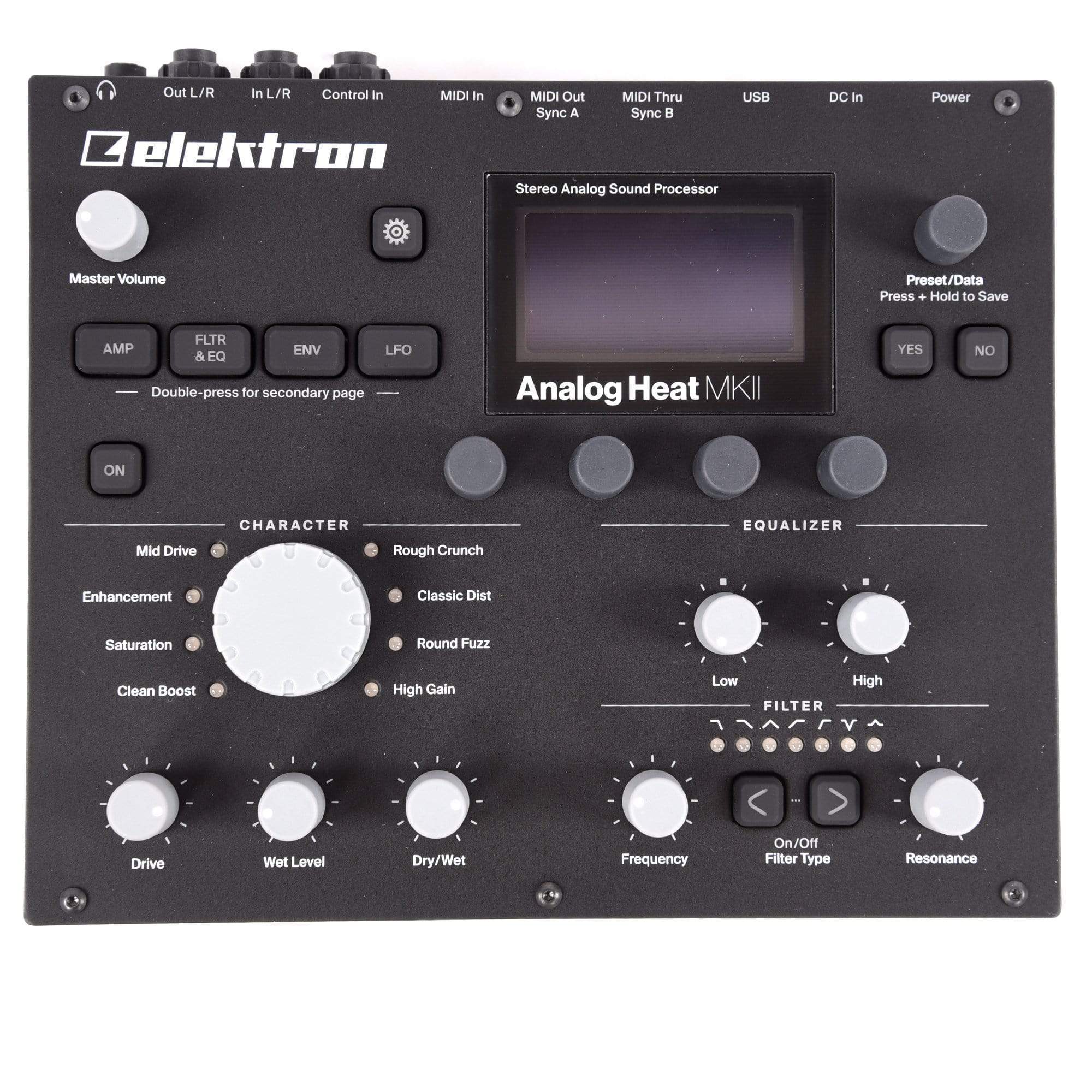
| Content | Add sparkly brilliance, or grimy roughness, to any sound source. Samplers, drum machines, synths, the master bus, you name it. Analog Heat MKII is a fiery furnace destined to make your music glow.
Sound better
Take a sound, any sound. Send it through the Analog Heat MKII, try out the eight different stereo analog distortion circuits, add stereo analog filtering and EQ, and hear beautiful things unfold. New life for your existing gear.
All analog, all yours
The eight stereo analog circuits are designed to quickly access varied and powerful sound shaping. Each circuit has a distinctive way of processing sound. Clean boost, tape-like saturation, tube amp-like enhancement, overdrive, crunch, distortion, harmonic fuzz or high gain? You’ll find your favorite flavor with ease.
Brighter and better
The MKII version of the Analog Heat features improved durability and precision encoders, new tough back-lit keys and a crisp OLED screen. The display is bigger, sharper and brighter: perfect for performing in the dark. There is also additional visual feedback on the Amp, Filter, Envelope and LFO pages that makes overview and understanding of sound processing and modulation a whole lot easier.
Sound processing
- 8 × Stereo analog distortion circuits
- 1 × Stereo analog multi-mode filter (7 filter types)
- 1 × 2 band adaptable stereo analog EQ
- 1 × Assignable envelope generator/envelope follower
- 1 × Assignable LFO
Storage
Hardware
- 128×64 pixel OLED screen
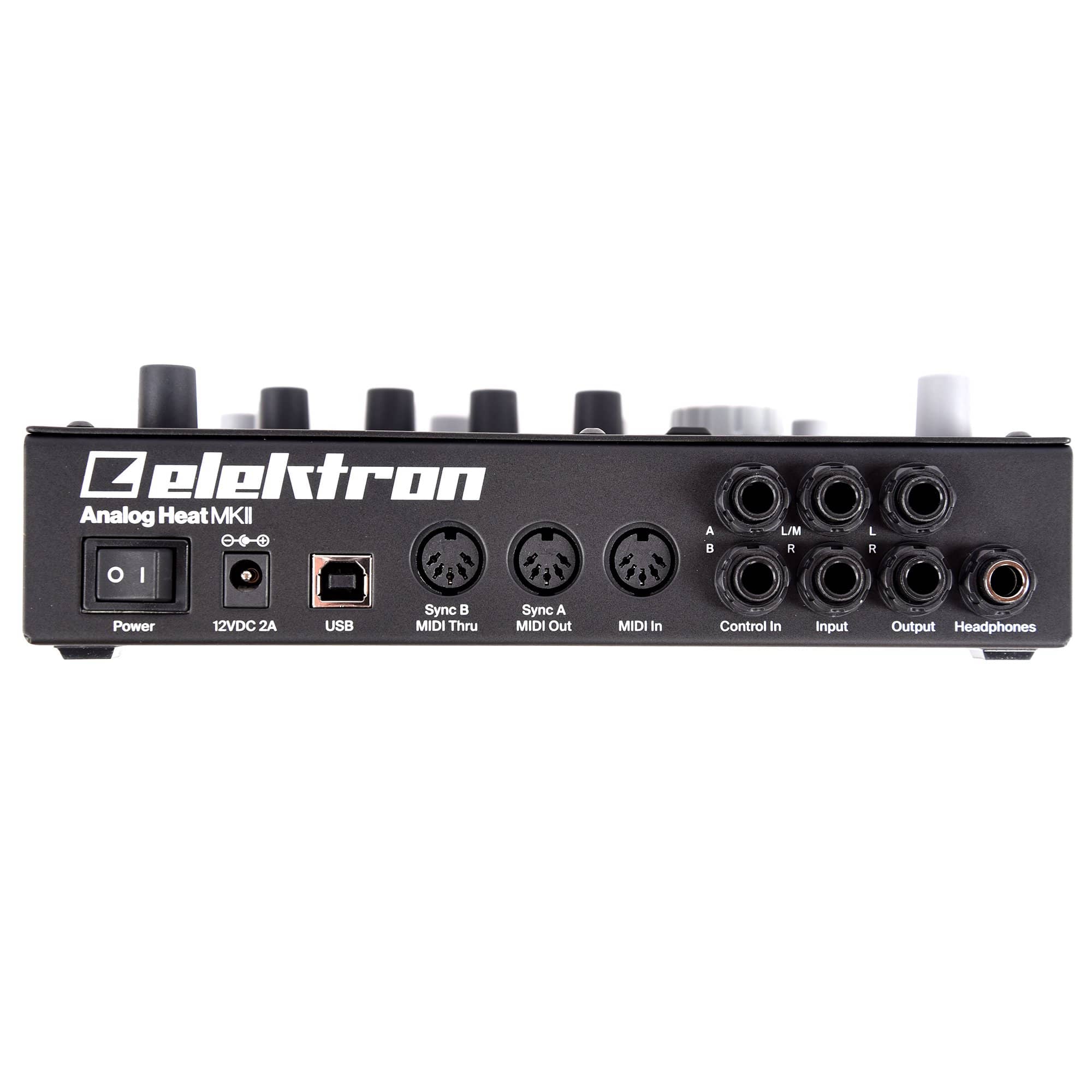
- MIDI In/Out/Thru with DIN Sync out
- 2 × ¼″ balanced audio out jacks
- 2 × ¼″ balanced audio in jacks
- 1 × ¼″ stereo headphones jack
- 2 × ¼″ CV/Expression pedal input jacks
- 48 kHz, 24-bit D/A and A/D converters
- Flash-EEPROM upgradable OS
- Hi-speed USB 2.0 port
Audio outputs
- Headphones out level: +19 dBu peak
- Headphones output impedance: 36 Ω
- Impedance balanced main outputs level: +19 dBu peak
- Main outputs impedance: 440 Ω unbalanced
Audio inputs
- Balanced audio input level: +19 dBu peak
- Audio input impedance: 39 kΩ
Control inputs
- Input level: -5 V – +5 V
- Accepts CV, Expression pedals, Foot switches
Physical specifications
- Sturdy steel casing
- Dimensions: W215×D184×H63 mm (8.5×7.2×2.5″) (including audio outputs, knobs and rubber feet)
- Weight: approximately 1.5 kg (3.3 lbs)
- 100×100 mm VESA mounting holes
Included in the box
- Power Supply PSU-3b
- Elektron USB cable
Analog Heat MKII and Overbridge
Any DAW user will love Analog Heat. It is perfect for adding analog warmth and grit to digital audio. Suitable on individual tracks as well as on the master bus. It can also double as a sound card, making it perfect for the nimble studio.
- Control your Analog Heat with audio and sync using a dedicated VST/AU
- plugin
- Process DAW audio with beautiful analog stereo filtering and distortion
- Mid/Side mode lets you expand audio processing possibilities
- Analog Heat MKII can be used as a 2 in/2 out sound card
- (CoreAudio/ASIO/WDM)
- Use Analog Heat as a separate sound card, all while using the other features
- of the instrument
- Total Recall remembers all Analog Heat settings when loading a DAW project
| The vintage EQ tones you know & love.
The 551 is the only equalizer for the 500 Series actually designed by Rupert Neve. Featuring 3 bands of EQ inspired by Mr. Neve’s most prized vintage designs, along with custom-wound inductors, transformers and class-A gain blocks, the 551 brings the thick, powerful lows and sweet highs of Rupert’s classics to the 500-Series format.
The “Best-Of” EQ
The 551’s 3-band, custom-tapped inductor EQ was inspired by our favorite elements of Rupert’s vintage EQ designs. The low frequency band is designed to produce a creamy, resonant bass response similar to a vintage 1064 – but unlike the vintage modules, the LF band on the 551 can be used as either a shelf or a peak filter, adding punch, dimension, and control to your low end.
The midrange band is based on that of the 1073, ideal for sweetening vocals and instruments while bringing them forward in a mix, and its proportional “Q” response makes it well-suited for minimizing problematic frequencies. The high frequency band is a hybrid vintage / modern design, blending inductor circuitry with capacitor-based topologies to achieve vintage tones with enhanced control. The High Pass filter is a 12dB/octave design with a fixed 80Hz frequency, and can be used in tandem with the low frequency EQ to add low-end presence without clouding the source material.
As with Rupert’s most prized classic designs, each EQ section uses low-feedback, class-A discrete electronics to prevent low-level artifacts and harshness from detracting from the tonal shaping. However, this new circuit is a decidedly modern design with updated techniques and components that were simply not available 50 years ago, and is definitely not a “clone”.
What Are Inductors?
Inductors are wires wound around a coil that provide a form of frequency-dependant resistance. When they saturate, they bring out beautifully musical harmonics that give your tracks the smooth, polished sound that has made Rupert’s consoles and equipment so desirable for over fifty years. This is what makes them different from capacitor-based EQ designs, which do a great job at surgical equalization. But inductors provide the tone.
While it is certainly possible to create a functioning EQ using off-the-shelf inductors, we choose to use our own custom inductors for the 551. This attention to detail in controlling variables such as the winding and core materials in relation to the surrounding circuitry allows the 551 to capture the vitality and personality of Rupert’s classic designs.
NOISE
- Measured at Main Output, un-weighted, 22Hz-22kHz, source impedance 40 Ohm balanced.
- Better than -102 dBV
FREQUENCY RESPONSE
Main output, no load: +/- 0.1 dBu from 20 Hz to 31.5 kHz, -1 dB @ 120 kHz
MAXIMUM OUTPUT LEVEL
23.25 dBu
TOTAL HARMONIC DISTORTION AND NOISE
- @ 1 kHz, +20 dBu output level, no load: Better than 0.0025%
- @ 20 Hz, +20 dBu output level, no load: 0.13% Typical (2nd and 3rd harmonic)
HIGH PASS FILTER
- -2.7 dB @ 80 Hz
- Slope: 12 dB/Octave
NOISE
- Measured at Main Output, un-weighted, 22 Hz - 22 kHz, source impedance 40 Ohm balanced.
- Better than -94 dBV
FREQUENCY RESPONSE
Main output, no load: +/- 0.25 dBu from 20 Hz to 45 kHz, -2 dB @ 120 kHz
MAXIMUM OUTPUT LEVEL
23 dBu
TOTAL HARMONIC DISTORTION AND NOISE
- @ 1 kHz, +20 dBu output level, no load: Better than 0.009%
- @ 20 Hz, +20 dBu output level, no load: 0.13% Typical (2nd and 3rd harmonic)
POWER REQUIREMENTS
- 120mA on +16VDC
- 110ma on -16VD
| In today’s modern age of digital recorders, DAWs and software plug-ins, Mike-E is the ultimate solution for getting a clean and strong, yet warm and musical signal into the box…and it couldn’t be easier to work – its front panel layout is so straight ahead that even inexperienced engineers will have no problem moving around on it right away.
When the engineering team at Empirical Labs sets out to build a microphone preamp, you can be sure it’ll deliver spectacular sound, be effortless to work, and will provide features unlike any other device in its class. To that end, we proudly present Mike-E, a high performance transformer-coupled mic preamp with a noise floor far below any microphone’s self noise, combined with a one-of-a-kind compressor/saturator circuit that delivers classic knee compression as well as versatile tonal ‘coloring’ that can replicate many of the best characteristics of vintage analog recording equipment.
Mic Preamp
The Mike-E features a super low noise transformer input amplifier section with the gain under precise digital control. The signal to noise far exceeds any microphone in existence. Having used many mic preamps over the years, we’ve implemented a unique stepped gain control that should be impervious to the normal flakiness that age causes to pots and detented switches. A “Bad!” LED indicates when the input signal is overloading the circuit.
CompSat
The CompSat’s unique circuitry sets the Mike-E apart from all other mic preamps.
- SATURATOR – a multi stage soft-clipping circuit. At lower levels, a triode-type saturation affects the signal. As the level increases, a second unique clip circuit starts to more severely flatten out the peaks.
- COMPRESSOR – based on ELI’s world famous Distressor, but with other characteristics (including a much longer attack time). Preset ratios include: 2:1, 4:1, 8:1…and, of course, Nuke.
- EMPHASIS – a two-stage circuit that boosts and soft clips high frequencies before the CompSat™ circuit, and then cuts the frequencies after it. Emphasis has the added perk of improving signal to noise, and is the reason analog tape decks used emphasis to begin with.
Frequency Response: 3 Hz to 200 kHz on (No CompSat). CompSat is 3Hz – 150Khz. Optional Transformer output is 6Hz–80kHz.
Signal to Noise: 130 dB signal to Noise.at 40dB gain. Maximum output is +28dBu.
Distortion: Ranges between .0006% and 15% depending on mode and settings.
I/O: Transformer coupled Input, Active and Transformer Outputs available. High quality audio caps used internally.
Impedance: Input Impedance is above 600 Ohms at all frequencies, transformer coupled. Output impedance is less than 38 ohms. Instrument In Impedance is 332K Ohms.
Attack/Decay Range: .9 – 70mS attack. .15 – 1 Sec.
Power Consumption: 15 Watts Max.
Metal Chassis: single height 1.75″ high, 10″ deep, 19″ wide. | FEATURES
- World-class, transformer-coupled preamp, compressor, and DI
- Gain: 0 - 66dB in 6dB increments
- Compressor: Single-knob opto-coupler compressor with 2:1 ratio
- Blend: Determines balance of mic and DI inputs
- Instrument gain: 0 - 30dB on instrument input
- 48V phantom power
- Silk: Adds nostalgic warmth and presence when engaged
- Instrument input: Front-panel TRS input and passive-through for Hi-Z sources
- Polarity reverse
- Threshold: When signals exceed threshold level, gain is reduced at a controlled 2:1 ratio with fixed attack and release time constants
- Indicators: Signal presence and clipping on both mic and DI signals, as well as compressor activation.
TECHNICAL SPECIFICATION
Rupert Neve Designs Portico 517: 500 Series Mic Pre / DI / Comp
- Frequency Response: Main Output, no load, -0.2dB @ 10Hz -3dB @ 160kHz
- Noise measured at main output, unweighted, 22Hz - 22kHz, terminated 150 ohm: Gain at unity: better than -100dBu; gain at 66dB: better than -62dBu Equivalent Input Noise: better than -128dBu, noise factor 1.5dB
- Maximum output level from 20Hz to 40kHz: +23dBu
- Total Harmonic Distortion and Noise: @ 1kHz, +20 dBu output: Main Output: Better than 0.001% @ 20Hz, +20 dBu output: Main Output: Better than 0.002% Silk Engaged: Better than 0.2% Second harmonic
- Crosstalk: Measured channel to channel: Better than -90dB @ 15kHz.
- Phantom Power: +48 Volts DC +/- 1%
| Rupert Neve Designs Portico 542 500 Series Tape FX Standard
FEATURES
- Add depth and character to your sound
- Control the mix of pre and post tape signals
- Send signals through "True Tape" circuitry
- Silk circuit, reduces negative feedback, adding harmonic content as needed
- Red Silk accentuates the saturation in the mid and high frequencies
- Use soft clip to tame overly transient material like drums
- Provides +/- 12dB adjustment of level on incoming signal levels
TECHNICAL SPECIFICATION
Rupert Neve Designs Portico 542 500 Series Tape FX
- Line Amp Specifications (Measurements with tape circuit disengaged)
- Noise: Measured at Main Output, un-weighted, 20Hz-22kHz, Input Terminated 40 Ohms.
- Unity Gain Better than -100dBu
- Frequency Response
- Measured at +10dBu, trim at unity.
- Main Output +/- 0.25dB from 5Hz to 60Khz -2dB @ 120KHz
- Maximum Output Level 23.25dBu
- Total Harmonic Distortion and Noise:
- @ 1kHz, +20dBu output level Better than 0.0025% @ 20Hz, +20dBu output level 0.07% Typical (2nd and 3rd harmonic)
- Tape FX Specifications
- Noise:
- Measured at Main Output, un-weighted, 20Hz-22kHz, Input Terminated 40 Ohms.
- Saturation @ minimum Better than -100dBu Saturation @ maximum Better than -100dBu
- Frequency Response:
- 15 IPS, Input @ -0 dBu -3dBu @ 28kHz Saturation @ minimum 0dBu @ 10Hz +5dBu Peak @ 60Hz
- Saturation @ maximum -3dBu @ 20kHz -3dBu @ 12.5Hz +2.4dBu Peak @ 60Hz
- 30 IPS, Input @ -0 dBu -3dBu @ 120kHz Saturation @ minimum -3dBu @ 10Hz +3.15dBu Peak @ 125Hz
- Saturation @ maximum -3dBu @ 100kHz -3dBu @ 12.5Hz
- +1.3dBu Peak @ 110Hz
- Total Harmonic Distortion and Noise
- Refer to sweeps on page10 15 IPS, Input @ -0 dBu 0.4% @ 3kHz to 1% @ 175Hz typical
- Saturation @ minimum Greater than 1% below 175Hz typical
- Saturation @ maximum 1% at 6kHz typical 0.3% @ 1kHz to 3% @ 50Hz typical
- 30 IPS, Input @ -0 dBu 1% at 1kHz typical
- Saturation @ minimum 0.6% @ 400Hz 5% @ 20Hz typical
- Saturation @ maximum 1.5% @ 20kHz to 0.4% @ 1kHz typical 0.4% @ 1kHz to 2 %@ 50Hz typical
- Power requirements:
- Supplied by 500 series rack with 110-125 mA @ +/- 16V DC
| Arguably the coolest and most unique device in the Empirical Labs arsenal, the FATSO (Full Analog Tape Simulator and Optimizer) is a digitally controlled analog device that gives musicians and engineers easy access to many of the desirable characteristics exhibited by older tube and Class A electronics and magnetic tape mediums. This two channel audio processor musically integrates frequencies and transients, increasing the apparent volume while keeping tight control over peak levels.
With the FATSO, recording studios and audio production facilities can enhance and soften the sound of Hardware Digital Recorders (HDRs) and Digital Audio Workstations (DAWs). Mix engineers will have the option not to have to use bulky, expensive analog tape recorders to get the warmth and sweet high end they’ve come to rely on for so many decades. Owners of DAWs and HDRs can finally put a stop to complaints about the coldness and brittle edge of their mixes and instruments. Even audiophiles can benefit from the FATSO, bringing back the warmth and ambience of LP’s and tapes to their CD players and other digital reproduction mediums.
The FATSO Goes to Eleven
ELEVEN is a new compressor for the FATSO, replacing the old GP Ratio, and emulates the famous UREI 1176LN in 20:1, with the slowest attack, and fastest release. This 1176 setting has been used on countless hit records through the decades. With the slower “1176” attack, the transients keep the dynamics present, while the high ratio, can radically limit the dynamic range of any source, making it present and sitting in a nice little place in your mix. One can slam it, or just touch it with a few dB of compression. You will find it great on Vocals, Bass, acoustic guitars, drum room mikes, pianos etc. Click here to find out how to upgrade your EL7 to an EL7X.
Four Types of Processing
- Harmonic Generation and Soft Clipper (Distortion Generation) – this class A circuit gently rounds the peaks like saturated tubes or tape.
- High Frequency Saturation (Warmth) – a one-of-a-kind dynamic low pass filter which softens high frequencies when they “pile up” on a source.
- Transformer & Tape Head Emulation – a simulation of the effect of input and output transformers of older devices, which adds the low frequency harmonics that characterize them, as well as analog tape..
- Classic Knee Compression – your typical automatic leveling device found on just about every instrument and vocal track as well as on the overall buss, done Empirical Labs compression – smooth and sweet, but in your face!
Universal Audio's FATSO Emulation
Endorsed and scrutinized for accuracy by designer Dave Derr of Empirical Labs, Universal Audio has painstakingly recreated the FATSO Jr. in this highly anticipated UAD Powered Plugin, capturing the sonic nuances of the original hardware. As part of the FATSO Powered Plugin, UA has also worked closely with Dave Derr to model the original concept of the FATSO, the FATSO Sr., with attack, release, and threshold compressor controls, among other features not available elsewhere.
Frequency Response: 2 Hz to 60 kHz in clean audio mode (+0, -3 dB).
Dynamic Range: 110 dB from maximum output (20 %THD soft clipping) to minimum output. Greater than 100 dB signal to noise.
Distortion: Ranges between .06% and 20% depending on mode and settings.
I/O: DC Coupled input and outputs.
Compressor Time Constants: Attack range 1ms – 60ms. Release range .05sec – 3.5 seconds. Attack and Releases are fixed by the compression type selected.
Power Consumption: 15 Watts Max.
Metal Chassis: single height 1.75″ high, 10″ deep, 19″ wide. |




Reviews
There are no reviews yet.