Empirical Labs EL8X Distressor Compressor w/ British Mod

$1,271.89

GTIN: 854682006023 SKU: 854682006023 Category: Tags: , ,

Description

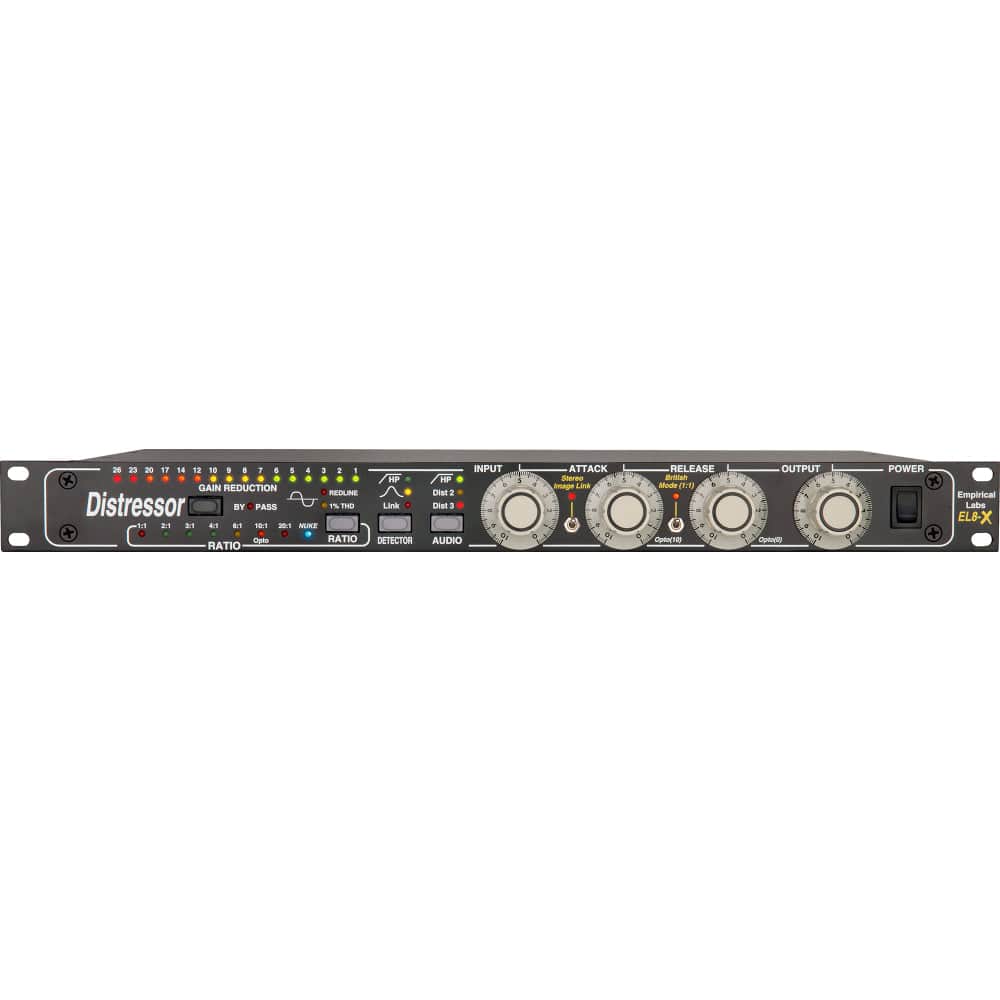
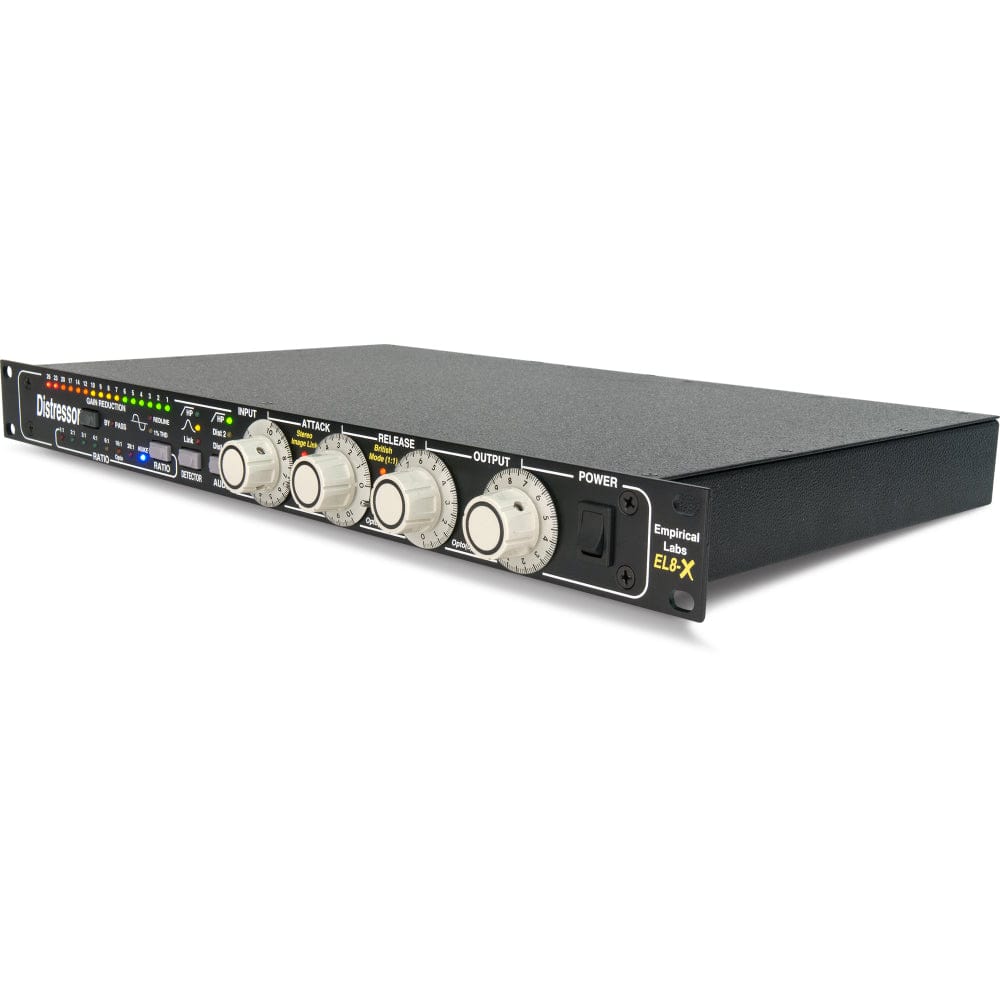
The product that started it all for Empirical Labs. Born of founder Dave Derr’s love of classic compressors like the 1176, LA-2A and Gain Brain (among others), the Distressor incorporates his favorite sonic characteristics of these, along with other unique and interesting features that have made it a staple for audio engineers all over the world. With over 28,000 units in the field, it’s safe to say that the Distressor is one of the best selling high end compressors of all time… if not THE best selling. A prominent recording engineer recently wagered that there probably was not a top 40 record made in the last five years that didn’t have at least one Distressor on it.
Besides providing a wide range of control and a unique feature set, the Distressor offers a warm, vintage sound by using a custom designed gain control circuit. This “warmth” or “vintage sound” has become a major issue in the last few decades, as the super clear and linear digital technology does next to nothing to soften “harsh” sounds, nor emphasize the bass frequencies in music sources. Conversely, older analog tape, vinyl records and tube equipment could not be prevented from coloring the sound, often to the frustration of recording engineers. However, many people now realize that this coloring can be extremely pleasant and musical. Digital technology is often referred to as “cold” and “brittle” among other terms (although we prefer “unforgiving”).
Unique Compression Curves
All eight of the Distressor’s curves are unique and distinctive, from the 1:1 mode that simply warms up signal with low order harmonics without intentional compression, to the “Nuke” setting – a brick wall limiting curve that shines on live drum room mics. Each curve has its own personality and several actually use different circuitry, and are effectively different compressors. Most exceptional is the 10:1 “Opto” ratio which uses separate detector circuitry to emulate the oldest (and valued) “light controlled” devices, such as the LA-2A.
Distortion (Color) Modes
Another large part of the Distressor’s personality and power derive from three modes that color the signal, even without compression. These extended audio modes were designed to allow emulation of some very old and expensive vintage compressors & limiters, and let the Distressor deliver a classic “knee” sound all its own by providing user programmable, warm harmonic distortion. In addition to the basic distortion mode, Distort 2 emphasizes tube-like 2nd order harmonics, while in Distort 3 setting the distortion becomes dominated by 3rd harmonics more closely resembling tape. Two HP filters – one in the audio path, one in the detector path – are also available to help with low frequencies that can cause pumping and breathing.
British Mode
The concept of British Mode came from an unusual setting on the classic UREI LN1176 limiter. The unit was designed to have only four ratios, each ratio being engaged by selecting one of four buttons. However, as early as 1980 (or before), renegade recording engineers, always on the lookout for something a little more “over-the-top”, found that you could make all four buttons stay in if you pressed them just right. What resulted was a very aggressive sound that had some elements of the unit’s 20:1 ratio, but with an unusual knee and new envelope shape. Somewhere along the line, someone called it “British Mode”, and the name stuck.
The EL8-X has the advantage of being able to selectively apply this aggressive characteristic – not just to the new “British” ratio (1:1) – to any of the ratios, simply by engaging the dedicated “British Mode” switch.
The British Mode and Image Link options are only available on the EL8-X.
Image Link
The original Distressor stereo link function used a summing and phase detection method, which allowed slight stereo image shifting. Although frequently desirable for its phase correction, and its “thickening” on open room mics and other stereo sources, this approach can sometimes be a problem on stereo program material where the producer/engineers want to maintain absolute left/right balance at all times. With the new “Stereo Image Link” option, the EL8-X now has three link options – the original “phase” link, the new Image Link and the combination of the two, phase and image linking – something never before offered on any compressors or limiters.
  • Frequency Response – 2 Hz to 160 kHz in clean audio mode (+0, -3 dB). Response is shaped in distortion modes (Dist 2, Dist 3).
  • Dynamic Range – 110 dB from max. output to min. output in 1:1 mode. Greater than 100 dB signal to noise in distort 3 mode.
  • Distortion – ranges between .02% and 20% depending on distortion mode and release times set on front panel.
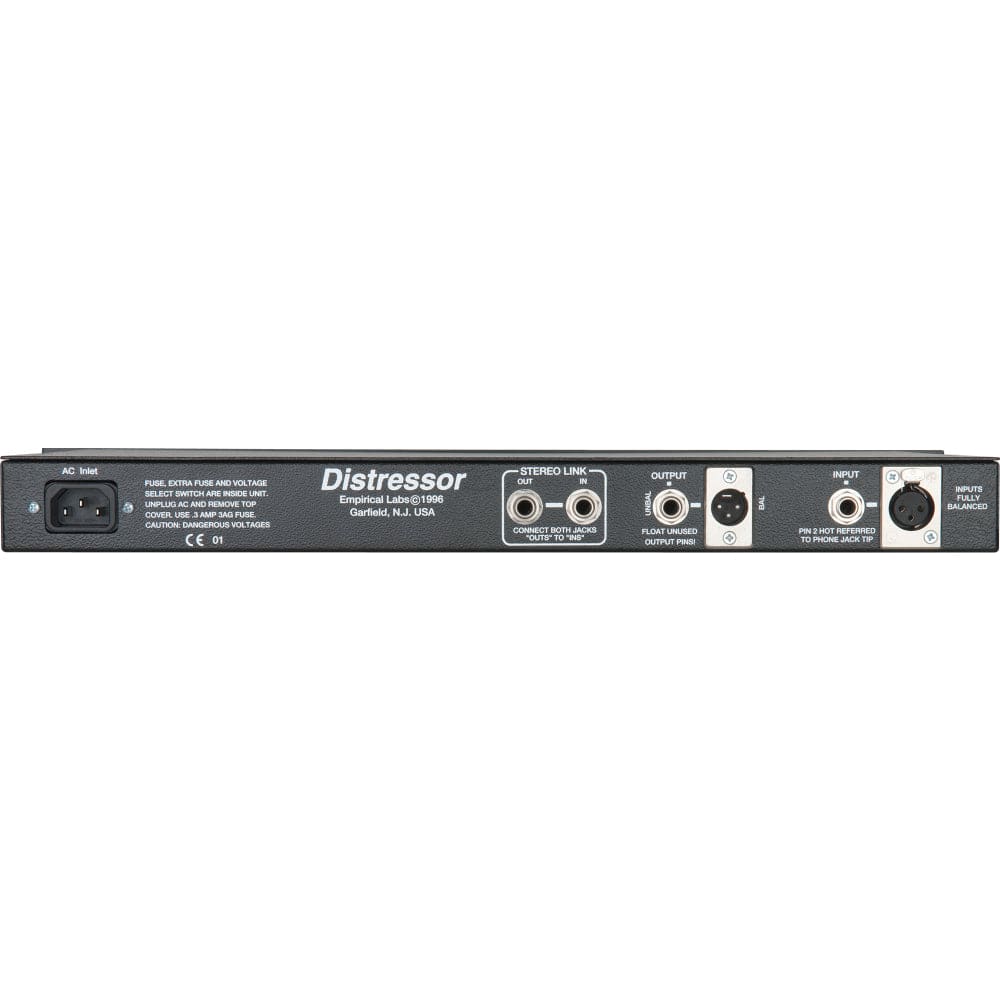
  • I/O – DC Coupled input and outputs.
  • Time Constants – Attack range 50uS – 50mS. Release range .05 sec to 3.5 seconds, normal modes and up to 20 seconds in 10:1 opto mode. Time constants are dependent on ratio.
  • Power Consumption – 15 Watts Max.
  • Metal Chassis – single height 1.75″ high, 10″ deep, 19″ wide.
  • Shipping info – 12.1 lbs mono. Mono box dimensions 22.5″ x 18.5″ x 3 1/4″.

Reviews

There are no reviews yet.

Be the first to review “Empirical Labs EL8X Distressor Compressor w/ British Mod”

Your email address will not be published. Required fields are marked *

Quick Comparison

SettingsEmpirical Labs EL8X Distressor Compressor w/ British Mod removeRadial X-Amp Active Reamper removeVermona Retroverb Lancet Spring Reverb Desktop Module removeEmpirical Labs EL8 Distressor Compressor removeRupert Neve Designs Portico 517: 500 Series Mic Pre / DI / Comp Standard removeZoom ZHA-4 Handy Headphone Amp remove
Image
SKU854682006023994139324451425050385741088940617196101395086018814515260025541
Rating
Price$1,271.89$153.42$366.93$1,564.49$834.26$52.32
Stock
Availability
Add to cart

Add to cart

Add to cart

Add to cart

Add to cart

Add to cart

Add to cart

Description
Content
The product that started it all for Empirical Labs. Born of founder Dave Derr’s love of classic compressors like the 1176, LA-2A and Gain Brain (among others), the Distressor incorporates his favorite sonic characteristics of these, along with other unique and interesting features that have made it a staple for audio engineers all over the world. With over 28,000 units in the field, it’s safe to say that the Distressor is one of the best selling high end compressors of all time… if not THE best selling. A prominent recording engineer recently wagered that there probably was not a top 40 record made in the last five years that didn’t have at least one Distressor on it.
Besides providing a wide range of control and a unique feature set, the Distressor offers a warm, vintage sound by using a custom designed gain control circuit. This “warmth” or “vintage sound” has become a major issue in the last few decades, as the super clear and linear digital technology does next to nothing to soften “harsh” sounds, nor emphasize the bass frequencies in music sources. Conversely, older analog tape, vinyl records and tube equipment could not be prevented from coloring the sound, often to the frustration of recording engineers. However, many people now realize that this coloring can be extremely pleasant and musical. Digital technology is often referred to as “cold” and “brittle” among other terms (although we prefer “unforgiving”).
Unique Compression Curves All eight of the Distressor’s curves are unique and distinctive, from the 1:1 mode that simply warms up signal with low order harmonics without intentional compression, to the “Nuke” setting – a brick wall limiting curve that shines on live drum room mics. Each curve has its own personality and several actually use different circuitry, and are effectively different compressors. Most exceptional is the 10:1 “Opto” ratio which uses separate detector circuitry to emulate the oldest (and valued) “light controlled” devices, such as the LA-2A.
Distortion (Color) Modes Another large part of the Distressor’s personality and power derive from three modes that color the signal, even without compression. These extended audio modes were designed to allow emulation of some very old and expensive vintage compressors & limiters, and let the Distressor deliver a classic “knee” sound all its own by providing user programmable, warm harmonic distortion. In addition to the basic distortion mode, Distort 2 emphasizes tube-like 2nd order harmonics, while in Distort 3 setting the distortion becomes dominated by 3rd harmonics more closely resembling tape. Two HP filters – one in the audio path, one in the detector path – are also available to help with low frequencies that can cause pumping and breathing.
British Mode The concept of British Mode came from an unusual setting on the classic UREI LN1176 limiter. The unit was designed to have only four ratios, each ratio being engaged by selecting one of four buttons. However, as early as 1980 (or before), renegade recording engineers, always on the lookout for something a little more “over-the-top”, found that you could make all four buttons stay in if you pressed them just right. What resulted was a very aggressive sound that had some elements of the unit’s 20:1 ratio, but with an unusual knee and new envelope shape. Somewhere along the line, someone called it “British Mode”, and the name stuck.
The EL8-X has the advantage of being able to selectively apply this aggressive characteristic – not just to the new “British” ratio (1:1) – to any of the ratios, simply by engaging the dedicated “British Mode” switch.
The British Mode and Image Link options are only available on the EL8-X.
Image Link The original Distressor stereo link function used a summing and phase detection method, which allowed slight stereo image shifting. Although frequently desirable for its phase correction, and its “thickening” on open room mics and other stereo sources, this approach can sometimes be a problem on stereo program material where the producer/engineers want to maintain absolute left/right balance at all times. With the new “Stereo Image Link” option, the EL8-X now has three link options – the original “phase” link, the new Image Link and the combination of the two, phase and image linking – something never before offered on any compressors or limiters.
  • Frequency Response – 2 Hz to 160 kHz in clean audio mode (+0, -3 dB). Response is shaped in distortion modes (Dist 2, Dist 3).
  • Dynamic Range – 110 dB from max. output to min. output in 1:1 mode. Greater than 100 dB signal to noise in distort 3 mode.
  • Distortion – ranges between .02% and 20% depending on distortion mode and release times set on front panel.
  • I/O – DC Coupled input and outputs.
  • Time Constants – Attack range 50uS – 50mS. Release range .05 sec to 3.5 seconds, normal modes and up to 20 seconds in 10:1 opto mode. Time constants are dependent on ratio.
  • Power Consumption – 15 Watts Max.
  • Metal Chassis – single height 1.75″ high, 10″ deep, 19″ wide.
  • Shipping info – 12.1 lbs mono. Mono box dimensions 22.5″ x 18.5″ x 3 1/4″.
Radial X-Amp Active Reamper
  • Active Reamp® with two outputs
  • 100% discrete class-A signal path
  • Transformer isolated to eliminate noise
  • Variable 'set & forget' level control
The Radial X-Amp is an active Reamper™ that allows the engineer to play a pre-recorded track back through guitar amplifiers and pedals. This opens the door to explore new musical sounds and spur on the creative process so that your recording stands out. Using the X-Amp is easy: start by recording a dry track using a high quality direct box like the Radial J48. Send the new track from your recorder via the X-Amp to your guitar amps, effect pedals or combinations thereof. Once the basic track has been recorded, replacing or adding tracks can be done well after the session player has gone home. This eliminates tiresome repetition and assures a fresh vibrant performance on the final recording. Furthermore, by driving two amps at the same time, new sounds and textures can be created while allowing you to make artistic decisions as the recording progresses. Following the critically acclaimed Radial JD7 Injector, the X-Amp employs a unique class-A circuit design that has been optimized for use with guitars. Features include balanced line level input with LED peak indicator and level control, class-A circuit topology for optimal reach and frequency response, a transformer isolated output to eliminate hum and buzz caused by ground loops, a 180º polarity reverse switch to bring both amps into phase, and a dual ground lift switch for noise-free operation. As with all Radial products, the X-Amp is built like a tank to provide years of trouble-free performance. An internal I-beam skeleton provides maximum protection against external stress which could cause solder points to fail. This is supplemented with an innovative bookend design that creates a protective zone around the switches, potentiometer and connectors. A full bottom no-slip pad performs double duty by keeping the X-Amp from sliding around when placed on a vibrating amplifier while also providing electrical and mechanical isolation. Reamping works equally well on bass, keyboards, drums and voice. Once you start Reamping, you will never record any other way. The Radial X-Amp… the active Reamp® for professional recording engineers.
Effective against boredom, supporting creative sound design A unique team play of spring reverberation, analogue multimode filtering, distortion and VCA, modulated by an ultra fast LFO and an envelope that can be triggered in flexible ways – Retroverb Lancet offers a comprehensive arsenal of many-sided effects for different applications. The spectrum by far surpasses classic reverberation, filter sweeps or overdrive because you are able to tweak and bend any parameter fast and intuitively to your liking. Retroverb Lancet will change the way you work with effects. It becomes part of your sound engine, fires it up and will end up as essential part of your sonic signature. Source of effectiveness We designed Retroverb Lancet in a way that it can perfectly handle signals of any kind: Guitars, basses, synthesizers, organs or microphones. On top of that, Retroverb Lancet allows you to create percussive sounds using its crash function. Retroverb Lancet is a real jack of all trades with character, suited for adventurous sound designers and tinkerers. Audio Input
  • max. input sensitivity: –32 dBu
  • impedance: 1 MΩ
Output
  • max. output level: 20 dBu
  • impedance: 600 Ω
Trigger- and CV-inputs
  • audio trigger
    • max. input sensitivity: –32 dBu
    • impedance: 1 MΩ
  • gate & CRASH
    • min. voltage: + 4 V
  • external cv
    • voltage: ± 10 V
Signal-to-Noise Ratio
  • direct: > 80 dB
  • effect (filter completely open, no reverb): > 75 dB
Spring Tank
  • number of springs: 3
  • reverbration decay: between 2.75 db and 4.00 s
Filter
  • modes: 24-db-lowpass, 24-db-highpass, 12-db-bandpass
  • modulations sources: envelope generator, envelope follower, external CV, LFO
LFO
  • frequency range: 0.05 Hz … 300 Hz
  • waveforms: ramp up, ramp down, square, sine, S&H, envelope generator
Envelope Generator
  • modes: AD, ASR
  • attack: 1 ms … 10 s
  • decay/release: 1 ms … 15 s
Miscellaneous
  • power supply: external DC-adapter with 12 V/1000 mA
  • dimensions: 26 cm x 14.5 cm x 8 cm (width x depth x height)
  • weight: 0.75 kg
Accessories
  • wooden side panels
The product that started it all for Empirical Labs. Born of founder Dave Derr’s love of classic compressors like the 1176, LA-2A and Gain Brain (among others), the Distressor incorporates his favorite sonic characteristics of these, along with other unique and interesting features that have made it a staple for audio engineers all over the world. With over 28,000 units in the field, it’s safe to say that the Distressor is one of the best selling high end compressors of all time… if not THE best selling. A prominent recording engineer recently wagered that there probably was not a top 40 record made in the last five years that didn’t have at least one Distressor on it.
Besides providing a wide range of control and a unique feature set, the Distressor offers a warm, vintage sound by using a custom designed gain control circuit. This “warmth” or “vintage sound” has become a major issue in the last few decades, as the super clear and linear digital technology does next to nothing to soften “harsh” sounds, nor emphasize the bass frequencies in music sources. Conversely, older analog tape, vinyl records and tube equipment could not be prevented from coloring the sound, often to the frustration of recording engineers. However, many people now realize that this coloring can be extremely pleasant and musical. Digital technology is often referred to as “cold” and “brittle” among other terms (although we prefer “unforgiving”).
Unique Compression Curves All eight of the Distressor’s curves are unique and distinctive, from the 1:1 mode that simply warms up signal with low order harmonics without intentional compression, to the “Nuke” setting – a brick wall limiting curve that shines on live drum room mics. Each curve has its own personality and several actually use different circuitry, and are effectively different compressors. Most exceptional is the 10:1 “Opto” ratio which uses separate detector circuitry to emulate the oldest (and valued) “light controlled” devices, such as the LA-2A.
Distortion (Color) Modes Another large part of the Distressor’s personality and power derive from three modes that color the signal, even without compression. These extended audio modes were designed to allow emulation of some very old and expensive vintage compressors & limiters, and let the Distressor deliver a classic “knee” sound all its own by providing user programmable, warm harmonic distortion. In addition to the basic distortion mode, Distort 2 emphasizes tube-like 2nd order harmonics, while in Distort 3 setting the distortion becomes dominated by 3rd harmonics more closely resembling tape. Two HP filters – one in the audio path, one in the detector path – are also available to help with low frequencies that can cause pumping and breathing.
  • Frequency Response – 2 Hz to 160 kHz in clean audio mode (+0, -3 dB). Response is shaped in distortion modes (Dist 2, Dist 3).
  • Dynamic Range – 110 dB from max. output to min. output in 1:1 mode. Greater than 100 dB signal to noise in distort 3 mode.
  • Distortion – ranges between .02% and 20% depending on distortion mode and release times set on front panel.
  • I/O – DC Coupled input and outputs.
  • Time Constants – Attack range 50uS – 50mS. Release range .05 sec to 3.5 seconds, normal modes and up to 20 seconds in 10:1 opto mode. Time constants are dependent on ratio.
  • Power Consumption – 15 Watts Max.
  • Metal Chassis – single height 1.75″ high, 10″ deep, 19″ wide.
  • Shipping info – 12.1 lbs mono. Mono box dimensions 22.5″ x 18.5″ x 3 1/4″.

FEATURES

  • World-class, transformer-coupled preamp, compressor, and DI
  • Gain: 0 - 66dB in 6dB increments
  • Compressor: Single-knob opto-coupler compressor with 2:1 ratio
  • Blend: Determines balance of mic and DI inputs
  • Instrument gain: 0 - 30dB on instrument input
  • 48V phantom power
  • Silk: Adds nostalgic warmth and presence when engaged
  • Instrument input: Front-panel TRS input and passive-through for Hi-Z sources
  • Polarity reverse
  • Threshold: When signals exceed threshold level, gain is reduced at a controlled 2:1 ratio with fixed attack and release time constants
  • Indicators: Signal presence and clipping on both mic and DI signals, as well as compressor activation.

TECHNICAL SPECIFICATION

Rupert Neve Designs Portico 517: 500 Series Mic Pre / DI / Comp
  • Frequency Response: Main Output, no load, -0.2dB @ 10Hz -3dB @ 160kHz
  • Noise measured at main output, unweighted, 22Hz - 22kHz, terminated 150 ohm: Gain at unity: better than -100dBu; gain at 66dB: better than -62dBu Equivalent Input Noise: better than -128dBu, noise factor 1.5dB
  • Maximum output level from 20Hz to 40kHz: +23dBu
  • Total Harmonic Distortion and Noise: @ 1kHz, +20 dBu output: Main Output: Better than 0.001% @ 20Hz, +20 dBu output: Main Output: Better than 0.002% Silk Engaged: Better than 0.2% Second harmonic
  • Crosstalk: Measured channel to channel: Better than -90dB @ 15kHz.
  • Phantom Power: +48 Volts DC +/- 1%
This item is in excellent working condition and barely used. The ZHA-4 splits a single stereo headphone output into four separate powered 1/8” headphone jacks, each with their own volume and mute control. Perfect for bands, podcasts, productions, and more. Two AA batteries provide hours of portable power. For longer sessions, connect the USB-C port to a portable battery or plug directly into the wall. What’s in the Box?
  • ZHA-4 Handy Headphone Amplifier
  • AA Batteries (x2)
  • Stereo Mini Audio Cable (19” / 50cm)
  • Quick Guide
Please Note: The item displayed in the images may not be the actual item you receive.
Weight
DimensionsN/AN/AN/AN/AN/AN/A
Additional information