| Content | At the heart of the ISA range is the microphone preamplifier with its Lundahl input transformer – essentially the same circuit, based on the original ISA110, that has been used for 30 years in successive Focusrite designs. The input transformer imparts a special character to the sound that can't be truly emulated in any other way: inseparable from the microphone itself, the transformer input stage is ideal for use with classic microphones. But this mic pre has a twist the original didn't have, which makes it far more versatile: four carefully-selected impedances allow you to match microphone to input in different ways. Bring out the character of a classic mic or emphasise a special feature, or go for a totally transparent, modern sound – it's up to you.Whether you're an artist, engineer or producer, you'll appreciate the versatility of the ISA One, with its front-panel DI input. The DI includes low/high impedance switching and an amplifier output, and its own feed to the optional A/D converter and separate rear-panel XLR output.
ISA series transformer-based preamplifier
Encased in a rugged and portable chassis, ISA One offers the classic Focusrite microphone preamplifier at its lowest cost to date.
Flexible independent DI channel
ISA One is ideal for both engineers and demanding performers alike, featuring independent gain control, an output for routing to an amp, an independent XLR output on the rear and routing to the optional A-D converter.
Switchable impedance
Choose one of four carefully selected input impedances, including the original ISA110 setting, to suit any microphone.
Headphone output with volume control
ISA One can feed either a sum of the two input to the headphones output, or an external stereo cue mix (such as a stereo feed from an interface) via two TRS jack inputs on the rear of the unit.
Dedicated insert point
Allows you to place extra processing between the preamplifier or DI and the optional converter, such as an EQ or compressor.
Optional stereo 192kHz A-D converter
You can chose to upgrade your unit with an optional digital card that delivers the best A-D performance in its class (dynamic range of 118dB). Alternatively, the ISA One Digital comes with the A-D converter as standard.
Lundahl LL1538 Input Transformer
The original mic transformer used in the original Red modules helps to provide the unique sound and performance of this groundbreaking design.
Backlit VU meter with variable calibration
ISA One has a moving coil VU meter with variable calibration to suit analogue and digital recording media, alongside two six-LED peak meters; inputs can be metered either pre- or post-insert.
W x D x H: 8.66" (W) x 4.1" (H) x 10" - 11.4" (D - top to bottom)
Weight: 8.6 lbs | Proven reverberation classic for the future
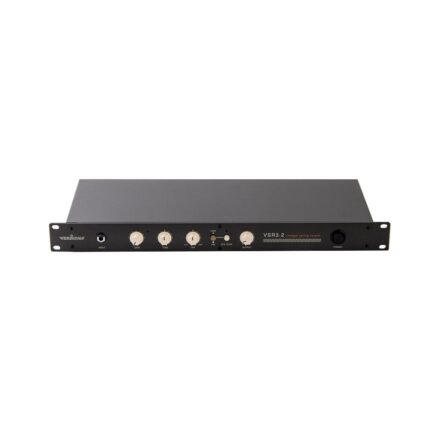
With the VSR 3.2, we happily rely on the proven old mechanical way to create reverberation. Rightly, because the used reverberation spring by AccuBell (formerly Accutronics) creates that magic 60's reverb which is slightly metallic and dense at the same time.
Just like it predecessors, VSR 3.2 has a straight-forward and honest approach: signal in - spring reverb - vintage sound out.
VSR 3.2 is equipped with an equalizer that is exactly adapted to the springs' frequency response. In addition, there are controls to mix the dry and effect signal as well as controls for the input and output level. This way, VSR 3.2 simply exactly does what it was designed to do.
Designed for every situation
Although using a large spring (type 9), VSR 3.2 fits in a 19" housing with one rack unit – minimal space requirements. Thanks to its extremely solid chassis, VSR 3.2 is a reliable vintage-effect that cannot only be used in a controlled studio environment. On the contrary, it also serves fine when being used in straining live situations.
VSR 3.2 grants your sound an elegant touch of "good old times". Its simplicity makes it an unbelievable versatile companion.
Inputs
- 1/4"-jack input front
- unbalanced
- max. input sensitivity: –40 dBu
- impedance: 1 MΩ
- 1/4"-jack input rear (1)
- unbalanced
- max. input sensitivity: 0 dBu
- impedance: 100 kΩ
- 1/4"-jack input rear (2)
- unbalanced
- max. input sensitivity: –20 dBu
- impedance: 10 kΩ
Outputs
- 1/4"-jack output (1)
- unbalanced
- max. output level: 0 dBu
- 1/4"-jack output (2)
- unbalanced
- max. output level: - 20 dBu
Signal-to-Noise Ratio
- direct: > 80 dBu
- effect: > 70 dBu
THD + Noise
Miscellaneous
- power supply: external DC-adapter with 12 V/1000 mA
- dimensions: 19“, 1 HE, ca. 190 mm deep
- weight: 2.5 kg
| In today’s modern age of digital recorders, DAWs and software plug-ins, Mike-E is the ultimate solution for getting a clean and strong, yet warm and musical signal into the box…and it couldn’t be easier to work – its front panel layout is so straight ahead that even inexperienced engineers will have no problem moving around on it right away.
When the engineering team at Empirical Labs sets out to build a microphone preamp, you can be sure it’ll deliver spectacular sound, be effortless to work, and will provide features unlike any other device in its class. To that end, we proudly present Mike-E, a high performance transformer-coupled mic preamp with a noise floor far below any microphone’s self noise, combined with a one-of-a-kind compressor/saturator circuit that delivers classic knee compression as well as versatile tonal ‘coloring’ that can replicate many of the best characteristics of vintage analog recording equipment.
Mic Preamp
The Mike-E features a super low noise transformer input amplifier section with the gain under precise digital control. The signal to noise far exceeds any microphone in existence. Having used many mic preamps over the years, we’ve implemented a unique stepped gain control that should be impervious to the normal flakiness that age causes to pots and detented switches. A “Bad!” LED indicates when the input signal is overloading the circuit.
CompSat
The CompSat’s unique circuitry sets the Mike-E apart from all other mic preamps.
- SATURATOR – a multi stage soft-clipping circuit. At lower levels, a triode-type saturation affects the signal. As the level increases, a second unique clip circuit starts to more severely flatten out the peaks.
- COMPRESSOR – based on ELI’s world famous Distressor, but with other characteristics (including a much longer attack time). Preset ratios include: 2:1, 4:1, 8:1…and, of course, Nuke.
- EMPHASIS – a two-stage circuit that boosts and soft clips high frequencies before the CompSat™ circuit, and then cuts the frequencies after it. Emphasis has the added perk of improving signal to noise, and is the reason analog tape decks used emphasis to begin with.
Frequency Response: 3 Hz to 200 kHz on (No CompSat). CompSat is 3Hz – 150Khz. Optional Transformer output is 6Hz–80kHz.
Signal to Noise: 130 dB signal to Noise.at 40dB gain. Maximum output is +28dBu.
Distortion: Ranges between .0006% and 15% depending on mode and settings.
I/O: Transformer coupled Input, Active and Transformer Outputs available. High quality audio caps used internally.
Impedance: Input Impedance is above 600 Ohms at all frequencies, transformer coupled. Output impedance is less than 38 ohms. Instrument In Impedance is 332K Ohms.
Attack/Decay Range: .9 – 70mS attack. .15 – 1 Sec.
Power Consumption: 15 Watts Max.
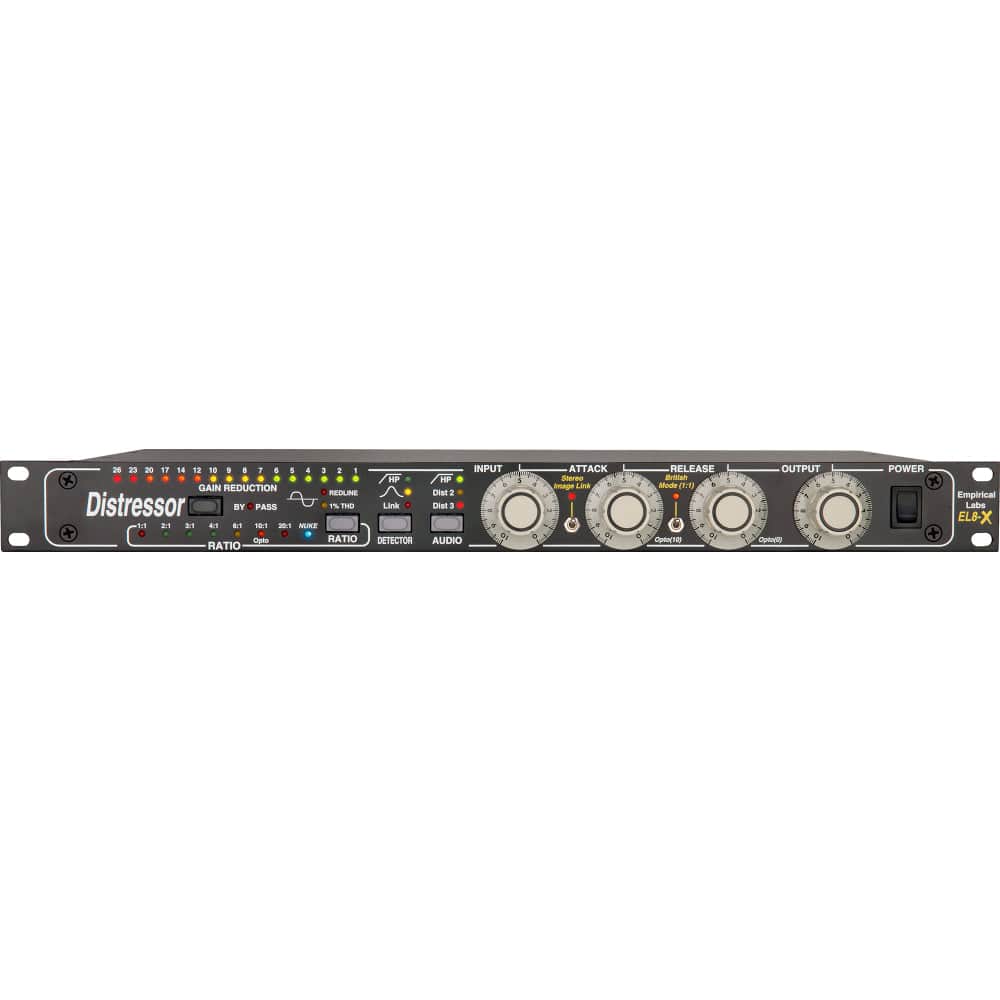
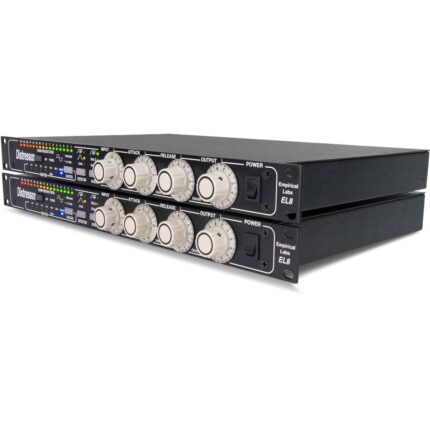
Metal Chassis: single height 1.75″ high, 10″ deep, 19″ wide. | The product that started it all for Empirical Labs. Born of founder Dave Derr’s love of classic compressors like the 1176, LA-2A and Gain Brain (among others), the Distressor incorporates his favorite sonic characteristics of these, along with other unique and interesting features that have made it a staple for audio engineers all over the world. With over 28,000 units in the field, it’s safe to say that the Distressor is one of the best selling high end compressors of all time… if not THE best selling. A prominent recording engineer recently wagered that there probably was not a top 40 record made in the last five years that didn’t have at least one Distressor on it.
Besides providing a wide range of control and a unique feature set, the Distressor offers a warm, vintage sound by using a custom designed gain control circuit. This “warmth” or “vintage sound” has become a major issue in the last few decades, as the super clear and linear digital technology does next to nothing to soften “harsh” sounds, nor emphasize the bass frequencies in music sources. Conversely, older analog tape, vinyl records and tube equipment could not be prevented from coloring the sound, often to the frustration of recording engineers. However, many people now realize that this coloring can be extremely pleasant and musical. Digital technology is often referred to as “cold” and “brittle” among other terms (although we prefer “unforgiving”).
Unique Compression Curves
All eight of the Distressor’s curves are unique and distinctive, from the 1:1 mode that simply warms up signal with low order harmonics without intentional compression, to the “Nuke” setting – a brick wall limiting curve that shines on live drum room mics. Each curve has its own personality and several actually use different circuitry, and are effectively different compressors. Most exceptional is the 10:1 “Opto” ratio which uses separate detector circuitry to emulate the oldest (and valued) “light controlled” devices, such as the LA-2A.
Distortion (Color) Modes
Another large part of the Distressor’s personality and power derive from three modes that color the signal, even without compression. These extended audio modes were designed to allow emulation of some very old and expensive vintage compressors & limiters, and let the Distressor deliver a classic “knee” sound all its own by providing user programmable, warm harmonic distortion. In addition to the basic distortion mode, Distort 2 emphasizes tube-like 2nd order harmonics, while in Distort 3 setting the distortion becomes dominated by 3rd harmonics more closely resembling tape. Two HP filters – one in the audio path, one in the detector path – are also available to help with low frequencies that can cause pumping and breathing.
British Mode
The concept of British Mode came from an unusual setting on the classic UREI LN1176 limiter. The unit was designed to have only four ratios, each ratio being engaged by selecting one of four buttons. However, as early as 1980 (or before), renegade recording engineers, always on the lookout for something a little more “over-the-top”, found that you could make all four buttons stay in if you pressed them just right. What resulted was a very aggressive sound that had some elements of the unit’s 20:1 ratio, but with an unusual knee and new envelope shape. Somewhere along the line, someone called it “British Mode”, and the name stuck.
The EL8-X has the advantage of being able to selectively apply this aggressive characteristic – not just to the new “British” ratio (1:1) – to any of the ratios, simply by engaging the dedicated “British Mode” switch.
The British Mode and Image Link options are only available on the EL8-X.
Image Link
The original Distressor stereo link function used a summing and phase detection method, which allowed slight stereo image shifting. Although frequently desirable for its phase correction, and its “thickening” on open room mics and other stereo sources, this approach can sometimes be a problem on stereo program material where the producer/engineers want to maintain absolute left/right balance at all times. With the new “Stereo Image Link” option, the EL8-X now has three link options – the original “phase” link, the new Image Link and the combination of the two, phase and image linking – something never before offered on any compressors or limiters.
- Frequency Response – 2 Hz to 160 kHz in clean audio mode (+0, -3 dB). Response is shaped in distortion modes (Dist 2, Dist 3).
- Dynamic Range – 110 dB from max. output to min. output in 1:1 mode. Greater than 100 dB signal to noise in distort 3 mode.
- Distortion – ranges between .02% and 20% depending on distortion mode and release times set on front panel.
- I/O – DC Coupled input and outputs.
- Time Constants – Attack range 50uS – 50mS. Release range .05 sec to 3.5 seconds, normal modes and up to 20 seconds in 10:1 opto mode. Time constants are dependent on ratio.
- Power Consumption – 15 Watts Max.
- Metal Chassis – single height 1.75″ high, 10″ deep, 19″ wide.
- Shipping info – 12.1 lbs mono. Mono box dimensions 22.5″ x 18.5″ x 3 1/4″.
| The vintage EQ tones you know & love.
The 551 is the only equalizer for the 500 Series actually designed by Rupert Neve. Featuring 3 bands of EQ inspired by Mr. Neve’s most prized vintage designs, along with custom-wound inductors, transformers and class-A gain blocks, the 551 brings the thick, powerful lows and sweet highs of Rupert’s classics to the 500-Series format.
The “Best-Of” EQ
The 551’s 3-band, custom-tapped inductor EQ was inspired by our favorite elements of Rupert’s vintage EQ designs. The low frequency band is designed to produce a creamy, resonant bass response similar to a vintage 1064 – but unlike the vintage modules, the LF band on the 551 can be used as either a shelf or a peak filter, adding punch, dimension, and control to your low end.
The midrange band is based on that of the 1073, ideal for sweetening vocals and instruments while bringing them forward in a mix, and its proportional “Q” response makes it well-suited for minimizing problematic frequencies. The high frequency band is a hybrid vintage / modern design, blending inductor circuitry with capacitor-based topologies to achieve vintage tones with enhanced control. The High Pass filter is a 12dB/octave design with a fixed 80Hz frequency, and can be used in tandem with the low frequency EQ to add low-end presence without clouding the source material.
As with Rupert’s most prized classic designs, each EQ section uses low-feedback, class-A discrete electronics to prevent low-level artifacts and harshness from detracting from the tonal shaping. However, this new circuit is a decidedly modern design with updated techniques and components that were simply not available 50 years ago, and is definitely not a “clone”.
What Are Inductors?
Inductors are wires wound around a coil that provide a form of frequency-dependant resistance. When they saturate, they bring out beautifully musical harmonics that give your tracks the smooth, polished sound that has made Rupert’s consoles and equipment so desirable for over fifty years. This is what makes them different from capacitor-based EQ designs, which do a great job at surgical equalization. But inductors provide the tone.
While it is certainly possible to create a functioning EQ using off-the-shelf inductors, we choose to use our own custom inductors for the 551. This attention to detail in controlling variables such as the winding and core materials in relation to the surrounding circuitry allows the 551 to capture the vitality and personality of Rupert’s classic designs.
NOISE
- Measured at Main Output, un-weighted, 22Hz-22kHz, source impedance 40 Ohm balanced.
- Better than -102 dBV
FREQUENCY RESPONSE
Main output, no load: +/- 0.1 dBu from 20 Hz to 31.5 kHz, -1 dB @ 120 kHz
MAXIMUM OUTPUT LEVEL
23.25 dBu
TOTAL HARMONIC DISTORTION AND NOISE
- @ 1 kHz, +20 dBu output level, no load: Better than 0.0025%
- @ 20 Hz, +20 dBu output level, no load: 0.13% Typical (2nd and 3rd harmonic)
HIGH PASS FILTER
- -2.7 dB @ 80 Hz
- Slope: 12 dB/Octave
NOISE
- Measured at Main Output, un-weighted, 22 Hz - 22 kHz, source impedance 40 Ohm balanced.
- Better than -94 dBV
FREQUENCY RESPONSE
Main output, no load: +/- 0.25 dBu from 20 Hz to 45 kHz, -2 dB @ 120 kHz
MAXIMUM OUTPUT LEVEL
23 dBu
TOTAL HARMONIC DISTORTION AND NOISE
- @ 1 kHz, +20 dBu output level, no load: Better than 0.009%
- @ 20 Hz, +20 dBu output level, no load: 0.13% Typical (2nd and 3rd harmonic)
POWER REQUIREMENTS
- 120mA on +16VDC
- 110ma on -16VD
| FEATURES
- The industry-standard tabletop looper, updated and enhanced
- Class-leading sound quality with 32-bit AD/DA and 32-bit floating-point processing
- Five simultaneous stereo phrase tracks with dedicated controls and independent volume faders
- Input FX and Track FX sections, each with four simultaneous effects and four quick-access banks
- Customizable FX and Track buttons for each phrase track
- Massive onboard effects selection with 49 Input FX types and 53 Track FX types, including new Harmony, Electric FX and many others
- Ultra-durable faders with longer throw for more precise adjustment
- Mark Back function provides enhanced undo/redo flexibility while performing
- Two XLR mic inputs with phantom power, two stereo line input pairs, and three stereo line output pairs
- 99 memories, each containing five phrase tracks, custom effects and playback settings, control assignments and more
- Synchronize your loops with over 200 onboard rhythm patterns and 16 drum kits
- Deep MIDI control support
- Two external control jacks, each with support for up to two footswitches or an expression pedal
- USB for data backup, phrase import/export with BOSS Tone Studio and pattern import with the RC Rhythm Converter
TECHNICAL SPECIFICATION
Boss RC-505MK2 Tabletop Loop Station
- Sampling Frequency: 44.1 kHz
- AD/DA Conversion: 32 bits
- Processing: 32-bit floating point
RECORDING/PLAYBACK
- Number of Tracks: 5
- Data Format: WAV (44.1 kHz, 32-bit float, stereo)
- Maximum Recording Time: Approx. 1.5 hours (1 track), Approx.13 hours (total of All memories)
- Rhythm Type: 200 types or greater
- Rhythm Kit: 16 types
EFFECTS
- INPUT FX: 49 types
- TRACK FX: 53 types
- MASTER FX: 2 types
- Memory: 99
- Display: Graphic LCD (128 x 64 dots, backlit LCD)
CONNECTORS
- MIC IN 1, 2 jack: XLR type (balanced, phantom power: DC 48 V, 10 mA Max
- INST IN 1, 2 jacks, MAIN OUT jacks, SUB OUT 1, 2 jacks: 1/4-inch phone type
- PHONES jack: Stereo 1/4-inch phone type
- CTL1,2/EXP1 jack, CTL3,4/EXP2 jack: 1/4-inch TRS phone type
- USB port: USB B type
- MIDI (IN, OUT) connectors
- DC IN jack
- Power Supply: AC adaptor
CURRENT DRAW
- 1.0 A (with phantom power)
- 0.9 A (without phantom power)
- Dimensions: 16-9/16" W x 9-1/4" D x 2-11/16" H
- Weight: 4 lb.
|







Reviews
There are no reviews yet.