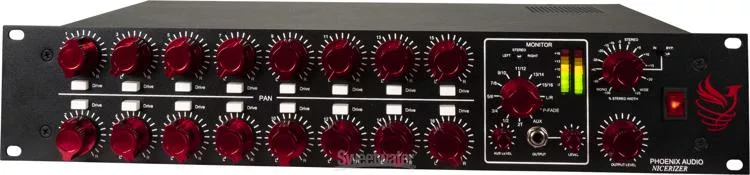
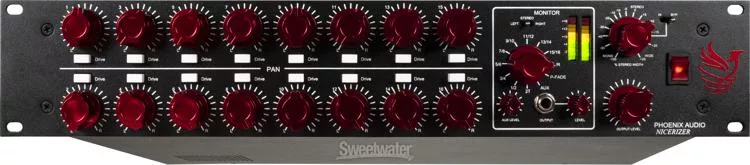
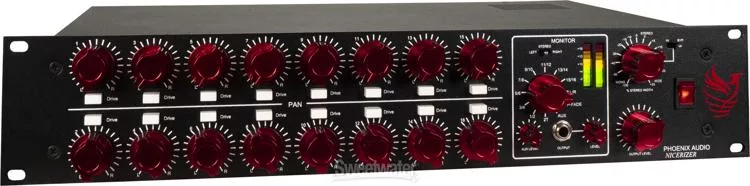
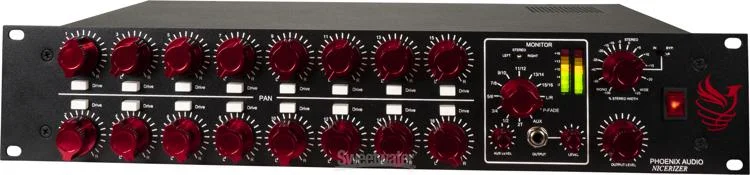
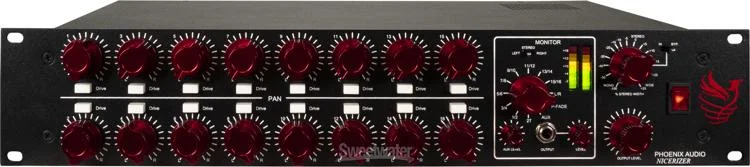
| Content | The immense flexibility of software mixers notwithstanding, there's nothing like the in-your-face punch, articulation, and dimensionality that a quality analog summing mixer can impart to your productions. The Phoenix Audio’s Nicerizer Series summing mixers rock proprietary Class A circuitry and smart features that make them legendary analog tone machines for a digital world. A 16-channel DAW summing mixer in a 2RU 19-inch rackmount chassis, the Nicerizer puts critical elements such as circuit gain staging and panning back into the analog realm where they handily outperform their digital emulations.
Hi-fidelity transformerless input stage
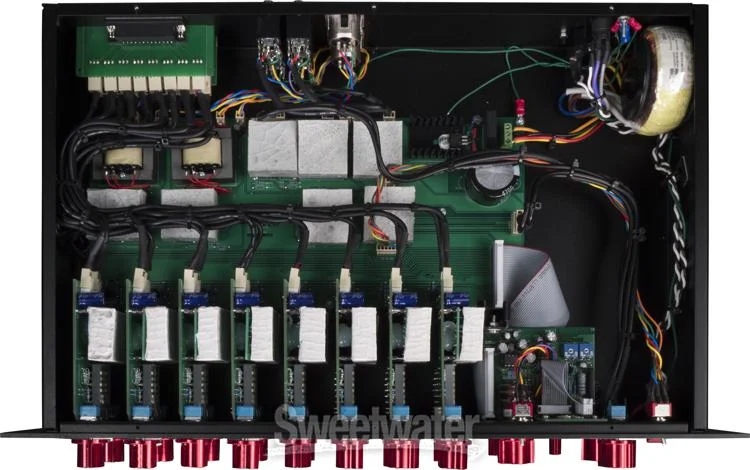
With their Nicerizer summing mixer, Phoenix takes a decidedly modern approach to Class A circuit design. The company's proprietary transformerless input stage delivers the full frequency spectrum with crystal-clear clarity and punch. Transformers tend to slow things down a bit — which can sound amazing in certain cases; but then slew rates take a hit, delivering sluggish transients and limiting your tonal palette.
Driven conservatively, Phoenix Audio's electronically balanced input stage serves up ultra-clear high-fidelity sound. If you're after fatter, more saturated tones, engage the +8dB switch individually on any channel to drive the circuit hotter for a punchy in-your-face sound that only discrete Class A buffer amps can deliver. The Nicerizer captures articulate, full-bodied input signals, allowing you to drive the output stage for an immense range of pure Class A tone, from modern audiophile clarity to vintage-flavored warmth.
Masterful transformer-balanced output stage
Phoenix Audio couples their custom-wound DB694 output transformer to a fully discrete, proprietary DSOP-2 output amplifier, itself a direct descendant of the renowned TF1 amp that Phoenix chief designer David Rees developed as an upgrade for vintage Neve 80 Series console modules. Outperforming the TF1, the DSOP-2 represents a pinnacle of Class A output circuit design, offering a seamless tonal range from ultra-clean to gorgeously saturated. With its big iron and massive headroom, you can drive the DSOP-2 to taste. Crank the Nicerizer's output stage to elicit beautifully saturated tones; back off for a cleaner high-fidelity sound, or dial up any flavor in-between.
Balanced/unbalanced
If your inputs come from a variety of sources, you're bound to be dealing with both balanced and unbalanced signals. No worries! The Nicerizer’s 16 inputs can accept either — without any of the gain loss all too common with many mixer inputs. This amazingly useful feature lets you easily execute many functions that are fast becoming standard practices, such as looping through guitar pedals or recording MIDI-driven synthesizers in real time while mixing.
The Width control
Once you've used the Nicerizer, you'll realize how valuable its unique control set is. The Width control incorporates elements of mid-side processing to narrow or widen your stereo image with the twist of a knob. If you haven’t used a width control before, trust Sweetwater: you're in for a treat! The Nicerizer's Width control offers a degree of spacial manipulation that can instantly tighten up a sprawling arrangement or unlock hidden dimensions in a mix.
Stereo bus insert
Today, it's quite common while mixing to strap a compressor or other processor across the mix bus, and the Nicerizer's stereo bus insert makes it easy. Monitor punchy, loudness-optimized mixes and get a head start on mastering while you're still mixing.
Independently controlled AUX output
Just before it hits the output transformers, the Nicerizer mults an output signal and routes it to a dedicated front-panel level control. This independently controlled AUX output lets you drive external monitor amps or simply bypass the output stage to send a transformerless sound to your recording device.
2-track Return
Another feature borrowed from large-format consoles is the 2-track Return input that lets you monitor an external output source through the Nicerizer's onboard headphone amplifier. Incredibly convenient, and great for A/B comparisons!
The Monitor Select switch
The Nicerizer 16 Mk2 features a unique Monitor Select switch, which lets you easily monitor single pairs of channels (1–2, 3–4, etc.), in addition to any of the Nicerizer's other stereo ports. Infinitely handy for a variety of workflows, this switch is the mixer's secret weapon, ready for all sorts of creative uses, from individual stem work to comparing mixes to direct comparison of multiple analog sources.
The Monitor Select switch Toggle
Once you’ve chosen which input pair you want to monitor via the Monitor Select switch, the Toggle allows you to monitor either the Left or Right channels in mono on both channels via the headphone amp, or to monitor in stereo. Critical analysis of your audio signals has never been easier.
Flexible LED metering
Following the Monitor Select switch, the Nicerizer's LED meter display gives you constant visual confirmation of your operating levels. Another big-console feature, the flexibility afforded by the metering being selectable for each channel as well as the main outputs makes the Nicerizer's metering setup indispensable for gain management as you finalize your productions.
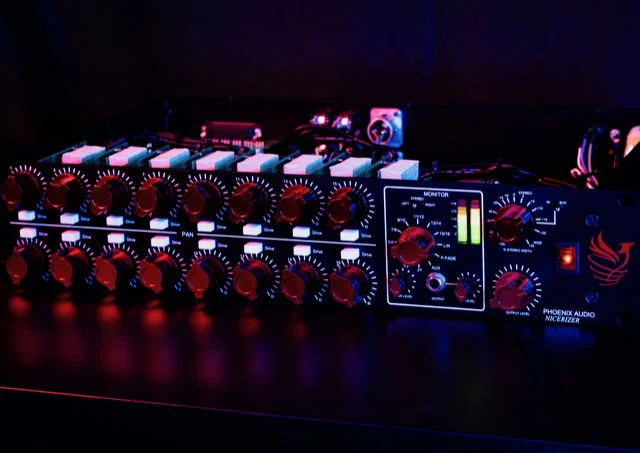
Phoenix Audio Nicerizer Features:
- 16-channel DAW Summing Mixer in a 2RU 19-inch rackmount chassis
- 16 channels of discrete Class A balanced transformerless input stage
- Discrete Class A transformer-balanced DSOP-2 output stage
- Phoenix custom-wired transformers on both outputs
- Individual detented pan controls on each channel
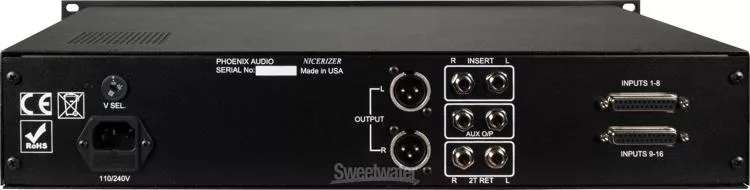
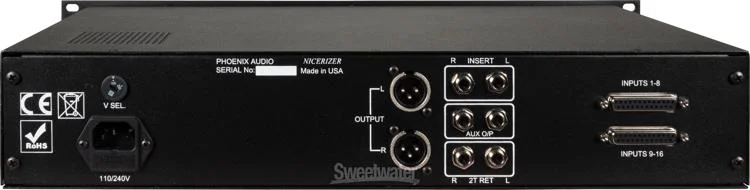
- 2 balanced 8-channel D-sub inputs — can accept balanced or unbalanced input with no -6dB loss
- Unbalanced 1/4-inch TRS insert sends on all Busses, including master Stereo Mix Bus insert
- Drive Technology button on each channel for color & saturation
- Master mix bus output level control
- Stereo LED level monitoring, switchable for each channel and Stereo Mix Bus
- Stereo/Mono External/Headphone monitoring output is switchable to each channel, external input (via 2T Return), AUX and main output (L, R, and Stereo)
- Main Outputs on balanced XLRs
- Unbalanced 1/4-inch TRS jacks for AUX outputs with front-panel level control
- 2-track stereo mono inputs on 1/4-inch TRS balanced jacks
- Bypassable Class A stereo Width control with lossless bass (pannable from mono to 25% Wider)
- Maximum Output Level of +26dB
- Generous headroom available on all channels
- Wired with PTFE silver-plated mil-spec cable
| The Dangerous Music Liaison puts the fun back into trying out creative combinations of gear. The Liaison also lets your setup remain absolutely flexible — just what you need if you want to survive in a market that often demands recording, mixing, and mastering services from a single studio. The Liaison's claim to fame is that it combines your favorite pieces of music gear together in various configurations, allowing you to try out new gear combinations and recall them later. But there's a lot more to the Dangerous Music Liaison than mere signal routing.
Mix, match, store, and recall all your favorite gear combinations
Dangerous Music has always been dedicated to providing serious engineers with the most useful gear possible. They've upped the ante again, with the Liaison. The Liaison lets you experiment with different combinations of gear, giving you a total of six discrete 2-channel inputs and two 2-channel buses. Want to hear how that compressor sounds pre- and post-EQ? With a Liaison, you can audition various hardware combinations as easily as swapping around plug-ins in a DAW. What's more, you can store and recall your favorite setups, so you can keep that killer vocal compression chain or that thumping kick drum processing path close at hand.
Flexible stereo buses give you advanced configuration options
When we ran the Dangerous Music Liaison through its paces here at Sweetwater, we found that its stereo buses do more than just compare two discrete signal paths. Depending on how you configure them, these stereo buses can provide you with two completely independent, flexible signal chains, each serving as its own small routing matrix. You can also combine both buses to create a long and flexible continuous signal-processing chain, in which you can reorder entire sections of your gear setup. Even cooler, you can use the Liaison's buses to establish complex parallel signal processing — opening up limitless sonic possibilities.
Mastering-grade components for unrivaled sound quality
As is the case with all Dangerous Music products, the Liaison is made entirely from mastering-grade components, so you never have to worry about audio coloration or latency. In fact, when set to simply pass audio, professional grade testers used to measure the Liaison read as though they were plugged into themselves. Talk about quality control! Here are some of the other specifics. Both the inserts and the buses feature straight-wire, unamplified, balanced signal paths. All audio is relay-switched via top-quality, gas-filled, bifurcated contact relays — ensuring that all switching is absolutely noiseless. The rest of the Liaison's signal paths feature mastering-grade components made by THAT Corp. and Burr-Brown.
What the pros are saying about the LIAISON:
- "The Dangerous LIAISON feels like engaging light-speed for my workflow...and make no mistake: workflow IS sound. The sheer speed at which you can do critical comparisons of entire signal chains does have a direct and positive impact how your music will sound." — Alberto Rizzo Schettino (Engineer)
- "One of the best features of the LIAISON is the monitor outs...you can monitor the signal at four points in the chain: before and after Bus A and B. The usefulness of this feature is huge, and Dangerous deserves major props for including it! The switching of inserts is managed by beefy relays that are as transparent as any I've ever heard." — Adam Gonsalves (Mastering Engineer)
- "LIAISON gives you the impetus to rethink how you record, mix, and master your music...[and] using the LIAISON is dead simple. I think of LIAISON not as an insert switcher, but as a creativity enabler." — Andy Hong (Writer/Reviewer)
- "The Dangerous LIAISON is incredibly exciting. To have a device that lets you so easily switch between processors, swap the order of processors, do quick A-B comparisons of signal chains. It makes my work better!" — Jonathan Wyner (Mastering Engineer)
- "Being able to switch devices from one bus to the other is extremely useful. The fast switching is amazing!" — Jeff Lipton (Mastering Engineer)
- "The LIAISON is really important — I can do a lot of combinations of chaining gear and I am able to work a lot faster. Before the LIAISON [I had to] switch the patchbay and compare the sounds. Now I am 20-times faster than before, I like the way the LIAISON allows me to still be in the energy of the music. — Antoine "Chab" Chabert (Mastering Engineer)
- "So happy with the LIAISON. Being able to switch gear in and out from the listening position without leaning over a patch bay is fantastic. After sitting in this chair for so many years, it actually improves my mixing ergonomics considerably." — Bob Power (Mastering Engineer)
Dangerous Music Liaison Features:
- Flexible signal routing matrix that allows you to combine the gear in your studio in fun, exciting, and creative ways
- Leverage all your gear, all the time
- Improve your tracks, mixes, and masters by auditioning and marrying the perfect ensemble of equipment
- 2 independent stereo buses mean you can set up 1 as a tracking path and the other as a mix path, without repatching, or chain them together
- Separate parallel processing loop to let drums breathe and crush simultaneously
- Create complex combinations of gear and A/B instantly
- Store your favorite settings to recall any tracking, mixing, or mastering configuration
- 6 stereo insert loops, assignable to 2 stereo buses
- Mastering-grade components ensure silent, relay-based switching and color-free audio
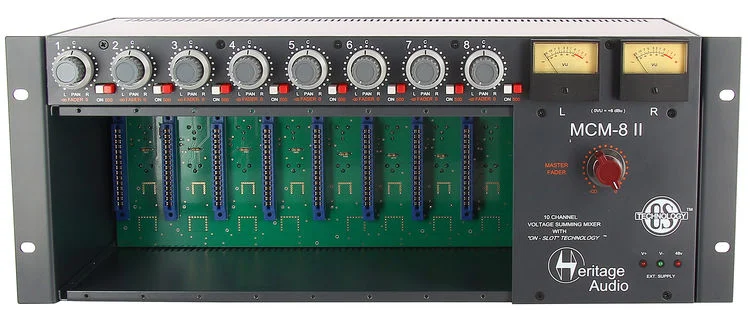
| Heritage Audio's MCM-8 MK2 is an 8-slot 500 Series chassis with an integrated 10-channel summing mixer. The top-of-the-line MCM-8 MK2 features On Slot Technology that leverages next-generation power electronics to handle power supply on a per slot basis. Each slot has its own power supply linear regulation stages, isolating each module from the rest. Your modules simply share the metal enclosure. Each slot even has test LEDs for checking correct power operation. Dual-concentric potentiometers handle Volume and Pan for each slot, with pan pots being center detented for precise center positioning. Each channel is equipped with an On switch to assign it to the mix bus. MK2 improvements include a lower noise floor and the addition of a bypass switch for each slot that still lets you use the summing mixer functions. Heritage Audio has earned the respect of Sweetwater engineers, and the MCM-8 MK2 lives up to that sterling reputation.
Superb build and feature set
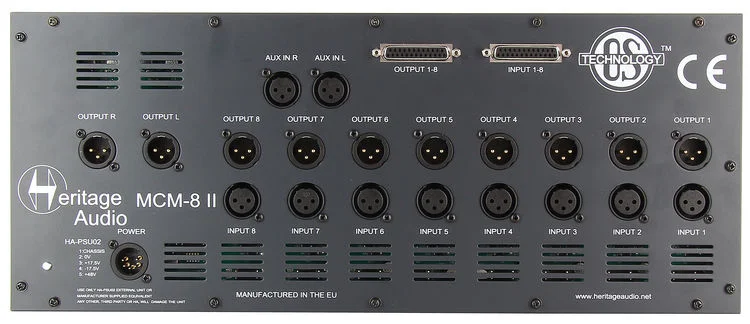
From its RAF blue-gray enclosure to the solid tactile feedback from its knobs and switches, the Heritage Audio MCM-8 MK2 unabashedly rocks vintage British Class A vibe. And just like the classic gear that inspires all Heritage Audio equipment, the MCM-8 MK2 boasts superb build quality and a very smart feature set. There's an additional stereo input on the back panel, which allows several MCM-8 MK2 units to be daisy-chained — or signals not needing further 500 Series processing to be mixed together. The central section sports analog VU meters and a Stereo Master fader. Gold-plated XLRs and DSUB25s handle the I/O.
Smart technology, superior sound
Thanks to Heritage Audio's On Slot Technology (OST), the MCM-8 MK2's power capability is a maximum of 400mA per rail, per slot — with an overall of 1.4A (1.6A non-continuous) per rail, whichever is reached first. Total available phantom power is 140mA. The mix bus has a passive voltage summing topology, similar to that found in Rupert Neve's 80 Series consoles of the 1970s. The gain loss is restored by the same Class A, 2n3055 driven, transformer-based output stage used in the Heritage Audio's modern-day version of the classic 1073. If you're not into specs, what this all means is that the MCM-8 MK2 is built right to give you many years of authoritative sonic performance and trouble-free use in your studio or on the road.
Heritage Audio MCM-8 MK2 Features:
- 8-slot 500 Series chassis with integrated 10-channel summing mixer
- NEW lower noise floor
- NEW bypass switch for each slot that leaves summing mixer functions enabled
- Mix bus with vintage Neve-style passive voltage summing topology
- Additional stereo input on the back panel allows several MCM-8s to be daisy-chained
- Central section sports analog VU meters and a Stereo Master fader
- Handles power supply on a per slots basis, isolating each module from the rest
- Gold-plated XLRs and DSUB25s handle your I/O
- 140mA total available phantom power
- Class A transformer-based output stage
- Solid build quality for many years of trouble-free use
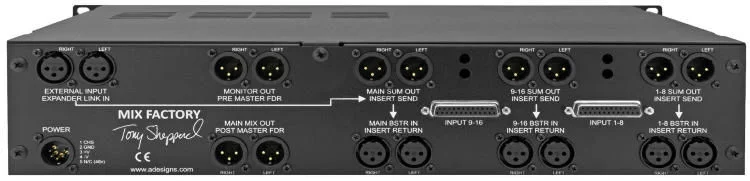
| The A-Designs Mix Factory takes a fresh approach to analog summing, delivering analog warmth with the depth and imaging needed to make your mixes truly stand out. Mix Factory inputs 16 channels and sums to balanced stereo outputs. All channels are fitted with gain controls, pan pots, and mutes. Two 8-channel groups are provided, each has an insert with mute button, and there is a master insert for all 16 channels. Mix Factory lets you switch between "clean," which bypasses the transformers, to "tonal," which introduces the harmonic enhancement of custom Cinemag output transformers. The Mix Factory is linkable, letting you expand to 64 or more channels. Take your studio to the next level with the A-Designs Mix Factory.
Benefits of the hybrid studio
Producer/engineer Tony Shepperd came up with the idea for Mix Factory, and it was brought to life by noted circuit design wizard Paul Wolff. Mr. Shepperd had been one of the modern engineers who subscribed to the "all-in-the-box" school of digital music production. At some point, however, he came to believe that digital and analog could very well coexist in the contemporary studio in a synergistic union that delivered additional "best-of-both-worlds" sonic benefits. This hybrid approach worked exceptionally well for Tony, taking his mixes to a new level. So much so that other engineers took notice and started asking him for tips. Today, most high-end recording facilities (including Sweetwater Studios) are hybridized in one sense or another. A-Designs' Mix Factory is a smart and cost-effective way to realize the many advantages of this approach.
A-Designs Mix Factory Features:
- 2RU 16-channel analog summing mixer
- 2 x 8-channel Groups
- All channels fitted with gain controls, pan pots, and mutes
- Switchable Cinemag output transformers
- Linkable, for easy studio expansion
- External power supply (included) switches between 120V and 230V
| Add the undeniably vibrant sound of analog summing to your DAW with the SPL MixDream XP 16 x 2 analog summing mixer. Take one of your past projects and mix it through the MixDream XP and you'll hear more depth, enhanced stereo imaging, and noticeably punchier dynamic impact. The Class A design and 60-volt rails in the MixDream XP provide amazing headroom and ultra-low noise, rivaling the sound of full-featured analog consoles. Once you've got your submixes sounding just right, Sweetwater can highly recommend the SPL MixDream XP summing mixer to take your mix over the top.
SPL MixDream XP 16 x 2 Summing Mixer at a Glance:
- Deeper, wider mixes from analog summing
- Premium analog design for top-notch sound
- Expandable for higher channel counts
Deeper, wider mixes from analog summing
While the debate over analog vs. digital summing is not new, most engineers agree that summing your mix through high-quality analog gear sounds awesome. Compared to the exact same mix summed in your DAW, you'll notice that the SPL MixDream XP sums your mix with greater depth and enhanced stereo definition, with an undeniably vibrant quality.
Premium analog design for top-notch sound
SPL designed the MixDream XP summing mixer with 60-volt rails for an outstanding 125dB dynamic range, with a very low noise floor too.The discrete Class A topology was designed to give you essentially the same sound as a high-end mixing console, in a convenient rackmount form factor.
Expandable for higher channel counts
Need more than 16 channels of analog summing? It's easy to expand your summing capabilities with additional MixDream XPs. Just use the expansion inputs to daisy-chain your MixDream XPs, or even mix and match with SPL MixDream model 2384 summing mixers.
SPL MixDream XP 16 x 2 Summing Mixer Features:
- 16-in, 2-out analog summing mixer
- Amazing dynamic range and ultra low noise, thanks to discrete Class A design and 60-volt rails
- Multiple units can be linked for surround operation
- Allows you to achieve an analog vibe that's difficult to create with plug-ins
- Ideal for mixing and mastering applications
| 20 canali (16 mono e 2 stereo) con ingressi combo jack 1/4/XLR - 22 tracce di registrazione simultanea e 20 tracce di playback - 22in/4 out USB come interfaccia - 6 monitor out - uscita cuffie con jack da 1/4 - phantom su tutti i canali XLR a gruppi di 4 - ingresso Hi-z sui canali 1 e 2 - pad di 26dB - compressore sui canali da 1 a 16 - tasto master mute - low-cut 40-600 Hz. 12dB/OCT - stereo panning - master e monitor out (A-F) - fino a 9 scene salvabili - doppio processore effetti regolabili - class compliant con sistemi iOS - App iOS per controllo a distanza tamite BTA-1 Bluetooth adapter (incluso) - registrazione su SD card (fino a 24bit/96kHz) o su PC/MAC come scheda audio - Rack ears incluse
Dimensioni: Lunghezza 55.5cm - Profondità 23.7cm - Altezza 43.6cm - Volume 0.057m³
Zoom # L-20R - Mixer digitale 20 canali. recorder e interfaccia audio - formato rack # P.A. / Mixer # Serie LiveTrack |














Reviews
There are no reviews yet.