| Content | Condition: Item is subject to minor cosmetic imperfections. Packaging may be in poor shape. The item displayed in the images may not be the actual item you receive.
- Converts balanced line level signals to unbalanced
- Stereo signal path with set & forget level control
- Transformer isolated to eliminate hum & buzz
- J-Iso features Jensen™ transformers for optimal signal path
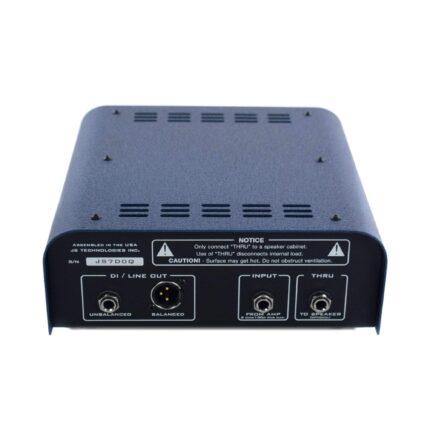
The Radial J-Iso and Pro-Iso are stereo line isolators designed to convert a professional +4dB line level balanced signal to an unbalanced -10dB consumer level device. This enables you to take the balanced output of a mixer and feed a consumer level recorder or audio input on a computer.
J-Iso Part # R800-1025: The J-Iso employs a premium Jensen transformer for optimal signal transfer to minimize distortion and artefact. Full bandwidth performance makes the J-Iso ideal for music production.
The passive design begins with 100% discrete components throughout. A set & forget level control lets you attenuate the input signal to prevent it from overloading the destination device. Output connections include a stereo pair of ¼" connectors, a set of RCAs and a mini 3.5mm (1/8") for interfacing to a mini recorder or lap-top computer. Transformer isolation helps eliminate hum and buzz caused by ground loops while eliminating stray DC currents from flowing.
Construction begins with 14 gauge steel throughout utilizing Radial's unique bookend construction. This creates a protective zone around the connectors and controls for added durability. The steel construction also assists by shielding the transformers from outside magnetic fields. Inside, the J-Iso features an innovative I-beam skeletal insert that makes it virtually impossible to torque the PC board. This reduces potential stress which could cause premature solder joint failure.
Designed for full range applications, the J-Iso combines exceptional signal handling with the type of durability that has made Radial famous. Signal Processors | Effective against boredom, supporting creative sound design
A unique team play of spring reverberation, analogue multimode filtering, distortion and VCA, modulated by an ultra fast LFO and an envelope that can be triggered in flexible ways – Retroverb Lancet offers a comprehensive arsenal of many-sided effects for different applications. The spectrum by far surpasses classic reverberation, filter sweeps or overdrive because you are able to tweak and bend any parameter fast and intuitively to your liking.
Retroverb Lancet will change the way you work with effects. It becomes part of your sound engine, fires it up and will end up as essential part of your sonic signature.
Source of effectiveness
We designed Retroverb Lancet in a way that it can perfectly handle signals of any kind: Guitars, basses, synthesizers, organs or microphones. On top of that, Retroverb Lancet allows you to create percussive sounds using its crash function.
Retroverb Lancet is a real jack of all trades with character, suited for adventurous sound designers and tinkerers.
Audio Input
- max. input sensitivity: –32 dBu
- impedance: 1 MΩ
Output
- max. output level: 20 dBu
- impedance: 600 Ω
Trigger- and CV-inputs
- audio trigger
- max. input sensitivity: –32 dBu
- impedance: 1 MΩ
- gate & CRASH
- external cv
Signal-to-Noise Ratio
- direct: > 80 dB
- effect (filter completely open, no reverb): > 75 dB
Spring Tank
- number of springs: 3
- reverbration decay: between 2.75 db and 4.00 s
Filter
- modes: 24-db-lowpass, 24-db-highpass, 12-db-bandpass
- modulations sources: envelope generator, envelope follower, external CV, LFO
LFO
- frequency range: 0.05 Hz … 300 Hz
- waveforms: ramp up, ramp down, square, sine, S&H, envelope generator
Envelope Generator
- modes: AD, ASR
- attack: 1 ms … 10 s
- decay/release: 1 ms … 15 s
Miscellaneous
- power supply: external DC-adapter with 12 V/1000 mA
- dimensions: 26 cm x 14.5 cm x 8 cm (width x depth x height)
- weight: 0.75 kg
Accessories
| In today’s modern age of digital recorders, DAWs and software plug-ins, Mike-E is the ultimate solution for getting a clean and strong, yet warm and musical signal into the box…and it couldn’t be easier to work – its front panel layout is so straight ahead that even inexperienced engineers will have no problem moving around on it right away.
When the engineering team at Empirical Labs sets out to build a microphone preamp, you can be sure it’ll deliver spectacular sound, be effortless to work, and will provide features unlike any other device in its class. To that end, we proudly present Mike-E, a high performance transformer-coupled mic preamp with a noise floor far below any microphone’s self noise, combined with a one-of-a-kind compressor/saturator circuit that delivers classic knee compression as well as versatile tonal ‘coloring’ that can replicate many of the best characteristics of vintage analog recording equipment.
Mic Preamp
The Mike-E features a super low noise transformer input amplifier section with the gain under precise digital control. The signal to noise far exceeds any microphone in existence. Having used many mic preamps over the years, we’ve implemented a unique stepped gain control that should be impervious to the normal flakiness that age causes to pots and detented switches. A “Bad!” LED indicates when the input signal is overloading the circuit.
CompSat
The CompSat’s unique circuitry sets the Mike-E apart from all other mic preamps.
- SATURATOR – a multi stage soft-clipping circuit. At lower levels, a triode-type saturation affects the signal. As the level increases, a second unique clip circuit starts to more severely flatten out the peaks.
- COMPRESSOR – based on ELI’s world famous Distressor, but with other characteristics (including a much longer attack time). Preset ratios include: 2:1, 4:1, 8:1…and, of course, Nuke.
- EMPHASIS – a two-stage circuit that boosts and soft clips high frequencies before the CompSat™ circuit, and then cuts the frequencies after it. Emphasis has the added perk of improving signal to noise, and is the reason analog tape decks used emphasis to begin with.
Frequency Response: 3 Hz to 200 kHz on (No CompSat). CompSat is 3Hz – 150Khz. Optional Transformer output is 6Hz–80kHz.
Signal to Noise: 130 dB signal to Noise.at 40dB gain. Maximum output is +28dBu.
Distortion: Ranges between .0006% and 15% depending on mode and settings.
I/O: Transformer coupled Input, Active and Transformer Outputs available. High quality audio caps used internally.
Impedance: Input Impedance is above 600 Ohms at all frequencies, transformer coupled. Output impedance is less than 38 ohms. Instrument In Impedance is 332K Ohms.
Attack/Decay Range: .9 – 70mS attack. .15 – 1 Sec.
Power Consumption: 15 Watts Max.
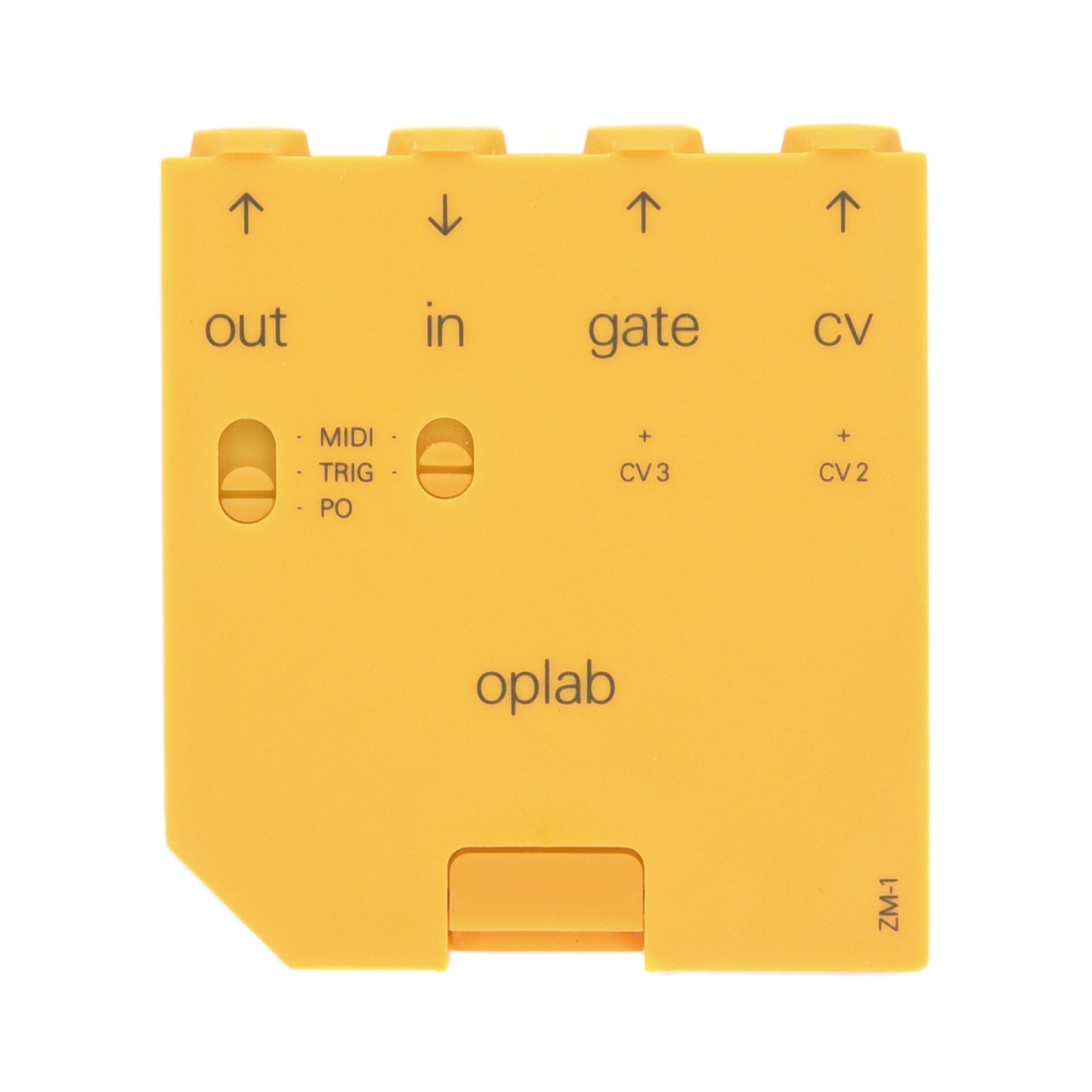
Metal Chassis: single height 1.75″ high, 10″ deep, 19″ wide. | Imagine having the power and flexibility of the OP-Z sequencer available to any other music equipment. Now you can, with the new oplab module - the magic link between OP-Z and the rest of the world. The oplab module is the first hardware expansion module for OP-Z. once mounted in the back of your OP-Z, you can use it to connect to any equipment using standard cv and gate, such as the pocket operator modular or any other modular system. It features three cv outs and one gate out, all programmable and playable from OP-Z. have your wall of modules sequenced from the palm of your hands. Use the po sync out to unleash the power of your regular pocket operators and have them play in sync with the rest of your setup. Even connect standard midi devices, using midi over 3.5 mm jack or the included midi over din adapter cable. Oplab features both midi in and out ports as well as trig in and out for other synthesizers and sequencers. | Arguably the coolest and most unique device in the Empirical Labs arsenal, the FATSO (Full Analog Tape Simulator and Optimizer) is a digitally controlled analog device that gives musicians and engineers easy access to many of the desirable characteristics exhibited by older tube and Class A electronics and magnetic tape mediums. This two channel audio processor musically integrates frequencies and transients, increasing the apparent volume while keeping tight control over peak levels.
With the FATSO, recording studios and audio production facilities can enhance and soften the sound of Hardware Digital Recorders (HDRs) and Digital Audio Workstations (DAWs). Mix engineers will have the option not to have to use bulky, expensive analog tape recorders to get the warmth and sweet high end they’ve come to rely on for so many decades. Owners of DAWs and HDRs can finally put a stop to complaints about the coldness and brittle edge of their mixes and instruments. Even audiophiles can benefit from the FATSO, bringing back the warmth and ambience of LP’s and tapes to their CD players and other digital reproduction mediums.
The FATSO Goes to Eleven
ELEVEN is a new compressor for the FATSO, replacing the old GP Ratio, and emulates the famous UREI 1176LN in 20:1, with the slowest attack, and fastest release. This 1176 setting has been used on countless hit records through the decades. With the slower “1176” attack, the transients keep the dynamics present, while the high ratio, can radically limit the dynamic range of any source, making it present and sitting in a nice little place in your mix. One can slam it, or just touch it with a few dB of compression. You will find it great on Vocals, Bass, acoustic guitars, drum room mikes, pianos etc. Click here to find out how to upgrade your EL7 to an EL7X.
Four Types of Processing
- Harmonic Generation and Soft Clipper (Distortion Generation) – this class A circuit gently rounds the peaks like saturated tubes or tape.
- High Frequency Saturation (Warmth) – a one-of-a-kind dynamic low pass filter which softens high frequencies when they “pile up” on a source.
- Transformer & Tape Head Emulation – a simulation of the effect of input and output transformers of older devices, which adds the low frequency harmonics that characterize them, as well as analog tape..
- Classic Knee Compression – your typical automatic leveling device found on just about every instrument and vocal track as well as on the overall buss, done Empirical Labs compression – smooth and sweet, but in your face!
Universal Audio's FATSO Emulation
Endorsed and scrutinized for accuracy by designer Dave Derr of Empirical Labs, Universal Audio has painstakingly recreated the FATSO Jr. in this highly anticipated UAD Powered Plugin, capturing the sonic nuances of the original hardware. As part of the FATSO Powered Plugin, UA has also worked closely with Dave Derr to model the original concept of the FATSO, the FATSO Sr., with attack, release, and threshold compressor controls, among other features not available elsewhere.
Frequency Response: 2 Hz to 60 kHz in clean audio mode (+0, -3 dB).
Dynamic Range: 110 dB from maximum output (20 %THD soft clipping) to minimum output. Greater than 100 dB signal to noise.
Distortion: Ranges between .06% and 20% depending on mode and settings.
I/O: DC Coupled input and outputs.
Compressor Time Constants: Attack range 1ms – 60ms. Release range .05sec – 3.5 seconds. Attack and Releases are fixed by the compression type selected.
Power Consumption: 15 Watts Max.
Metal Chassis: single height 1.75″ high, 10″ deep, 19″ wide. | Proven reverberation classic for the future
With the VSR 3.2, we happily rely on the proven old mechanical way to create reverberation. Rightly, because the used reverberation spring by AccuBell (formerly Accutronics) creates that magic 60's reverb which is slightly metallic and dense at the same time.
Just like it predecessors, VSR 3.2 has a straight-forward and honest approach: signal in - spring reverb - vintage sound out.
VSR 3.2 is equipped with an equalizer that is exactly adapted to the springs' frequency response. In addition, there are controls to mix the dry and effect signal as well as controls for the input and output level. This way, VSR 3.2 simply exactly does what it was designed to do.
Designed for every situation
Although using a large spring (type 9), VSR 3.2 fits in a 19" housing with one rack unit – minimal space requirements. Thanks to its extremely solid chassis, VSR 3.2 is a reliable vintage-effect that cannot only be used in a controlled studio environment. On the contrary, it also serves fine when being used in straining live situations.
VSR 3.2 grants your sound an elegant touch of "good old times". Its simplicity makes it an unbelievable versatile companion.
Inputs
- 1/4"-jack input front
- unbalanced
- max. input sensitivity: –40 dBu
- impedance: 1 MΩ
- 1/4"-jack input rear (1)
- unbalanced
- max. input sensitivity: 0 dBu
- impedance: 100 kΩ
- 1/4"-jack input rear (2)
- unbalanced
- max. input sensitivity: –20 dBu
- impedance: 10 kΩ
Outputs
- 1/4"-jack output (1)
- unbalanced
- max. output level: 0 dBu
- 1/4"-jack output (2)
- unbalanced
- max. output level: - 20 dBu
Signal-to-Noise Ratio
- direct: > 80 dBu
- effect: > 70 dBu
THD + Noise
Miscellaneous
- power supply: external DC-adapter with 12 V/1000 mA
- dimensions: 19“, 1 HE, ca. 190 mm deep
- weight: 2.5 kg
|






Reviews
There are no reviews yet.