| Content |
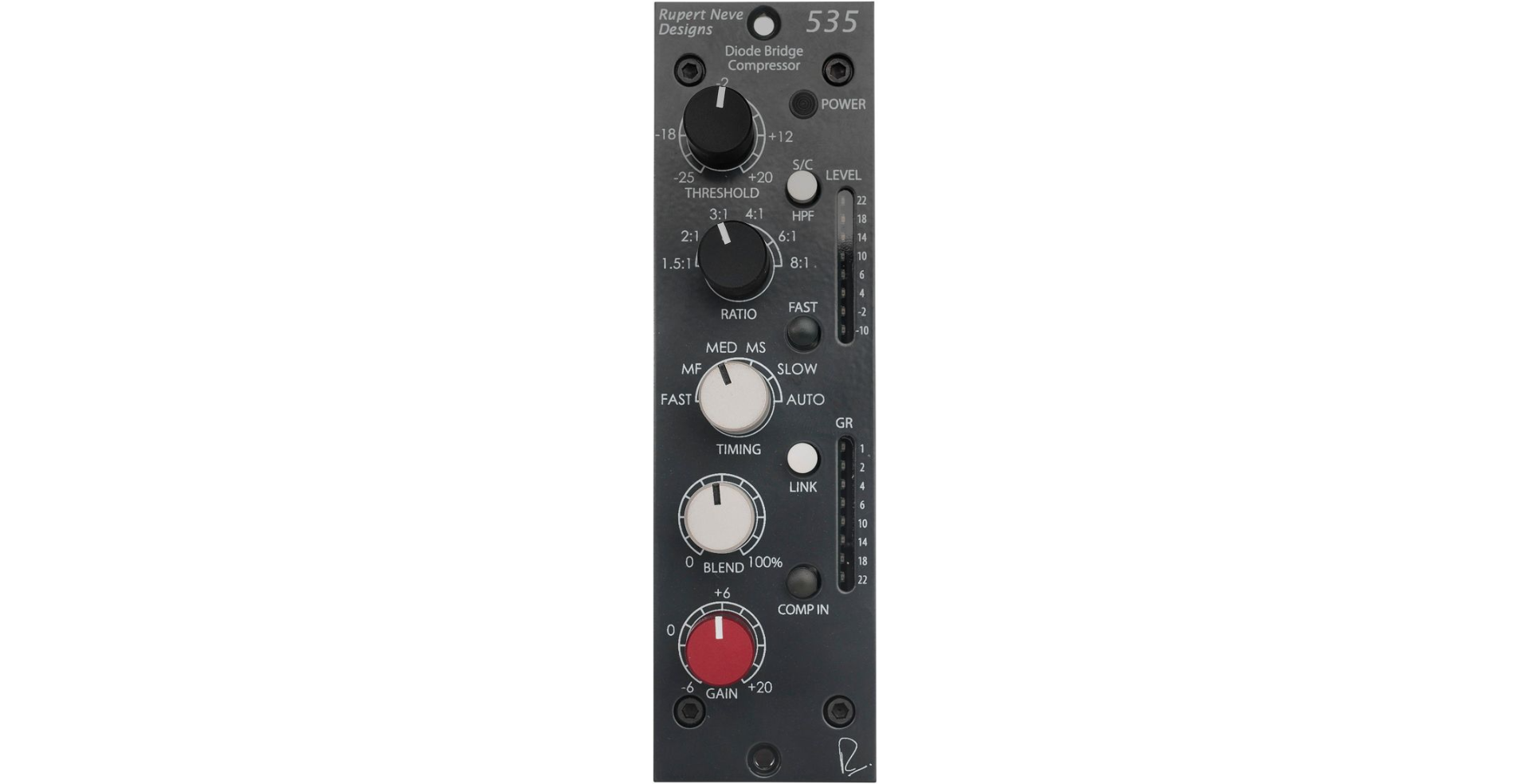
- FAST – Fast Attack (750us), Fast Release (130ms)
- MF – Medium Attack (2.25ms), Fast Release (130ms)
- MED – Medium Attack (2.25ms), Medium Release (400ms)
- MS – Medium Attack (4ms), Slow Release (725ms)
- SLOW – Slow Attack (10ms), Slow Release (1S)
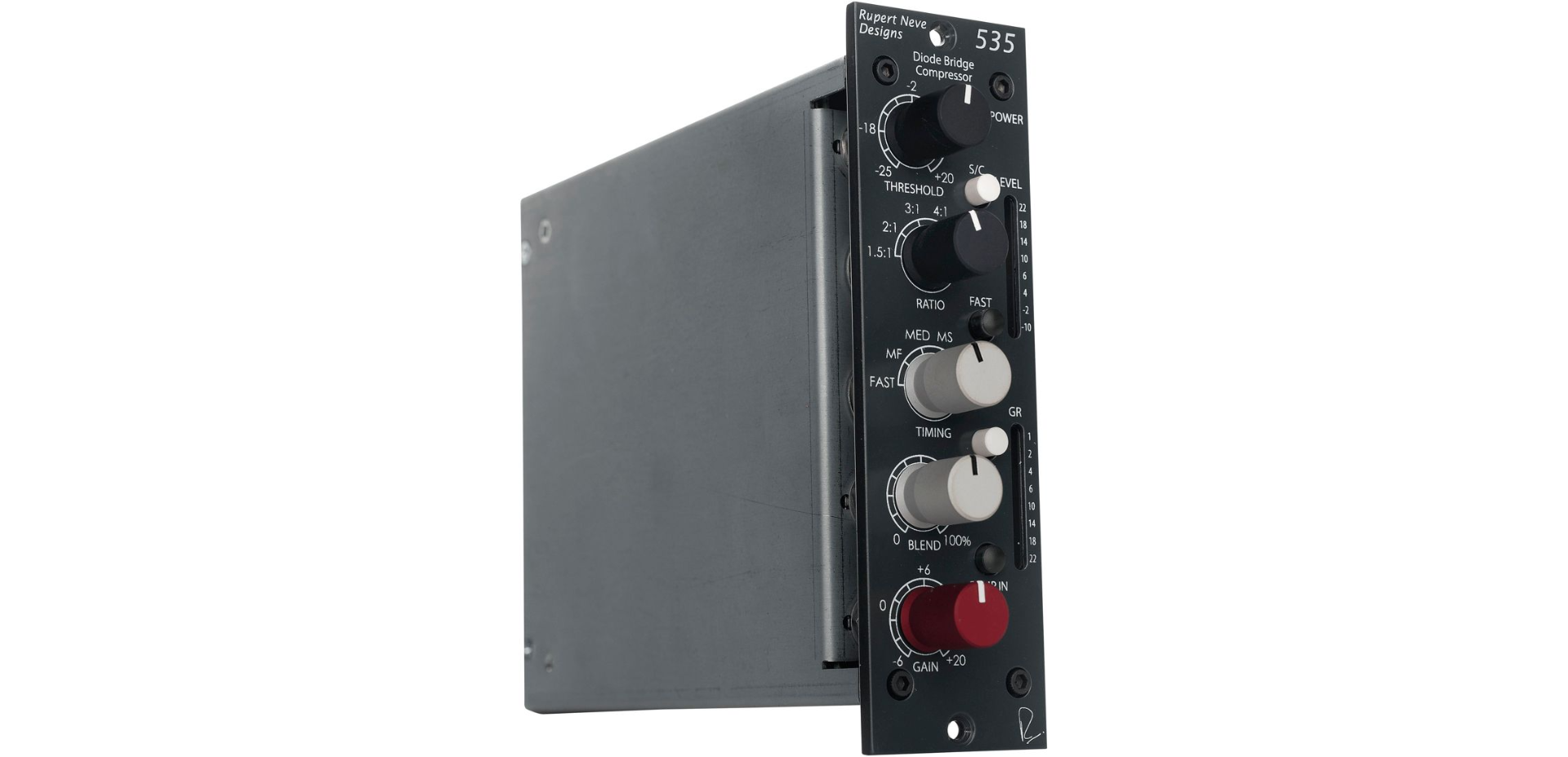
- AUTO – Medium Attack (5ms), Dual Decay Release (T1 500ms, T2 1s)The LINK switch allows the compressor to be linked to another 535 compressor module via a sidechain control voltage. In link mode, the compressor generating the greater sidechain voltage (resulting in higher amounts of compression) will control the compression of both audio signal paths to maintain proper stereo center image while compressing. Note: it is advisable to always audition the unlinked sound as well, to decide if the benefit of a constant stereo center image is worth the potential trade-off of reduced left / right independence in the stereo field.
-
SIDECHAIN HPF
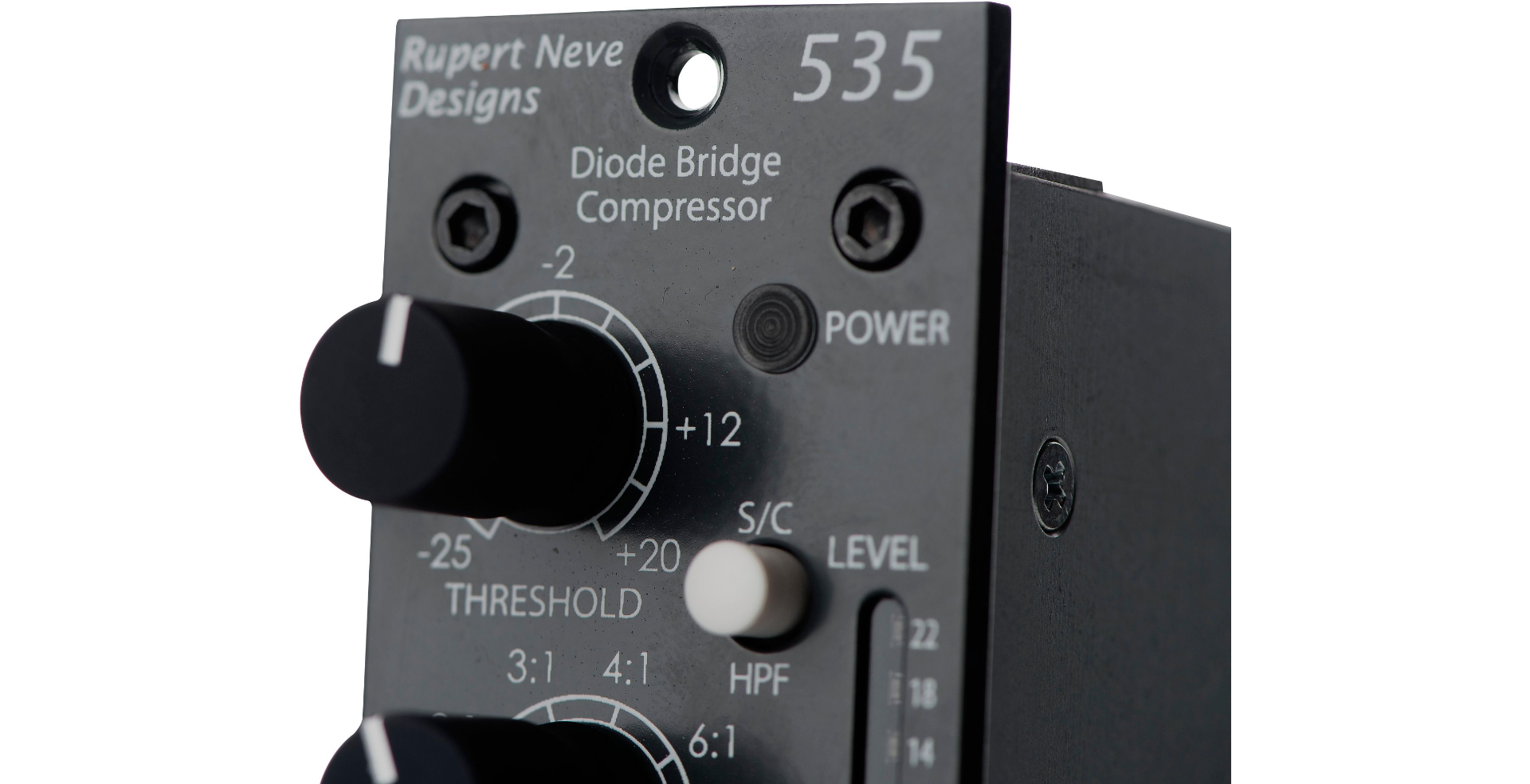
- The S/C HPF switch allows the user to insert a 12dB/octave 150Hz high-pass filter in the compressor sidechain. When this filter is engaged, the compressor will be considerably less responsive to information below 150Hz. For example: if used on a drum kit, the low end of the kick drum would have less proportional effect on the compression than a snare drum or cymbals, since a significant portion of the kick drum’s dynamic energy is focused below 150Hz.
LEVEL AND GAIN REDUCTION METERING
- These two LED meters provide accurate representations of both the output level of the compressor and the amount of gain reduction being applied to the input signal.
| FEATURES
- The industry-standard tabletop looper, updated and enhanced
- Class-leading sound quality with 32-bit AD/DA and 32-bit floating-point processing
- Five simultaneous stereo phrase tracks with dedicated controls and independent volume faders
- Input FX and Track FX sections, each with four simultaneous effects and four quick-access banks
- Customizable FX and Track buttons for each phrase track
- Massive onboard effects selection with 49 Input FX types and 53 Track FX types, including new Harmony, Electric FX and many others
- Ultra-durable faders with longer throw for more precise adjustment
- Mark Back function provides enhanced undo/redo flexibility while performing
- Two XLR mic inputs with phantom power, two stereo line input pairs, and three stereo line output pairs
- 99 memories, each containing five phrase tracks, custom effects and playback settings, control assignments and more
- Synchronize your loops with over 200 onboard rhythm patterns and 16 drum kits
- Deep MIDI control support
- Two external control jacks, each with support for up to two footswitches or an expression pedal
- USB for data backup, phrase import/export with BOSS Tone Studio and pattern import with the RC Rhythm Converter
TECHNICAL SPECIFICATION
Boss RC-505MK2 Tabletop Loop Station
- Sampling Frequency: 44.1 kHz
- AD/DA Conversion: 32 bits
- Processing: 32-bit floating point
RECORDING/PLAYBACK
- Number of Tracks: 5
- Data Format: WAV (44.1 kHz, 32-bit float, stereo)
- Maximum Recording Time: Approx. 1.5 hours (1 track), Approx.13 hours (total of All memories)
- Rhythm Type: 200 types or greater
- Rhythm Kit: 16 types
EFFECTS
- INPUT FX: 49 types
- TRACK FX: 53 types
- MASTER FX: 2 types
- Memory: 99
- Display: Graphic LCD (128 x 64 dots, backlit LCD)
CONNECTORS
- MIC IN 1, 2 jack: XLR type (balanced, phantom power: DC 48 V, 10 mA Max
- INST IN 1, 2 jacks, MAIN OUT jacks, SUB OUT 1, 2 jacks: 1/4-inch phone type
- PHONES jack: Stereo 1/4-inch phone type
- CTL1,2/EXP1 jack, CTL3,4/EXP2 jack: 1/4-inch TRS phone type
- USB port: USB B type
- MIDI (IN, OUT) connectors
- DC IN jack
- Power Supply: AC adaptor
CURRENT DRAW
- 1.0 A (with phantom power)
- 0.9 A (without phantom power)
- Dimensions: 16-9/16" W x 9-1/4" D x 2-11/16" H
- Weight: 4 lb.
| Effective against boredom, supporting creative sound design
A unique team play of spring reverberation, analogue multimode filtering, distortion and VCA, modulated by an ultra fast LFO and an envelope that can be triggered in flexible ways – Retroverb Lancet offers a comprehensive arsenal of many-sided effects for different applications. The spectrum by far surpasses classic reverberation, filter sweeps or overdrive because you are able to tweak and bend any parameter fast and intuitively to your liking.
Retroverb Lancet will change the way you work with effects. It becomes part of your sound engine, fires it up and will end up as essential part of your sonic signature.
Source of effectiveness
We designed Retroverb Lancet in a way that it can perfectly handle signals of any kind: Guitars, basses, synthesizers, organs or microphones. On top of that, Retroverb Lancet allows you to create percussive sounds using its crash function.
Retroverb Lancet is a real jack of all trades with character, suited for adventurous sound designers and tinkerers.
Audio Input
- max. input sensitivity: –32 dBu
- impedance: 1 MΩ
Output
- max. output level: 20 dBu
- impedance: 600 Ω
Trigger- and CV-inputs
- audio trigger
- max. input sensitivity: –32 dBu
- impedance: 1 MΩ
- gate & CRASH
- external cv
Signal-to-Noise Ratio
- direct: > 80 dB
- effect (filter completely open, no reverb): > 75 dB
Spring Tank
- number of springs: 3
- reverbration decay: between 2.75 db and 4.00 s
Filter
- modes: 24-db-lowpass, 24-db-highpass, 12-db-bandpass
- modulations sources: envelope generator, envelope follower, external CV, LFO
LFO
- frequency range: 0.05 Hz … 300 Hz
- waveforms: ramp up, ramp down, square, sine, S&H, envelope generator
Envelope Generator
- modes: AD, ASR
- attack: 1 ms … 10 s
- decay/release: 1 ms … 15 s
Miscellaneous
- power supply: external DC-adapter with 12 V/1000 mA
- dimensions: 26 cm x 14.5 cm x 8 cm (width x depth x height)
- weight: 0.75 kg
Accessories
| Arguably the coolest and most unique device in the Empirical Labs arsenal, the FATSO (Full Analog Tape Simulator and Optimizer) is a digitally controlled analog device that gives musicians and engineers easy access to many of the desirable characteristics exhibited by older tube and Class A electronics and magnetic tape mediums. This two channel audio processor musically integrates frequencies and transients, increasing the apparent volume while keeping tight control over peak levels.
With the FATSO, recording studios and audio production facilities can enhance and soften the sound of Hardware Digital Recorders (HDRs) and Digital Audio Workstations (DAWs). Mix engineers will have the option not to have to use bulky, expensive analog tape recorders to get the warmth and sweet high end they’ve come to rely on for so many decades. Owners of DAWs and HDRs can finally put a stop to complaints about the coldness and brittle edge of their mixes and instruments. Even audiophiles can benefit from the FATSO, bringing back the warmth and ambience of LP’s and tapes to their CD players and other digital reproduction mediums.
The FATSO Goes to Eleven
ELEVEN is a new compressor for the FATSO, replacing the old GP Ratio, and emulates the famous UREI 1176LN in 20:1, with the slowest attack, and fastest release. This 1176 setting has been used on countless hit records through the decades. With the slower “1176” attack, the transients keep the dynamics present, while the high ratio, can radically limit the dynamic range of any source, making it present and sitting in a nice little place in your mix. One can slam it, or just touch it with a few dB of compression. You will find it great on Vocals, Bass, acoustic guitars, drum room mikes, pianos etc. Click here to find out how to upgrade your EL7 to an EL7X.
Four Types of Processing
- Harmonic Generation and Soft Clipper (Distortion Generation) – this class A circuit gently rounds the peaks like saturated tubes or tape.
- High Frequency Saturation (Warmth) – a one-of-a-kind dynamic low pass filter which softens high frequencies when they “pile up” on a source.
- Transformer & Tape Head Emulation – a simulation of the effect of input and output transformers of older devices, which adds the low frequency harmonics that characterize them, as well as analog tape..
- Classic Knee Compression – your typical automatic leveling device found on just about every instrument and vocal track as well as on the overall buss, done Empirical Labs compression – smooth and sweet, but in your face!
Universal Audio's FATSO Emulation
Endorsed and scrutinized for accuracy by designer Dave Derr of Empirical Labs, Universal Audio has painstakingly recreated the FATSO Jr. in this highly anticipated UAD Powered Plugin, capturing the sonic nuances of the original hardware. As part of the FATSO Powered Plugin, UA has also worked closely with Dave Derr to model the original concept of the FATSO, the FATSO Sr., with attack, release, and threshold compressor controls, among other features not available elsewhere.
Frequency Response: 2 Hz to 60 kHz in clean audio mode (+0, -3 dB).
Dynamic Range: 110 dB from maximum output (20 %THD soft clipping) to minimum output. Greater than 100 dB signal to noise.
Distortion: Ranges between .06% and 20% depending on mode and settings.
I/O: DC Coupled input and outputs.
Compressor Time Constants: Attack range 1ms – 60ms. Release range .05sec – 3.5 seconds. Attack and Releases are fixed by the compression type selected.
Power Consumption: 15 Watts Max.
Metal Chassis: single height 1.75″ high, 10″ deep, 19″ wide. | FEATURES
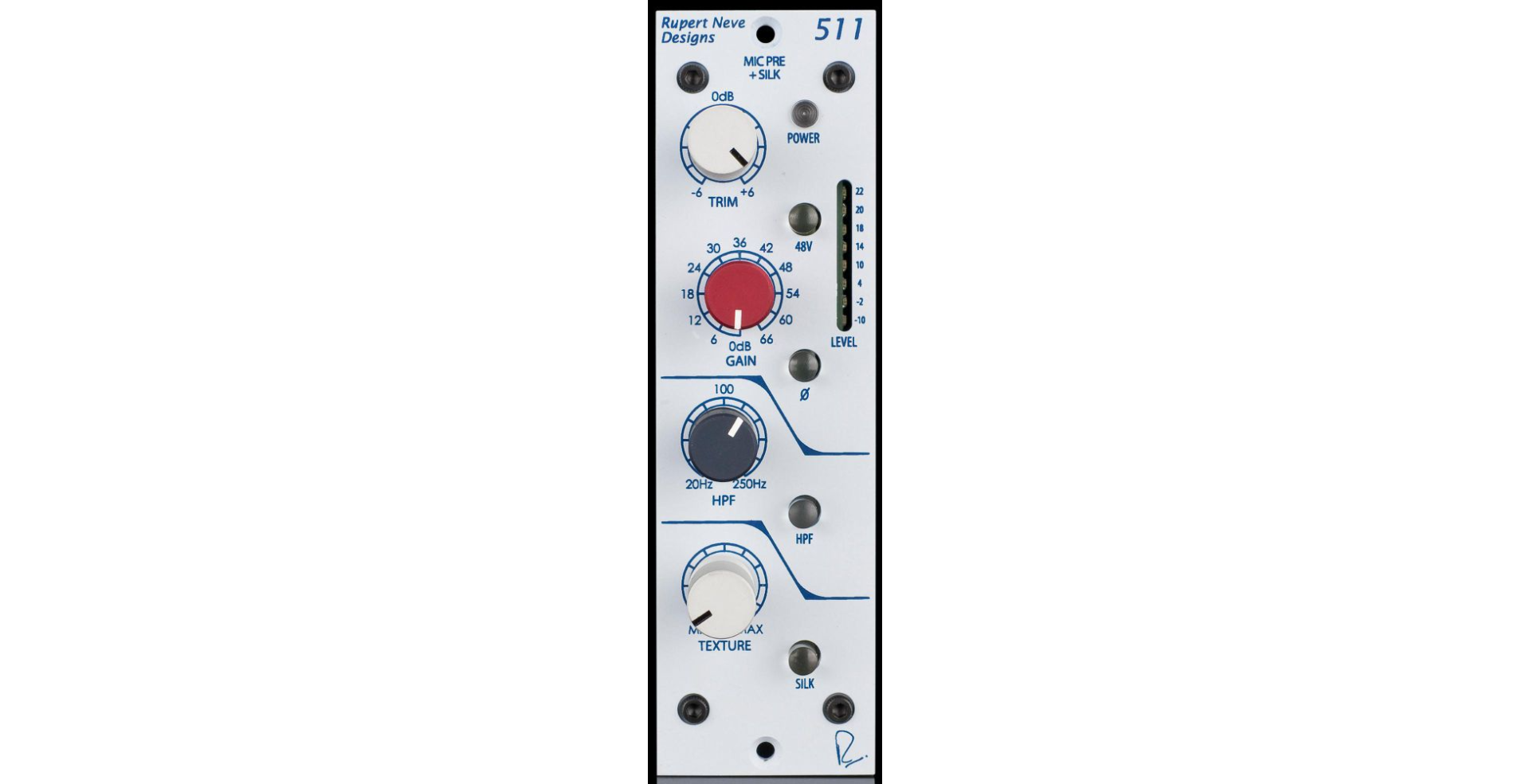
- 12-way precision rotary switch controls gain from 0 to 66 dB in 6 dB steps
- Continuously variable +/-6 dB level control
- Silk circuit, reduces negative feedback, adding harmonic content as needed
- Red Silk accentuates the saturation in the mid and high frequencies
- Same presence and sweetness found in standard Portico Series modules
|
Number of Channels |
Single |
|
Inputs |
1x XLR, balanced |
|
Output |
1x XLR, transformer-balanced |
|
Maximum Output Level |
+23dBu |
|
Meter |
8 segment LED meter |
|
Power Requirements |
Power Requirements @ +/-16VDC 100mA |
|
Dimensions |
Not specified by manufacturer |
|
Box Dimensions (LxWxH) |
10.2 x 7.8 x 2" |
| The product that started it all for Empirical Labs. Born of founder Dave Derr’s love of classic compressors like the 1176, LA-2A and Gain Brain (among others), the Distressor incorporates his favorite sonic characteristics of these, along with other unique and interesting features that have made it a staple for audio engineers all over the world. With over 28,000 units in the field, it’s safe to say that the Distressor is one of the best selling high end compressors of all time… if not THE best selling. A prominent recording engineer recently wagered that there probably was not a top 40 record made in the last five years that didn’t have at least one Distressor on it.
Besides providing a wide range of control and a unique feature set, the Distressor offers a warm, vintage sound by using a custom designed gain control circuit. This “warmth” or “vintage sound” has become a major issue in the last few decades, as the super clear and linear digital technology does next to nothing to soften “harsh” sounds, nor emphasize the bass frequencies in music sources. Conversely, older analog tape, vinyl records and tube equipment could not be prevented from coloring the sound, often to the frustration of recording engineers. However, many people now realize that this coloring can be extremely pleasant and musical. Digital technology is often referred to as “cold” and “brittle” among other terms (although we prefer “unforgiving”).
Unique Compression Curves
All eight of the Distressor’s curves are unique and distinctive, from the 1:1 mode that simply warms up signal with low order harmonics without intentional compression, to the “Nuke” setting – a brick wall limiting curve that shines on live drum room mics. Each curve has its own personality and several actually use different circuitry, and are effectively different compressors. Most exceptional is the 10:1 “Opto” ratio which uses separate detector circuitry to emulate the oldest (and valued) “light controlled” devices, such as the LA-2A.
Distortion (Color) Modes
Another large part of the Distressor’s personality and power derive from three modes that color the signal, even without compression. These extended audio modes were designed to allow emulation of some very old and expensive vintage compressors & limiters, and let the Distressor deliver a classic “knee” sound all its own by providing user programmable, warm harmonic distortion. In addition to the basic distortion mode, Distort 2 emphasizes tube-like 2nd order harmonics, while in Distort 3 setting the distortion becomes dominated by 3rd harmonics more closely resembling tape. Two HP filters – one in the audio path, one in the detector path – are also available to help with low frequencies that can cause pumping and breathing.
- Frequency Response – 2 Hz to 160 kHz in clean audio mode (+0, -3 dB). Response is shaped in distortion modes (Dist 2, Dist 3).
- Dynamic Range – 110 dB from max. output to min. output in 1:1 mode. Greater than 100 dB signal to noise in distort 3 mode.
- Distortion – ranges between .02% and 20% depending on distortion mode and release times set on front panel.
- I/O – DC Coupled input and outputs.
- Time Constants – Attack range 50uS – 50mS. Release range .05 sec to 3.5 seconds, normal modes and up to 20 seconds in 10:1 opto mode. Time constants are dependent on ratio.
- Power Consumption – 15 Watts Max.
- Metal Chassis – single height 1.75″ high, 10″ deep, 19″ wide.
- Shipping info – 12.1 lbs mono. Mono box dimensions 22.5″ x 18.5″ x 3 1/4″.
|






Reviews
There are no reviews yet.