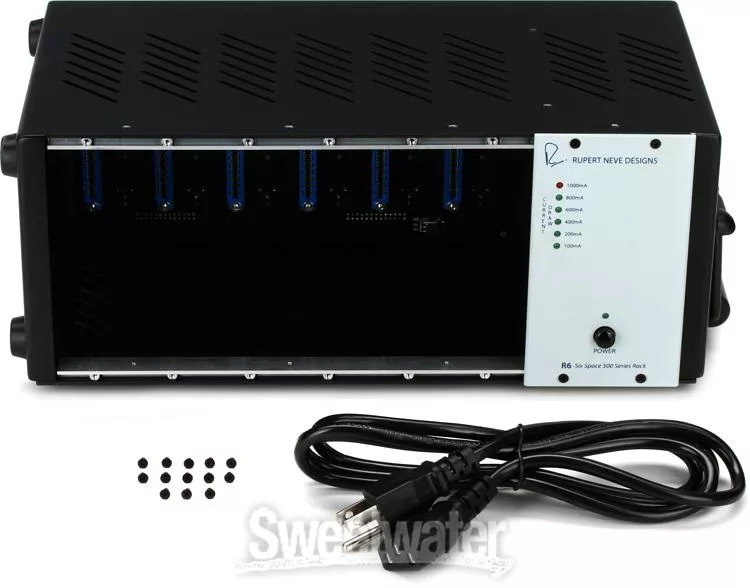
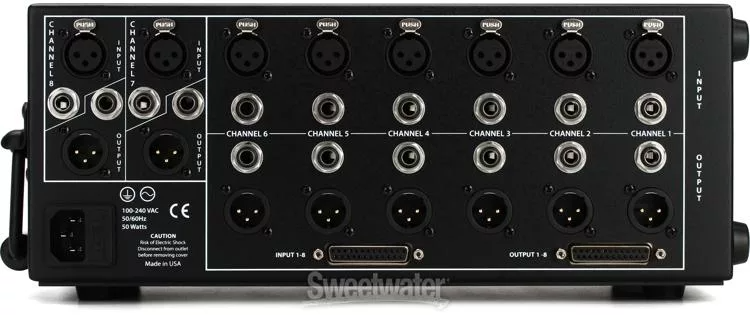
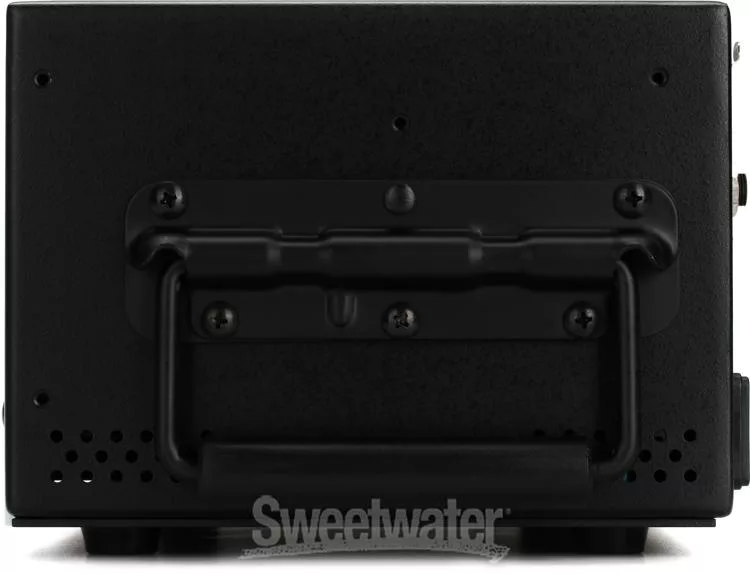
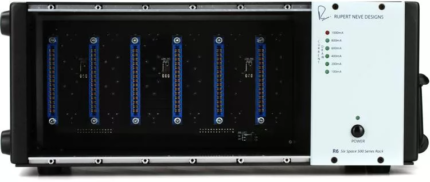
| Content | Rupert Neve Designs R6 500 Series chassis is a 6-space, steel rack enclosure that sports XLR, TRS, and DB-25 I/O to work with any studio setup. To ensure your modules are properly powered, the R6 has 150% of the required current, so you'll never be underpowered. It also has a built-in LED display to show current consumption and a double-shielded internal power supply that won't add any interference or unwanted noise to your signal. Rupert Neve is an audio legend. So you know when he designs a 500 Series chassis, it's top-shelf, all the way. Give your 500 Series modules the pampering they deserve with the Rupert Neve Designs R6 500 Series rack.
Genius in the details
With the Rupert Neve Designs' RND R6, there's genius in the details. The R6's double-shielded internal power supply was meticulously designed to avoid magnetic induction in any of its module slots. The power supply is a Switchmode type, and great care was taken to ensure that the frequencies are considerably outside the audible band. There's an internal jumper configuration that makes it easy to link slots in pairs. It's even fitted with variable-position screw holes that slide to accommodate modules that are slightly out-of-spec, which makes the insertion of modules quick and easy. Trust Sweetwater: when it comes to 500 Series racks, the RND R6 is as good as it gets.
Rupert Neve Designs RND R6 500 Series Rack Features at a Glance:
- Supplies 150% of the required current
- LED current consumption meter displays available current
- XLR, TRS, and DB-25 I/O
- Variable-position screw holes make for quick and easy module insertion
- Double-shielded internal power supply designed to avoid magnetic induction in module slots
- Switchmode PSU with frequencies considerably outside audible band
- Internal jumper configuration lets you link slots in pairs
| In addition to the 100% analog tape emulation circuitry – great for bringing out 3rd-order harmonics – the 542 incorporates a soft-clip circuit that tames the harshest sources and enhances 2nd-order harmonics, variable Silk Red & Blue for an infinite variety of transformer tones, and a blend control to dial in in the perfect amount of saturation.
Transformers Imitating Tape
Unlike digital emulations, the “True Tape” drive circuit works by feeding a custom-designed interstage transformer acting as a “record head”, which in turn is coupled to a correctly-equalized replay amplifier. As the voltage rises on the “record head”, saturation increases, and a soft clip circuit engages at higher levels to round off peak transients. The sound of the tape circuit can be further modified with selectable 15 / 30 IPS modes and a pre/post-tape blend control.
What is Silk?
In addition to the tape circuit, the continuously variable Texture control with Silk Red and Silk Blue modes provides a whole other level of control over the harmonic density and tonality of your tracks & mixes. The Silk Red mode accentuates transformer saturation in the high and high-mid frequencies to amplify the vibrant midrange harmonics associated with Rupert’s vintage equipment, while Silk Blue accentuates saturation of the lows and low-mids to add thickness and weight to any source – especially useful for “thin-sounding” tracks or mixes. Unlike EQ, these Silk & Texture controls saturate the output transformers, and add highly musical harmonics to the source material according to the amount of Texture applied.
Drive the 542 hard, choose your Silk flavor, and crank the Texture knob for a rich, saturated, vintage vibe – or disengage Silk entirely for a more purist, hi-fi tape effect. The choice is yours.
LINE AMP NOISE
- Measurements with tape circuit disengaged. Measured at Main Output, un-weighted, 20 Hz - 22 kHz, Input Terminated 40 Ohm.
- Unity Gain: Better than -100 dBV
FREQUENCY RESPONSE
- Measured at +10 dBu, trim at unity.
- Main Output: +/- 0.25 dB from 5 Hz to 60 kHz, -2 dB @ 120 kHz
MAXIMUM OUTPUT LEVEL
23.25 dBu
TOTAL HARMONIC DISTORTION AND NOISE
- @ 1 kHz, +20 dBu output level: Better than 0.002%
- @ 20 Hz, +20 dBu output level: 0.07% Typical (2nd and 3rd harmonic)
TAPE FX SPECIFICATIONS
NOISE
- Measured at Main Output, un-weighted, 20 Hz - 22 kHz, Input Terminated 40 Ohm.
- Saturation @ minimum: Better than -100 dBu
- Saturation @ maximum: Better than -100 dBu
FREQUENCY RESPONSE
- 15 IPS, Input @ -0 dBu: -3 dBu @ 28 kHz
- Saturation @ minimum: 0 dBu @ 10 Hz
- +5 dBu Peak @ 60 Hz Saturation @ maximum: -3 dBu @ 20 kHz
- -3 dBu @ 12.5 Hz
- +2.4 dBu Peak @ 60 Hz
- 30 IPS, Input @ -0 dBu: -3 dBu @ 120 kHz
- Saturation @ minimum: -3 dBu @ 10 Hz, +3.15 dBu Peak @ 125 Hz
- Saturation @ maximum: -3 dBu @ 100 kHz
- -3 dBu @ 12.5 Hz
- +1.3 dBu Peak @ 110 Hz
TOTAL HARMONIC DISTORTION AND NOISE
15 IPS
- Input @ -0 dBu: 0.4% @ 3 kHz to 1% @ 175 Hz typical Saturation @ minimum: Greater than 1% below 175 Hz typical
- Saturation @ maximum: 1% at 6 kHz typical, 0.3% @ 1 kHz to 3% @ 50 Hz typical
30 IPS
- Input @ -0 dBu: 1% at 1 kHz typical
- Saturation @ minimum: 0.6% @ 400 Hz to 5% @ 20 Hz typical
- Saturation @ maximum: 1.5% @ 20 kHz to 0.4% @ 1 kHz typical, 0.4% @ 1 kHz to 2% @ 50 Hz typical
POWER REQUIREMENTS
Supplied by 500 series rack with 110-125 mA @ +/- 16V DC | The Shelford Channel is built around Rupert Neve’s first new transformer-gain, class-A microphone preamplifier in over 40 years, a “best-of-the-classics” inductor EQ section, a tone-packed diode bridge compressor, the power of variable Silk saturation, a new dual-tap transformer output stage, and twice the operating voltage of vintage designs.
The Input Stage and Transformer Gain Mic Pre
Like Rupert’s designs from his time in Little Shelford , the Shelford Channel’s preamplifier uses a directly-coupled transformer input with gain provided by the custom transformer itself – a first in over 40 years for Rupert Neve. This new custom-designed input transformer, along with its careful integration with the surrounding class-A circuitry, is critical to the Channel’s bold and instantly recognizable character.
Conveniently, the Direct Input uses the same topology as the best-selling RNDI Active Transformer Direct Interface, providing astonishing clarity for high-Z instrument signals, with unparalleled low-frequency response and an incredibly smooth high end.
What is Silk?
The Silk & Texture circuit on the Shelford Channel allows you to fine-tune the amount (and type) of harmonic content in the output stage. This means your signal can be adjusted from quite transparent to settings that produce nearly 10x the amount of sonic color as Rupert’s vintage modules – and in two very unique modes. No matter what sound you’re looking for, Silk can help get you there.
The Dual Tap Transformer Output
Complementing the Silk circuit is the custom-designed output transformer, which uses Rupert Neve Designs’ unique dual-tap output topology. This offers both full-headroom (+26dBu) and -6dB outputs, allowing the engineer to drive the unit fully into classic transformer saturation without clipping converters and other devices later in the chain.
The “Best-Of” EQ
The Shelford Channel’s 3-band, custom-tapped inductor EQ was inspired by our favorite elements of Rupert’s vintage EQ designs. The low frequency band is designed to produce a creamy, resonant bass response similar to a vintage 1064 – but unlike the vintage modules, the LF band on the Shelford Channel can be used as either a shelf or a peak filter, adding punch, dimension, and control to your low end.
The midrange band is based on that of the 1073, ideal for sweetening vocals and instruments while bringing them forward in a mix, and its proportional “Q” response makes it well-suited for minimizing problematic frequencies. The high frequency band is a hybrid vintage / modern design, blending inductor circuitry with capacitor-based topologies to achieve vintage tones with enhanced control, with the shelf / peak corner switchable between 8K or 16K.
The Diode Bridge Compressor
Like the Inductor EQ and Transformer Gain microphone preamp, the Diode Bridge Compressor in the Shelford Channel is based on the same topologies found in Rupert’s vintage designs – but refined & adapted for the modern engineer.
What is diode bridge compression? Where the VCA compressor found in the Master Buss Processor provides unmatched clarity, the weighty, harmonically rich tonality of diode bridge compression can be essential in pushing key sources like vocals, electric guitars, bass and drums to the forefront of a mix.
By understanding the limitations of vintage units like the legendary 2254, painstaking effort was taken to reproduce the unique tone of these classics while improving the noise floor & accuracy, expanding inflexible time constants, adding full wave sidechain detection for improved dynamic response, and widening the range of threshold and ratio controls.
Delivering the powerful sound of these iconic designs with enhanced flexibility for the modern age, the Shelford’s diode bridge compressor is a dynamic tool equipped to make a statement on virtually any mix or track.
MIC PREAMP
INPUT IMPEDANCE
2200 Ohm
MAXIMUM INPUT
- +21.5 dBu from 150 Hz to 22 kHz
- +8 dBu 20 Hz to 22 kHz
NOISE
- Un-weighted, 22 Hz-22 kHz, source impedance 150 Ohm balanced.
- Main Out @ unity gain -100.9 dBu
- -6 dB Out @ unity gain -106.6 dBu
- +30 dB gain (Main Out) -91.37 dBu
- +66 dB Gain (Main Out) -64.1 dBu
- Equivalent Input Noise -121.37 dBu
FREQUENCY RESPONSE
+/-0.25 dB from 17 Hz to 45 kHz
DIRECT INPUT
MAXIMUM INPUT
8 dBu @ 20 Hz to 120 kHz
NOISE (MAIN OUTPUT)
-100 dBu (22 Hz to 22 kHz)
LINE INPUT
MAXIMUM INPUT LEVEL
+30.5 dBu 20 Hz to 30 kHz
TOTAL HARMONIC DISTORTION AND NOISE
- @ 1 kHz, +20 dBu output level, no load: Better than 0.002%
- @ 20 Hz, +20 dBu output level, no load: 0.05% Typical (2nd and 3rd harmonic)
NOISE (MAIN OUTPUT)
Un-weighted, 22 Hz - 22 kHz, source impedance 40 Ohm balanced, no load.
-101.1 dBu
FREQUENCY RESPONSE
+/- 0.25 dBu from less than 10 Hz to 110 kHz
-0.32 dB @ 120 kHz
MAXIMUM OUTPUT LEVEL
+26 dBu @ 16 Hz to 20 kHz
TOTAL HARMONIC DISTORTION AND NOISE WITH SILK ENGAGED
RED
- MIN TEXTURE @ 100 Hz, +20 dBu input level, no load: 0.0131%, mostly 3rd harmonic (typical)
- MAX TEXTURE @ 100 Hz, +20 dBu input level, no load: 1.66%, mostly 2rd harmonic (typical)
BLUE
- MIN TEXTURE @ 100Hz, +20 dBu input level, no load: 0.0079%, mostly 3rd harmonic (typical)
- MAX TEXTURE @ 100Hz, +20 dBu input level, no load: 0.941%, mostly 2rd harmonic (typical)
HIGH PASS FILTER
- Continuously variable swept frequency from 20 Hz to 250 Hz.
- Slope: 12 dB/Octave
EQ NOISE
Un-weighted, 22 Hz-22 kHz: -92 dBu
SIGNAL PRESENT
Illuminates GREEN when input stage signal level reaches -20 dBu
OVERLOAD INDICATOR
Illuminates RED when input stage signal level reaches -23 dBu
DIODE BRIDGE COMPRESSOR
- NOISE (BW 22 Hz – 22 kHz)
- 0 dB Makeup Gain: -84.5 dBu
- +20 dB Makeup Gain: -64.2 dBu
TIME CONSTANTS
- Measurements taken represent full range achievable between 1.5:1 Ratio and 8:1 Ratio setting.
- 0 dBu I/P 1kHz Burst Tone used for all recorded measurements.
- Fast (TC1): Attack 180µS — 1.8mS // Release 100mS – 150mS
- MedFast (TC2): Attack 750µS – 5.25mS // Release 160mS – 250mS
- Med (TC3): 2.7mS – 18mS // Release 350mS – 525mS
- MedSlow (TC4): 4.6mS – 38mS // Release 600mS – 1 S
- Slow (TC5): 11mS – 72.5mS // Release 800mS – 1.25 S
- Auto (TC6): 5.75mS – 35.5mS // Release T1 400mS – 850mS, T2 TBD
- “Fast” Mode Multiplier: Modifies aforementioned TC’s by 70% of original value
PRODUCT DIMENSIONS
19” (48.3 cm) x 10.5” (26.7 cm) x 1.75” (4.4 cm) |
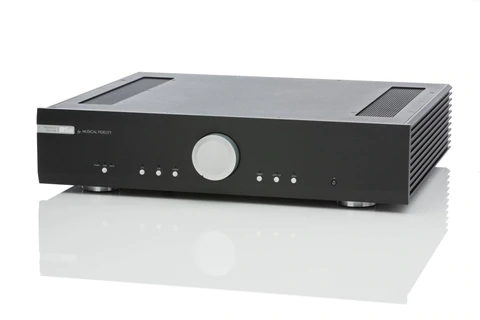
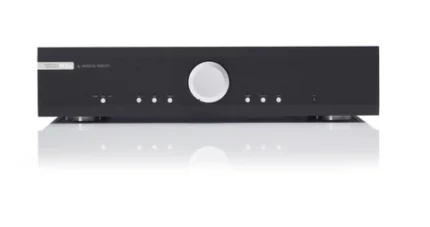
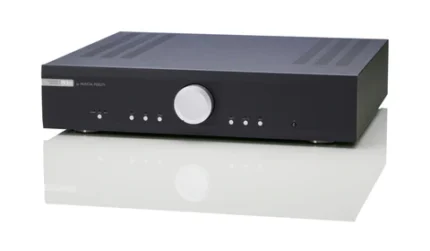
The M5si is a sensational integrated amplifier with exceptional power and clarity.
The M5si is a real high end amplifier. At 150wpc, with high current delivery, it will drive virtually any loudspeaker easily.
Internally the M5si is configured as two independent monoblocs with a separate preamp, but all mounted on one pcb. Its technical performance is about equal to the M6si.
The M5si In Brief
- 150wpc
- Excellent technical performance
- Preamp output
- Unconditional stability, will drive any loudspeaker
- Wide range of useful inputs including asynchronous USB and MM phono
- Excellent hunky build quality
Specifications
Power output: 150 W per channel into 8 ohm
Signal to Noise Ratio: >100 dB ‘A’ - weighted
Frequency Response: +0, –0.1 dB, 10 Hz to 20 kHz
Inputs: 4x Line Level RCA, 1x USB type ‘B’ connector - asynchronous data stream at up to 24-bit/96kHz, 1 x MM phono input, Trigger in
Phono
Sensitivity: 3 mV nominal (MM)
Signal / noise ratio: >70 dB ‘A’-weighted
Input impedance: 50 k ohm (MM)
Frequency response: RIAA/IEC ±0.5 dB 20 Hz-20 kHz
Outputs: Trigger out, Fixed, line level output, Variable, preamp output
Dimensions - WxHxD (mm): 440 x 100 x 405
Weight (unpacked / packed): 14.6 kg/ 18.8 kg
| The vintage EQ tones you know & love.
The 551 is the only equalizer for the 500 Series actually designed by Rupert Neve. Featuring 3 bands of EQ inspired by Mr. Neve’s most prized vintage designs, along with custom-wound inductors, transformers and class-A gain blocks, the 551 brings the thick, powerful lows and sweet highs of Rupert’s classics to the 500-Series format.
The “Best-Of” EQ
The 551’s 3-band, custom-tapped inductor EQ was inspired by our favorite elements of Rupert’s vintage EQ designs. The low frequency band is designed to produce a creamy, resonant bass response similar to a vintage 1064 – but unlike the vintage modules, the LF band on the 551 can be used as either a shelf or a peak filter, adding punch, dimension, and control to your low end.
The midrange band is based on that of the 1073, ideal for sweetening vocals and instruments while bringing them forward in a mix, and its proportional “Q” response makes it well-suited for minimizing problematic frequencies. The high frequency band is a hybrid vintage / modern design, blending inductor circuitry with capacitor-based topologies to achieve vintage tones with enhanced control. The High Pass filter is a 12dB/octave design with a fixed 80Hz frequency, and can be used in tandem with the low frequency EQ to add low-end presence without clouding the source material.
As with Rupert’s most prized classic designs, each EQ section uses low-feedback, class-A discrete electronics to prevent low-level artifacts and harshness from detracting from the tonal shaping. However, this new circuit is a decidedly modern design with updated techniques and components that were simply not available 50 years ago, and is definitely not a “clone”.
What Are Inductors?
Inductors are wires wound around a coil that provide a form of frequency-dependant resistance. When they saturate, they bring out beautifully musical harmonics that give your tracks the smooth, polished sound that has made Rupert’s consoles and equipment so desirable for over fifty years. This is what makes them different from capacitor-based EQ designs, which do a great job at surgical equalization. But inductors provide the tone.
While it is certainly possible to create a functioning EQ using off-the-shelf inductors, we choose to use our own custom inductors for the 551. This attention to detail in controlling variables such as the winding and core materials in relation to the surrounding circuitry allows the 551 to capture the vitality and personality of Rupert’s classic designs.
NOISE
- Measured at Main Output, un-weighted, 22Hz-22kHz, source impedance 40 Ohm balanced.
- Better than -102 dBV
FREQUENCY RESPONSE
Main output, no load: +/- 0.1 dBu from 20 Hz to 31.5 kHz, -1 dB @ 120 kHz
MAXIMUM OUTPUT LEVEL
23.25 dBu
TOTAL HARMONIC DISTORTION AND NOISE
- @ 1 kHz, +20 dBu output level, no load: Better than 0.0025%
- @ 20 Hz, +20 dBu output level, no load: 0.13% Typical (2nd and 3rd harmonic)
HIGH PASS FILTER
- -2.7 dB @ 80 Hz
- Slope: 12 dB/Octave
NOISE
- Measured at Main Output, un-weighted, 22 Hz - 22 kHz, source impedance 40 Ohm balanced.
- Better than -94 dBV
FREQUENCY RESPONSE
Main output, no load: +/- 0.25 dBu from 20 Hz to 45 kHz, -2 dB @ 120 kHz
MAXIMUM OUTPUT LEVEL
23 dBu
TOTAL HARMONIC DISTORTION AND NOISE
- @ 1 kHz, +20 dBu output level, no load: Better than 0.009%
- @ 20 Hz, +20 dBu output level, no load: 0.13% Typical (2nd and 3rd harmonic)
POWER REQUIREMENTS
- 120mA on +16VDC
- 110ma on -16VD
| Discover the PM7000N, the first Marantz fully discrete, current feedback integrated Hi-Fi amplifier with HEOS Built-in technology. The ideal choice for audiophiles that require Marantz musical sound and music streaming, the PM700N includes high-grade audio components, current feedback HDAMs, a toroidal transformer, and a high-speed instantaneous current power supply. The versatile PM7000N features multiple analog and digital inputs, and decodes digital audio files ALAC, FLAC and WAV lossless files up to 24-bit/192-kHz — plus, DSD 2.8MHz and 5.6MHz tracks for high-resolution listening. Stream your favorite music wirelessly, and control the amplifier with leading voice agents Apple Siri, Google Assistant, and Amazon Alexa.
Features
- Power to suit your audio preference: 2ch fully discrete current feedback integrated Hi-Fi amplifier; 60W per channel (8-ohm, 20Hz – 20kHz)
- Wide range of connectivity:
- Four analog inputs, one analog output, one coaxial input, two optical digital inputs and one USB-A for high-resolution audio files
- Marantz proprietary HDAM-SA3 circuit: Wider dynamic range with lower distortion for the output stage
- Flexibility for all configurations: Tone control to tune sound to your exact specifications and dedicated subwoofer output for evenly dispersed bass, no audible peaks or dips
- Newly designed electric volume circuit: Use the latest volume control IC to realize better channel separation, dynamic range, and distortion-reduction
- Play vinyl with exceptional clarity: Integrated phono input with newly designed FET input stage to improve signal purity and sound
- Premium Marantz SPKT-1+ speaker terminals: Improved connection to speakers
- Stream music from your favorite sources: Play songs from TuneIn, Internet Radio, Pandora, Spotify, SiriusXM, Amazon Prime Music, TIDAL and more via AirPlay 2, Bluetooth and the HEOS app (music streaming services may vary by region)
- Speak your commands: Supports Amazon Alexa, Google Assistant and Apple Siri voice agents for seamless voice control
- High-performance, high-resolution audio playback: Ability to decode high-resolution audio ALAC, FLAC and WAV lossless files up to 24-bit/192-kHz — plus, DSD 2.8MHz and 5.6MHz tracks for high-resolution listening
- Built-in Bluetooth and Wi-Fi with 2.4GHz/5GHz dual band support: Improved network stability even in Wi-Fi crowded homes
- Works with your TV remote: Program the PM7000N to work with your TV remote and easily adjust volume up, volume down, mute and source selection
Specifications
Inputs: RCA line x 3, RCA MM phono x 1, digital coax x 1, optical x 2, USB A x 1, Ethernet
Phono input sensitivity: 2 mV @ 47 kOhm
Phono SNR: 87 dB
Outputs: Tape out, subwoofer out, headphone out, speaker A and B
Power output (8 ohm / 4 ohm): 60 W / 80 W
Damping factor: 100 and over
Dimensions: 17.3" x 14.9" x 4.9"
Weight: 23.8 lb
|









Reviews
There are no reviews yet.