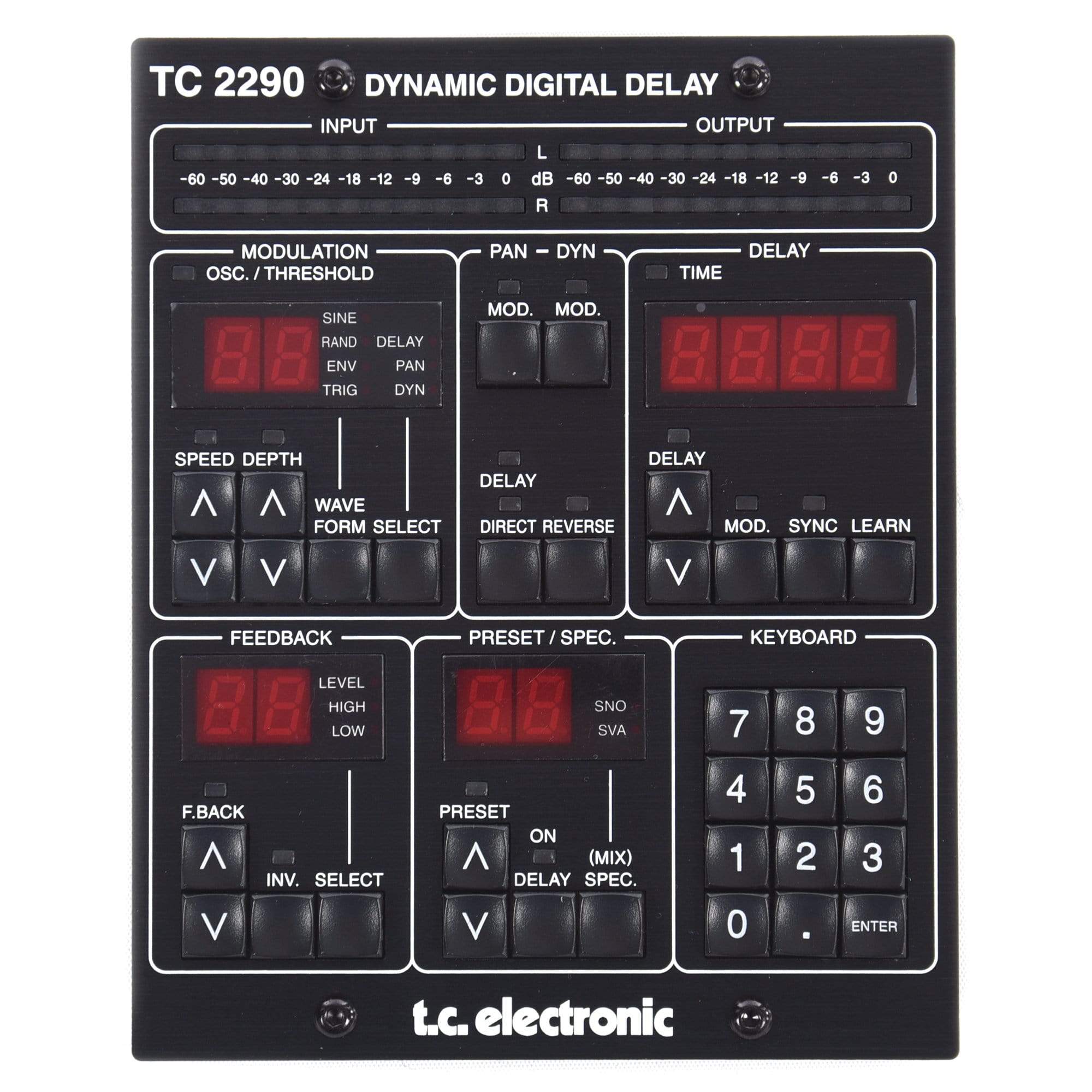
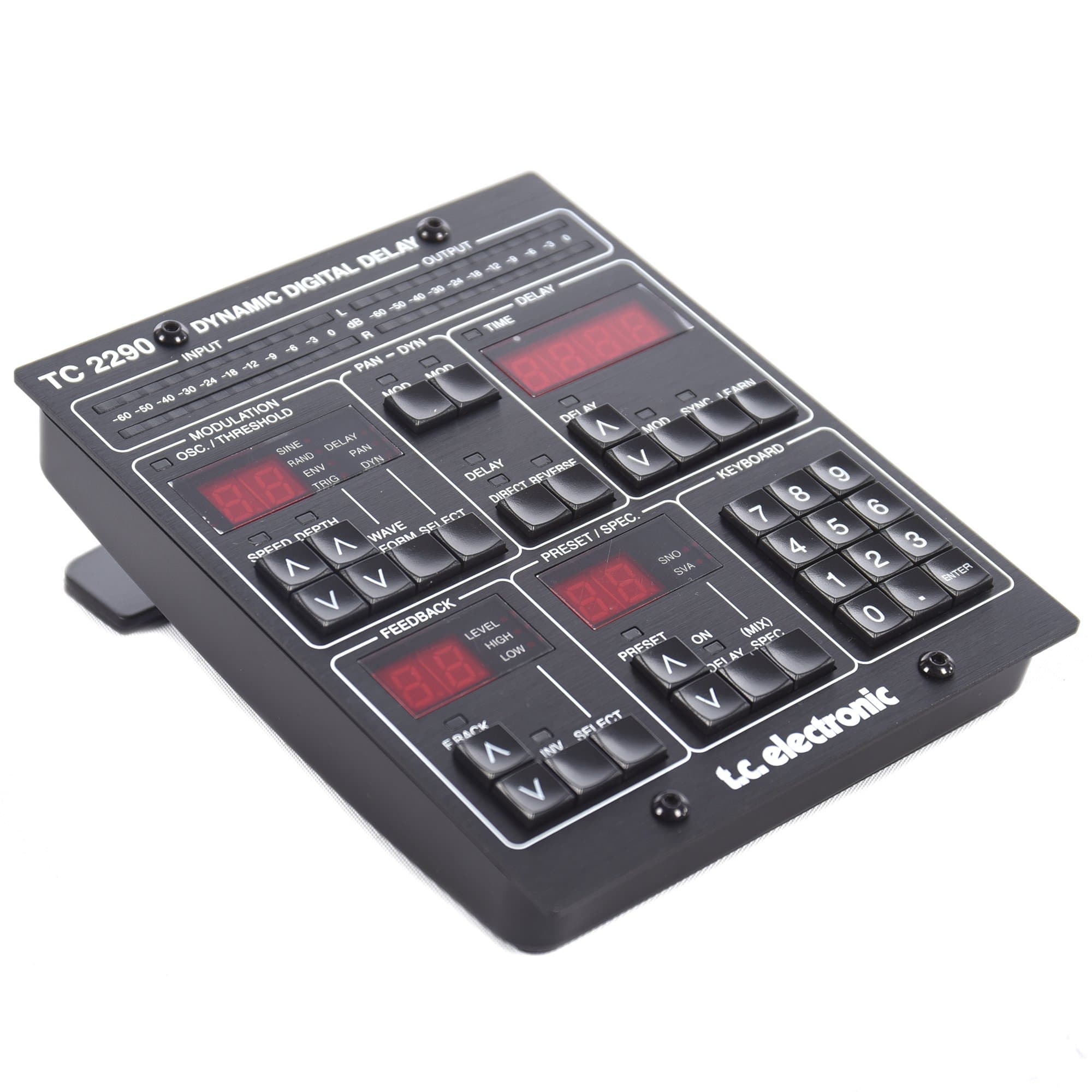
| Content | TC2290-DT is a groundbreaking, versatile delay solution that features a dedicated hardware interface with full DAW integration and powerful signature presets that will fuel your inspiration and add instant character to your tracks.
Capable of conjuring up virtually any conceivable delay type, TC2290-DT makes it easy to vitalize your tracks with everything from crisp repeats, to complex delay rhythms and ultra-expressive modulated soundscapes.
TC2290-DT’s sleek tactile controls and authentic tone recreations gives you total creative control of your delay, allowing you to explore and experiment to your heart’s content. With its superior sound quality and extremely musical response, TC2290-DT is like adding another musical instrument to the mix!
- Desktop controlled plug-in brings legendary TC2290 dynamic delay to your DAW
- Complete delay solution with extensive modulation capabilities for your favorite audio software
- High-quality tactile interface with authentic "look and feel" of celebrated TC2290 rack delay
- Custom-designed signature presets featuring world-class artists and recording engineers
- High-resolution input/output meters for accurate signal monitoring
- DAW tempo, automation and project recall support
- Award-winning TC ELECTRONIC algorithms for cutting-edge effects
- Powered by USB
- - ready for Mac* and PC
- Standard VST*, Audio Units* and AAX* plug-in processing, compatible with all major DAWs including Pro Tools*, Cubase*, Nuendo*, Logic Pro*, GarageBand* and Ableton Live*
| The Suhr Reactive Load delivers a simple solution to capture all of the warmth, and dynamics of your sound, without the hassle of miking a speaker cabinet during a live or recorded performance.
The Reactive Load takes the place of your speaker cabinet in your signal chain. It provides an 8Ω load for your tube amplifier (maximum 100 watts), and produces a balanced and unbalanced signal that interfaces with recording devices, effects, and power amplifiers.
The Suhr Reactive Load is the perfect link between your amplifier and computer audio recording interface. You can use the Reactive Load with your existing library of speaker impulse responses (IR) for the most realistic direct recording experience possible.
Traditional resistive load boxes will safely load your amplifier, but they also alter the tone, dynamics, and response of your amplifier. Real speakers do not have a fixed resistance across the entire frequency spectrum. Real speakers are reactive.
The impedance curve of the Reactive Load has been painstakingly tuned to react like a speaker. Your amp will never know the difference.
The Reactive Load is dedicated to being the absolute best load box possible with zero compromises, and therefore does not include speaker emulation. You can use the Reactive Load with your speaker-sim or impulse response of choice, and benefit from the natural response, dynamics, and touch sensitivity of your amp.
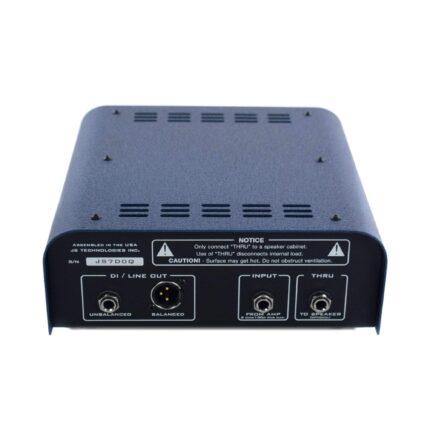
The Suhr Reactive Load features a balanced or unbalanced line level output. The INPUT is optimized for the 8 ohm output of your amplifier and the THRU jack can be connected to a physical speaker cabinet. If a physical cabinet is connected to the THRU jack, the Reactive Load’s internal load is bypassed and the amp will see the load of the physical cabinet.
SPEAKER INPUT IMPEDANCE: 8 Ohm
DI / LINE OUT LEVEL: +4 dBu at 7 watts input, maximum level setting
BALANCED LINE OUTPUT IMPEDANCE: Less than 6KΩ
UNBALANCED LINE OUTPUT IMPEDANCE: Less than 6KΩ
MAXIMUM RECOMMENDED INPUT POWER: 100 Watts RMS
ROHS COMPLIANT: Yes
DIMENSIONS: 8.8" (W) x 8.9" (D) x 3.6" (H)
WEIGHT: 6.6lb | The product that started it all for Empirical Labs. Born of founder Dave Derr’s love of classic compressors like the 1176, LA-2A and Gain Brain (among others), the Distressor incorporates his favorite sonic characteristics of these, along with other unique and interesting features that have made it a staple for audio engineers all over the world. With over 28,000 units in the field, it’s safe to say that the Distressor is one of the best selling high end compressors of all time… if not THE best selling. A prominent recording engineer recently wagered that there probably was not a top 40 record made in the last five years that didn’t have at least one Distressor on it.
Besides providing a wide range of control and a unique feature set, the Distressor offers a warm, vintage sound by using a custom designed gain control circuit. This “warmth” or “vintage sound” has become a major issue in the last few decades, as the super clear and linear digital technology does next to nothing to soften “harsh” sounds, nor emphasize the bass frequencies in music sources. Conversely, older analog tape, vinyl records and tube equipment could not be prevented from coloring the sound, often to the frustration of recording engineers. However, many people now realize that this coloring can be extremely pleasant and musical. Digital technology is often referred to as “cold” and “brittle” among other terms (although we prefer “unforgiving”).
Unique Compression Curves
All eight of the Distressor’s curves are unique and distinctive, from the 1:1 mode that simply warms up signal with low order harmonics without intentional compression, to the “Nuke” setting – a brick wall limiting curve that shines on live drum room mics. Each curve has its own personality and several actually use different circuitry, and are effectively different compressors. Most exceptional is the 10:1 “Opto” ratio which uses separate detector circuitry to emulate the oldest (and valued) “light controlled” devices, such as the LA-2A.
Distortion (Color) Modes
Another large part of the Distressor’s personality and power derive from three modes that color the signal, even without compression. These extended audio modes were designed to allow emulation of some very old and expensive vintage compressors & limiters, and let the Distressor deliver a classic “knee” sound all its own by providing user programmable, warm harmonic distortion. In addition to the basic distortion mode, Distort 2 emphasizes tube-like 2nd order harmonics, while in Distort 3 setting the distortion becomes dominated by 3rd harmonics more closely resembling tape. Two HP filters – one in the audio path, one in the detector path – are also available to help with low frequencies that can cause pumping and breathing.
- Frequency Response – 2 Hz to 160 kHz in clean audio mode (+0, -3 dB). Response is shaped in distortion modes (Dist 2, Dist 3).
- Dynamic Range – 110 dB from max. output to min. output in 1:1 mode. Greater than 100 dB signal to noise in distort 3 mode.
- Distortion – ranges between .02% and 20% depending on distortion mode and release times set on front panel.
- I/O – DC Coupled input and outputs.
- Time Constants – Attack range 50uS – 50mS. Release range .05 sec to 3.5 seconds, normal modes and up to 20 seconds in 10:1 opto mode. Time constants are dependent on ratio.
- Power Consumption – 15 Watts Max.
- Metal Chassis – single height 1.75″ high, 10″ deep, 19″ wide.
- Shipping info – 12.1 lbs mono. Mono box dimensions 22.5″ x 18.5″ x 3 1/4″.
| Arguably the coolest and most unique device in the Empirical Labs arsenal, the FATSO (Full Analog Tape Simulator and Optimizer) is a digitally controlled analog device that gives musicians and engineers easy access to many of the desirable characteristics exhibited by older tube and Class A electronics and magnetic tape mediums. This two channel audio processor musically integrates frequencies and transients, increasing the apparent volume while keeping tight control over peak levels.
With the FATSO, recording studios and audio production facilities can enhance and soften the sound of Hardware Digital Recorders (HDRs) and Digital Audio Workstations (DAWs). Mix engineers will have the option not to have to use bulky, expensive analog tape recorders to get the warmth and sweet high end they’ve come to rely on for so many decades. Owners of DAWs and HDRs can finally put a stop to complaints about the coldness and brittle edge of their mixes and instruments. Even audiophiles can benefit from the FATSO, bringing back the warmth and ambience of LP’s and tapes to their CD players and other digital reproduction mediums.
The FATSO Goes to Eleven
ELEVEN is a new compressor for the FATSO, replacing the old GP Ratio, and emulates the famous UREI 1176LN in 20:1, with the slowest attack, and fastest release. This 1176 setting has been used on countless hit records through the decades. With the slower “1176” attack, the transients keep the dynamics present, while the high ratio, can radically limit the dynamic range of any source, making it present and sitting in a nice little place in your mix. One can slam it, or just touch it with a few dB of compression. You will find it great on Vocals, Bass, acoustic guitars, drum room mikes, pianos etc. Click here to find out how to upgrade your EL7 to an EL7X.
Four Types of Processing
- Harmonic Generation and Soft Clipper (Distortion Generation) – this class A circuit gently rounds the peaks like saturated tubes or tape.
- High Frequency Saturation (Warmth) – a one-of-a-kind dynamic low pass filter which softens high frequencies when they “pile up” on a source.
- Transformer & Tape Head Emulation – a simulation of the effect of input and output transformers of older devices, which adds the low frequency harmonics that characterize them, as well as analog tape..
- Classic Knee Compression – your typical automatic leveling device found on just about every instrument and vocal track as well as on the overall buss, done Empirical Labs compression – smooth and sweet, but in your face!
Universal Audio's FATSO Emulation
Endorsed and scrutinized for accuracy by designer Dave Derr of Empirical Labs, Universal Audio has painstakingly recreated the FATSO Jr. in this highly anticipated UAD Powered Plugin, capturing the sonic nuances of the original hardware. As part of the FATSO Powered Plugin, UA has also worked closely with Dave Derr to model the original concept of the FATSO, the FATSO Sr., with attack, release, and threshold compressor controls, among other features not available elsewhere.
Frequency Response: 2 Hz to 60 kHz in clean audio mode (+0, -3 dB).
Dynamic Range: 110 dB from maximum output (20 %THD soft clipping) to minimum output. Greater than 100 dB signal to noise.
Distortion: Ranges between .06% and 20% depending on mode and settings.
I/O: DC Coupled input and outputs.
Compressor Time Constants: Attack range 1ms – 60ms. Release range .05sec – 3.5 seconds. Attack and Releases are fixed by the compression type selected.
Power Consumption: 15 Watts Max.
Metal Chassis: single height 1.75″ high, 10″ deep, 19″ wide. | FEATURES
- World-class, transformer-coupled preamp, compressor, and DI
- Gain: 0 - 66dB in 6dB increments
- Compressor: Single-knob opto-coupler compressor with 2:1 ratio
- Blend: Determines balance of mic and DI inputs
- Instrument gain: 0 - 30dB on instrument input
- 48V phantom power
- Silk: Adds nostalgic warmth and presence when engaged
- Instrument input: Front-panel TRS input and passive-through for Hi-Z sources
- Polarity reverse
- Threshold: When signals exceed threshold level, gain is reduced at a controlled 2:1 ratio with fixed attack and release time constants
- Indicators: Signal presence and clipping on both mic and DI signals, as well as compressor activation.
TECHNICAL SPECIFICATION
Rupert Neve Designs Portico 517: 500 Series Mic Pre / DI / Comp
- Frequency Response: Main Output, no load, -0.2dB @ 10Hz -3dB @ 160kHz
- Noise measured at main output, unweighted, 22Hz - 22kHz, terminated 150 ohm: Gain at unity: better than -100dBu; gain at 66dB: better than -62dBu Equivalent Input Noise: better than -128dBu, noise factor 1.5dB
- Maximum output level from 20Hz to 40kHz: +23dBu
- Total Harmonic Distortion and Noise: @ 1kHz, +20 dBu output: Main Output: Better than 0.001% @ 20Hz, +20 dBu output: Main Output: Better than 0.002% Silk Engaged: Better than 0.2% Second harmonic
- Crosstalk: Measured channel to channel: Better than -90dB @ 15kHz.
- Phantom Power: +48 Volts DC +/- 1%
| In today’s modern age of digital recorders, DAWs and software plug-ins, Mike-E is the ultimate solution for getting a clean and strong, yet warm and musical signal into the box…and it couldn’t be easier to work – its front panel layout is so straight ahead that even inexperienced engineers will have no problem moving around on it right away.
When the engineering team at Empirical Labs sets out to build a microphone preamp, you can be sure it’ll deliver spectacular sound, be effortless to work, and will provide features unlike any other device in its class. To that end, we proudly present Mike-E, a high performance transformer-coupled mic preamp with a noise floor far below any microphone’s self noise, combined with a one-of-a-kind compressor/saturator circuit that delivers classic knee compression as well as versatile tonal ‘coloring’ that can replicate many of the best characteristics of vintage analog recording equipment.
Mic Preamp
The Mike-E features a super low noise transformer input amplifier section with the gain under precise digital control. The signal to noise far exceeds any microphone in existence. Having used many mic preamps over the years, we’ve implemented a unique stepped gain control that should be impervious to the normal flakiness that age causes to pots and detented switches. A “Bad!” LED indicates when the input signal is overloading the circuit.
CompSat
The CompSat’s unique circuitry sets the Mike-E apart from all other mic preamps.
- SATURATOR – a multi stage soft-clipping circuit. At lower levels, a triode-type saturation affects the signal. As the level increases, a second unique clip circuit starts to more severely flatten out the peaks.
- COMPRESSOR – based on ELI’s world famous Distressor, but with other characteristics (including a much longer attack time). Preset ratios include: 2:1, 4:1, 8:1…and, of course, Nuke.
- EMPHASIS – a two-stage circuit that boosts and soft clips high frequencies before the CompSat™ circuit, and then cuts the frequencies after it. Emphasis has the added perk of improving signal to noise, and is the reason analog tape decks used emphasis to begin with.
Frequency Response: 3 Hz to 200 kHz on (No CompSat). CompSat is 3Hz – 150Khz. Optional Transformer output is 6Hz–80kHz.
Signal to Noise: 130 dB signal to Noise.at 40dB gain. Maximum output is +28dBu.
Distortion: Ranges between .0006% and 15% depending on mode and settings.
I/O: Transformer coupled Input, Active and Transformer Outputs available. High quality audio caps used internally.
Impedance: Input Impedance is above 600 Ohms at all frequencies, transformer coupled. Output impedance is less than 38 ohms. Instrument In Impedance is 332K Ohms.
Attack/Decay Range: .9 – 70mS attack. .15 – 1 Sec.
Power Consumption: 15 Watts Max.
Metal Chassis: single height 1.75″ high, 10″ deep, 19″ wide. |






Reviews
There are no reviews yet.