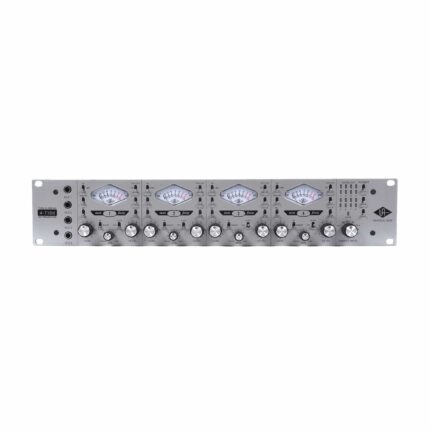
| Content | By merging the best of UA’s classic analog design with smart modern features and workflow enhancements, the 4-710d is the most flexible microphone preamp in the UA lineup.
Featuring four high-end mic/line preamps with a unique tube/solid-state tone blending circuit, as well as classic 1176-style compression on each mic channel, the 4-710d also offers tons of digital I/O to expand your setup.
NOW YOU CAN:
- Track through meticulously designed UA tube preamp circuitry
- Blend tube and solid-state textures for tons of flexibility
- Harness classic 1176-style compression on each mic channel
- Add 8 inputs to any Apollo interface via ADAT optical connection
Bring your Mic Collection to Life with a Wide Range of UA Preamp Tones
At the core of the 4-710d are four channels of tone-blending “Twin-Finity” mic preamps. Each channel offers 100% tube and 100% solid-state signal path, as well as the ability to continuously blend between the two circuits. This gives you tons of textures — from creamy to crunchy — and lets you dial in the perfect amount of tube grit or solid-state sheen.
A Legendary Compression Circuit
Each of the 4-710d’s four channels features true-bypass 1176-style compression, including specially tuned "fast" and "slow" settings. This enables quick, on-the-fly tweaking for fattening up a vocal, hold a bass guitar in place, or for adding sizzle and texture to synths and horns.
Add Inputs and Professional A/D Conversion
With eight analog inputs, the 4-710d is perfect for expanding your studio. Digitized via ultra high-quality 24-bit A/D converters at selectable sample rates up to 192 kHz, the 4-710d easily connects to most interfaces with its dual ADAT optical or AES/EBU DB-25 connectors.
Preamplifiers
- Four TEC Award-winning 710 Twin-Finity™ microphone/line preamps, each featuring:
- Dual-path 285-volt Class-A tube and transimpedance solid-state preamps
- Phase-aligned tone-blending of tube and solid state circuits, creamy to crunchy
- Newly designed 1176-style compression circuit per preamp channel
- JFET Direct Input with 2.2MΩ ultra Hi-Z impedance w/auto input override
- Large backlit VU meters for flexible metering of input drive, gain level, and gain reduction
- Balanced send/return inserts (half-normalled)
- 48V phantom power
- 75 Hz low cut filter
- Polarity switch
- Monolithic balanced output stage
Analog-to-Digital Conversion
- Eight channels of high quality 24-bit A/D conversion:
- Selectable sample rates up to 192 kHz
- Digital output via dual ADAT optical and AES/EBU DB-25 connectors
- 8-channel soft limiter (switchable for all channels)
- Ultra-low jitter clock subsystem
- LED metering array with clip/hold indicators
- 75Ω BNC work clock I/O
- Digital outputs anti-pop protection on power-up
Other
- Universal voltage internal power supply
- Heavy-duty metal construction, two-space rack unit
- One year warranty including parts and labor
| This item is in excellent working condition and barely used.
The ZHA-4 splits a single stereo headphone output into four separate powered 1/8” headphone jacks, each with their own volume and mute control. Perfect for bands, podcasts, productions, and more.
Two AA batteries provide hours of portable power. For longer sessions, connect the USB-C port to a portable battery or plug directly into the wall.
What’s in the Box?
- ZHA-4 Handy Headphone Amplifier
- AA Batteries (x2)
- Stereo Mini Audio Cable (19” / 50cm)
- Quick Guide
Please Note: The item displayed in the images may not be the actual item you receive. | FEATURES
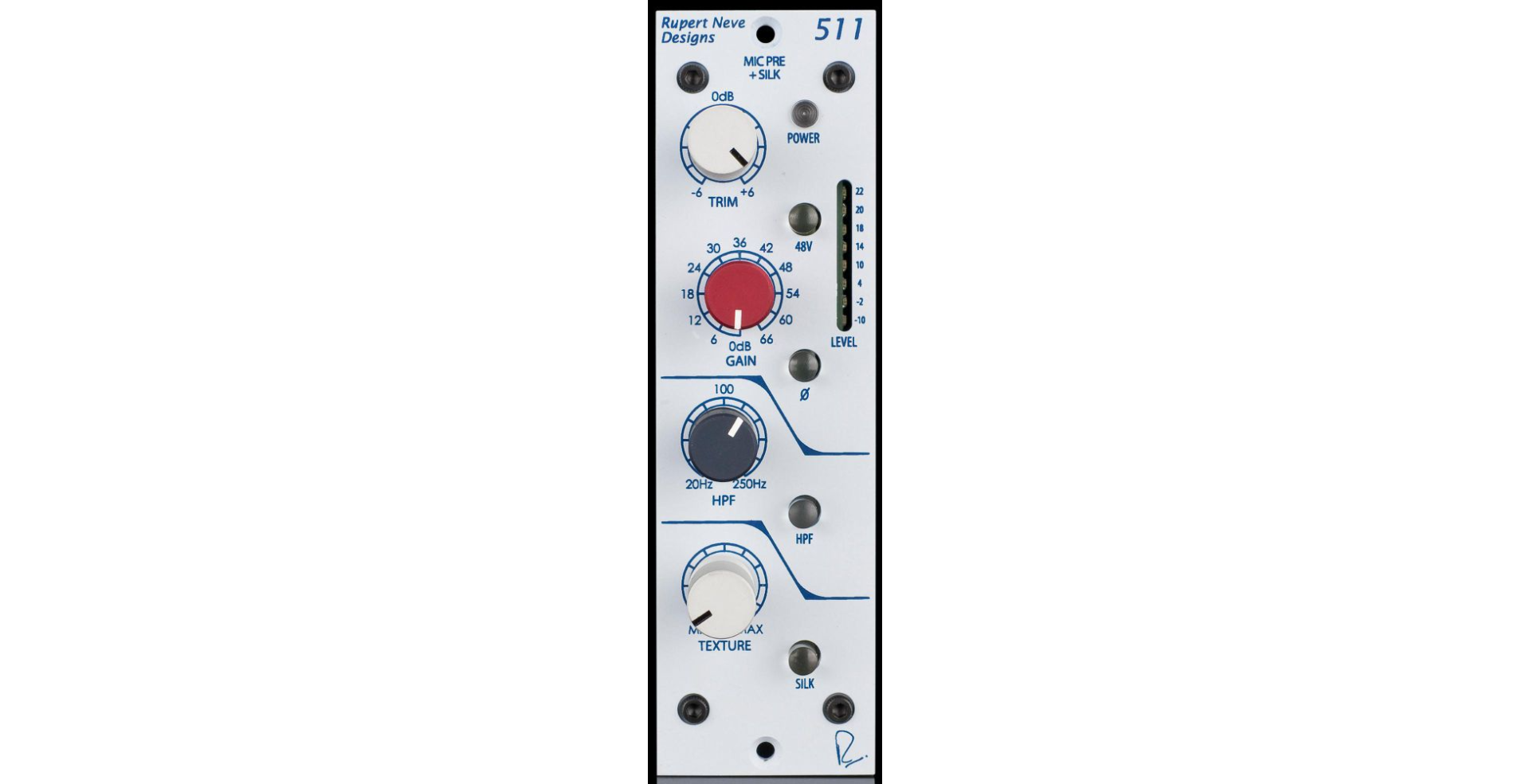
- 12-way precision rotary switch controls gain from 0 to 66 dB in 6 dB steps
- Continuously variable +/-6 dB level control
- Silk circuit, reduces negative feedback, adding harmonic content as needed
- Red Silk accentuates the saturation in the mid and high frequencies
- Same presence and sweetness found in standard Portico Series modules
|
Number of Channels |
Single |
|
Inputs |
1x XLR, balanced |
|
Output |
1x XLR, transformer-balanced |
|
Maximum Output Level |
+23dBu |
|
Meter |
8 segment LED meter |
|
Power Requirements |
Power Requirements @ +/-16VDC 100mA |
|
Dimensions |
Not specified by manufacturer |
|
Box Dimensions (LxWxH) |
10.2 x 7.8 x 2" |
| In today’s modern age of digital recorders, DAWs and software plug-ins, Mike-E is the ultimate solution for getting a clean and strong, yet warm and musical signal into the box…and it couldn’t be easier to work – its front panel layout is so straight ahead that even inexperienced engineers will have no problem moving around on it right away.
When the engineering team at Empirical Labs sets out to build a microphone preamp, you can be sure it’ll deliver spectacular sound, be effortless to work, and will provide features unlike any other device in its class. To that end, we proudly present Mike-E, a high performance transformer-coupled mic preamp with a noise floor far below any microphone’s self noise, combined with a one-of-a-kind compressor/saturator circuit that delivers classic knee compression as well as versatile tonal ‘coloring’ that can replicate many of the best characteristics of vintage analog recording equipment.
Mic Preamp
The Mike-E features a super low noise transformer input amplifier section with the gain under precise digital control. The signal to noise far exceeds any microphone in existence. Having used many mic preamps over the years, we’ve implemented a unique stepped gain control that should be impervious to the normal flakiness that age causes to pots and detented switches. A “Bad!” LED indicates when the input signal is overloading the circuit.
CompSat
The CompSat’s unique circuitry sets the Mike-E apart from all other mic preamps.
- SATURATOR – a multi stage soft-clipping circuit. At lower levels, a triode-type saturation affects the signal. As the level increases, a second unique clip circuit starts to more severely flatten out the peaks.
- COMPRESSOR – based on ELI’s world famous Distressor, but with other characteristics (including a much longer attack time). Preset ratios include: 2:1, 4:1, 8:1…and, of course, Nuke.
- EMPHASIS – a two-stage circuit that boosts and soft clips high frequencies before the CompSat™ circuit, and then cuts the frequencies after it. Emphasis has the added perk of improving signal to noise, and is the reason analog tape decks used emphasis to begin with.
Frequency Response: 3 Hz to 200 kHz on (No CompSat). CompSat is 3Hz – 150Khz. Optional Transformer output is 6Hz–80kHz.
Signal to Noise: 130 dB signal to Noise.at 40dB gain. Maximum output is +28dBu.
Distortion: Ranges between .0006% and 15% depending on mode and settings.
I/O: Transformer coupled Input, Active and Transformer Outputs available. High quality audio caps used internally.
Impedance: Input Impedance is above 600 Ohms at all frequencies, transformer coupled. Output impedance is less than 38 ohms. Instrument In Impedance is 332K Ohms.
Attack/Decay Range: .9 – 70mS attack. .15 – 1 Sec.
Power Consumption: 15 Watts Max.
Metal Chassis: single height 1.75″ high, 10″ deep, 19″ wide. | Arguably the coolest and most unique device in the Empirical Labs arsenal, the FATSO (Full Analog Tape Simulator and Optimizer) is a digitally controlled analog device that gives musicians and engineers easy access to many of the desirable characteristics exhibited by older tube and Class A electronics and magnetic tape mediums. This two channel audio processor musically integrates frequencies and transients, increasing the apparent volume while keeping tight control over peak levels.
With the FATSO, recording studios and audio production facilities can enhance and soften the sound of Hardware Digital Recorders (HDRs) and Digital Audio Workstations (DAWs). Mix engineers will have the option not to have to use bulky, expensive analog tape recorders to get the warmth and sweet high end they’ve come to rely on for so many decades. Owners of DAWs and HDRs can finally put a stop to complaints about the coldness and brittle edge of their mixes and instruments. Even audiophiles can benefit from the FATSO, bringing back the warmth and ambience of LP’s and tapes to their CD players and other digital reproduction mediums.
The FATSO Goes to Eleven
ELEVEN is a new compressor for the FATSO, replacing the old GP Ratio, and emulates the famous UREI 1176LN in 20:1, with the slowest attack, and fastest release. This 1176 setting has been used on countless hit records through the decades. With the slower “1176” attack, the transients keep the dynamics present, while the high ratio, can radically limit the dynamic range of any source, making it present and sitting in a nice little place in your mix. One can slam it, or just touch it with a few dB of compression. You will find it great on Vocals, Bass, acoustic guitars, drum room mikes, pianos etc. Click here to find out how to upgrade your EL7 to an EL7X.
Four Types of Processing
- Harmonic Generation and Soft Clipper (Distortion Generation) – this class A circuit gently rounds the peaks like saturated tubes or tape.
- High Frequency Saturation (Warmth) – a one-of-a-kind dynamic low pass filter which softens high frequencies when they “pile up” on a source.
- Transformer & Tape Head Emulation – a simulation of the effect of input and output transformers of older devices, which adds the low frequency harmonics that characterize them, as well as analog tape..
- Classic Knee Compression – your typical automatic leveling device found on just about every instrument and vocal track as well as on the overall buss, done Empirical Labs compression – smooth and sweet, but in your face!
Universal Audio's FATSO Emulation
Endorsed and scrutinized for accuracy by designer Dave Derr of Empirical Labs, Universal Audio has painstakingly recreated the FATSO Jr. in this highly anticipated UAD Powered Plugin, capturing the sonic nuances of the original hardware. As part of the FATSO Powered Plugin, UA has also worked closely with Dave Derr to model the original concept of the FATSO, the FATSO Sr., with attack, release, and threshold compressor controls, among other features not available elsewhere.
Frequency Response: 2 Hz to 60 kHz in clean audio mode (+0, -3 dB).
Dynamic Range: 110 dB from maximum output (20 %THD soft clipping) to minimum output. Greater than 100 dB signal to noise.
Distortion: Ranges between .06% and 20% depending on mode and settings.
I/O: DC Coupled input and outputs.
Compressor Time Constants: Attack range 1ms – 60ms. Release range .05sec – 3.5 seconds. Attack and Releases are fixed by the compression type selected.
Power Consumption: 15 Watts Max.
Metal Chassis: single height 1.75″ high, 10″ deep, 19″ wide. | Firmly rooted in six decades of console design experience, the 5057 Orbit gives your mixes the legendary tonality, power, and wide-open soundstage that only Rupert Neve’s class-A analog summing can provide. Coupled with Rupert’s famous custom audio transformers and Silk Red & Blue circuitry for variable harmonic saturation, the Orbit launches sterile in-the-box mixes to new heights of tone, depth and clarity – without compromising the recallable convenience and repeatability of your DAW-based workflow.
When you push a mix buss and output transformers towards saturation, the non-linear, musical harmonics that occur are what truly glue a recording together and bring it to life.
Rather than using an external summing solution that offers little more than an ultra-clean representation of the in-the-box experience, the Orbit provides the extraordinary richness, harmonic complexity and depth that only a Rupert Neve console can bring to your mixes.
The Orbit utilizes a highly custom output transformer configuration originally developed for the acclaimed Shelford Channel, which provides both a Main Output and a -6dB Output – the latter of which enables you to fully drive the Orbit to achieve more transformer harmonics without clipping the next device in the chain. This unique transformer drive is a hallmark of the sound of Rupert Neve throughout the years – and the sound of countless classic hit records.
Classic Sounds on Demand
Every mix demands its own treatment. In addition to the choice of outputs, the continuously variable Texture control with Silk Red and Silk Blue modes gives you complete control over the harmonic density and tonality of your mix – or lets you keep it utterly pristine and uncolored.
The Silk Red mode accentuates transformer saturation in the high and high-mid frequencies to amplify the vibrant midrange harmonics associated with Rupert’s vintage equipment, while Silk Blue accentuates saturation of the lows and low-mids to add thickness and weight to any source – especially useful for “thin-sounding” mixes. Unlike EQ, these Silk & Texture controls saturate the output transformers, and add highly musical harmonics to the source material according to the amount of Texture applied.
Drive the mix buss hard, choose your Silk flavor, and crank the Texture knob for a rich, saturated, vintage vibe – or disengage Silk entirely for clear, wide-open sonic beauty. The choice is yours.
Build your Dream
While the Orbit is an extremely effective tool on its own, multiple units can be combined through the Buss Link for a higher channel count. The 5057 Orbit can also be used as a building block in an expandable summing system utilizing the 5059 Satellite for flexible summing & routing, and the 5060 Centerpiece for additional mixing and monitoring features.
These units create the core of a world-class analog modular console system rivaling any traditional large-scale studio setup.
Channel Separation and Accuracy
With precisely fixed channel levels and accurate mix buss attenuation via high-quality stepped switching, the Orbit’s purist signal path has vanishingly low crosstalk, and channels matched to within +/-0.1dB. This provides your mixes with the widest and most accurate stereo image, the greatest depth, and the most direct signal path, allowing you to hear every single detail of your mixes.
DAW Based Recall without Compromise
Frequent recalls can be a challenge for modern mix engineers. The Orbit’s elegant simplicity and fixed level accuracy provides rapid, repeatable DAW-based recall from mix to mix, while adding the rich, unrivaled sound quality of Mr. Neve’s class-A transformer-coupled mix buss.
INPUT IMPEDANCE
16K Ohm
FREQUENCY RESPONSE
- 10 Hz to 50 kHz: +/- 0.1 dB
- 150 kHz: -3 dB
NOISE
- From 22 Hz - 22 kHz.
- -90 dBu typical
MAXIMUM INPUT LEVEL
@ 1 kHz: +26 dBu
MAXIMUM OUTPUT LEVEL
@ 1 kHz: +26 dBu
THD+N%
- From 22 Hz - 22 kHz.
- 0 dBu @ 1 kHz: 0.003%
- +20 dBu @ 1 kHz: 0.0006%
CROSSTALK
- 1 kHz: -103 dBu
- 10 kHz: -93 dBu
PRODUCT DIMENSIONS
19” W (48.3 cm) x 9” D (22.9 cm) x 1.75” H (4.4 cm)
SHIPPING DIMENSIONS
24” L (61 cm) x 13” W (33 cm) x 4” H (10.2 cm)
SHIPPING WEIGHT
10 lbs (4.5 kg) |




Reviews
There are no reviews yet.