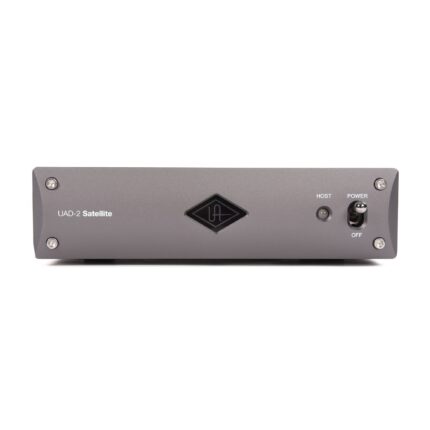
| Content | The UAD-2 Satellite Thunderbolt is a powerhouse DSP accelerator that gives Mac and Windows 10 users complete access to the world’s most detailed and authentic analog emulation plug-ins, available exclusively on the UAD platform.
Bolstered by next-generation connectivity, UAD-2 Satellite Thunderbolt 3 lets you run large professional mixes with the rich analog character of award-winning UA-developed plug-ins, including exclusive titles from Neve, Fender, Lexicon, Studer, and many more. Plus, it’s backward-compatible with Thunderbolt 1 and 2 UA devices.
UAD Plug-In Craftsmanship: The Science Behind the Scenes
In developing UAD plug-ins, UA’s acclaimed engineers undertake intensive physical modeling of classic audio hardware — “rebuilding” vintage analog gear in the digital world, component by component. UAD plug-ins replicate the exact, sometimes quirky behavior of the most prized analog hardware in existence, bringing you rich, three-dimensional sound and harmonics "in the box.”
Run UAD Powered Plug-Ins via Thunderbolt 3 on modern Mac and Windows 10 systems (backwards compatible with Thunderbolt 1 and 2 devices)
- 4 (QUAD) or 8 (OCTO) SHARC processors provide a massive DSP boost for running large professional mixes
- Access over 100 plug-ins from Ampex, Lexicon, Studer, Neve, Manley, SSL, EMT, Helios, and more
- Includes Analog Classics Plus bundle featuring Legacy editions of LA-2A Classic Audio Leveler, 1176 Classic Limiting Amplifiers, Pultec EQP-1A, Pultec Pro, and Fairchild 670 plug-ins, plus 610-B Tube Preamp & EQ, and more
- Compatible with Pro Tools, Logic Pro X, Cubase, Live, and more
- Combine with other Thunderbolt-equipped UAD-2 devices including PCIe card(s), UA Audio Interfaces, and additional Satellites
- Dual Thunderbolt 3 ports for daisy-chaining of Thunderbolt peripherals
| Proven reverberation classic for the future
With the VSR 3.2, we happily rely on the proven old mechanical way to create reverberation. Rightly, because the used reverberation spring by AccuBell (formerly Accutronics) creates that magic 60's reverb which is slightly metallic and dense at the same time.
Just like it predecessors, VSR 3.2 has a straight-forward and honest approach: signal in - spring reverb - vintage sound out.
VSR 3.2 is equipped with an equalizer that is exactly adapted to the springs' frequency response. In addition, there are controls to mix the dry and effect signal as well as controls for the input and output level. This way, VSR 3.2 simply exactly does what it was designed to do.
Designed for every situation
Although using a large spring (type 9), VSR 3.2 fits in a 19" housing with one rack unit – minimal space requirements. Thanks to its extremely solid chassis, VSR 3.2 is a reliable vintage-effect that cannot only be used in a controlled studio environment. On the contrary, it also serves fine when being used in straining live situations.
VSR 3.2 grants your sound an elegant touch of "good old times". Its simplicity makes it an unbelievable versatile companion.
Inputs
- 1/4"-jack input front
- unbalanced
- max. input sensitivity: –40 dBu
- impedance: 1 MΩ
- 1/4"-jack input rear (1)
- unbalanced
- max. input sensitivity: 0 dBu
- impedance: 100 kΩ
- 1/4"-jack input rear (2)
- unbalanced
- max. input sensitivity: –20 dBu
- impedance: 10 kΩ
Outputs
- 1/4"-jack output (1)
- unbalanced
- max. output level: 0 dBu
- 1/4"-jack output (2)
- unbalanced
- max. output level: - 20 dBu
Signal-to-Noise Ratio
- direct: > 80 dBu
- effect: > 70 dBu
THD + Noise
Miscellaneous
- power supply: external DC-adapter with 12 V/1000 mA
- dimensions: 19“, 1 HE, ca. 190 mm deep
- weight: 2.5 kg
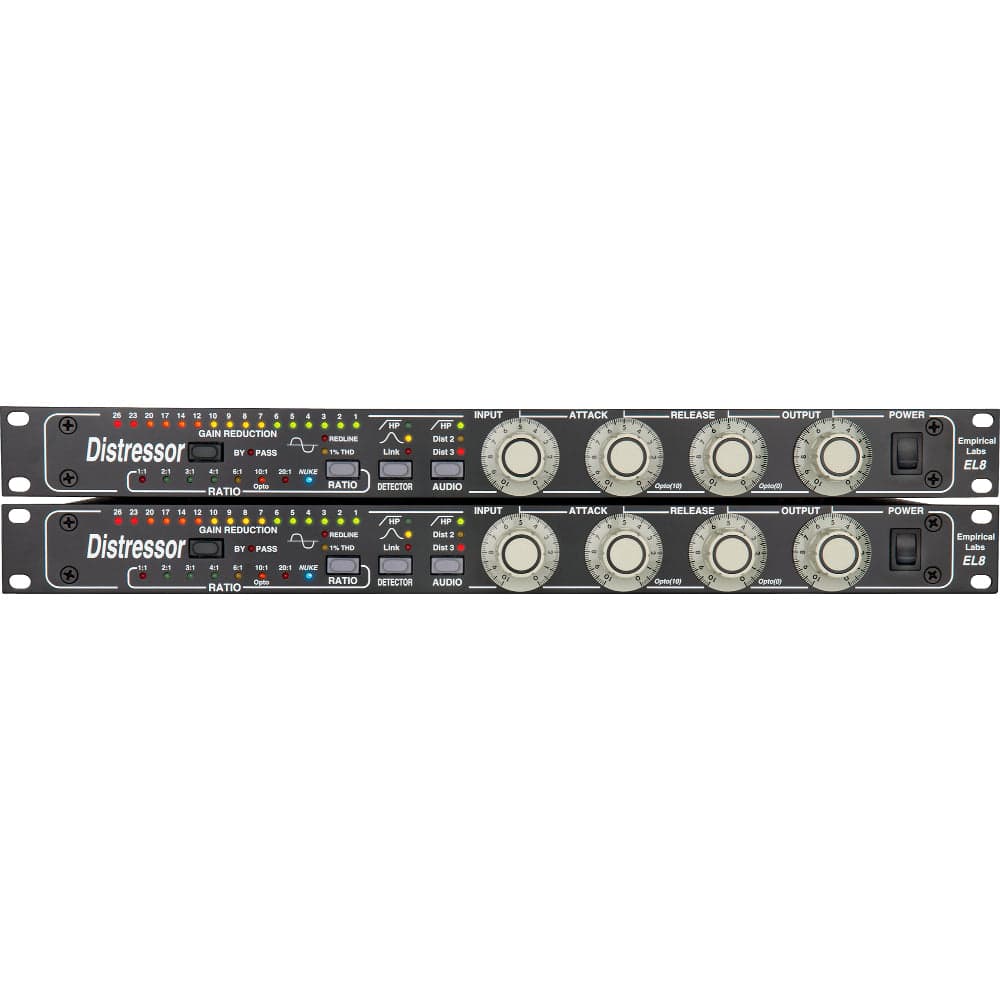
| The product that started it all for Empirical Labs. Born of founder Dave Derr’s love of classic compressors like the 1176, LA-2A and Gain Brain (among others), the Distressor incorporates his favorite sonic characteristics of these, along with other unique and interesting features that have made it a staple for audio engineers all over the world. With over 28,000 units in the field, it’s safe to say that the Distressor is one of the best selling high end compressors of all time… if not THE best selling. A prominent recording engineer recently wagered that there probably was not a top 40 record made in the last five years that didn’t have at least one Distressor on it.
Besides providing a wide range of control and a unique feature set, the Distressor offers a warm, vintage sound by using a custom designed gain control circuit. This “warmth” or “vintage sound” has become a major issue in the last few decades, as the super clear and linear digital technology does next to nothing to soften “harsh” sounds, nor emphasize the bass frequencies in music sources. Conversely, older analog tape, vinyl records and tube equipment could not be prevented from coloring the sound, often to the frustration of recording engineers. However, many people now realize that this coloring can be extremely pleasant and musical. Digital technology is often referred to as “cold” and “brittle” among other terms (although we prefer “unforgiving”).
Unique Compression Curves
All eight of the Distressor’s curves are unique and distinctive, from the 1:1 mode that simply warms up signal with low order harmonics without intentional compression, to the “Nuke” setting – a brick wall limiting curve that shines on live drum room mics. Each curve has its own personality and several actually use different circuitry, and are effectively different compressors. Most exceptional is the 10:1 “Opto” ratio which uses separate detector circuitry to emulate the oldest (and valued) “light controlled” devices, such as the LA-2A.
Distortion (Color) Modes
Another large part of the Distressor’s personality and power derive from three modes that color the signal, even without compression. These extended audio modes were designed to allow emulation of some very old and expensive vintage compressors & limiters, and let the Distressor deliver a classic “knee” sound all its own by providing user programmable, warm harmonic distortion. In addition to the basic distortion mode, Distort 2 emphasizes tube-like 2nd order harmonics, while in Distort 3 setting the distortion becomes dominated by 3rd harmonics more closely resembling tape. Two HP filters – one in the audio path, one in the detector path – are also available to help with low frequencies that can cause pumping and breathing.
Go Stereo
For many Distressor owners, one is never enough – in fact, one extremely successful engineer has twelve of them! For those who want (at least) a stereo pair, ELI offers the EL8-S, a pair of Distressors that are matched at the factory, and come with the cables you need to lock them together.
- Frequency Response – 2 Hz to 160 kHz in clean audio mode (+0, -3 dB). Response is shaped in distortion modes (Dist 2, Dist 3).
- Dynamic Range – 110 dB from max. output to min. output in 1:1 mode. Greater than 100 dB signal to noise in distort 3 mode.
- Distortion – ranges between .02% and 20% depending on distortion mode and release times set on front panel.
- I/O – DC Coupled input and outputs.
- Time Constants – Attack range 50uS – 50mS. Release range .05 sec to 3.5 seconds, normal modes and up to 20 seconds in 10:1 opto mode. Time constants are dependent on ratio.
- Power Consumption – 15 Watts Max.
- Metal Chassis – single height 1.75″ high, 10″ deep, 19″ wide.
- Shipping info – 24.2 lbs Stereo pair. Stereo Pair box dimensions 22.5″ x 18.5″ x 6 1/4.
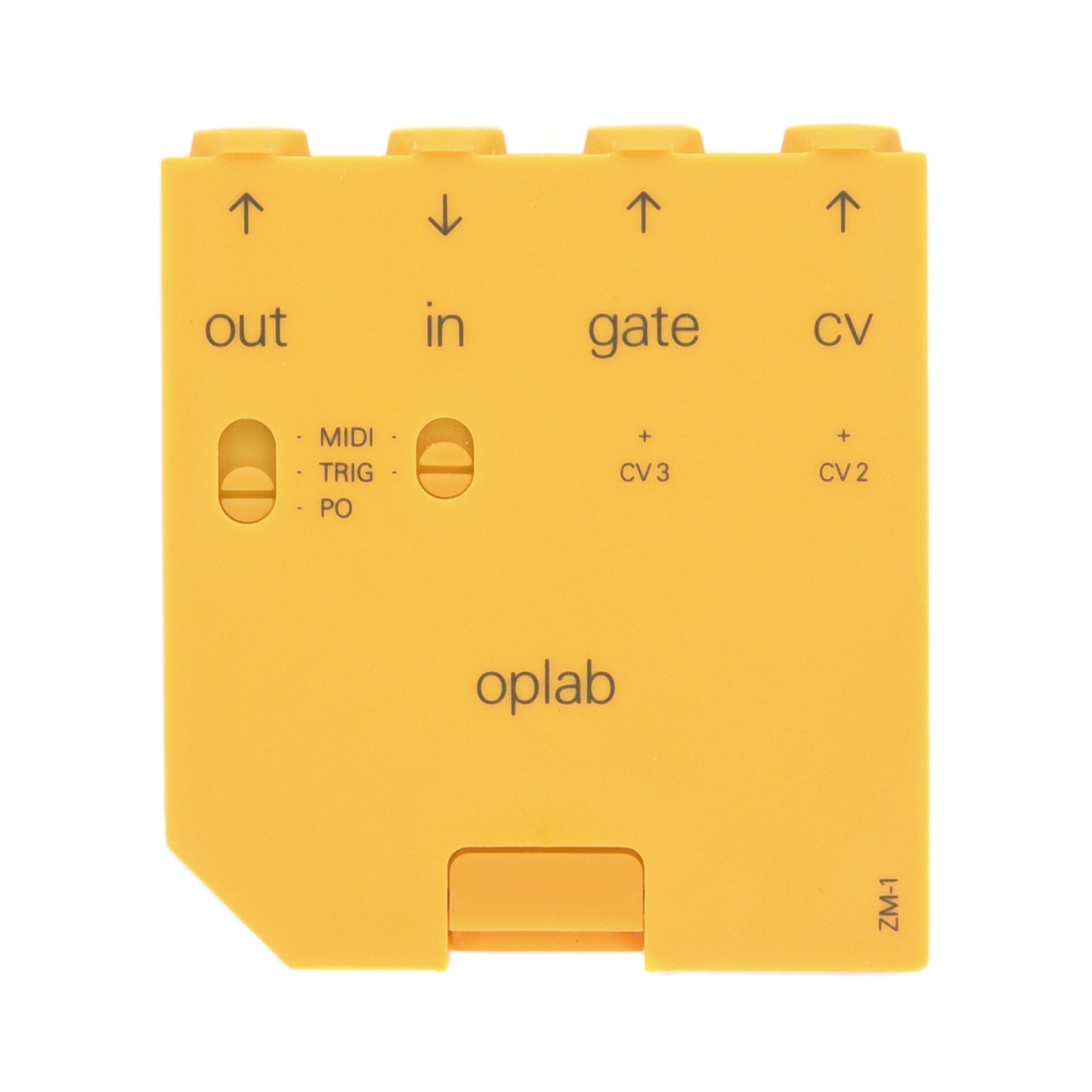
| Imagine having the power and flexibility of the OP-Z sequencer available to any other music equipment. Now you can, with the new oplab module - the magic link between OP-Z and the rest of the world. The oplab module is the first hardware expansion module for OP-Z. once mounted in the back of your OP-Z, you can use it to connect to any equipment using standard cv and gate, such as the pocket operator modular or any other modular system. It features three cv outs and one gate out, all programmable and playable from OP-Z. have your wall of modules sequenced from the palm of your hands. Use the po sync out to unleash the power of your regular pocket operators and have them play in sync with the rest of your setup. Even connect standard midi devices, using midi over 3.5 mm jack or the included midi over din adapter cable. Oplab features both midi in and out ports as well as trig in and out for other synthesizers and sequencers. | The product that started it all for Empirical Labs. Born of founder Dave Derr’s love of classic compressors like the 1176, LA-2A and Gain Brain (among others), the Distressor incorporates his favorite sonic characteristics of these, along with other unique and interesting features that have made it a staple for audio engineers all over the world. With over 28,000 units in the field, it’s safe to say that the Distressor is one of the best selling high end compressors of all time… if not THE best selling. A prominent recording engineer recently wagered that there probably was not a top 40 record made in the last five years that didn’t have at least one Distressor on it.
Besides providing a wide range of control and a unique feature set, the Distressor offers a warm, vintage sound by using a custom designed gain control circuit. This “warmth” or “vintage sound” has become a major issue in the last few decades, as the super clear and linear digital technology does next to nothing to soften “harsh” sounds, nor emphasize the bass frequencies in music sources. Conversely, older analog tape, vinyl records and tube equipment could not be prevented from coloring the sound, often to the frustration of recording engineers. However, many people now realize that this coloring can be extremely pleasant and musical. Digital technology is often referred to as “cold” and “brittle” among other terms (although we prefer “unforgiving”).
Unique Compression Curves
All eight of the Distressor’s curves are unique and distinctive, from the 1:1 mode that simply warms up signal with low order harmonics without intentional compression, to the “Nuke” setting – a brick wall limiting curve that shines on live drum room mics. Each curve has its own personality and several actually use different circuitry, and are effectively different compressors. Most exceptional is the 10:1 “Opto” ratio which uses separate detector circuitry to emulate the oldest (and valued) “light controlled” devices, such as the LA-2A.
Distortion (Color) Modes
Another large part of the Distressor’s personality and power derive from three modes that color the signal, even without compression. These extended audio modes were designed to allow emulation of some very old and expensive vintage compressors & limiters, and let the Distressor deliver a classic “knee” sound all its own by providing user programmable, warm harmonic distortion. In addition to the basic distortion mode, Distort 2 emphasizes tube-like 2nd order harmonics, while in Distort 3 setting the distortion becomes dominated by 3rd harmonics more closely resembling tape. Two HP filters – one in the audio path, one in the detector path – are also available to help with low frequencies that can cause pumping and breathing.
- Frequency Response – 2 Hz to 160 kHz in clean audio mode (+0, -3 dB). Response is shaped in distortion modes (Dist 2, Dist 3).
- Dynamic Range – 110 dB from max. output to min. output in 1:1 mode. Greater than 100 dB signal to noise in distort 3 mode.
- Distortion – ranges between .02% and 20% depending on distortion mode and release times set on front panel.
- I/O – DC Coupled input and outputs.
- Time Constants – Attack range 50uS – 50mS. Release range .05 sec to 3.5 seconds, normal modes and up to 20 seconds in 10:1 opto mode. Time constants are dependent on ratio.
- Power Consumption – 15 Watts Max.
- Metal Chassis – single height 1.75″ high, 10″ deep, 19″ wide.
- Shipping info – 12.1 lbs mono. Mono box dimensions 22.5″ x 18.5″ x 3 1/4″.
| This item is in excellent working condition and barely used.
The ZHA-4 splits a single stereo headphone output into four separate powered 1/8” headphone jacks, each with their own volume and mute control. Perfect for bands, podcasts, productions, and more.
Two AA batteries provide hours of portable power. For longer sessions, connect the USB-C port to a portable battery or plug directly into the wall.
What’s in the Box?
- ZHA-4 Handy Headphone Amplifier
- AA Batteries (x2)
- Stereo Mini Audio Cable (19” / 50cm)
- Quick Guide
Please Note: The item displayed in the images may not be the actual item you receive. |






Reviews
There are no reviews yet.