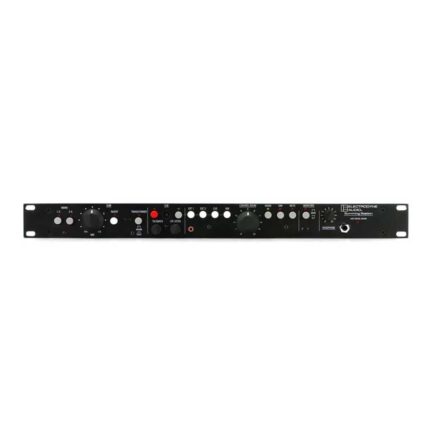
| Content | Electrodyne consoles served up some of the hottest hits of the late '60s and early '70s at top studios like Capitol, Warners, Stax, Decca, and Motown. Now the Electrodyne Summing Station fortifies your rack with the iconic Electrodyne sound from analog's golden era. The Summing Station is, essentially, the center section of a classic 1970s Electrodyne large-format console, providing a 16-channel active summing network and stereo mix bus facilities for modern DAW-based studios. Boasting an extremely low-distortion balanced signal path for monitoring accuracy, the Summing Station uses classic Electrodyne design technology that includes original Electrodyne design output transformers, discrete transistor op-amps, and transformer control for "tight" vs. "warm" mix bus sonics.
Analog warmth and punch — optimized for the digital era
Can't afford a vintage Electrodyne console for your DAW-based studio? No worries. Designed for professional project studios and production facilities, the Summing Station is perfect for enhancing clinical-sounding digital stems and mixes with classic Electrodyne analog warmth and punch. Optimized for the digital era, Summing Station delivers all the functionality you don't get from your DAW.
In addition to its studio-grade 16-channel active summing network, the Summing Station includes a comprehensive Control Room Monitor section with Stereo Mix and Artist Cue facilities; a high-power, low-distortion headphone amplifier; a 3.5mm TRS Mobile Device input; Mono, Dim, and Mute controls; a Main/Alt Monitor selector with precision level trims for Alternate speakers; a precision-detented Control Room Level pot; and an integrated Talkback mic and CR-to-Studio Listen function. Lastly, you get the legendary all-discrete Electrodyne console sound in a compact, cost-effective package.
The Electrodyne legacy
As one of the very first console manufacturers, Electrodyne was instrumental in transforming the way records and films were recorded and mixed. Sweetwater is proud to be part of that great legacy. And we are very excited about the Electrodyne Summing Station — it sounds amazing! We're sure you'll agree.
Electrodyne Summing Station Features:
- Classic Electrodyne 1970s large-format console summing and stereo mix bus
- 16-channel active summing network and Stereo Bus with fully balanced stereo insert path
- Transformer-balanced analog outputs
- Transformer control for "tight" vs. "warm" mix bus sonics
- Precision-detented Master Bus Level pot with Stereo Bus calibration trimmers
- Original Electrodyne design transformers and discrete transistor op-amps
- Studio-grade Control Room Monitor section:
- Stereo Mix and Artist Cue facilities
- Balanced XLR I/O; 3.5mm TRS Mobile Device inputs
- Precision-detented Control Room Level pot
- Mono, Dim, and Mute controls
- Main/Alt Monitor selector with precision level trimmers for Alternate speakers
- Extremely low-distortion balanced signal path for quality and accuracy of monitoring
- High-power, low-distortion headphone amplifier
- Artist Cue and Talkback:
- Cue input Talkback Loop for Artist Headphone / Studio Monitor Mix
- Integrated Talkback mic with Control Room Monitor Dim function and Remote Talkback jack
- Control Room Listen function allows artists in the Studio to hear Control Room Sources for playback and rehearsal
| Brand New Midas ProX with Neutron.
In person demos are available. Shipping cost is the buyers responsibility and will be determined by buyers location. Please message to discuss shipping. If purchased without a shipping agreement in place, the buyer will be responsible for local pickup.
The Midas PRO Series family moves up a gear with the PRO X control centre and the industry-changing NEUTRON Audio System Engine. Featuring 168 simultaneous input channels and 99 time-aligned and phase-coherent mix buses, the PRO X sets a new performance benchmark in high-profile live sound applications and is a truly impressive digital control surface for the engineer whose very livelihood depends on both unparalleled functionality and reliability. Like all PRO Series consoles, the PRO X features managed latency and 40 bit floating point processing precision.
HyperMAC and AES50 audio networking technologies allow the PRO X to dynamically assign up to 288 inputs and 294 outputs at 96 kHz sampling rate to any of its input channels and bus outputs on a scene-by-scene basis. This high level of connectivity, coupled with the large channel and bus counts, makes the PRO X equally at home in theatres and symphony halls as it is in live concert touring, outside broadcast and music festivals. | The Ultimate Desktop Mixer Legendary SSL studio tools redefined and streamlined
To the casual observer SiX looks like any other compact desktop mixer. Look a little closer and like all SSL consoles, SiX reveals a carefully considered feature set that is driven by an obsessive desire for total flexibility, to encompass every creative eventuality. It may be small but SiX is a classic SSL design. It carries the DNA of 40 years of true expertise in creative studio workflow. Listen to SiX and you will experience the impeccable sonic performance that is the hallmark of every SSL console. It is powerful and intuitive. Inspired and rewarding.
SiX is a condensed professional console for use in the studio, in post-production, on stage, and for podcasting. SiX offers big console sound and an impressive set of utility features in a format that is small enough to stick in a bag a go wherever you need it. SiX is stunning value; it offers two recording channels with SuperAnalogueTM mic pres, two band EQ, an essential one knob version of the classic SSL Channel Compressor, a new two-band Channel EQ, inserts and 100mm faders. There is a two-knob version of the legendary G-Series Bus Compressor on the main mix bus and the unique Listen Mic Compressor on the Talkback. In mixdown mode it is a very capable twelve channel summing system that offers analogue detail, depth and width to your mixes.
The SuperAnalogue™ Sound of SSL
SiX is an SSL SuperAnalogue™ design – it gives you the sonic signature of a large format SSL console on your desktop or in your backpack. Its signal path is fully balanced from front to back on everything except the headphone output. It delivers pristine, detailed audio with wide dynamic range, ultra-low noise, ultra-low distortion and superb imaging. If you want to know more about the technical reasons why SSL mixers sound so good read our document.
Two Recording Channels
SiX has two mono channels with SSL SuperAnalogue™ Mic’ Pre’s; these are transparent, fast and have a much wider available gain range than you would typically get on a compact desktop mixer – 66dB of gain compared to the more typical mid-40s or 50dB found in desktop mixers. They have phantom power, 75Hz high pass filter and an independent line-level input which can be switched to instrument level input with high impedance.
Moving down the channel strip we have a brand-new one knob compressor circuit. This design is based on and has the same sound as the classic SSL feed-forward Channel Compressor circuit. It has a program-dependent attack time, a fixed release time and fixed ratio. Simply adjust the threshold, watch the traffic lights flash to see how much compression is happening and rely on the circuit to automatically adjust gain to match input levels. This is a cool-sounding circuit that makes it simple to dial in a consistent level and get signals sitting right in the sweet spot.
Both mono channels have a new two-band SSL EQ that may be independently switched between shelf and bell curves, with different centre frequencies for each type. This approach draws upon the SSL design legacy of specifying response curves and centre frequencies for channel EQ that are immediately intuitively pleasing in their response; these curves and frequencies were selected by our team as the most “musically useful” for a wide range of sources.
SiX has 100mm faders. We spent some time working on alternate fader tapers and settled on a law that gave us the most control over the most useable gain range, making on-stage level control far easier than it would be with a rotary or a 60mm fader as found on other compact mixers.
Each channel has a fully balanced insert point for integrating other signal processors which is after the EQ and Compressor circuits, and like all SSLs the insert send is always active – meaning you can use this as a “dry” record send to your DAW if required.
At the bottom of the mono channels we have an ALTernate input switch which can source 2 extra mono channels from a connector on the rear of the console which can be used at mixdown.
Line Level Heaven
SiX has two stereo input channels with -10/+20 dB trim for line sources such as synthesisers, drum machines, output from soundcards etc. These have their own balance controls and 100mm faders. If only the Left input of a stereo channel is connected (and the right left free) the channel will automatically switch to mono, panned centre.
While SiX might be small it can handle a lot of inputs at mix-down! Using the two mono input and the two stereo input channels gives SiX its name, but we also have two stereo EXTernal inputs (with volume controls in the master section) which can be sent to the mix bus. Include the ALT inputs and we have up to 12 channels that can be summed into the main mix bus.
Master Bus Magic
SiX has a G Series Bus Compressor on the main mix bus. This uses the same circuit design as the legendary SSL Bus Compressor from our larger consoles but with a fixed ratio, attack, and release settings and a more modern quad-VCA chip. The simplified controls make it very easy to get that SSL glue and snap on whatever you push through your master bus. SiX also has a set of inserts on the main mix bus that can be used to bring external processing tools (like SSL Fusion) to your mixdown.
Routing Pro
SiX has a collection of professional routing & monitoring features taken directly from our large format console heritage. It has two Stereo Cue buses (with level and pan controls) for individual artist foldback mixes. The Master Section has main and alternate monitor outputs with a proper monitor source matrix, as well as mono check, dim and cut. The fader channels all have proper PFL and a Mute button that routes the muted signal to a ‘Bus B’. Bus B can be used as a convenient DAW record send but it can also be routed to the monitor matrix. This means that the muted signal can be monitored without it feeding the main mix bus and then switched in to the main mix with the Mute button – perfect for live webcasting because a remote feed can be monitored ‘offline’ and punched in to the broadcast feed. There is a talkback mic’ input with phantom power and SSL’s unique, crunchy Listen Mic Compressor, which of course also serves as a unique processing tool that delivers that classic 1980’s slammed drums sound.
Key Features:
A fully professional condensed console for use in the studio, in post-production, on stage, and for podcasting.
Benchmark SuperAnalogue™ audio performance
Ultra low noise : ultra-low distortion : pristine sound
Stunning Record Path
Two SSL console grade SuperAnalogue mic pre’s
Classic SSL Channel Processing
Essential versions of SSL Channel EQ and Dynamics
The unique Listen Mic Compressor
Nothing slams drums quite like it!
Professional Routing & Monitoring
The hidden versatility of truly professional features
12 Input Summing at Mixdown
12 line level inputs with channel and Master Bus inserts
Legendary Master Bus Compressor
An essential version of the incredible SSL legacy
Completely balanced signal path
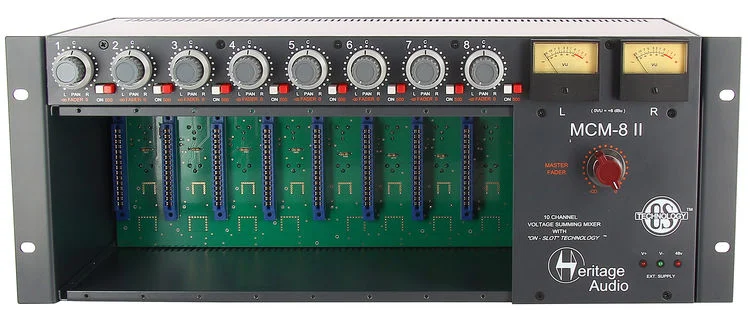
Everything except the headphone jack is fully balanced | Heritage Audio's MCM-8 MK2 is an 8-slot 500 Series chassis with an integrated 10-channel summing mixer. The top-of-the-line MCM-8 MK2 features On Slot Technology that leverages next-generation power electronics to handle power supply on a per slot basis. Each slot has its own power supply linear regulation stages, isolating each module from the rest. Your modules simply share the metal enclosure. Each slot even has test LEDs for checking correct power operation. Dual-concentric potentiometers handle Volume and Pan for each slot, with pan pots being center detented for precise center positioning. Each channel is equipped with an On switch to assign it to the mix bus. MK2 improvements include a lower noise floor and the addition of a bypass switch for each slot that still lets you use the summing mixer functions. Heritage Audio has earned the respect of Sweetwater engineers, and the MCM-8 MK2 lives up to that sterling reputation.
Superb build and feature set
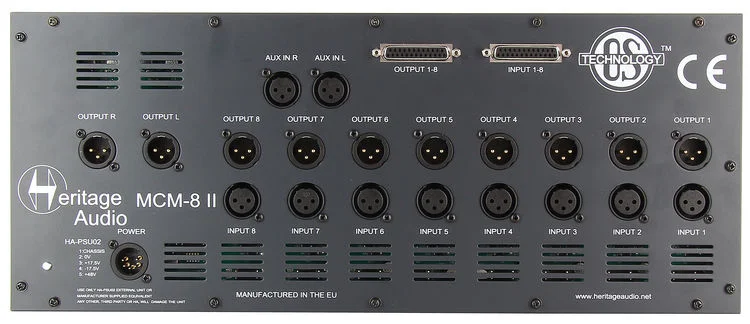
From its RAF blue-gray enclosure to the solid tactile feedback from its knobs and switches, the Heritage Audio MCM-8 MK2 unabashedly rocks vintage British Class A vibe. And just like the classic gear that inspires all Heritage Audio equipment, the MCM-8 MK2 boasts superb build quality and a very smart feature set. There's an additional stereo input on the back panel, which allows several MCM-8 MK2 units to be daisy-chained — or signals not needing further 500 Series processing to be mixed together. The central section sports analog VU meters and a Stereo Master fader. Gold-plated XLRs and DSUB25s handle the I/O.
Smart technology, superior sound
Thanks to Heritage Audio's On Slot Technology (OST), the MCM-8 MK2's power capability is a maximum of 400mA per rail, per slot — with an overall of 1.4A (1.6A non-continuous) per rail, whichever is reached first. Total available phantom power is 140mA. The mix bus has a passive voltage summing topology, similar to that found in Rupert Neve's 80 Series consoles of the 1970s. The gain loss is restored by the same Class A, 2n3055 driven, transformer-based output stage used in the Heritage Audio's modern-day version of the classic 1073. If you're not into specs, what this all means is that the MCM-8 MK2 is built right to give you many years of authoritative sonic performance and trouble-free use in your studio or on the road.
Heritage Audio MCM-8 MK2 Features:
- 8-slot 500 Series chassis with integrated 10-channel summing mixer
- NEW lower noise floor
- NEW bypass switch for each slot that leaves summing mixer functions enabled
- Mix bus with vintage Neve-style passive voltage summing topology
- Additional stereo input on the back panel allows several MCM-8s to be daisy-chained
- Central section sports analog VU meters and a Stereo Master fader
- Handles power supply on a per slots basis, isolating each module from the rest
- Gold-plated XLRs and DSUB25s handle your I/O
- 140mA total available phantom power
- Class A transformer-based output stage
- Solid build quality for many years of trouble-free use
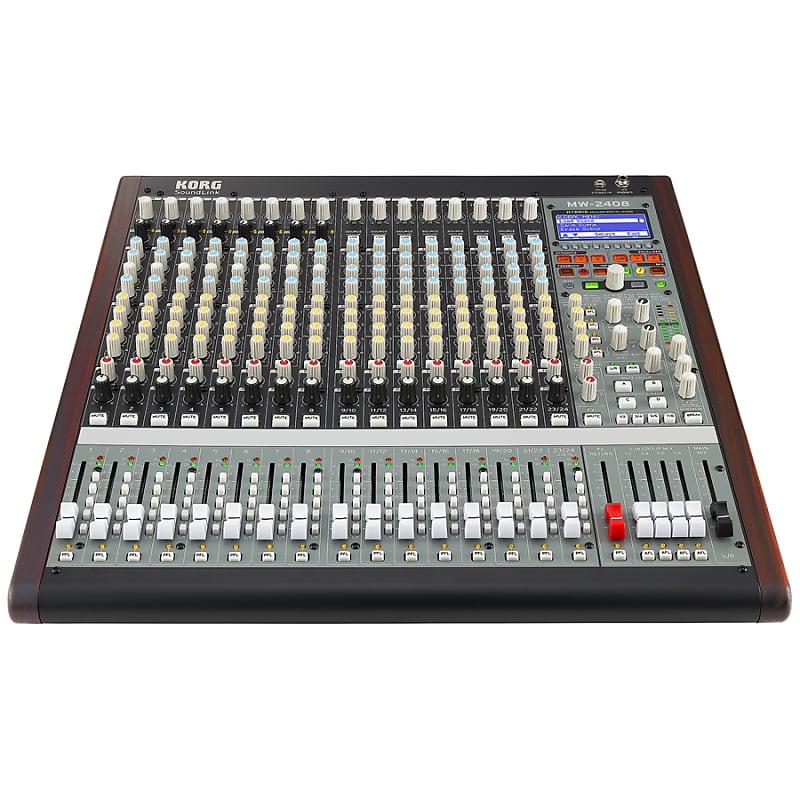
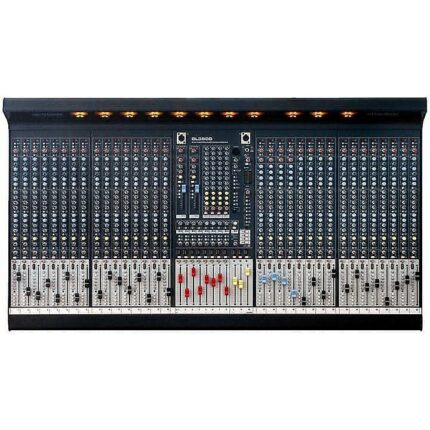
| KORG MW 2408 MIXER MIXER | Avid S1 eight-fader EUCON control surface
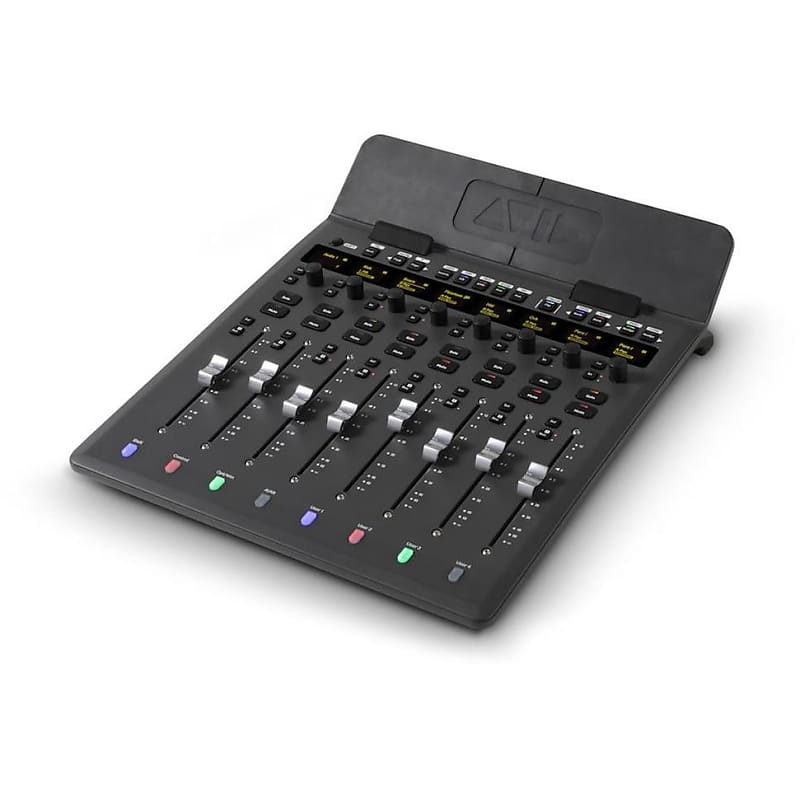
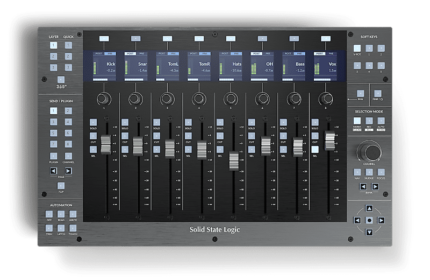
The Avid S1 is an eight-fader EUCON control surface with unparalleled speed, rich visual feedback, and software integration of Avid's high-end consoles in a slimline surface that's an easy fit for any space or budget. Avid S1 gives you deep hands-on control of your favorite audio and video software and, together with the free Pro Tools | Control app for iPad (iPad not included), provides great ergonomic efficiency, easy touch workflows, and S6-style metering and processing views, so you can navigate large sessions quickly, mix more intuitively, and turn around better sounding mixes fast.
Mix big on a smaller scale
While Avid S1 fits easily between your display and keyboard, it packs a lot of mixing power into its small surface. From motorized faders and knobs that respond to your touch, to fast-access touchscreen workflows and Soft Keys that enable you to perform complex tasks with a single press, S1 provides the speed and versatility to accelerate any music, audio post, or video project.
Get unmatched software integration
S1 is powered by EUCON, Avid’s high-speed Ethernet control protocol that delivers deep hardware/software integration, giving you full touch and tactile access to a host of Avid and third-party software functions and controls. You can even switch between multiple applications—and workstations—at the touch of a button, providing the most fluid editing and mixing experience.
Specifications:
- Faders: Eight motorized, touch-sensitive, 100 mm long-throw faders
- Knobs: Eight push-top, touch-sensitive rotary encoders
- Additional controls: Assorted hardware buttons/keys for various functions and mode selections, including Mute, Solo, Record-enable, Bank, Nudge, and more
- Software interface: Supports the free Pro Tools | Control app running on iPad (iPad not included), providing touchscreen control, project navigation, macro triggers, and more
- Displays: Eight high-resolution OLED displays, plus multiple status LEDs and multicolor track buttons; channel metering, monitoring, processing, track status, automation modes, and other views provided by Pro Tools | Control on iPad
- Height (front, rear): 1.2 inches, 3.8 inches (29 mm, 97 mm)
- Width: 12.3 inches (312 mm)
- Depth: 14.9 inches (377 mm)
|







Reviews
There are no reviews yet.