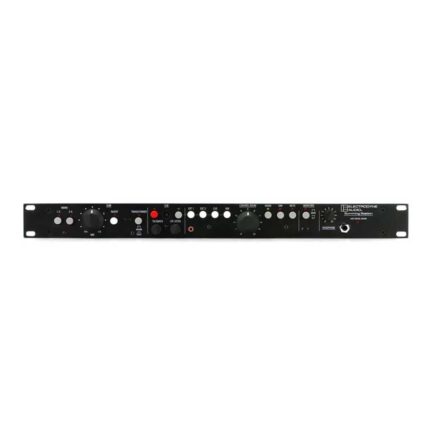
| Content | Electrodyne consoles served up some of the hottest hits of the late '60s and early '70s at top studios like Capitol, Warners, Stax, Decca, and Motown. Now the Electrodyne Summing Station fortifies your rack with the iconic Electrodyne sound from analog's golden era. The Summing Station is, essentially, the center section of a classic 1970s Electrodyne large-format console, providing a 16-channel active summing network and stereo mix bus facilities for modern DAW-based studios. Boasting an extremely low-distortion balanced signal path for monitoring accuracy, the Summing Station uses classic Electrodyne design technology that includes original Electrodyne design output transformers, discrete transistor op-amps, and transformer control for "tight" vs. "warm" mix bus sonics.
Analog warmth and punch — optimized for the digital era
Can't afford a vintage Electrodyne console for your DAW-based studio? No worries. Designed for professional project studios and production facilities, the Summing Station is perfect for enhancing clinical-sounding digital stems and mixes with classic Electrodyne analog warmth and punch. Optimized for the digital era, Summing Station delivers all the functionality you don't get from your DAW.
In addition to its studio-grade 16-channel active summing network, the Summing Station includes a comprehensive Control Room Monitor section with Stereo Mix and Artist Cue facilities; a high-power, low-distortion headphone amplifier; a 3.5mm TRS Mobile Device input; Mono, Dim, and Mute controls; a Main/Alt Monitor selector with precision level trims for Alternate speakers; a precision-detented Control Room Level pot; and an integrated Talkback mic and CR-to-Studio Listen function. Lastly, you get the legendary all-discrete Electrodyne console sound in a compact, cost-effective package.
The Electrodyne legacy
As one of the very first console manufacturers, Electrodyne was instrumental in transforming the way records and films were recorded and mixed. Sweetwater is proud to be part of that great legacy. And we are very excited about the Electrodyne Summing Station — it sounds amazing! We're sure you'll agree.
Electrodyne Summing Station Features:
- Classic Electrodyne 1970s large-format console summing and stereo mix bus
- 16-channel active summing network and Stereo Bus with fully balanced stereo insert path
- Transformer-balanced analog outputs
- Transformer control for "tight" vs. "warm" mix bus sonics
- Precision-detented Master Bus Level pot with Stereo Bus calibration trimmers
- Original Electrodyne design transformers and discrete transistor op-amps
- Studio-grade Control Room Monitor section:
- Stereo Mix and Artist Cue facilities
- Balanced XLR I/O; 3.5mm TRS Mobile Device inputs
- Precision-detented Control Room Level pot
- Mono, Dim, and Mute controls
- Main/Alt Monitor selector with precision level trimmers for Alternate speakers
- Extremely low-distortion balanced signal path for quality and accuracy of monitoring
- High-power, low-distortion headphone amplifier
- Artist Cue and Talkback:
- Cue input Talkback Loop for Artist Headphone / Studio Monitor Mix
- Integrated Talkback mic with Control Room Monitor Dim function and Remote Talkback jack
- Control Room Listen function allows artists in the Studio to hear Control Room Sources for playback and rehearsal
| Brand New, in sealed original box, never used, in perfect condition!
Tascam product info:
Built-in DSP 4 line outputs Dante converter to respond to various needs of contractor market and professional audio scene.
The ML-4D/OUT-E is a compact converter that converts Dante input signals into 4-channel line output signals. With half the size of a standard 1U rack, the ML-4D/OUT-E is suitable for different Dante systems as an exquisite analog output unit. The built-in DSP mixer enables small scale systems to fully perform with a variety of input/output models the TASCAM Dante Compact Processor Series offers. ML-4D/OUT-E supports up to 96kHz/24bit and uses Euroblock connectors for analog line output.
4 line output
4 Dante input/output
Supports PoE (Power over Ethernet)
Up to 24bit/96kHz
Includes a variety of DSP functions for optimal use in different scenes/environments (Output effects, 4 in/4 out matrix mixer)
Supports Dante daisy chain; this allows two Dante Compact Processor models to be connected without a network switch
Compatible with Dante Domain Manager and Dante AES67 Mode
Flexible scene preset function allows to work in different area situations (Up to 50 presets)
Timer event function allows to automatically switch scenes at a specified time (planned to be compatible on a future version update)
2 types of user control software available for Windows/Mac/iOS/Android devices:
For integrators: input/output routing selection, DSP/design/scene settings of the complete system, etc.
For end-users: simple app design for only the necessary functions such as area volume settings, etc.
Remote control via GPI and Dante
Half-rack mountable size
Equipped with indicators that show LAN/Dante connection status and sample rate
Equipped with signal indicators that monitor line output signals
Configurable reference level (via remote control only) | If you're seeking to take your projects to a level on par with world-class analog consoles, the AMS Neve 8816 will lead you to new sonic frontiers and beyond. The 8816's handbuilt, handwired 16-channel mixer employs the same transformer-balanced mix bus circuitry as a '70s-era Neve 80-series console, infusing every signal that flows through it with increased headroom, punch, and dimensionality. The 8816 does more than mere analog summing, however. This feature-laden box also includes cue mixing, metering, per-channel solo/mute, and talkback functionality. Its capable monitoring section includes a volume knob, an auxiliary input, dual headphone outputs, and alternate speaker outputs. Beyond that, the 8816 includes a main stereo insert send/return for strapping a compressor, EQ, or other processing across your entire mix, while its unique Width knob gives you a level of control over your mix’s stereo field that’s generally reserved for top-level mastering facilities. Craving tactile, hands-on control over your mix? Add an 8804 Fader Pack (sold separately). The 8816 also includes a USB port for saving and recalling settings to and from your computer, plus a digital I/O option, which provides you with A/D conversion (option card sold separately).
Inject your projects with the unmistakable Neve sound
Vintage Neve 80-series consoles are simply legendary. Watch Dave Grohl’s Sound City documentary for definitive proof, or listen to any of the countless chart-topping recordings that were made with one. Elton John, Steely Dan, Nirvana, Pink Floyd, Dire Straits, George Clinton, Chick Corea, Grateful Dead, REO Speedwagon, Cheap Trick, Foreigner, Tom Petty and the Heartbreakers, Pat Benatar, Santana, Ratt, Rage Against the Machine, Tool, Slayer, Kings of Leon, Slipknot, Elvis Costello, Everclear, Mastodon, and many other artists were recorded or mixed on a Neve 80-series console. The AMS Neve 8816 contains genuine 80-series topology, boasting two custom Neve Marinair specification transformers on its stereo mix bus. Whether you use it for tracking and overdubbing, submixing and summing, or mastering, the 8816 will infuse your projects with the authoritative sound of a classic Neve console. All the sonic hallmarks are present: the heft, the muscle, the three-dimensional non-linearities — enabling you to add color and vibrancy to every project.
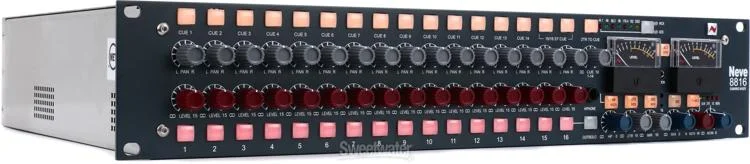
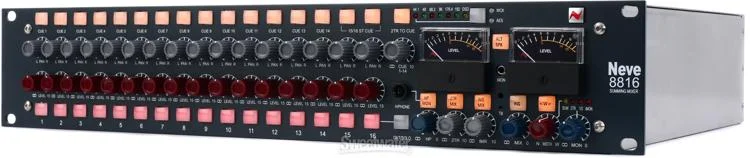
16 feature-packed channels of classic Neve character
The AMS Neve 8816 is centered around a feature-rich 16-channel analog mixer. Each channel boasts a line-level input with a rotary Level control, a rotary Pan control, a Cue button, and a Cut/Solo button. The Level knob, which accommodates both +4dBu and -10dBV sources, ranges from ∞dB to +15dB with 0dB set at approximately 12 o’clock. The Pan knob offers smooth, progressive operation with -3dB center attenuation. The Cue button sends the channel’s input, pre-fader, and pre-pan to the 8816’s cue mix. Channels 1–14 are individually switchable to the cue mix, while Channels 15–16 are stereo linked. At Sweetwater, we’ve found channels 15–16 incredibly useful for playback of a rough 2-track artist mix while overdubbing. The Cut/Solo button enables you to mute or solo a track. Since the 8816’s solo system is latching, you can also build solo groups, then use the master Cut/Solo button to audition or mute a group — a must-have feature when comping or sorting out EQ or balance problems.
A full-blown Neve console in a 2U rackmount format
The sheer number of the 8816's mix send/return options is enough to make your head spin, in a good way. Place a stereo compressor, EQ, or other processing across your entire mix, or create a parallel return for New York-style compression. Access high-end, mastering-studio-level stereo image enhancement with the Width control. Route the 8816’s 2-track return to its cue mix, or replace your headphone cue mix with the main monitor mix. The insert return and 2-track return feature independent level controls, providing you with near-endless customization. You can also put the 8816’s sends/return in Mid-Side mode. There’s even a hidden talkback mic that you can engage with a push of the 8816’s headphone level knob. With all of this complexity, you may be concerned that you’ll lose your settings. Don't worry: the 8816’s USB port allows for easy recall of your settings via control software on your Mac or PC. And if you need more inputs, you can cascade up to 32 units for up to 512 channels.
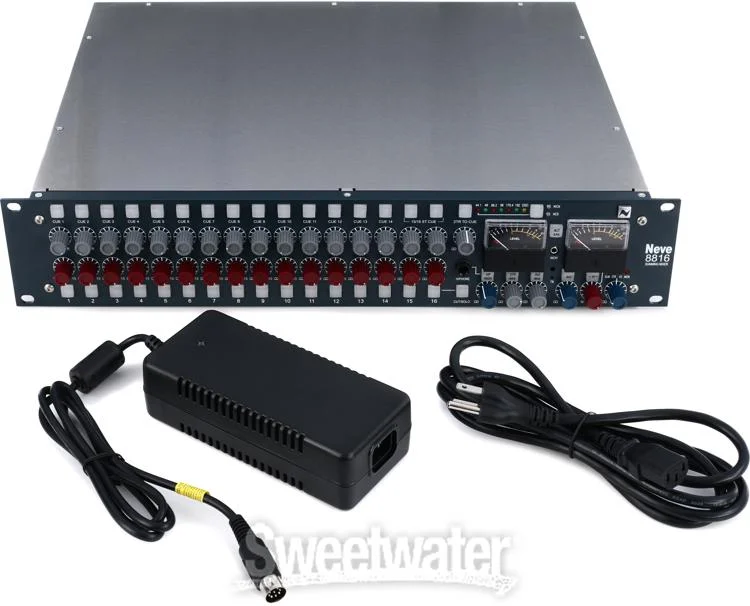
Comprehensive monitoring section
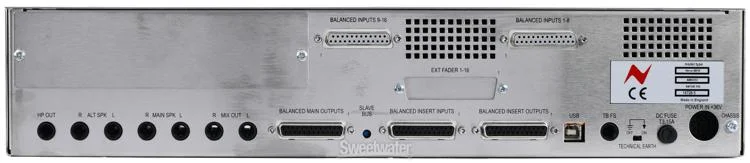
The AMS Neve 8816’s comprehensive monitoring section puts it at the very heart of your studio. You get four monitoring sources: the 8816’s 2-track return, channels 1/2 (pre-fader), its auxiliary input, and your main monitor mix. A Mon Level knob allows you to calibrate your mixing levels (we recommend aiming for 85dB), while a Mix Level knob controls the output level to your DAW. Main/alternate speaker outputs enable you to reference your mixes on a second set of studio monitors. The 8816’s dual headphone outputs are wired in parallel, one on the front panel and the other on the rear, where there are also balanced line outputs for feeding a separate headphone amp. You also get two quasi-PPM VU meters fed from the 8816’s main outputs, along with analog and digital clip indicator LEDs.
The legend continues
At Sweetwater, the name Neve commands reverence. Rupert Neve started designing audio equipment in the tube console era but made his mark with solid-state designs. Setting up shop in Little Shelford in the ’60s, Mr. Neve faced many obstacles establishing his brand amid a new technological landscape. Transistors were new, expensive, and difficult to obtain in quantity in the UK. Reliable faders didn’t exist yet — a far cry from today’s world, where parts are affordable and readily available from multiple suppliers, all competing to win bids. Nevertheless, Rupert persisted. And by the early 1970s, the Neve company was humming along, taking orders and building custom transformer-balanced consoles for recording and broadcast studios the world over.
Neve 80-series consoles had a huge, punchy, and authoritative sound that defined the sound of ’70s rock. From London to New York to Los Angeles and beyond, top studios were installing Neve desks as fast as they could. By 1978, with the introduction of the majestic 8078 — the pinnacle of handwired analog “production” consoles — and NECAM automation system, Neve boards were the main component of the success formula for any recording studio with world-class aspirations. In the decades since, AMS Neve has innovated with groundbreaking products such as the VR, VX, and 88R series consoles. And today, the company continues to advance the state of the art with cutting-edge pro audio gear that sounds incredible and intelligently addresses the challenges of the digital age.
AMS Neve 8816 Summing Mixer Features:
- Packs the sound and functionality of a Neve console into a 2U rackmount unit
- Contains genuine Neve 80-series topology, including 2 custom Marinair transformers
- Ideal for tracking, overdubbing, submixing, summing, and mastering alike
- 16 channels of analog summing add color and vibrancy to every project
- Each channel boasts rotary Level and Pan controls, plus Cue and Cut/Solo buttons
- Mix insert points for adding effects to individual channels
- Comprehensive cue mixing for creating custom-tailored headphone mixes
- Main stereo insert send/return for adding processing to your mix bus
- Width knob supplies high-end-mastering-studio-level stereo image enhancement
- Main/alternate speaker outputs enable referencing on a second set of studio monitors
- 2-track return, auxiliary input, and dual headphone outputs
- Sends/returns boast a Mid-Side mode for added flexibility
- Hidden talkback mic is engaged with a push of the headphone level knob
- 2 quasi-PPM VU meters for the main outputs, plus analog and digital clip indicator LEDs
- USB port allows for recall of your settings via control software on your Mac or PC
- Cascade up to 32 units for up to 512 channels
- 8804 Fader Pack gives you tactile, hands-on control over your mix (sold separately)
- Digital I/O option provides A/D conversion (option card sold separately)
| 20 canali (16 mono e 2 stereo) con ingressi combo jack 1/4/XLR - 22 tracce di registrazione simultanea e 20 tracce di playback - 22in/4 out USB come interfaccia - 6 monitor out - uscita cuffie con jack da 1/4 - phantom su tutti i canali XLR a gruppi di 4 - ingresso Hi-z sui canali 1 e 2 - pad di 26dB - compressore sui canali da 1 a 16 - tasto master mute - low-cut 40-600 Hz. 12dB/OCT - stereo panning - master e monitor out (A-F) - fino a 9 scene salvabili - doppio processore effetti regolabili - class compliant con sistemi iOS - App iOS per controllo a distanza tamite BTA-1 Bluetooth adapter (incluso) - registrazione su SD card (fino a 24bit/96kHz) o su PC/MAC come scheda audio - Rack ears incluse
Dimensioni: Lunghezza 55.5cm - Profondità 23.7cm - Altezza 43.6cm - Volume 0.057m³
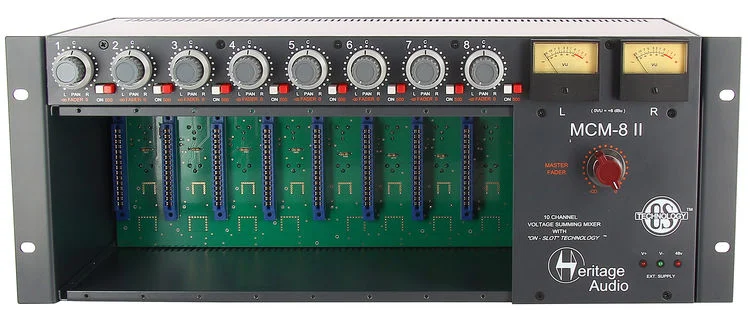
Zoom # L-20R - Mixer digitale 20 canali. recorder e interfaccia audio - formato rack # P.A. / Mixer # Serie LiveTrack | Heritage Audio's MCM-8 MK2 is an 8-slot 500 Series chassis with an integrated 10-channel summing mixer. The top-of-the-line MCM-8 MK2 features On Slot Technology that leverages next-generation power electronics to handle power supply on a per slot basis. Each slot has its own power supply linear regulation stages, isolating each module from the rest. Your modules simply share the metal enclosure. Each slot even has test LEDs for checking correct power operation. Dual-concentric potentiometers handle Volume and Pan for each slot, with pan pots being center detented for precise center positioning. Each channel is equipped with an On switch to assign it to the mix bus. MK2 improvements include a lower noise floor and the addition of a bypass switch for each slot that still lets you use the summing mixer functions. Heritage Audio has earned the respect of Sweetwater engineers, and the MCM-8 MK2 lives up to that sterling reputation.
Superb build and feature set
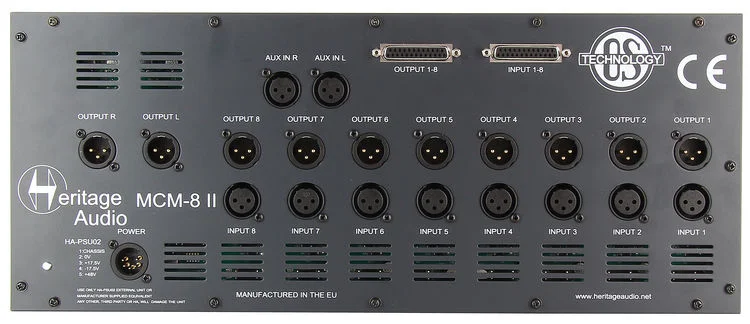
From its RAF blue-gray enclosure to the solid tactile feedback from its knobs and switches, the Heritage Audio MCM-8 MK2 unabashedly rocks vintage British Class A vibe. And just like the classic gear that inspires all Heritage Audio equipment, the MCM-8 MK2 boasts superb build quality and a very smart feature set. There's an additional stereo input on the back panel, which allows several MCM-8 MK2 units to be daisy-chained — or signals not needing further 500 Series processing to be mixed together. The central section sports analog VU meters and a Stereo Master fader. Gold-plated XLRs and DSUB25s handle the I/O.
Smart technology, superior sound
Thanks to Heritage Audio's On Slot Technology (OST), the MCM-8 MK2's power capability is a maximum of 400mA per rail, per slot — with an overall of 1.4A (1.6A non-continuous) per rail, whichever is reached first. Total available phantom power is 140mA. The mix bus has a passive voltage summing topology, similar to that found in Rupert Neve's 80 Series consoles of the 1970s. The gain loss is restored by the same Class A, 2n3055 driven, transformer-based output stage used in the Heritage Audio's modern-day version of the classic 1073. If you're not into specs, what this all means is that the MCM-8 MK2 is built right to give you many years of authoritative sonic performance and trouble-free use in your studio or on the road.
Heritage Audio MCM-8 MK2 Features:
- 8-slot 500 Series chassis with integrated 10-channel summing mixer
- NEW lower noise floor
- NEW bypass switch for each slot that leaves summing mixer functions enabled
- Mix bus with vintage Neve-style passive voltage summing topology
- Additional stereo input on the back panel allows several MCM-8s to be daisy-chained
- Central section sports analog VU meters and a Stereo Master fader
- Handles power supply on a per slots basis, isolating each module from the rest
- Gold-plated XLRs and DSUB25s handle your I/O
- 140mA total available phantom power
- Class A transformer-based output stage
- Solid build quality for many years of trouble-free use
| Midas Pro2C. Brand new, full Midas warranty.
Compact Live Digital Console Control Centre with 64 Input Channels, 8 Midas Microphone Preamplifiers, 27 Mix Buses, 96 kHz Sample Rate and Touring Grade Road Case
Shipping will cost extra based on buyers location. If purchased without an agreement in place, buyer will be responsible for organizing their own pickup or shipping. |










Reviews
There are no reviews yet.