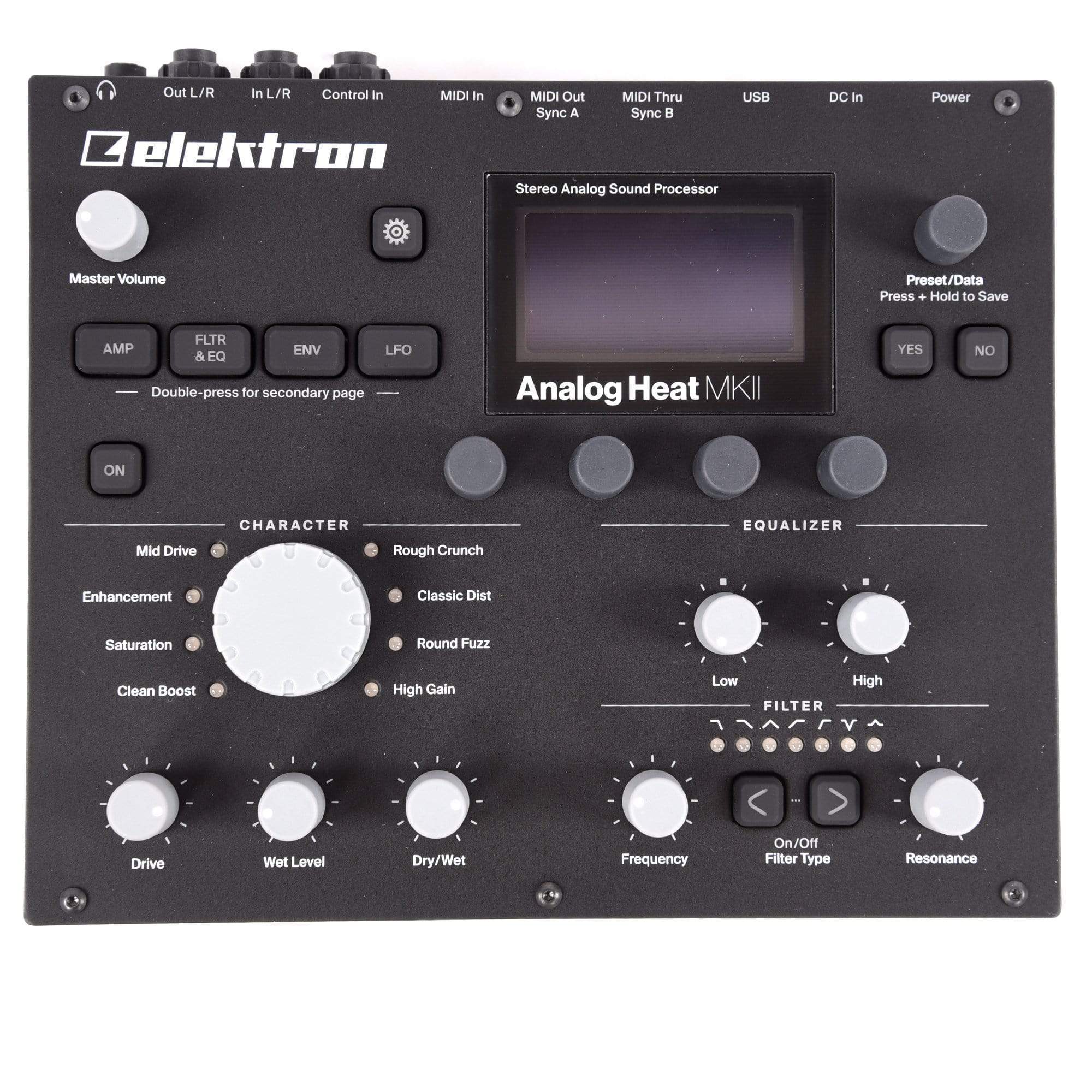
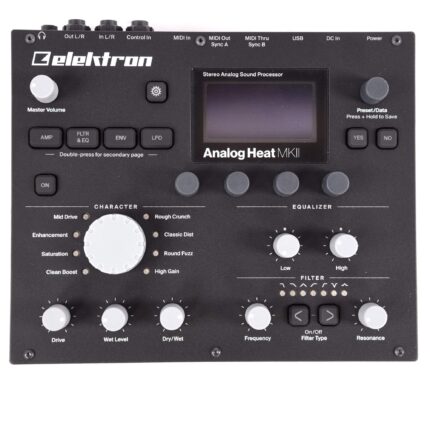
| Content | Add sparkly brilliance, or grimy roughness, to any sound source. Samplers, drum machines, synths, the master bus, you name it. Analog Heat MKII is a fiery furnace destined to make your music glow.
Sound better
Take a sound, any sound. Send it through the Analog Heat MKII, try out the eight different stereo analog distortion circuits, add stereo analog filtering and EQ, and hear beautiful things unfold. New life for your existing gear.
All analog, all yours
The eight stereo analog circuits are designed to quickly access varied and powerful sound shaping. Each circuit has a distinctive way of processing sound. Clean boost, tape-like saturation, tube amp-like enhancement, overdrive, crunch, distortion, harmonic fuzz or high gain? You’ll find your favorite flavor with ease.
Brighter and better
The MKII version of the Analog Heat features improved durability and precision encoders, new tough back-lit keys and a crisp OLED screen. The display is bigger, sharper and brighter: perfect for performing in the dark. There is also additional visual feedback on the Amp, Filter, Envelope and LFO pages that makes overview and understanding of sound processing and modulation a whole lot easier.
Sound processing
- 8 × Stereo analog distortion circuits
- 1 × Stereo analog multi-mode filter (7 filter types)
- 1 × 2 band adaptable stereo analog EQ
- 1 × Assignable envelope generator/envelope follower
- 1 × Assignable LFO
Storage
Hardware
- 128×64 pixel OLED screen
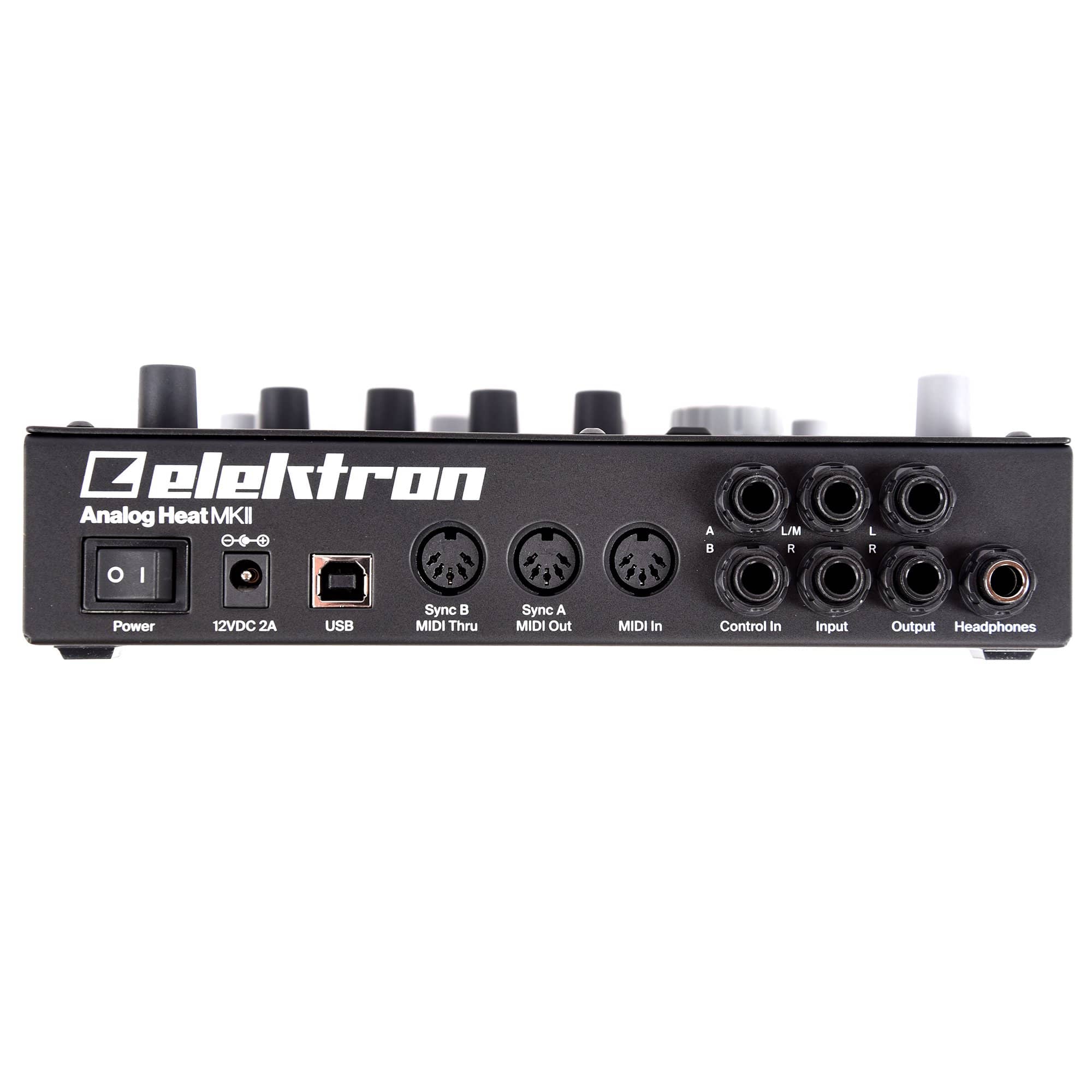
- MIDI In/Out/Thru with DIN Sync out
- 2 × ¼″ balanced audio out jacks
- 2 × ¼″ balanced audio in jacks
- 1 × ¼″ stereo headphones jack
- 2 × ¼″ CV/Expression pedal input jacks
- 48 kHz, 24-bit D/A and A/D converters
- Flash-EEPROM upgradable OS
- Hi-speed USB 2.0 port
Audio outputs
- Headphones out level: +19 dBu peak
- Headphones output impedance: 36 Ω
- Impedance balanced main outputs level: +19 dBu peak
- Main outputs impedance: 440 Ω unbalanced
Audio inputs
- Balanced audio input level: +19 dBu peak
- Audio input impedance: 39 kΩ
Control inputs
- Input level: -5 V – +5 V
- Accepts CV, Expression pedals, Foot switches
Physical specifications
- Sturdy steel casing
- Dimensions: W215×D184×H63 mm (8.5×7.2×2.5″) (including audio outputs, knobs and rubber feet)
- Weight: approximately 1.5 kg (3.3 lbs)
- 100×100 mm VESA mounting holes
Included in the box
- Power Supply PSU-3b
- Elektron USB cable
Analog Heat MKII and Overbridge
Any DAW user will love Analog Heat. It is perfect for adding analog warmth and grit to digital audio. Suitable on individual tracks as well as on the master bus. It can also double as a sound card, making it perfect for the nimble studio.
- Control your Analog Heat with audio and sync using a dedicated VST/AU
- plugin
- Process DAW audio with beautiful analog stereo filtering and distortion
- Mid/Side mode lets you expand audio processing possibilities
- Analog Heat MKII can be used as a 2 in/2 out sound card
- (CoreAudio/ASIO/WDM)
- Use Analog Heat as a separate sound card, all while using the other features
- of the instrument
- Total Recall remembers all Analog Heat settings when loading a DAW project
| The vintage EQ tones you know & love.
The 551 is the only equalizer for the 500 Series actually designed by Rupert Neve. Featuring 3 bands of EQ inspired by Mr. Neve’s most prized vintage designs, along with custom-wound inductors, transformers and class-A gain blocks, the 551 brings the thick, powerful lows and sweet highs of Rupert’s classics to the 500-Series format.
The “Best-Of” EQ
The 551’s 3-band, custom-tapped inductor EQ was inspired by our favorite elements of Rupert’s vintage EQ designs. The low frequency band is designed to produce a creamy, resonant bass response similar to a vintage 1064 – but unlike the vintage modules, the LF band on the 551 can be used as either a shelf or a peak filter, adding punch, dimension, and control to your low end.
The midrange band is based on that of the 1073, ideal for sweetening vocals and instruments while bringing them forward in a mix, and its proportional “Q” response makes it well-suited for minimizing problematic frequencies. The high frequency band is a hybrid vintage / modern design, blending inductor circuitry with capacitor-based topologies to achieve vintage tones with enhanced control. The High Pass filter is a 12dB/octave design with a fixed 80Hz frequency, and can be used in tandem with the low frequency EQ to add low-end presence without clouding the source material.
As with Rupert’s most prized classic designs, each EQ section uses low-feedback, class-A discrete electronics to prevent low-level artifacts and harshness from detracting from the tonal shaping. However, this new circuit is a decidedly modern design with updated techniques and components that were simply not available 50 years ago, and is definitely not a “clone”.
What Are Inductors?
Inductors are wires wound around a coil that provide a form of frequency-dependant resistance. When they saturate, they bring out beautifully musical harmonics that give your tracks the smooth, polished sound that has made Rupert’s consoles and equipment so desirable for over fifty years. This is what makes them different from capacitor-based EQ designs, which do a great job at surgical equalization. But inductors provide the tone.
While it is certainly possible to create a functioning EQ using off-the-shelf inductors, we choose to use our own custom inductors for the 551. This attention to detail in controlling variables such as the winding and core materials in relation to the surrounding circuitry allows the 551 to capture the vitality and personality of Rupert’s classic designs.
NOISE
- Measured at Main Output, un-weighted, 22Hz-22kHz, source impedance 40 Ohm balanced.
- Better than -102 dBV
FREQUENCY RESPONSE
Main output, no load: +/- 0.1 dBu from 20 Hz to 31.5 kHz, -1 dB @ 120 kHz
MAXIMUM OUTPUT LEVEL
23.25 dBu
TOTAL HARMONIC DISTORTION AND NOISE
- @ 1 kHz, +20 dBu output level, no load: Better than 0.0025%
- @ 20 Hz, +20 dBu output level, no load: 0.13% Typical (2nd and 3rd harmonic)
HIGH PASS FILTER
- -2.7 dB @ 80 Hz
- Slope: 12 dB/Octave
NOISE
- Measured at Main Output, un-weighted, 22 Hz - 22 kHz, source impedance 40 Ohm balanced.
- Better than -94 dBV
FREQUENCY RESPONSE
Main output, no load: +/- 0.25 dBu from 20 Hz to 45 kHz, -2 dB @ 120 kHz
MAXIMUM OUTPUT LEVEL
23 dBu
TOTAL HARMONIC DISTORTION AND NOISE
- @ 1 kHz, +20 dBu output level, no load: Better than 0.009%
- @ 20 Hz, +20 dBu output level, no load: 0.13% Typical (2nd and 3rd harmonic)
POWER REQUIREMENTS
- 120mA on +16VDC
- 110ma on -16VD
| Effective against boredom, supporting creative sound design
A unique team play of spring reverberation, analogue multimode filtering, distortion and VCA, modulated by an ultra fast LFO and an envelope that can be triggered in flexible ways – Retroverb Lancet offers a comprehensive arsenal of many-sided effects for different applications. The spectrum by far surpasses classic reverberation, filter sweeps or overdrive because you are able to tweak and bend any parameter fast and intuitively to your liking.
Retroverb Lancet will change the way you work with effects. It becomes part of your sound engine, fires it up and will end up as essential part of your sonic signature.
Source of effectiveness
We designed Retroverb Lancet in a way that it can perfectly handle signals of any kind: Guitars, basses, synthesizers, organs or microphones. On top of that, Retroverb Lancet allows you to create percussive sounds using its crash function.
Retroverb Lancet is a real jack of all trades with character, suited for adventurous sound designers and tinkerers.
Audio Input
- max. input sensitivity: –32 dBu
- impedance: 1 MΩ
Output
- max. output level: 20 dBu
- impedance: 600 Ω
Trigger- and CV-inputs
- audio trigger
- max. input sensitivity: –32 dBu
- impedance: 1 MΩ
- gate & CRASH
- external cv
Signal-to-Noise Ratio
- direct: > 80 dB
- effect (filter completely open, no reverb): > 75 dB
Spring Tank
- number of springs: 3
- reverbration decay: between 2.75 db and 4.00 s
Filter
- modes: 24-db-lowpass, 24-db-highpass, 12-db-bandpass
- modulations sources: envelope generator, envelope follower, external CV, LFO
LFO
- frequency range: 0.05 Hz … 300 Hz
- waveforms: ramp up, ramp down, square, sine, S&H, envelope generator
Envelope Generator
- modes: AD, ASR
- attack: 1 ms … 10 s
- decay/release: 1 ms … 15 s
Miscellaneous
- power supply: external DC-adapter with 12 V/1000 mA
- dimensions: 26 cm x 14.5 cm x 8 cm (width x depth x height)
- weight: 0.75 kg
Accessories
| The Suhr Reactive Load delivers a simple solution to capture all of the warmth, and dynamics of your sound, without the hassle of miking a speaker cabinet during a live or recorded performance.
The Reactive Load takes the place of your speaker cabinet in your signal chain. It provides an 8Ω load for your tube amplifier (maximum 100 watts), and produces a balanced and unbalanced signal that interfaces with recording devices, effects, and power amplifiers.
The Suhr Reactive Load is the perfect link between your amplifier and computer audio recording interface. You can use the Reactive Load with your existing library of speaker impulse responses (IR) for the most realistic direct recording experience possible.
Traditional resistive load boxes will safely load your amplifier, but they also alter the tone, dynamics, and response of your amplifier. Real speakers do not have a fixed resistance across the entire frequency spectrum. Real speakers are reactive.
The impedance curve of the Reactive Load has been painstakingly tuned to react like a speaker. Your amp will never know the difference.
The Reactive Load is dedicated to being the absolute best load box possible with zero compromises, and therefore does not include speaker emulation. You can use the Reactive Load with your speaker-sim or impulse response of choice, and benefit from the natural response, dynamics, and touch sensitivity of your amp.
The Suhr Reactive Load features a balanced or unbalanced line level output. The INPUT is optimized for the 8 ohm output of your amplifier and the THRU jack can be connected to a physical speaker cabinet. If a physical cabinet is connected to the THRU jack, the Reactive Load’s internal load is bypassed and the amp will see the load of the physical cabinet.
SPEAKER INPUT IMPEDANCE: 8 Ohm
DI / LINE OUT LEVEL: +4 dBu at 7 watts input, maximum level setting
BALANCED LINE OUTPUT IMPEDANCE: Less than 6KΩ
UNBALANCED LINE OUTPUT IMPEDANCE: Less than 6KΩ
MAXIMUM RECOMMENDED INPUT POWER: 100 Watts RMS
ROHS COMPLIANT: Yes
DIMENSIONS: 8.8" (W) x 8.9" (D) x 3.6" (H)
WEIGHT: 6.6lb
| Proven reverberation classic for the future
With the VSR 3.2, we happily rely on the proven old mechanical way to create reverberation. Rightly, because the used reverberation spring by AccuBell (formerly Accutronics) creates that magic 60's reverb which is slightly metallic and dense at the same time.
Just like it predecessors, VSR 3.2 has a straight-forward and honest approach: signal in - spring reverb - vintage sound out.
VSR 3.2 is equipped with an equalizer that is exactly adapted to the springs' frequency response. In addition, there are controls to mix the dry and effect signal as well as controls for the input and output level. This way, VSR 3.2 simply exactly does what it was designed to do.
Designed for every situation
Although using a large spring (type 9), VSR 3.2 fits in a 19" housing with one rack unit – minimal space requirements. Thanks to its extremely solid chassis, VSR 3.2 is a reliable vintage-effect that cannot only be used in a controlled studio environment. On the contrary, it also serves fine when being used in straining live situations.
VSR 3.2 grants your sound an elegant touch of "good old times". Its simplicity makes it an unbelievable versatile companion.
Inputs
- 1/4"-jack input front
- unbalanced
- max. input sensitivity: –40 dBu
- impedance: 1 MΩ
- 1/4"-jack input rear (1)
- unbalanced
- max. input sensitivity: 0 dBu
- impedance: 100 kΩ
- 1/4"-jack input rear (2)
- unbalanced
- max. input sensitivity: –20 dBu
- impedance: 10 kΩ
Outputs
- 1/4"-jack output (1)
- unbalanced
- max. output level: 0 dBu
- 1/4"-jack output (2)
- unbalanced
- max. output level: - 20 dBu
Signal-to-Noise Ratio
- direct: > 80 dBu
- effect: > 70 dBu
THD + Noise
Miscellaneous
- power supply: external DC-adapter with 12 V/1000 mA
- dimensions: 19“, 1 HE, ca. 190 mm deep
- weight: 2.5 kg
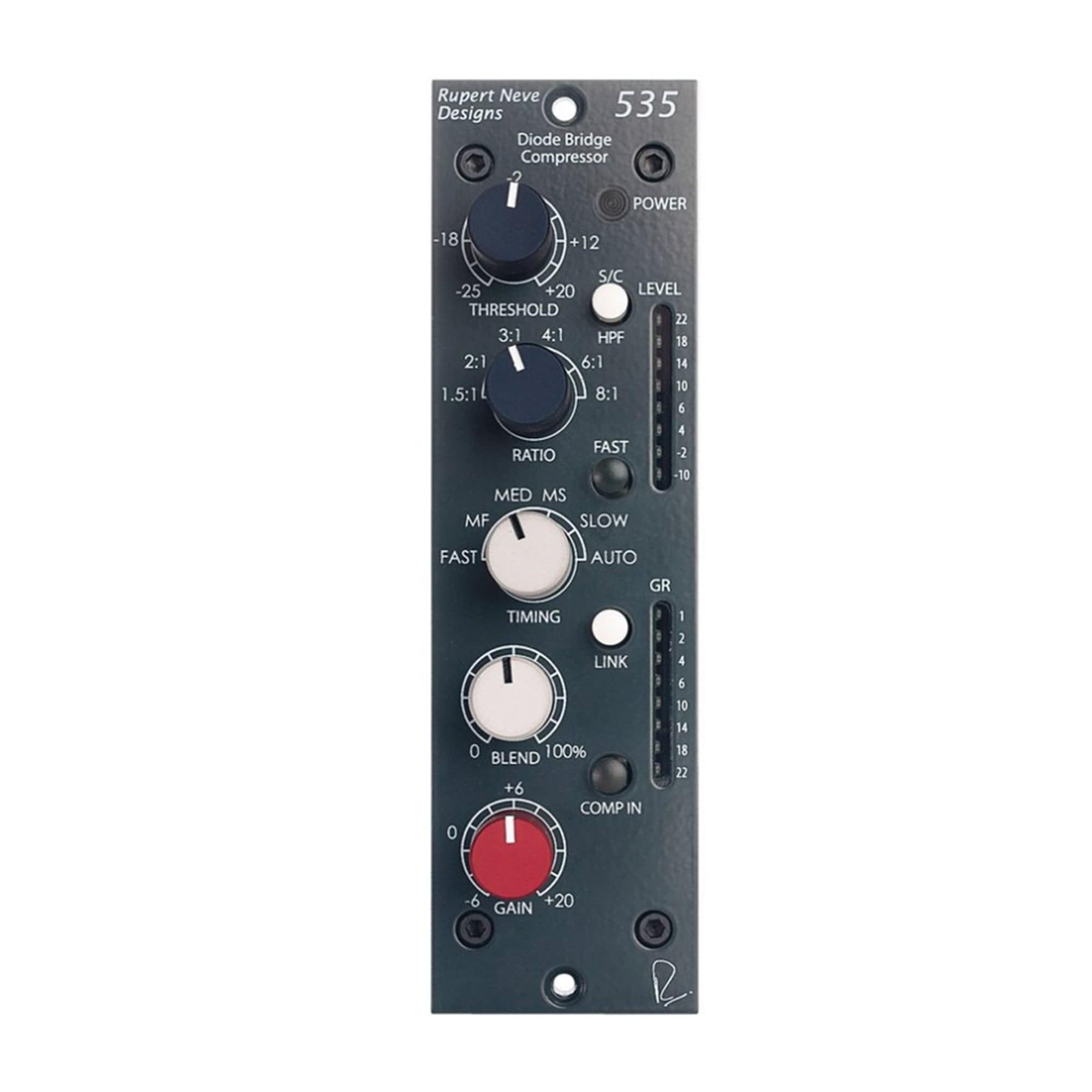
| Originally developed for the dynamics circuit of the acclaimed Shelford Channel, the 535 Diode Bridge Compressor captures the soul of Rupert Neve’s original 2254 compressor while providing modern updates including advanced timing control, significantly lower noise, fully stepped controls throughout, and internal parallel processing capabilities.
What is diode bridge compression?
Where the VCA compressor found in the Master Buss Processor provides unmatched clarity, the weighty, harmonically rich tonality of diode bridge compression can be essential in pushing key sources like vocals, electric guitars, bass and drums to the forefront of a mix.
By understanding the limitations of vintage units like the legendary 2254, painstaking effort was taken to reproduce the unique tone of these classics while improving the noise floor & accuracy, expanding inflexible time constants, adding full wave sidechain detection for improved dynamic response, and widening the range of threshold and ratio controls.
Delivering the powerful sound of these iconic designs with enhanced flexibility for the modern age, the 535 Diode Bridge Compressor is a dynamic tool equipped to make a bold statement on virtually any mix or track.
LINE INPUT TO LINE OUTPUT
- Compressor Bypassed.
- Z source = 40 Ohm Balanced
INPUT IMPEDANCE
10K Ohm
OUTPUT IMPEDANCE
40 Ohm
MAXIMUM INPUT LEVEL
+23.5 dBu
MAXIMUM OUTPUT LEVEL
+23.5 dBu
NOISE
- 22 Hz - 22 kHz BW.
- -101 dBu
FREQUENCY RESPONSE
- 10 Hz - 120 kHz, 30ft Output XLR Cable.
- +/- 0.25 dB
THD+N
- @ 1 kHz @ Maximum Output Level, 22 Hz - 22 kHz BW.
- 0.001%
|






Reviews
There are no reviews yet.