| Content | As with ELI’s other signal processors, the Lil FrEQ Equalizer takes a somewhat unique approach to its job. Instead of daisy chaining several equalizers and frequency processors, we combined most of the sound sculpting tools an engineer needs into a compact single rack space box, while still offering the highest performance of any design in its class.
Eight Sections of Processing
There are eight sections of processing – what other EQ offers that? Even better – in addition to a master bypass, each of the Lil FrEQ’s sections features its own dedicated bypass switch, letting you instantly A/B the effect of each section as you adjust and fine-tune them.
HIGH PASS – The High Pass section is a really easy to use sharp filter that cuts all content below one of eight preset frequencies from 30-330 Hz. This filter is very steep and has a special shape that prevents frequencies from thinning out just above the cutoff point. The corner frequency is selected using up/down buttons, and indicated by LEDs that glow softly when the section is bypassed, and brightly when the section is engaged.
HIGH & LOW SHELVING – These two knobs function similarly to the familiar “bass and treble” tone controls found on many consumer audio playback systems; however, these are designed to a much higher performance standard, providing exceptionally smooth and musical boost and cut on the high and low frequencies.
PARAMETRIC EQ – The Lil FrEQ has four sections of fully parametric EQ (LF, Lo Mid, Hi Mid and HF), with each section featuring individual gain, bandwidth (Q) and frequency controls. It may be the cleanest parametric EQ section ever produced, operating below .0007% THD (Total Harmonic Distortion) even at extremely high audio levels. Try finding those specs anywhere else!
DS (DYNAMIC EQ) – The DS section provides the highest performance, easiest to use, and possibly most natural sounding “De-esser” ever built. This powerful tool combines tunable filters with a compressor-like circuit that can help contain and control excessive high frequency content such as sibilants or other sharp transients, especially in the absence of other lower frequency content. It can also function as a one of a kind soft knee High Frequency limiter, which is one of the main things responsible for the Lil FrEQ becoming the go-to vocal EQ for engineers everywhere. It has been used on many acclaimed albums and major live performances all over the world, becoming the “go to” EQ for key tracks like lead vocals, snares, and bass. There are now dozens of hit record vocals that were processed thru the Lil FrEQ.
Frequency Response: 5 Hz to 140 kHz on transformerless inputs and outputs. Transformer output 10Hz to 110 kHz.
Dynamic Range: 120 dB from maximum output (.1% clipping) to minimum output. Greater than 110 dB signal to noise.
Distortion: Ranges between .00056% and .005% depending on mode and settings. DS section has THD < .005%.
I/O: DC coupled inputs and outputs and one transformer coupled output.
Dynamic Time Constraints: Attack is approximately .5 ms. Release .04 sec fixed internally.
Power Consumption: 15 Watts Max.
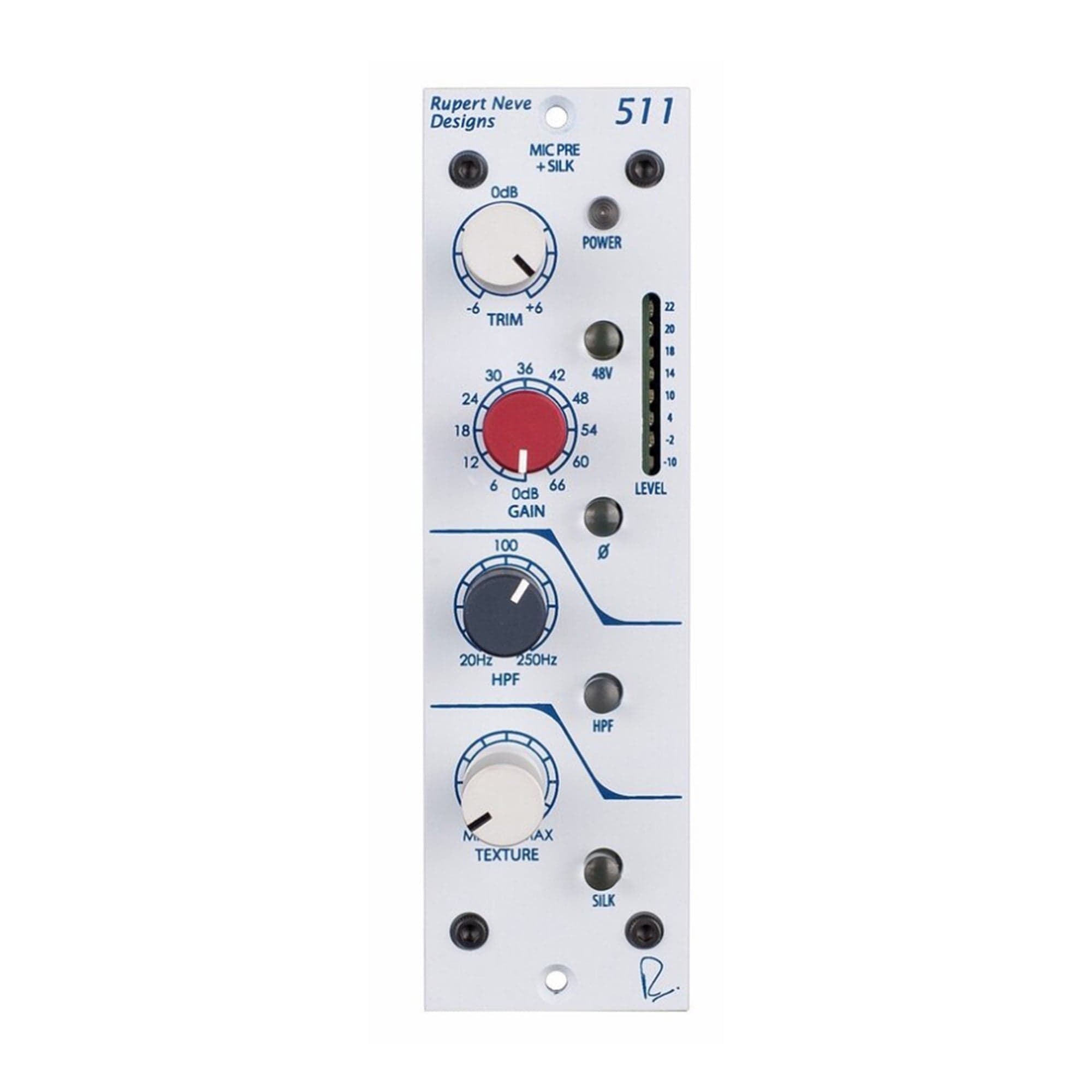
Metal Chassis: single height 1.75″ high, 10″ deep, 19″ wide. | With a big, bold preamp, a swept high-pass filter and the powerful saturation control of variable Silk, the 511 combines legendary Rupert Neve tone with 500 Series value.
What is Silk?
One of the key features of the 511 is the Silk / Texture control. The Silk circuit was initially developed for the original Portico series mic preamplifiers, and was only a single switch – on or off – that added a specified amount of musical, pleasing harmonic saturation to the unit’s output stage.
Taking this concept one step further, the Texture knob is designed to adjust the actual amount of harmonic content from the source material.
So how does it work? By reducing negative feedback across the output transformer and adjusting this feedback’s frequency response, the Silk / Texture circuit provides the sweet, musical saturation found in Rupert’s legendary vintage designs – but with complete & precise control over the amount of classic tone you want.
NOISE
- Measured at Main Output, un-weighted, 22 Hz - 22 kHz, source impedance 150 Ohm balanced. Noise performance can vary depending on the 500 series and / or interference from stray magnetic fields.
- Unity Gain: Better than -103 dBV
- Gain @ +66 dB: Better than -60 dBV
- Equivalent Input Noise: -125 dB
FREQUENCY RESPONSE
- Main output, no load.
- +/- 0.1 dBu from 10 Hz to 31.5 kHz
- -2.6 dB @ 120 kHz
MAXIMUM OUTPUT LEVEL
+23 dBu
TOTAL HARMONIC DISTORTION AND NOISE, NO SILK
- @ 1 kHz, +20 dBu output level, no load: Better than 0.0025%
- @ 20 Hz, +20 dBu output level, no load: 0.025% Typical (2nd and 3rd harmonic)
TOTAL HARMONIC DISTORTION AND NOISE WITH SILK ENGAGED
- @ 100 Hz, +20 dBu input level, no load.
- TEXTURE @ min: 0.015%, mostly 3rd harmonic typical
- TEXTURE @ max: 2%, mostly 2rd harmonic typical
GAIN
- Unity up to +66 dB in 6 dB steps.
- Trim continuously adjustable from -6 dB to +6 dB.
PHANTOM POWER
Supplied by the 500 series rack power supply. Switch selectable on faceplate.
HIGH PASS FILTER
- Continuously variable swept frequency from 20 Hz to 250 Hz.
- Slope: 12 dB/Octave
POWER REQUIREMENTS
@ +/-16VDC, 100mA | In today’s modern age of digital recorders, DAWs and software plug-ins, Mike-E is the ultimate solution for getting a clean and strong, yet warm and musical signal into the box…and it couldn’t be easier to work – its front panel layout is so straight ahead that even inexperienced engineers will have no problem moving around on it right away.
When the engineering team at Empirical Labs sets out to build a microphone preamp, you can be sure it’ll deliver spectacular sound, be effortless to work, and will provide features unlike any other device in its class. To that end, we proudly present Mike-E, a high performance transformer-coupled mic preamp with a noise floor far below any microphone’s self noise, combined with a one-of-a-kind compressor/saturator circuit that delivers classic knee compression as well as versatile tonal ‘coloring’ that can replicate many of the best characteristics of vintage analog recording equipment.
Mic Preamp
The Mike-E features a super low noise transformer input amplifier section with the gain under precise digital control. The signal to noise far exceeds any microphone in existence. Having used many mic preamps over the years, we’ve implemented a unique stepped gain control that should be impervious to the normal flakiness that age causes to pots and detented switches. A “Bad!” LED indicates when the input signal is overloading the circuit.
CompSat
The CompSat’s unique circuitry sets the Mike-E apart from all other mic preamps.
- SATURATOR – a multi stage soft-clipping circuit. At lower levels, a triode-type saturation affects the signal. As the level increases, a second unique clip circuit starts to more severely flatten out the peaks.
- COMPRESSOR – based on ELI’s world famous Distressor, but with other characteristics (including a much longer attack time). Preset ratios include: 2:1, 4:1, 8:1…and, of course, Nuke.
- EMPHASIS – a two-stage circuit that boosts and soft clips high frequencies before the CompSat™ circuit, and then cuts the frequencies after it. Emphasis has the added perk of improving signal to noise, and is the reason analog tape decks used emphasis to begin with.
Frequency Response: 3 Hz to 200 kHz on (No CompSat). CompSat is 3Hz – 150Khz. Optional Transformer output is 6Hz–80kHz.
Signal to Noise: 130 dB signal to Noise.at 40dB gain. Maximum output is +28dBu.
Distortion: Ranges between .0006% and 15% depending on mode and settings.
I/O: Transformer coupled Input, Active and Transformer Outputs available. High quality audio caps used internally.
Impedance: Input Impedance is above 600 Ohms at all frequencies, transformer coupled. Output impedance is less than 38 ohms. Instrument In Impedance is 332K Ohms.
Attack/Decay Range: .9 – 70mS attack. .15 – 1 Sec.
Power Consumption: 15 Watts Max.
Metal Chassis: single height 1.75″ high, 10″ deep, 19″ wide. |
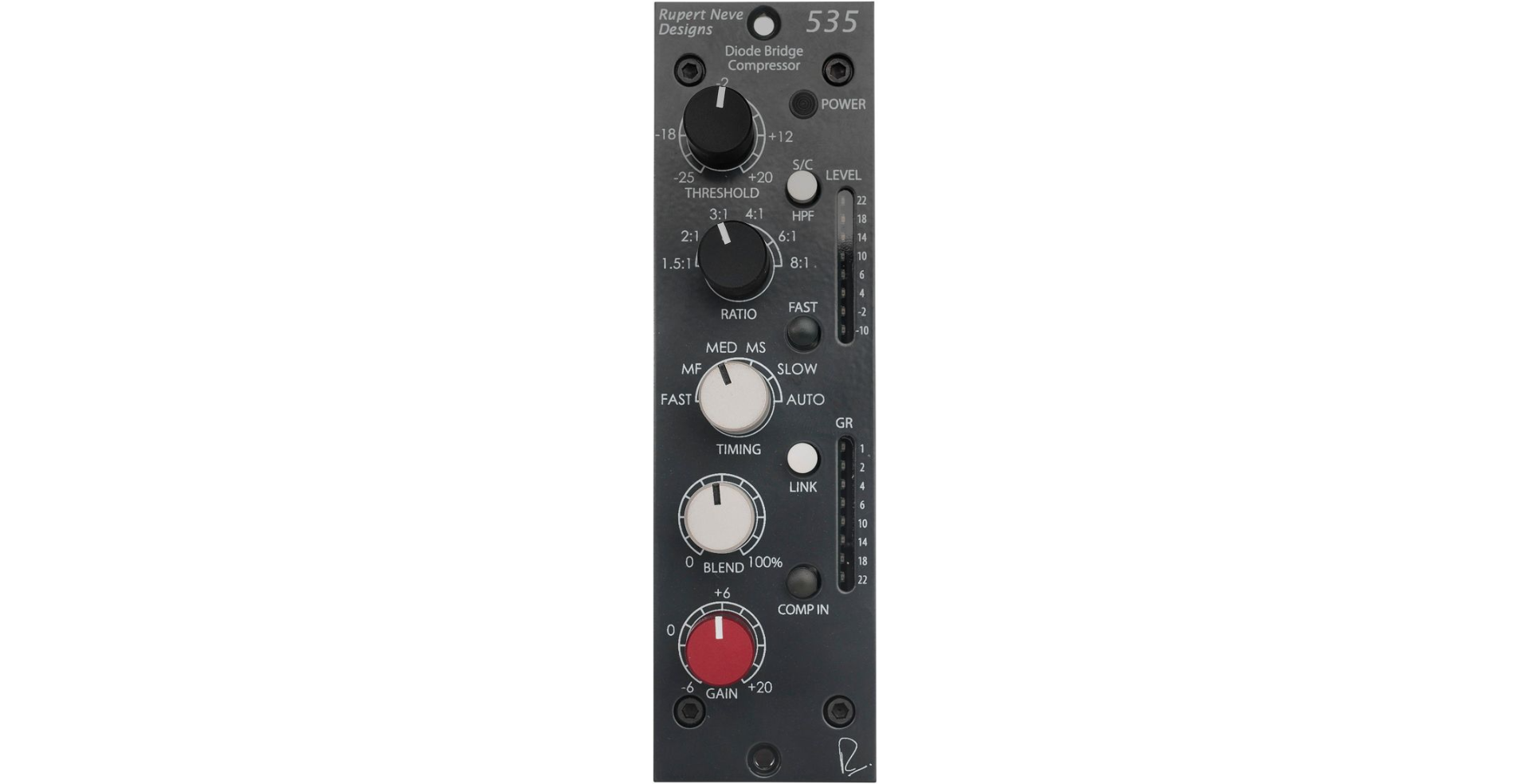
- FAST – Fast Attack (750us), Fast Release (130ms)
- MF – Medium Attack (2.25ms), Fast Release (130ms)
- MED – Medium Attack (2.25ms), Medium Release (400ms)
- MS – Medium Attack (4ms), Slow Release (725ms)
- SLOW – Slow Attack (10ms), Slow Release (1S)
- AUTO – Medium Attack (5ms), Dual Decay Release (T1 500ms, T2 1s)The LINK switch allows the compressor to be linked to another 535 compressor module via a sidechain control voltage. In link mode, the compressor generating the greater sidechain voltage (resulting in higher amounts of compression) will control the compression of both audio signal paths to maintain proper stereo center image while compressing. Note: it is advisable to always audition the unlinked sound as well, to decide if the benefit of a constant stereo center image is worth the potential trade-off of reduced left / right independence in the stereo field.
-
SIDECHAIN HPF
- The S/C HPF switch allows the user to insert a 12dB/octave 150Hz high-pass filter in the compressor sidechain. When this filter is engaged, the compressor will be considerably less responsive to information below 150Hz. For example: if used on a drum kit, the low end of the kick drum would have less proportional effect on the compression than a snare drum or cymbals, since a significant portion of the kick drum’s dynamic energy is focused below 150Hz.
LEVEL AND GAIN REDUCTION METERING
- These two LED meters provide accurate representations of both the output level of the compressor and the amount of gain reduction being applied to the input signal.
| Rackmount PG-X Power Conditioner with PG-90 Filtering Technology, Panasonic and Wima capacitors, eight rear switched, filtered and surge protected outlets, one front-panel switched convenience outlet and USB port for device charging.
Your gear deserves the best power, and we took great care in making sure the PG-X delivers just that — thanks to PG-90 Filtering Technology. In testing, this has provided an average of 90% of noise filtering, as opposed to the typical average of 76% found in other power conditioners at the same price point.
Confidence Inspiring Power
There’s nothing worse than scoring that “must-have” piece of gear, only to find that it’s noiser than should be expected, missing high frequency detail, or even worse — having it fried by power surges!
Black Lion Audio has been trusted for years for modifying the best gear and making it even better, and that’s what it took to create the PG-X: taking industry-standard designs, and improving them to the point of peak performance.
After creating the original PG-1, Black Lion Audio knew that plenty of professionals on a smaller budget felt left out, as some features might not be as important as an economy price-point. The PG-X was built with this in mind, while still providing best-of-class power conditioning!
High-end Filtering
Your gear deserves the best power, and we took great care in making sure the PG-X delivers just that — thanks to PG-90 Filtering Technology. In testing, this has provided an average of 90% of noise filtering, as opposed to the typical average of 76% found in other power conditioners at the same price point.
Professional Power
The PG-X features a bank of eight switched, filtered and surge protected outlets on the back panel. On the front panel, the PG-X sports one unswitched convenience outlet and a USB port for device charging.
It takes more than a few rack-mounted outlets to inspire true confidence in your power conditioner, and that’s where the PG-X delivers: best-of-class power filtering!
- Protects your gear from power-spike damage
- Provides clean, well-regulated power for optimum performance
- Features PG-90 Filtering Technology
- Top-drawer components and design for superior power and noise filtering
- Built with premium Panasonic and Wima capacitors
- Rugged 1U rackmount chassis
- 8 switched, filtered, and surge-protected outlets on rear panel
- 1 filtered convenience outlet on front panel
- USB port on front panel
Type: Rackmount
Number of Outlets: 1 x Front, 8 x Rear
Output Current: 15A
USB: 1 x Type A
Features: High frequency noise filter
Rackmountable: Yes
Power Source: Fixed AC cable
Height: 1.7″
Width: 19″
Depth: 9.8″
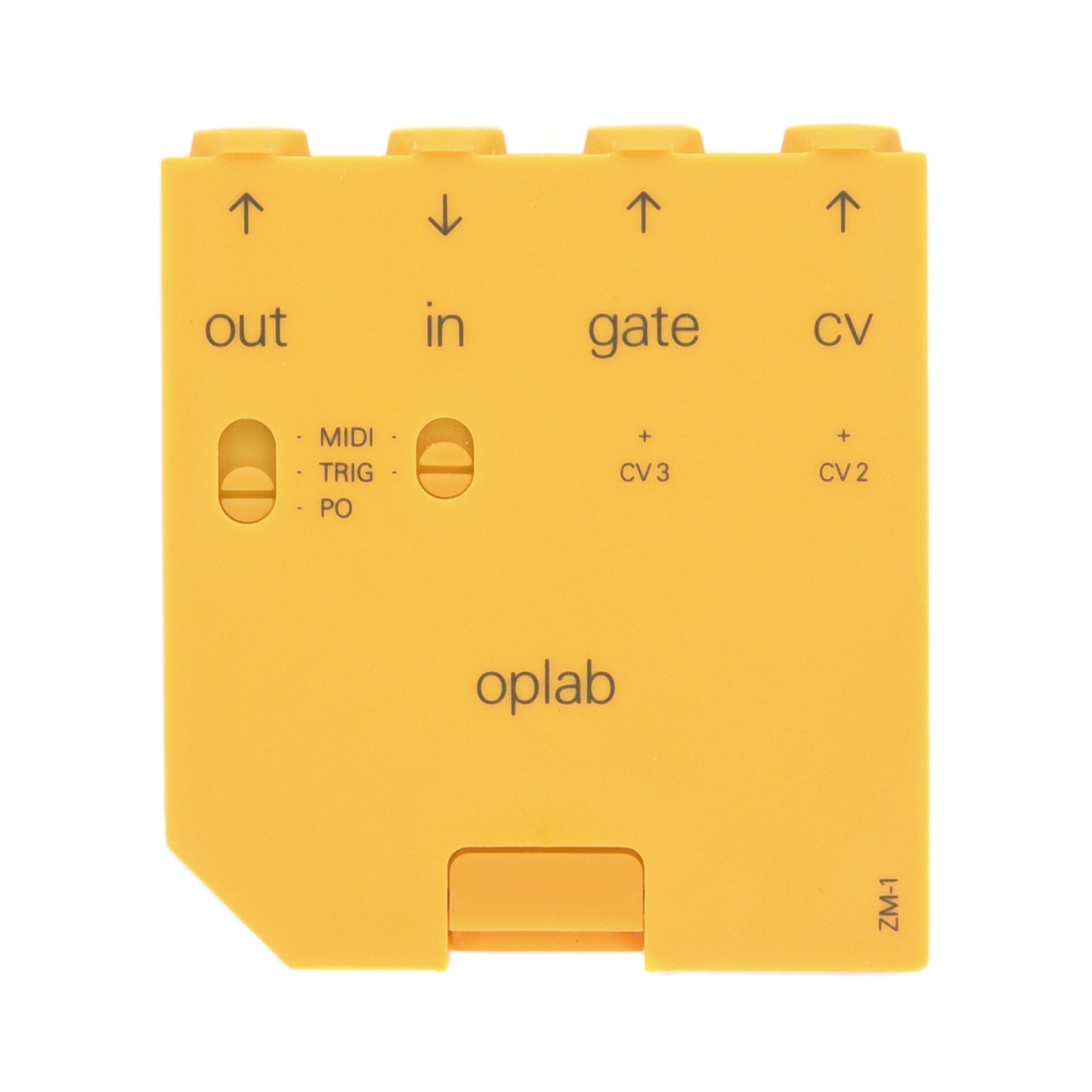
Weight: 3 lbs. | Imagine having the power and flexibility of the OP-Z sequencer available to any other music equipment. Now you can, with the new oplab module - the magic link between OP-Z and the rest of the world. The oplab module is the first hardware expansion module for OP-Z. once mounted in the back of your OP-Z, you can use it to connect to any equipment using standard cv and gate, such as the pocket operator modular or any other modular system. It features three cv outs and one gate out, all programmable and playable from OP-Z. have your wall of modules sequenced from the palm of your hands. Use the po sync out to unleash the power of your regular pocket operators and have them play in sync with the rest of your setup. Even connect standard midi devices, using midi over 3.5 mm jack or the included midi over din adapter cable. Oplab features both midi in and out ports as well as trig in and out for other synthesizers and sequencers. |







Reviews
There are no reviews yet.