| Content | As with ELI’s other signal processors, the Lil FrEQ Equalizer takes a somewhat unique approach to its job. Instead of daisy chaining several equalizers and frequency processors, we combined most of the sound sculpting tools an engineer needs into a compact single rack space box, while still offering the highest performance of any design in its class.
Eight Sections of Processing
There are eight sections of processing – what other EQ offers that? Even better – in addition to a master bypass, each of the Lil FrEQ’s sections features its own dedicated bypass switch, letting you instantly A/B the effect of each section as you adjust and fine-tune them.
HIGH PASS – The High Pass section is a really easy to use sharp filter that cuts all content below one of eight preset frequencies from 30-330 Hz. This filter is very steep and has a special shape that prevents frequencies from thinning out just above the cutoff point. The corner frequency is selected using up/down buttons, and indicated by LEDs that glow softly when the section is bypassed, and brightly when the section is engaged.
HIGH & LOW SHELVING – These two knobs function similarly to the familiar “bass and treble” tone controls found on many consumer audio playback systems; however, these are designed to a much higher performance standard, providing exceptionally smooth and musical boost and cut on the high and low frequencies.
PARAMETRIC EQ – The Lil FrEQ has four sections of fully parametric EQ (LF, Lo Mid, Hi Mid and HF), with each section featuring individual gain, bandwidth (Q) and frequency controls. It may be the cleanest parametric EQ section ever produced, operating below .0007% THD (Total Harmonic Distortion) even at extremely high audio levels. Try finding those specs anywhere else!
DS (DYNAMIC EQ) – The DS section provides the highest performance, easiest to use, and possibly most natural sounding “De-esser” ever built. This powerful tool combines tunable filters with a compressor-like circuit that can help contain and control excessive high frequency content such as sibilants or other sharp transients, especially in the absence of other lower frequency content. It can also function as a one of a kind soft knee High Frequency limiter, which is one of the main things responsible for the Lil FrEQ becoming the go-to vocal EQ for engineers everywhere. It has been used on many acclaimed albums and major live performances all over the world, becoming the “go to” EQ for key tracks like lead vocals, snares, and bass. There are now dozens of hit record vocals that were processed thru the Lil FrEQ.
Frequency Response: 5 Hz to 140 kHz on transformerless inputs and outputs. Transformer output 10Hz to 110 kHz.
Dynamic Range: 120 dB from maximum output (.1% clipping) to minimum output. Greater than 110 dB signal to noise.
Distortion: Ranges between .00056% and .005% depending on mode and settings. DS section has THD < .005%.
I/O: DC coupled inputs and outputs and one transformer coupled output.
Dynamic Time Constraints: Attack is approximately .5 ms. Release .04 sec fixed internally.
Power Consumption: 15 Watts Max.
Metal Chassis: single height 1.75″ high, 10″ deep, 19″ wide. | Firmly rooted in six decades of console design experience, the 5057 Orbit gives your mixes the legendary tonality, power, and wide-open soundstage that only Rupert Neve’s class-A analog summing can provide. Coupled with Rupert’s famous custom audio transformers and Silk Red & Blue circuitry for variable harmonic saturation, the Orbit launches sterile in-the-box mixes to new heights of tone, depth and clarity – without compromising the recallable convenience and repeatability of your DAW-based workflow.
When you push a mix buss and output transformers towards saturation, the non-linear, musical harmonics that occur are what truly glue a recording together and bring it to life.
Rather than using an external summing solution that offers little more than an ultra-clean representation of the in-the-box experience, the Orbit provides the extraordinary richness, harmonic complexity and depth that only a Rupert Neve console can bring to your mixes.
The Orbit utilizes a highly custom output transformer configuration originally developed for the acclaimed Shelford Channel, which provides both a Main Output and a -6dB Output – the latter of which enables you to fully drive the Orbit to achieve more transformer harmonics without clipping the next device in the chain. This unique transformer drive is a hallmark of the sound of Rupert Neve throughout the years – and the sound of countless classic hit records.
Classic Sounds on Demand
Every mix demands its own treatment. In addition to the choice of outputs, the continuously variable Texture control with Silk Red and Silk Blue modes gives you complete control over the harmonic density and tonality of your mix – or lets you keep it utterly pristine and uncolored.
The Silk Red mode accentuates transformer saturation in the high and high-mid frequencies to amplify the vibrant midrange harmonics associated with Rupert’s vintage equipment, while Silk Blue accentuates saturation of the lows and low-mids to add thickness and weight to any source – especially useful for “thin-sounding” mixes. Unlike EQ, these Silk & Texture controls saturate the output transformers, and add highly musical harmonics to the source material according to the amount of Texture applied.
Drive the mix buss hard, choose your Silk flavor, and crank the Texture knob for a rich, saturated, vintage vibe – or disengage Silk entirely for clear, wide-open sonic beauty. The choice is yours.
Build your Dream
While the Orbit is an extremely effective tool on its own, multiple units can be combined through the Buss Link for a higher channel count. The 5057 Orbit can also be used as a building block in an expandable summing system utilizing the 5059 Satellite for flexible summing & routing, and the 5060 Centerpiece for additional mixing and monitoring features.
These units create the core of a world-class analog modular console system rivaling any traditional large-scale studio setup.
Channel Separation and Accuracy
With precisely fixed channel levels and accurate mix buss attenuation via high-quality stepped switching, the Orbit’s purist signal path has vanishingly low crosstalk, and channels matched to within +/-0.1dB. This provides your mixes with the widest and most accurate stereo image, the greatest depth, and the most direct signal path, allowing you to hear every single detail of your mixes.
DAW Based Recall without Compromise
Frequent recalls can be a challenge for modern mix engineers. The Orbit’s elegant simplicity and fixed level accuracy provides rapid, repeatable DAW-based recall from mix to mix, while adding the rich, unrivaled sound quality of Mr. Neve’s class-A transformer-coupled mix buss.
INPUT IMPEDANCE
16K Ohm
FREQUENCY RESPONSE
- 10 Hz to 50 kHz: +/- 0.1 dB
- 150 kHz: -3 dB
NOISE
- From 22 Hz - 22 kHz.
- -90 dBu typical
MAXIMUM INPUT LEVEL
@ 1 kHz: +26 dBu
MAXIMUM OUTPUT LEVEL
@ 1 kHz: +26 dBu
THD+N%
- From 22 Hz - 22 kHz.
- 0 dBu @ 1 kHz: 0.003%
- +20 dBu @ 1 kHz: 0.0006%
CROSSTALK
- 1 kHz: -103 dBu
- 10 kHz: -93 dBu
PRODUCT DIMENSIONS
19” W (48.3 cm) x 9” D (22.9 cm) x 1.75” H (4.4 cm)
SHIPPING DIMENSIONS
24” L (61 cm) x 13” W (33 cm) x 4” H (10.2 cm)
SHIPPING WEIGHT
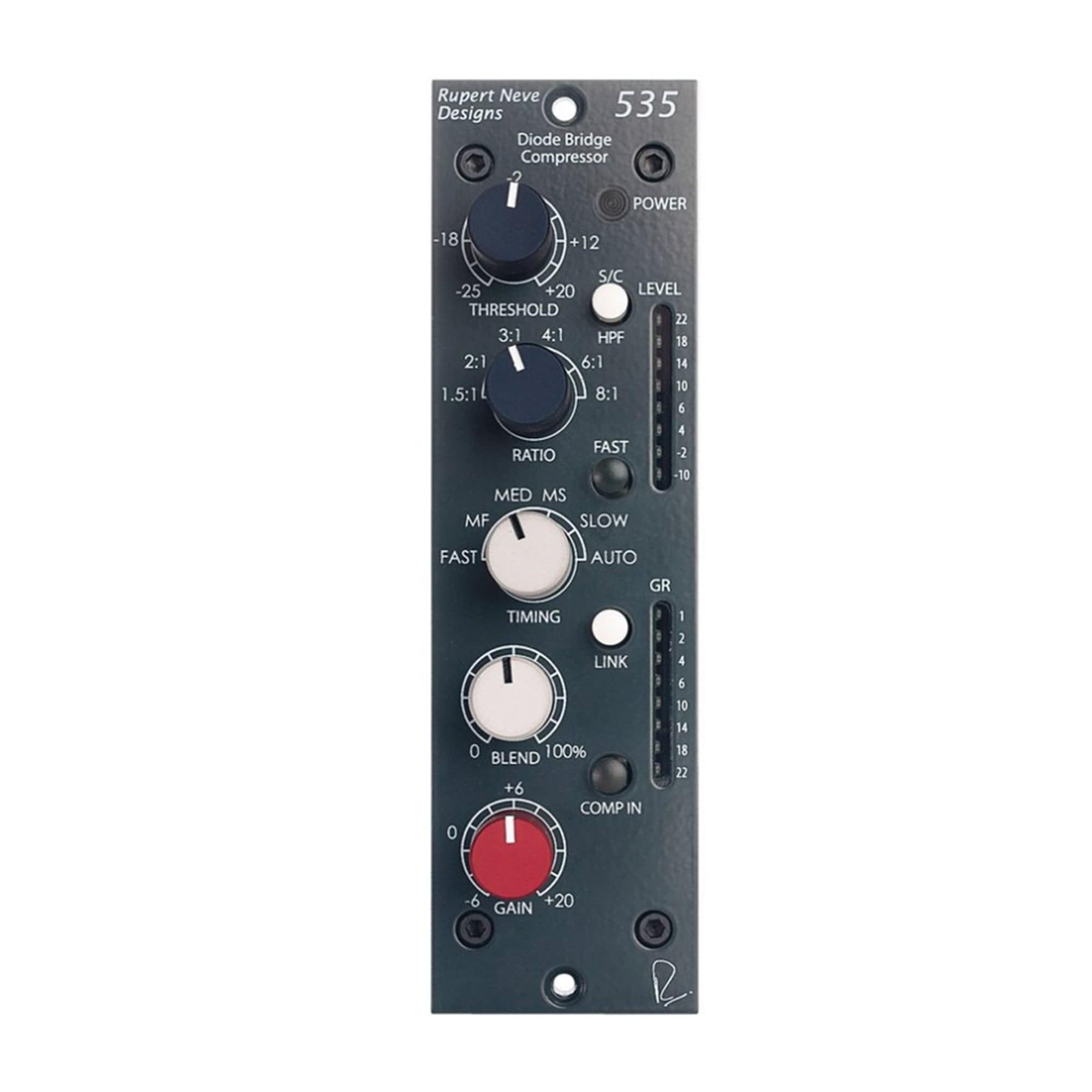
10 lbs (4.5 kg) | Originally developed for the dynamics circuit of the acclaimed Shelford Channel, the 535 Diode Bridge Compressor captures the soul of Rupert Neve’s original 2254 compressor while providing modern updates including advanced timing control, significantly lower noise, fully stepped controls throughout, and internal parallel processing capabilities.
What is diode bridge compression?
Where the VCA compressor found in the Master Buss Processor provides unmatched clarity, the weighty, harmonically rich tonality of diode bridge compression can be essential in pushing key sources like vocals, electric guitars, bass and drums to the forefront of a mix.
By understanding the limitations of vintage units like the legendary 2254, painstaking effort was taken to reproduce the unique tone of these classics while improving the noise floor & accuracy, expanding inflexible time constants, adding full wave sidechain detection for improved dynamic response, and widening the range of threshold and ratio controls.
Delivering the powerful sound of these iconic designs with enhanced flexibility for the modern age, the 535 Diode Bridge Compressor is a dynamic tool equipped to make a bold statement on virtually any mix or track.
LINE INPUT TO LINE OUTPUT
- Compressor Bypassed.
- Z source = 40 Ohm Balanced
INPUT IMPEDANCE
10K Ohm
OUTPUT IMPEDANCE
40 Ohm
MAXIMUM INPUT LEVEL
+23.5 dBu
MAXIMUM OUTPUT LEVEL
+23.5 dBu
NOISE
- 22 Hz - 22 kHz BW.
- -101 dBu
FREQUENCY RESPONSE
- 10 Hz - 120 kHz, 30ft Output XLR Cable.
- +/- 0.25 dB
THD+N
- @ 1 kHz @ Maximum Output Level, 22 Hz - 22 kHz BW.
- 0.001%
| The product that started it all for Empirical Labs. Born of founder Dave Derr’s love of classic compressors like the 1176, LA-2A and Gain Brain (among others), the Distressor incorporates his favorite sonic characteristics of these, along with other unique and interesting features that have made it a staple for audio engineers all over the world. With over 28,000 units in the field, it’s safe to say that the Distressor is one of the best selling high end compressors of all time… if not THE best selling. A prominent recording engineer recently wagered that there probably was not a top 40 record made in the last five years that didn’t have at least one Distressor on it.
Besides providing a wide range of control and a unique feature set, the Distressor offers a warm, vintage sound by using a custom designed gain control circuit. This “warmth” or “vintage sound” has become a major issue in the last few decades, as the super clear and linear digital technology does next to nothing to soften “harsh” sounds, nor emphasize the bass frequencies in music sources. Conversely, older analog tape, vinyl records and tube equipment could not be prevented from coloring the sound, often to the frustration of recording engineers. However, many people now realize that this coloring can be extremely pleasant and musical. Digital technology is often referred to as “cold” and “brittle” among other terms (although we prefer “unforgiving”).
Unique Compression Curves
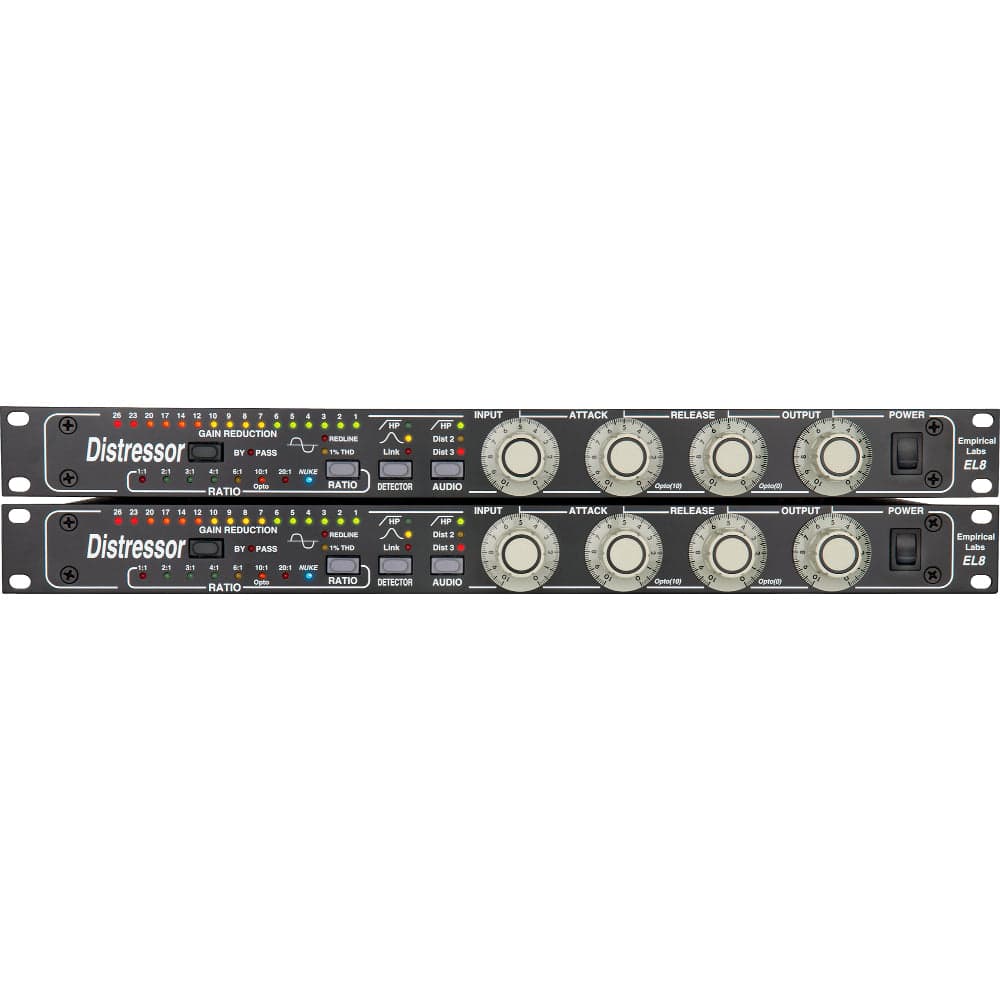
All eight of the Distressor’s curves are unique and distinctive, from the 1:1 mode that simply warms up signal with low order harmonics without intentional compression, to the “Nuke” setting – a brick wall limiting curve that shines on live drum room mics. Each curve has its own personality and several actually use different circuitry, and are effectively different compressors. Most exceptional is the 10:1 “Opto” ratio which uses separate detector circuitry to emulate the oldest (and valued) “light controlled” devices, such as the LA-2A.
Distortion (Color) Modes
Another large part of the Distressor’s personality and power derive from three modes that color the signal, even without compression. These extended audio modes were designed to allow emulation of some very old and expensive vintage compressors & limiters, and let the Distressor deliver a classic “knee” sound all its own by providing user programmable, warm harmonic distortion. In addition to the basic distortion mode, Distort 2 emphasizes tube-like 2nd order harmonics, while in Distort 3 setting the distortion becomes dominated by 3rd harmonics more closely resembling tape. Two HP filters – one in the audio path, one in the detector path – are also available to help with low frequencies that can cause pumping and breathing.
Go Stereo
For many Distressor owners, one is never enough – in fact, one extremely successful engineer has twelve of them! For those who want (at least) a stereo pair, ELI offers the EL8-S, a pair of Distressors that are matched at the factory, and come with the cables you need to lock them together.
- Frequency Response – 2 Hz to 160 kHz in clean audio mode (+0, -3 dB). Response is shaped in distortion modes (Dist 2, Dist 3).
- Dynamic Range – 110 dB from max. output to min. output in 1:1 mode. Greater than 100 dB signal to noise in distort 3 mode.
- Distortion – ranges between .02% and 20% depending on distortion mode and release times set on front panel.
- I/O – DC Coupled input and outputs.
- Time Constants – Attack range 50uS – 50mS. Release range .05 sec to 3.5 seconds, normal modes and up to 20 seconds in 10:1 opto mode. Time constants are dependent on ratio.
- Power Consumption – 15 Watts Max.
- Metal Chassis – single height 1.75″ high, 10″ deep, 19″ wide.
- Shipping info – 24.2 lbs Stereo pair. Stereo Pair box dimensions 22.5″ x 18.5″ x 6 1/4.
| Effective against boredom, supporting creative sound design
A unique team play of spring reverberation, analogue multimode filtering, distortion and VCA, modulated by an ultra fast LFO and an envelope that can be triggered in flexible ways – Retroverb Lancet offers a comprehensive arsenal of many-sided effects for different applications. The spectrum by far surpasses classic reverberation, filter sweeps or overdrive because you are able to tweak and bend any parameter fast and intuitively to your liking.
Retroverb Lancet will change the way you work with effects. It becomes part of your sound engine, fires it up and will end up as essential part of your sonic signature.
Source of effectiveness
We designed Retroverb Lancet in a way that it can perfectly handle signals of any kind: Guitars, basses, synthesizers, organs or microphones. On top of that, Retroverb Lancet allows you to create percussive sounds using its crash function.
Retroverb Lancet is a real jack of all trades with character, suited for adventurous sound designers and tinkerers.
Audio Input
- max. input sensitivity: –32 dBu
- impedance: 1 MΩ
Output
- max. output level: 20 dBu
- impedance: 600 Ω
Trigger- and CV-inputs
- audio trigger
- max. input sensitivity: –32 dBu
- impedance: 1 MΩ
- gate & CRASH
- external cv
Signal-to-Noise Ratio
- direct: > 80 dB
- effect (filter completely open, no reverb): > 75 dB
Spring Tank
- number of springs: 3
- reverbration decay: between 2.75 db and 4.00 s
Filter
- modes: 24-db-lowpass, 24-db-highpass, 12-db-bandpass
- modulations sources: envelope generator, envelope follower, external CV, LFO
LFO
- frequency range: 0.05 Hz … 300 Hz
- waveforms: ramp up, ramp down, square, sine, S&H, envelope generator
Envelope Generator
- modes: AD, ASR
- attack: 1 ms … 10 s
- decay/release: 1 ms … 15 s
Miscellaneous
- power supply: external DC-adapter with 12 V/1000 mA
- dimensions: 26 cm x 14.5 cm x 8 cm (width x depth x height)
- weight: 0.75 kg
Accessories
| Rackmount PG-X Power Conditioner with PG-90 Filtering Technology, Panasonic and Wima capacitors, eight rear switched, filtered and surge protected outlets, one front-panel switched convenience outlet and USB port for device charging.
Your gear deserves the best power, and we took great care in making sure the PG-X delivers just that — thanks to PG-90 Filtering Technology. In testing, this has provided an average of 90% of noise filtering, as opposed to the typical average of 76% found in other power conditioners at the same price point.
Confidence Inspiring Power
There’s nothing worse than scoring that “must-have” piece of gear, only to find that it’s noiser than should be expected, missing high frequency detail, or even worse — having it fried by power surges!
Black Lion Audio has been trusted for years for modifying the best gear and making it even better, and that’s what it took to create the PG-X: taking industry-standard designs, and improving them to the point of peak performance.
After creating the original PG-1, Black Lion Audio knew that plenty of professionals on a smaller budget felt left out, as some features might not be as important as an economy price-point. The PG-X was built with this in mind, while still providing best-of-class power conditioning!
High-end Filtering
Your gear deserves the best power, and we took great care in making sure the PG-X delivers just that — thanks to PG-90 Filtering Technology. In testing, this has provided an average of 90% of noise filtering, as opposed to the typical average of 76% found in other power conditioners at the same price point.
Professional Power
The PG-X features a bank of eight switched, filtered and surge protected outlets on the back panel. On the front panel, the PG-X sports one unswitched convenience outlet and a USB port for device charging.
It takes more than a few rack-mounted outlets to inspire true confidence in your power conditioner, and that’s where the PG-X delivers: best-of-class power filtering!
- Protects your gear from power-spike damage
- Provides clean, well-regulated power for optimum performance
- Features PG-90 Filtering Technology
- Top-drawer components and design for superior power and noise filtering
- Built with premium Panasonic and Wima capacitors
- Rugged 1U rackmount chassis
- 8 switched, filtered, and surge-protected outlets on rear panel
- 1 filtered convenience outlet on front panel
- USB port on front panel
Type: Rackmount
Number of Outlets: 1 x Front, 8 x Rear
Output Current: 15A
USB: 1 x Type A
Features: High frequency noise filter
Rackmountable: Yes
Power Source: Fixed AC cable
Height: 1.7″
Width: 19″
Depth: 9.8″
Weight: 3 lbs. |






Reviews
There are no reviews yet.