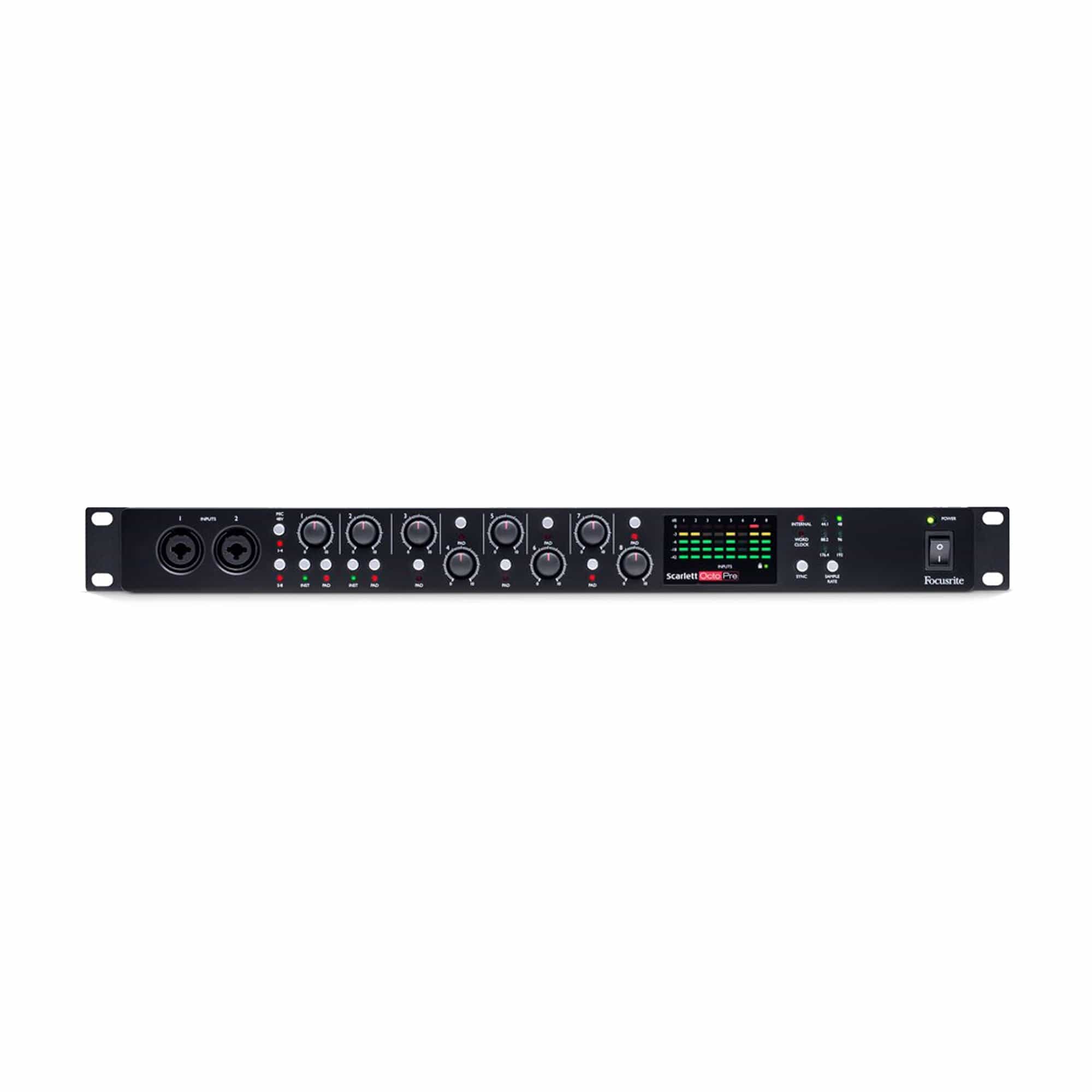
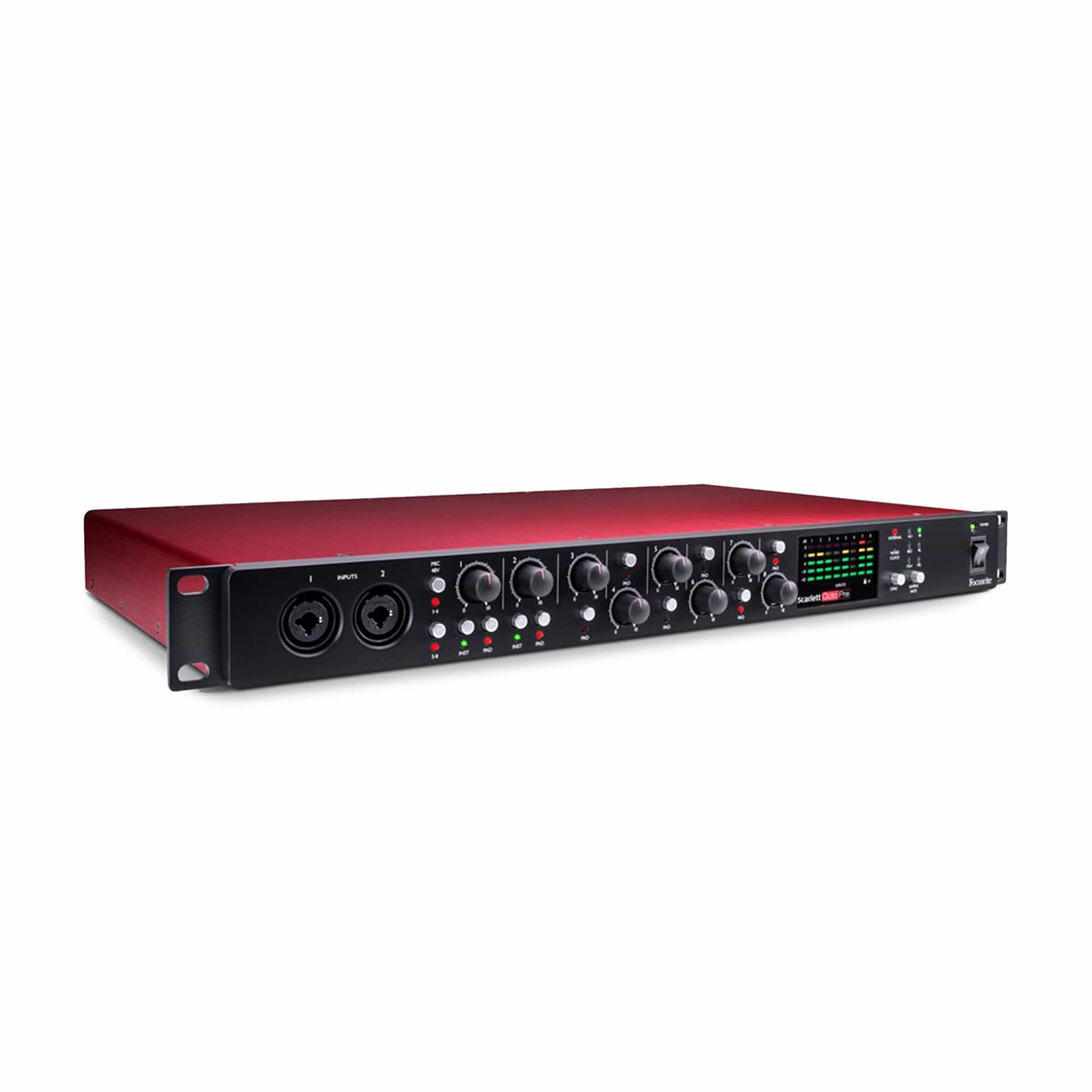
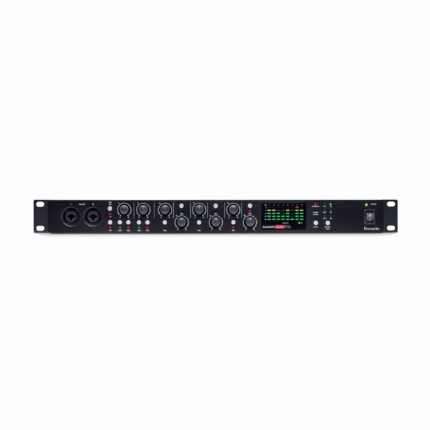
| Content | The Scarlett OctoPre is the ideal 8-channel expansion for any Scarlett - or other digital interface with ADAT inputs. ADAT is a simple and easy way of increasing the number of simultaneous recording channels available in your studio. With eight channels of Focusrite's 2nd generation Scarlett preamps and precision A-D conversion at sample rates up to 192 kHz, Scarlett OctoPre is the ideal way of increasing the number of inputs in your studio. It also offers eight balanced line outputs, sourced directly from their respective mic preamps for use on stage in a live environment.
Eight natural-sounding 2nd generation Scarlett mic/line inputs deliver high headroom, plenty of clean gain, low noise and minimal distortion - ideal for tracking drums as well guitars, keyboards, vocals and more. The front panel features two newly-designed instrument inputs with extended headroom. ADAT outputs let you connect to any interface or digital system with ADAT optical inputs, and analogue line outputs let you feed an analogue console at the same time as recording with the digital outputs.
- Eight natural-sounding 2nd generation Scarlett mic preamps
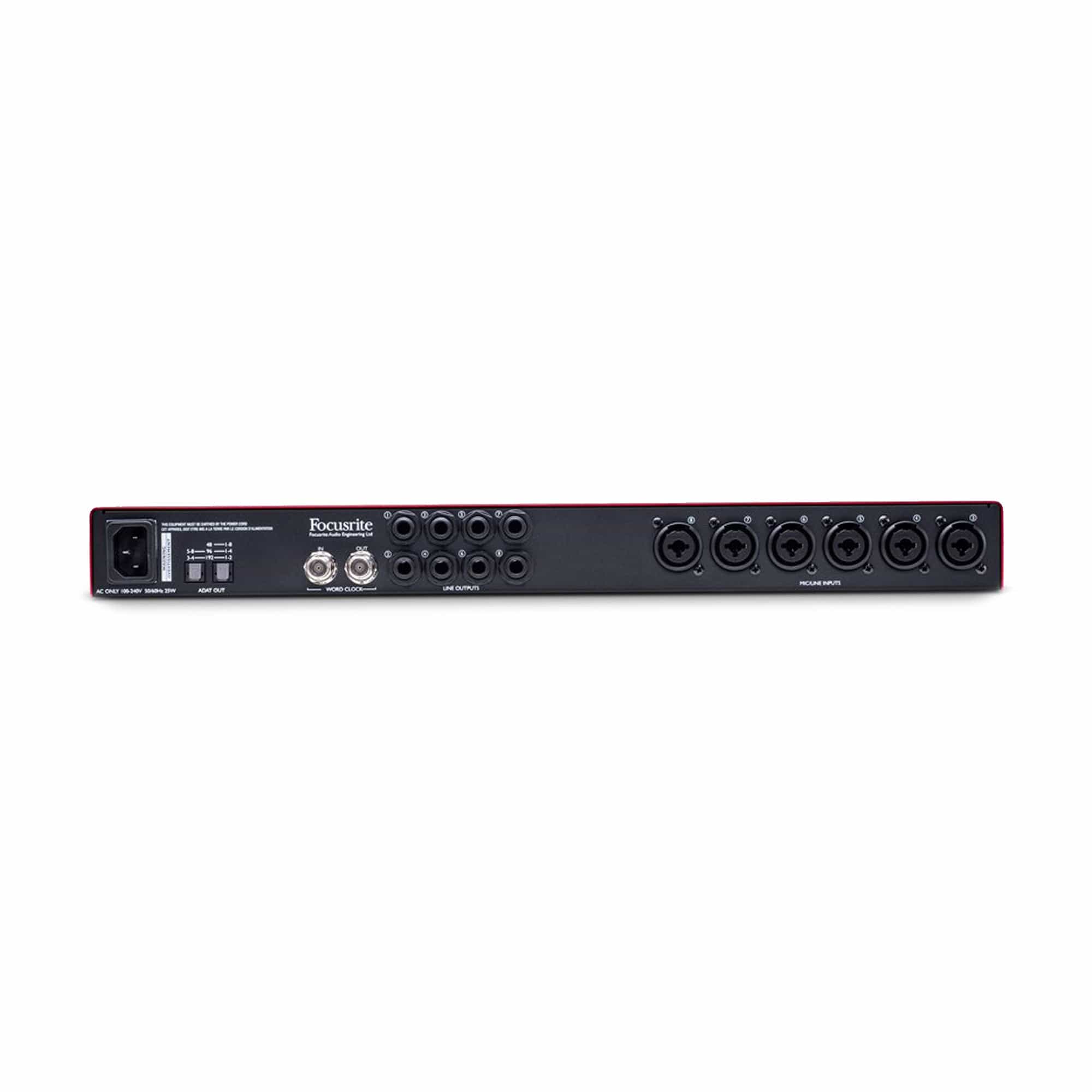
- Eight balanced line inputs
- Focusrite precision A-D conversion up to sample rates of 192 kHz
- Dual front-panel instrument inputs
- Pad on every channel for extra headroom - ideal for loud sources such as drums
- Eight balanced line outputs - ideal for live use
- Accurate 5-segment LED input metering
- Simple ADAT connectivity via optical cables
- 48V Phantom power available on every channel for condenser mics
- State-of-the-art digital clocking with Word Clock I/O for synchronisation with external devices
Create studio quality vocals, powerful guitars, luscious keys and huge drums, then mix and master with iconic Focusrite studio hardware – all in the box. Every new Focusrite Scarlett 3rd Gen interface comes with an unbeatable range of tried-and tested studio tools from some of the biggest names in the business:
- Antares Auto-Tune Access
- Relab’s LX480 Essentials
- Softube Marshall Silver Jubilee 2555
- XLN Audio Addictive Keys
- XLN Audio Addictive Drums 2: Studio Rock kit
- Brainworx bx_oberhausen
- Brainworx bx_console Focusrite SC
- Focusrite Red Plug-in Suite
- Brainworx bx_masterdesk
| FEATURES
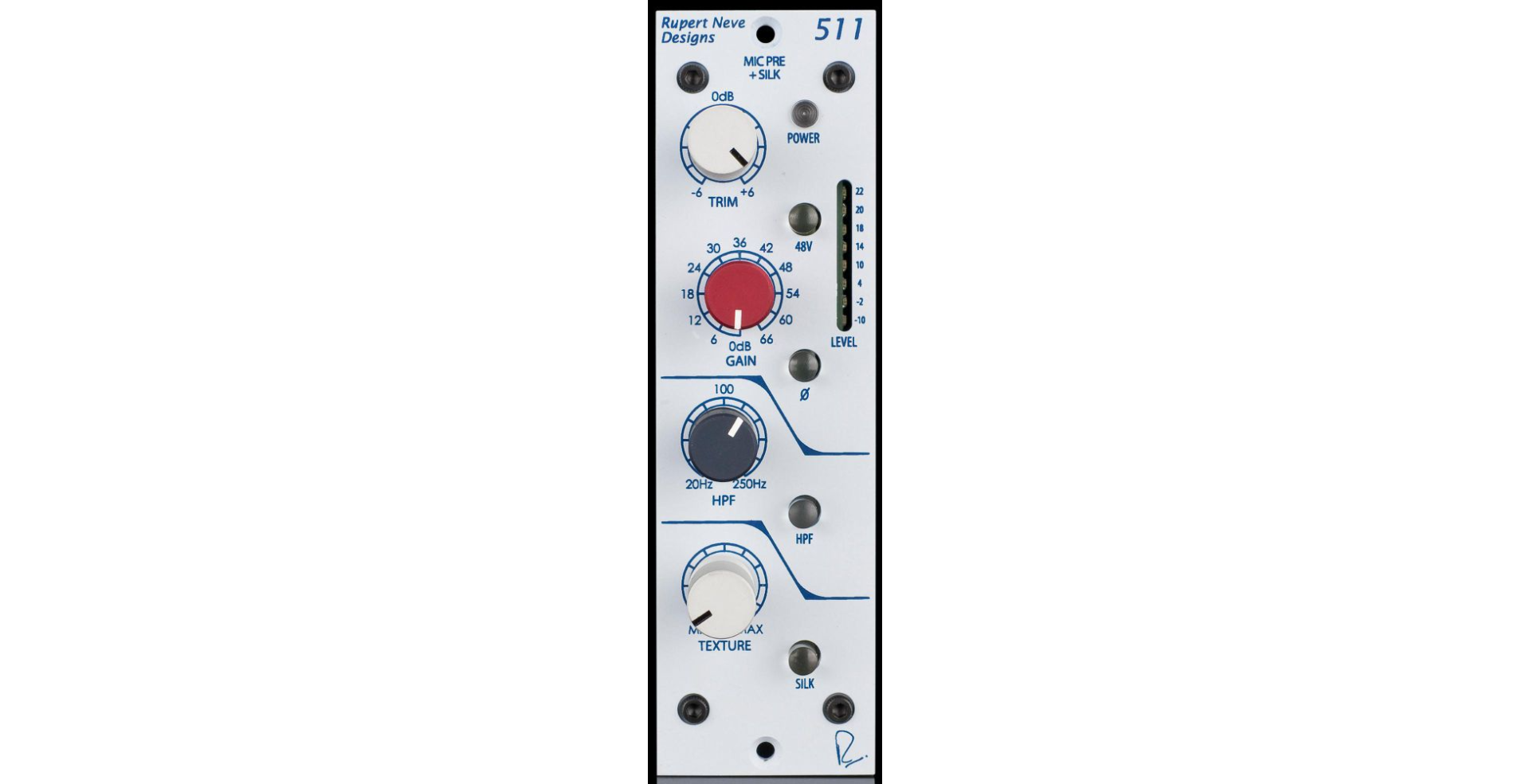
- 12-way precision rotary switch controls gain from 0 to 66 dB in 6 dB steps
- Continuously variable +/-6 dB level control
- Silk circuit, reduces negative feedback, adding harmonic content as needed
- Red Silk accentuates the saturation in the mid and high frequencies
- Same presence and sweetness found in standard Portico Series modules
|
Number of Channels |
Single |
|
Inputs |
1x XLR, balanced |
|
Output |
1x XLR, transformer-balanced |
|
Maximum Output Level |
+23dBu |
|
Meter |
8 segment LED meter |
|
Power Requirements |
Power Requirements @ +/-16VDC 100mA |
|
Dimensions |
Not specified by manufacturer |
|
Box Dimensions (LxWxH) |
10.2 x 7.8 x 2" |
| The product that started it all for Empirical Labs. Born of founder Dave Derr’s love of classic compressors like the 1176, LA-2A and Gain Brain (among others), the Distressor incorporates his favorite sonic characteristics of these, along with other unique and interesting features that have made it a staple for audio engineers all over the world. With over 28,000 units in the field, it’s safe to say that the Distressor is one of the best selling high end compressors of all time… if not THE best selling. A prominent recording engineer recently wagered that there probably was not a top 40 record made in the last five years that didn’t have at least one Distressor on it.
Besides providing a wide range of control and a unique feature set, the Distressor offers a warm, vintage sound by using a custom designed gain control circuit. This “warmth” or “vintage sound” has become a major issue in the last few decades, as the super clear and linear digital technology does next to nothing to soften “harsh” sounds, nor emphasize the bass frequencies in music sources. Conversely, older analog tape, vinyl records and tube equipment could not be prevented from coloring the sound, often to the frustration of recording engineers. However, many people now realize that this coloring can be extremely pleasant and musical. Digital technology is often referred to as “cold” and “brittle” among other terms (although we prefer “unforgiving”).
Unique Compression Curves
All eight of the Distressor’s curves are unique and distinctive, from the 1:1 mode that simply warms up signal with low order harmonics without intentional compression, to the “Nuke” setting – a brick wall limiting curve that shines on live drum room mics. Each curve has its own personality and several actually use different circuitry, and are effectively different compressors. Most exceptional is the 10:1 “Opto” ratio which uses separate detector circuitry to emulate the oldest (and valued) “light controlled” devices, such as the LA-2A.
Distortion (Color) Modes
Another large part of the Distressor’s personality and power derive from three modes that color the signal, even without compression. These extended audio modes were designed to allow emulation of some very old and expensive vintage compressors & limiters, and let the Distressor deliver a classic “knee” sound all its own by providing user programmable, warm harmonic distortion. In addition to the basic distortion mode, Distort 2 emphasizes tube-like 2nd order harmonics, while in Distort 3 setting the distortion becomes dominated by 3rd harmonics more closely resembling tape. Two HP filters – one in the audio path, one in the detector path – are also available to help with low frequencies that can cause pumping and breathing.
- Frequency Response – 2 Hz to 160 kHz in clean audio mode (+0, -3 dB). Response is shaped in distortion modes (Dist 2, Dist 3).
- Dynamic Range – 110 dB from max. output to min. output in 1:1 mode. Greater than 100 dB signal to noise in distort 3 mode.
- Distortion – ranges between .02% and 20% depending on distortion mode and release times set on front panel.
- I/O – DC Coupled input and outputs.
- Time Constants – Attack range 50uS – 50mS. Release range .05 sec to 3.5 seconds, normal modes and up to 20 seconds in 10:1 opto mode. Time constants are dependent on ratio.
- Power Consumption – 15 Watts Max.
- Metal Chassis – single height 1.75″ high, 10″ deep, 19″ wide.
- Shipping info – 12.1 lbs mono. Mono box dimensions 22.5″ x 18.5″ x 3 1/4″.
| Rupert Neve Designs Portico 542 500 Series Tape FX Standard
FEATURES
- Add depth and character to your sound
- Control the mix of pre and post tape signals
- Send signals through "True Tape" circuitry
- Silk circuit, reduces negative feedback, adding harmonic content as needed
- Red Silk accentuates the saturation in the mid and high frequencies
- Use soft clip to tame overly transient material like drums
- Provides +/- 12dB adjustment of level on incoming signal levels
TECHNICAL SPECIFICATION
Rupert Neve Designs Portico 542 500 Series Tape FX
- Line Amp Specifications (Measurements with tape circuit disengaged)
- Noise: Measured at Main Output, un-weighted, 20Hz-22kHz, Input Terminated 40 Ohms.
- Unity Gain Better than -100dBu
- Frequency Response
- Measured at +10dBu, trim at unity.
- Main Output +/- 0.25dB from 5Hz to 60Khz -2dB @ 120KHz
- Maximum Output Level 23.25dBu
- Total Harmonic Distortion and Noise:
- @ 1kHz, +20dBu output level Better than 0.0025% @ 20Hz, +20dBu output level 0.07% Typical (2nd and 3rd harmonic)
- Tape FX Specifications
- Noise:
- Measured at Main Output, un-weighted, 20Hz-22kHz, Input Terminated 40 Ohms.
- Saturation @ minimum Better than -100dBu Saturation @ maximum Better than -100dBu
- Frequency Response:
- 15 IPS, Input @ -0 dBu -3dBu @ 28kHz Saturation @ minimum 0dBu @ 10Hz +5dBu Peak @ 60Hz
- Saturation @ maximum -3dBu @ 20kHz -3dBu @ 12.5Hz +2.4dBu Peak @ 60Hz
- 30 IPS, Input @ -0 dBu -3dBu @ 120kHz Saturation @ minimum -3dBu @ 10Hz +3.15dBu Peak @ 125Hz
- Saturation @ maximum -3dBu @ 100kHz -3dBu @ 12.5Hz
- +1.3dBu Peak @ 110Hz
- Total Harmonic Distortion and Noise
- Refer to sweeps on page10 15 IPS, Input @ -0 dBu 0.4% @ 3kHz to 1% @ 175Hz typical
- Saturation @ minimum Greater than 1% below 175Hz typical
- Saturation @ maximum 1% at 6kHz typical 0.3% @ 1kHz to 3% @ 50Hz typical
- 30 IPS, Input @ -0 dBu 1% at 1kHz typical
- Saturation @ minimum 0.6% @ 400Hz 5% @ 20Hz typical
- Saturation @ maximum 1.5% @ 20kHz to 0.4% @ 1kHz typical 0.4% @ 1kHz to 2 %@ 50Hz typical
- Power requirements:
- Supplied by 500 series rack with 110-125 mA @ +/- 16V DC
| Rackmount PG-X Power Conditioner with PG-90 Filtering Technology, Panasonic and Wima capacitors, eight rear switched, filtered and surge protected outlets, one front-panel switched convenience outlet and USB port for device charging.
Your gear deserves the best power, and we took great care in making sure the PG-X delivers just that — thanks to PG-90 Filtering Technology. In testing, this has provided an average of 90% of noise filtering, as opposed to the typical average of 76% found in other power conditioners at the same price point.
Confidence Inspiring Power
There’s nothing worse than scoring that “must-have” piece of gear, only to find that it’s noiser than should be expected, missing high frequency detail, or even worse — having it fried by power surges!
Black Lion Audio has been trusted for years for modifying the best gear and making it even better, and that’s what it took to create the PG-X: taking industry-standard designs, and improving them to the point of peak performance.
After creating the original PG-1, Black Lion Audio knew that plenty of professionals on a smaller budget felt left out, as some features might not be as important as an economy price-point. The PG-X was built with this in mind, while still providing best-of-class power conditioning!
High-end Filtering
Your gear deserves the best power, and we took great care in making sure the PG-X delivers just that — thanks to PG-90 Filtering Technology. In testing, this has provided an average of 90% of noise filtering, as opposed to the typical average of 76% found in other power conditioners at the same price point.
Professional Power
The PG-X features a bank of eight switched, filtered and surge protected outlets on the back panel. On the front panel, the PG-X sports one unswitched convenience outlet and a USB port for device charging.
It takes more than a few rack-mounted outlets to inspire true confidence in your power conditioner, and that’s where the PG-X delivers: best-of-class power filtering!
- Protects your gear from power-spike damage
- Provides clean, well-regulated power for optimum performance
- Features PG-90 Filtering Technology
- Top-drawer components and design for superior power and noise filtering
- Built with premium Panasonic and Wima capacitors
- Rugged 1U rackmount chassis
- 8 switched, filtered, and surge-protected outlets on rear panel
- 1 filtered convenience outlet on front panel
- USB port on front panel
Type: Rackmount
Number of Outlets: 1 x Front, 8 x Rear
Output Current: 15A
USB: 1 x Type A
Features: High frequency noise filter
Rackmountable: Yes
Power Source: Fixed AC cable
Height: 1.7″
Width: 19″
Depth: 9.8″
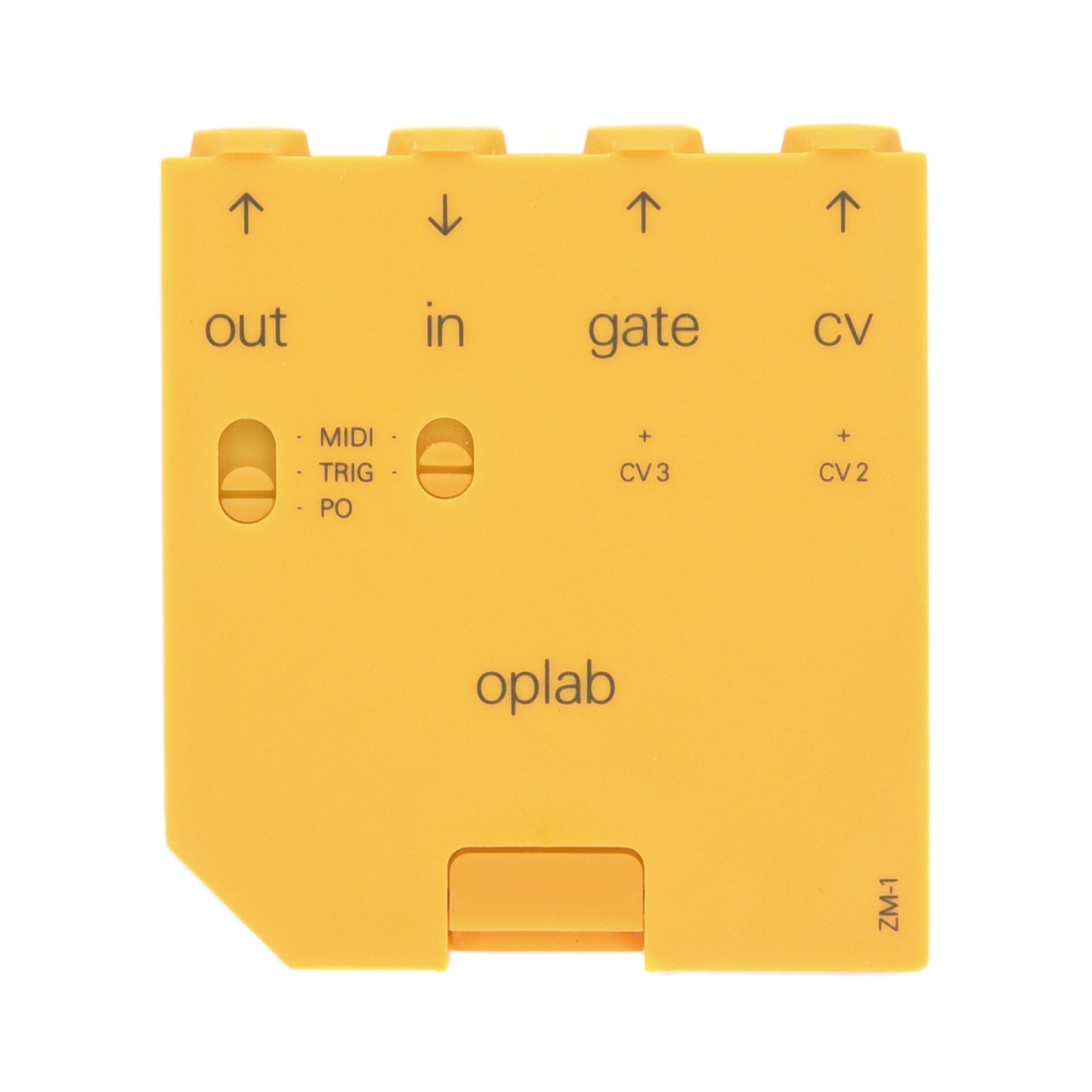
Weight: 3 lbs. | Imagine having the power and flexibility of the OP-Z sequencer available to any other music equipment. Now you can, with the new oplab module - the magic link between OP-Z and the rest of the world. The oplab module is the first hardware expansion module for OP-Z. once mounted in the back of your OP-Z, you can use it to connect to any equipment using standard cv and gate, such as the pocket operator modular or any other modular system. It features three cv outs and one gate out, all programmable and playable from OP-Z. have your wall of modules sequenced from the palm of your hands. Use the po sync out to unleash the power of your regular pocket operators and have them play in sync with the rest of your setup. Even connect standard midi devices, using midi over 3.5 mm jack or the included midi over din adapter cable. Oplab features both midi in and out ports as well as trig in and out for other synthesizers and sequencers. |






Reviews
There are no reviews yet.