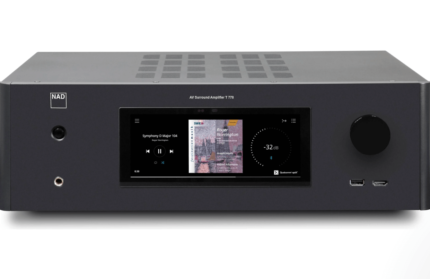
| Content | NAD Electronics T 778 Reference 9.2 Channel A/V Receiver
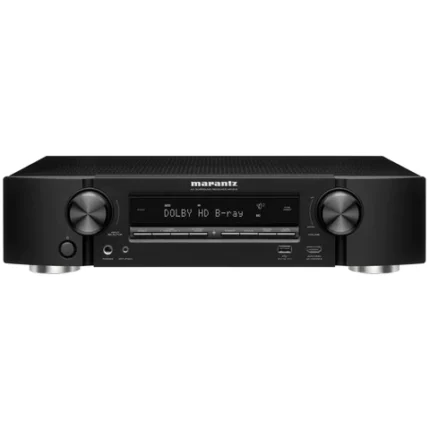
NAD s reference Audio Video Receiver (AVR) is a cutting-edge powerhouse for state of the art music and home theater. Well known for our high value/ high performance reputation in the AVR category, the brand s reference model builds on that legacy with an expansion of unwavering philosophy of real-world performance, simplicity of operation, and future upgradeability.
Introducing the T 778 A/V Surround Amplifier
BluOS Enabled 4K Ultra HD Receiver with Immersive Sound
NAD s reference Audio Video Receiver (AVR) is a cutting-edge powerhouse for state of the art music and home theater. Well known for our high value/ high performance reputation in the AVR category, the brand s reference model builds on that legacy with an expansion of unwavering philosophy of real-world performance, simplicity of operation, and future upgradeability.
Efficient Distortion-free Amplification
The T 778 features the latest developments in NAD s Hybrid Digital technology to create 9 high current/high power channels of amplification with improved efficiency. Designed with NAD s full disclosure approach to power ratings, the NAD AVR conservatively delivers 85W FDP and 9 x 140W FTC, all channels driven at rated distortion. For flexibility, the amp channels are configurable to be used for surround or second zone audio. The silent black background and explosive dynamics afforded by this amplifier technology adds lifelike realism, drama and excitement to all your music and movies.
Fully Featured Surround
The T 778 is second-to-none in terms of flexibility and up-to-the-minute digital technology. Only NAD offers Modular Design Construction (MDC), the company s proven method for preventing premature obsolescence. 7.1.4 Dolby Atmos , DTS Master Audio combine with Dirac Live room correction to deliver hyper-realism that captures every dimension of a performance. Add bit-perfect 4K UHD video pass-through and the T 778 delivers the most accurate sound and image experience you ve ever had. Musical performance is outstanding with High Res Multi-room streaming via BluOS.
Complete and Compact
As with all NAD components, the company s latest offering continues their simple is better design philosophy. This sensible approach contributes to ease of use and maximizes performance where it counts. A perfect example is the striking new touch screen and ergonomic refinements that simplify operation and ease of access. The T 778 features NAD s legendary sound quality along with complete compatibility with all the latest features and formats to ensure lifelike music and movie enjoyment.
Key Features of the NAD T 778:
- 9 channels of NAD s latest Hybrid Digital Amplifier Technology
- New touch screen and improved ergonomics for user-friendly operation
- 4K UHD video pass-through
- HDMI CEC/eARC
- High-Res BluOS enabled Network Streaming
- Dirac Live Room Correction
- Full decoding of MQA content via BluOS.
- Apple AirPlay 2
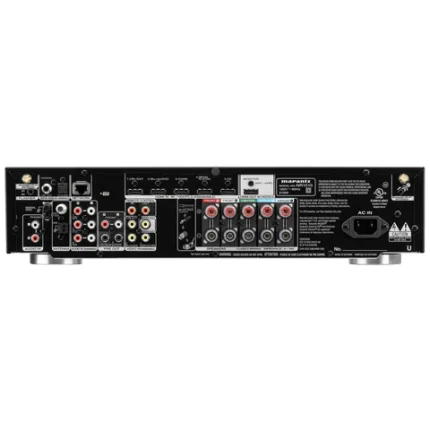
- MDC (Modular Design Construction) offers ability to upgrade to future digital formats as they become available. Two MDC slots provided.
- CI friendly- RS232 Serial Control Port. Trigger In/Out.
- IR In with learning function
| The M3si integrated amplifier produces high quality sound, has an extensive range of useful inputs and offers high reliability, compact size and a fair price. With its strong 85 watts per channel, the M3si will drive a huge variety of appropriate loudspeakers. It has inputs for phono (MM), 4 line inputs and USB ‘B’ up to 24bit 96 kHz.
The M3si’s sound is effortless, clear and sweet. It projects wide and deep images and has plenty of power to deliver excellent dynamic range.
The M3si is unconditionally stable and will drive any appropriate loudspeaker with ease.
Although it is Musical Fidelity’s lowest price amplifier, it embodies our hallmark values of uncoloured, stress-free sound, outstanding technical performance and great value for money.
M3si In Brief
- 85WPC
- Excellent technical performance
- Preamp output
- Unconditional stability, will drive any loudspeaker
- Wide range of useful inputs
- including asynchronous USB and MM phono
- Excellent build quality and convenient size
Specifications
Power output: 85 W per channel into 8 ohm
THD(+ noise): <0.014 % typical, 20 Hz to 20 kHz
Signal to Noise Ratio: >98 dB ‘A’-weighted
Frequency Response: +0, –0.1 dB, 10 Hz to 20 kHz
Inputs: 4x Line Level RCA / Phono, 1x USB type ‘B’ connector - Asynchronous data stream at up to 24-bit/96kHz, 1x MM Phono input
Phono
Sensitivity (nominal): 3 mV (suitable for cartridges giving 1.5mV or more including high output MC types)
Signal / noise ratio: >70 dB ‘A’-weighted
Input impedance: 50 k ohm
Frequency response: RIAA/IEC ±1 dB, 20 Hz to 20 kHz
Dimensions - WxHxD (mm): 440 x 100 x 400
Weight (unpacked / packed): 9.2 kg/ 13 kg | Rupert Neve Designs' Shelford Channel, over a half century in the making, is the definitive evolution of Mr. Neve's renowned 80 Series channel module technology, updated and refined for the contemporary studio. The Shelford Channel is fitted with Rupert's latest Class A transformer-gain mic preamp, the best-of-the-classics Inductor EQ from the Shelford 5052, a punchy diode-bridge compressor, the alluring analog textures of variable Silk saturation, a state-of-the-art dual-tap transformer output stage with massive headroom, and double the operating voltage of vintage designs. Offering rich tonal options for making audacious statements with your music, along with precision-detented controls for recall, the Shelford Channel delivers the authoritative sonic essence of classic Rupert Neve designs, along with modern versatility.
Input stage and transformer-gain mic pre
Rupert Neve's first new Class A, transformer-gain mic preamplifier in over 40 years makes its debut in the Shelford Channel. Rupert has spec'd this preamp with a direct-coupled transformer input; gain is provided by the custom transformer itself. The proprietary input transformer, and its meticulous integration with the surrounding Class A input amplifiers, plays an outsized role in the Channel's immediately recognizable sonics: punchy and creamy-smooth, with excellent isolation and vanishingly low noise.
The Shelford Channel's front-panel hi-Z instrument input uses the same discrete Class A field-effect transistor with transformer topology as Rupert Neve Designs' acclaimed RNDI; for gain, however, it utilizes the new RN4012 input transformer directly into the mic preamp. This design provides astonishing clarity on hi-Z sources, with substantial low-end weight and silky-smooth high frequencies. The DI also gives you a passive thru output to feed a guitar or bass amp.
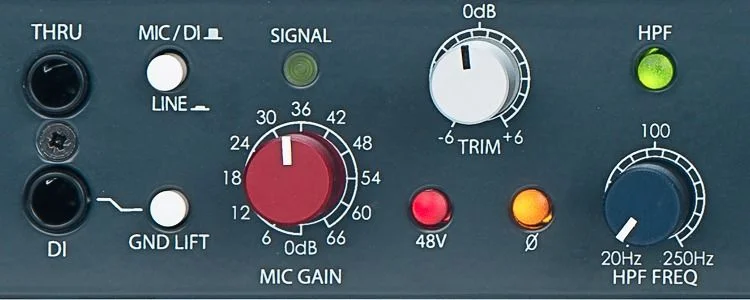
- Mic-DI/Line: switches between microphone/direct injection input and line input
- GND Lift: disconnects the audio signal ground from chassis earth
- Signal LED: green indicates Signal Present; red indicates imminent input stage clipping
- Mic Gain: 12-way precision rotary, controls gain from 0dB to 66dB in 6dB steps
- Trim: rotary switch provides further continuous gain adjustment of +/-6dB
- 48V: switch engages phantom power on the mic input
- Phase: inverts the polarity of the signal path (illuminates when engaged)
- HPF Freq: engages a 12dB/octave highpass filter, variable from 20Hz-250Hz
The best-of-the-classics inductor EQ
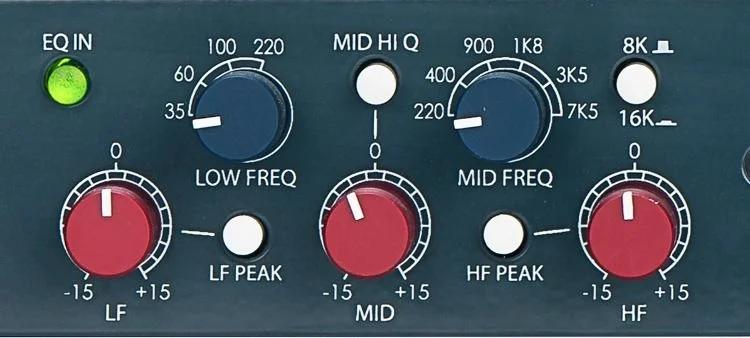
The Shelford Channel's EQ section is a 3-band, custom-tapped inductor circuit containing Rupert's favorite bands from his vintage equalizer designs. The low-frequency band is primarily based on the 1064 — acclaimed for its creamy, resonant bass. Unlike the 1064, though, the Channel gives you added dimension, punch, and control over your low end by letting you use the LF band as either a peaking or a shelving filter. The midrange band is based on the venerable 1073 and is perfect for sweetening instruments and vocals while nudging them forward in a mix. "Proportional Q" response also makes it ideal for attenuating problem frequencies. The high-frequency band is a hybrid design with the best of vintage and modern attributes. It should be noted that this EQ is in no way a clone; it's a decidedly modern design using components and techniques that simply did not exist in the 1970s — for instance, the use of capacitor-based topologies to achieve sonic richness and enhanced control.
- EQ In: engages all EQ frequency bands except HPF
- LF: adjusts up to 15dB of boost/cut at the selected low frequency
- Low Freq: 4-position rotary switch for selecting LF band corner or center frequency
- LF Peak: selects LF shelving (out) or peaking (in) mode
- Mid Hi Q: selects between a mid-band resonance of 2 (out) or 3.5 (in)
- Mid: adjusts up to 15dB of boost/cut at selected mid frequency
- Mid Freq: 6-position rotary switch selects center frequency of the midband EQ stage
- HF Peak: selects HF shelving (out) or peaking (in) mode
- 8K/16K: selects between an 8kHz (out) or 16kHz (in) center or corner frequency for HF band
- HF: adjusts up to 15dB of boost or cut at selected high frequency
The Super Diode-bridge Compressor
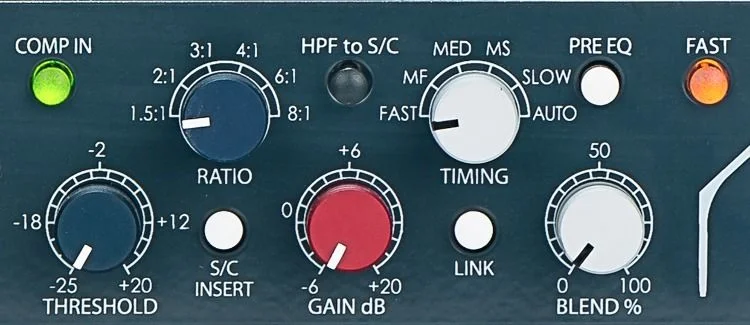
Like the Shelford Channel's inductor EQ and transformer-gain microphone preamp, the diode-bridge compressor/limiter is based on the topologies found in vintage Neve designs such as the 2254. It improves, however, on the early designs by the inclusion of full-wave rectification and a bevy of new control features. Although Rupert's vintage diode-bridge compressors were prized for their warm, punchy response, they were somewhat compromised by imprecise controls, attack-time inflexibility, low headroom, and high noise. The Shelford Channel's Super Diode-bridge Compressor delivers the attitude-packed, "in your face" sound of those classics, but with modern precision and flexibility — which makes it ideal on any source. Full Side-chain and stereo Link features are provided.
- Side Chain Insert Jacks (rear-panel): for fine tuning of compressor operation
- Comp In: engages the Channel's compressor-limiter section
- Threshold: sets level where the compressor "kicks in"
- Ratio: sets compression slope from 1.5:1 (minimal) to 8:1 (heavy)
- SC Insert: inserts rear-panel sidechain insert jacks into sidechain signal path
- HPF to S/C: routes highpass filter into the circuit that compressor uses to determine level
- Gain: for adding make-up gain to compensate for level attenuation lost to compression
- Timing: 6-position rotary adjusts attack/release speed of the compressor
- Link: links the sidechain control of multiple units for ganged or stereo operation
- Pre EQ: changes the order of compressor in the circuit chain
- Blend: mixes the dry and compressed signal for handy parallel compression
- Fast: speeds up both attack and release of the selected compressor time constant
Dual-tap transformer output
The Shelford Channel's output stage serves up the inimitable sound of Rupert Neve's classic designs while providing far more tonal versatility. The dual-tap output for the RN2042 square-core output transformer provides both high- and low-headroom outputs without compromising performance. The high-headroom tap takes advantage of the Shelford's higher-voltage design, delivering a pristine sound without non-linear output-stage coloration at high levels. The low-headroom tap, on the other hand, lets you drive the full voltage range of the Channel to accentuate this non-linear harmonic content — without clipping most pro interfaces. For vocals, drums, guitars, bass, and other instruments, this output lets you hit the transformer's sweet spot, which can inject life into a recorded performance in a way that other effects cannot.
The Silk and Texture controls
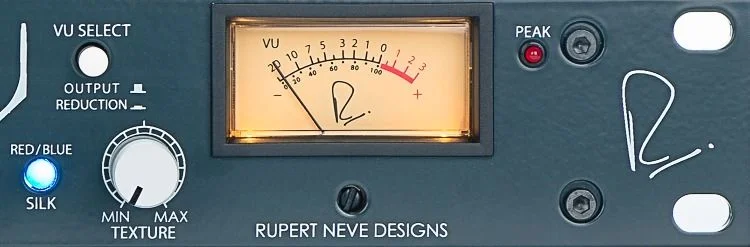
The Shelford Channel is packing a secret weapon the classics never had: its output transformer features the Silk Red/Blue and Texture controls from the Portico II Series that let you tailor the harmonic content and tonality of the output stage. By engaging these controls and sufficiently driving your output, you can dial in delectable 2nd- and 3rd-order harmonic distortion (that's the good kind) and saturation of the output transformer, imbuing your tracks with juicy rich thickness (think: 1073 on steroids) — with no danger of overloading the output stage. The Silk Red mode emphasizes harmonic content generated by the source's high frequencies; Blue mode, conversely, works off the low frequencies. The Texture knob controls the amount of added harmonic content. Disengage Silk, and your output is pristine and modern, while retaining Rupert's bigger-than-life transformer sonic signature.
The magical sound of Neve
Rupert Neve is an audio legend whose electronics designs defined the golden age of analog. Those of us at Sweetwater who have had the privilege of working on a Neve 8078 or its predecessors can attest to the fact that Neve's Series 80 consoles were indeed the pinnacle of hand-wired analog mixing desks. Mr. Neve has remained at the forefront of audio-circuit innovation for over half a century, and his current company, Rupert Neve Designs, continues to advance the state of the art with cutting-edge products that sound incredible and intelligently address the challenges of the digital age.
Rupert Neve Designs Shelford Channel Features:
- The definitive evolution of Rupert Neve's renowned 80 Series channel module technology
- A complete channel strip that delivers the essence of classic designs, along with modern versatility
- Input stage and transformer-gain mic pre
- Front-panel hi-Z direct input
- Best-of-the-classics inductor EQ
- Super Diode-bridge Compressor
- Dual-tap transformer output
- Silk and Texture controls
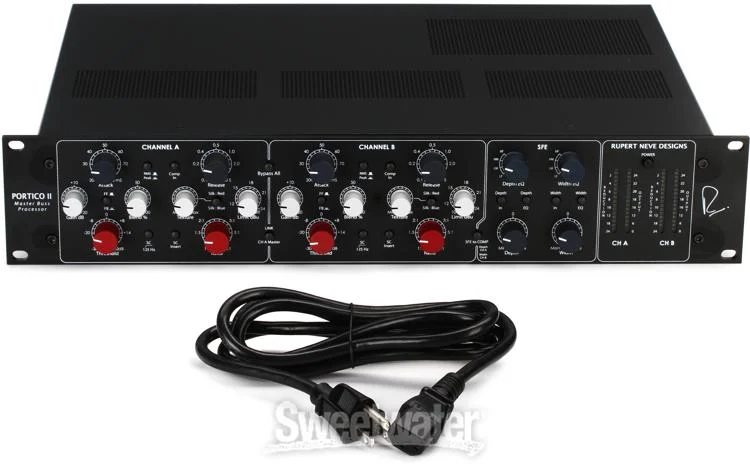
| The Rupert Neve Designs Portico II Master Bus Processor lets you enhance, reshape, and polish your sound to perfection. Whether you want to add finishing touches to your master bus, level out a stereo group, or add new life to mono sound sources, the Portico II Master Bus Processor gives you the compression, limiting, and stereo field manipulation you need. Featuring custom input and output transformers designed by Rupert Neve, the Portico II Master Bus Processor implements the same ultra-smooth Class A signal processing made famous by the 5088 console and the Portico II Channel, as well as 72V topology, which gives it enormous headroom while allowing it to integrate seamlessly with virtually any system. If you’re serious about your sound, then it’s time to ask your Sales Engineer about the Rupert Neve Designs Portico II Master Bus Processor!
Powerful and flexible compression
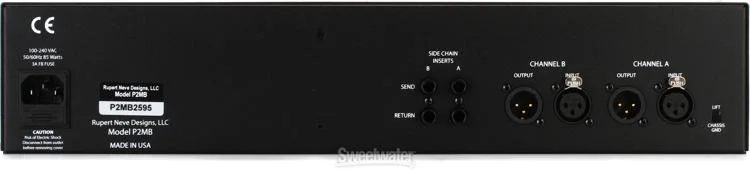
Both channels of the Portico II Master Bus Processor feature one of Rupert Neve Designs’ most versatile compressors to date. Whether you want to add punch to your mix or smooth out your vocal subgroup, the Portico II Master Bus Processor has the compression you need. Controls for ratio, threshold, attack, release, blend, sidechain highpass filter, limiting, and makeup gain let you dial in the perfect dynamics quickly and easily. Use the two compressors independently, or instantly link them with the push of a button. Variable Silk Red/Blue Texture controls let you add classic Neve harmonic warmth; while a blend control lets you dial in the dry signal for instant parallel processing, so you can get all of the compression you want without losing transients. In addition, the Portico II Master Bus Processor gives you a choice of either vintage-flavored feed-back or modern-sounding feed-forward compression modes.
Transparent, musical limiter that’s effortless to use
Often overlooked at first glance, the Portico II Master Bus Processor’s 1-knob limiter is a powerful, flexible, and remarkably easy-to-use tool that lets you get the most out of the Portico II Master Bus Processor’s compression section. Rupert Neve Designs’ Adaptive Release Technology gives this limiter its unique ability to grab onto fast transients, without smothering the rest of the signal. Plus, you have the option to blend compressed and dry signals together for parallel processing that maintains natural-sounding dynamics without clipping. This gracious behavior means you can set it and forget it, with the added security of knowing your masters will be free from clipping and broadcast-ready.
Sidechain inserts for creative ducking
Every dynamics processor has a sidechain circuit that examines the signal and determines how much the VCA will reduce gain — but not every unit provides access to its sidechain. In compressors without a separate sidechain input, your main input signal is, essentially, compressing itself. With compressors like the one in the RND Portico II Master Bus Processor, you can insert external processing on the sidechain — or introduce a different signal that determines the compression action on the main signal. It’s an incredibly useful feature that lets you, for instance, automatically duck a track to make space for another (very popular for that EDM mix pumping effect). Combined with the sidechain HP filter, it gives you an impressive amount of tonal versatility.
Amazing Stereo Field Editor
Although the Rupert Neve Designs Portico II Master Bus Processor functions wonderfully as a dual-mono processor, it really shines in stereo mode. That’s thanks to its unique Stereo Field Editor. The Stereo Field Editor uses advanced Mid/Side stereo manipulation techniques, allowing you to adjust your stereo bus’s width, depth, and ambience. Beyond widening your stereo image, the Portico II Master Bus Processor can actually bring center-panned instruments out in your mix. That makes the Portico II Master Bus Processor an invaluable tool for mastering, as well as defining the spread of your subgroups during mixdown.
The legend continues
Rupert Neve’s 80 Series consoles had a huge, punchy, and authoritative sound that defined the sound of ’70s rock. From London to New York to Los Angeles and beyond, top studios were installing Neve boards as fast as they could. By 1977, with the introduction of the NECAM automation system, 80 Series boards were the main component of the success formula for any recording studio with world-class aspirations. Mr. Neve’s current company, Rupert Neve Designs, continues to advance the state of the art with cutting-edge products that sound incredible and intelligently address the challenges of the digital age. With your Rupert Neve Designs Portico II Master Bus Processor from Sweetwater, the legend continues.
Rupert Neve Designs Portico II Master Bus Processor Features:
- Powerful 2-channel compressor/limiter/stereo field manipulator
- Custom input and output transformers designed by Rupert Neve
- Full compression sections for both channels, including attack, release, ratio, and threshold controls
- Sidechain inserts and highpass filters for both compressors
- Feed-back/Feed-forward switch lets you select between vintage-style and modern compression modes
- Silk Texture control with Red/Blue modes for classic Neve harmonic warmth
- Blend controls allow you to mix dry signal back into your compression, preserving transients while adding punch
- Simple and highly musical 1-knob limiter with Adaptive Release Technology allows for brickwall limiting that doesn’t distort or affect signal under the threshold
- Stereo Field Editor section includes independent level and EQ for width and depth, allowing you to dial in the perfect stereo field
|
Easily integrate Hi-Res Audio, network streaming, and music control BluOS App in your C 390DD
Direct Digital DAC Amplifier or Masters M12 Digital Preamp DAC. Featuring BluOS, the music management software developed by NAD’s sister brand, Bluesound, the DD-BluOS module is a complete digital music solution at an amazingly affordable price. Thanks to the forward-looking innovation of Modular Design Construction, you can now add BluOS network and internet music streaming with advanced music management to your NAD C 390DD or M12.
As an internal module there are no external wires or power supplies required and integration with the C 390DD or M12 operating firmware is hand-in-glove. Both Ethernet and Wi-Fi operate in asynchronous mode for lowest jitter performance and allow connection to music stored anywhere on the local network or streamed directly from the Internet using a popular music services like Spotify Connect, Rdio, and Slacker. You can also play music from a USB drive or hard drive via the USB A port.
In addition to a standard Local Area Network, BluOS requires an iOS or Android smartphone or tablet (NAD offers free iOS and Android Apps) to control and manage your music. While the expected functions of Play/Pause/Skip are present, BluOS also brings all of your music together integrating locally stored music (like iTunes) and music streaming services. BluOS does not rely on middleware like UPnP/DLNA/AirPlay with their inherent limitations, but instead creates direct shares with music in all formats including FLAC, ALAC and WAV with data rates up to 24/192. Playlists can be created and managed right inside the BluOS App. Gapless playback is supported and the DD-BluOS is fully compatible with Bluesound High-Res Wireless Multi-room Players to form integrated whole-house systems. Includes an external USB WiFi module to optimize signal strength.
| Packed with ultra-fast, rock-solid performance, the Behringer S32 32-channel digital snake system bridges the gap between your band, your FOH engineer, and your audience. With the S32, you get 32 remote-controllable Midas-designed preamps and 16 analog, servo-balanced XLR returns at the stage end, and it's all piped through a single, convenient Cat 5e cable, thanks to integrated SuperMac technology from Klark Teknik. In other words: no more bulky analog snake! So step up to the digital age — order your Behringer S32 32-channel digital snake system from Sweetwater today!
AES50 networking capability provides compatibility with many digital mixers
When Behringer first developed their S32 digital snake system, they intended it to go hand-in-hand with their powerful X32 digital mixing system. But limiting such a convenient and affordable digital snake to the X32 alone would have been a shame, which is why Behringer designed it around the strict guidelines established by Klark Teknik. The result is an affordable digital snake that's completely compatible with any digital console that sports an AES50 digital Ethernet connection. So if you're running a Midas or Behringer digital mixing board, if it's got an AES50 Ethernet port on it, if you've got an S32 digital snake, you're never more than a single connection away from your stage box.
Remote-controllable preamps make setup fast, easy, and painless
Even if you try to get a jog in every day, no one likes having to run up to the stage every time you have to make an adjustment to your stage box. Thanks to the Behringer S32 digital snake system's remote-controllable preamp design, those back-and-forth cross-venue dashes are a thing of the past. Using the Klark Teknik SuperMAC protocol, your S32 will show up in your digital mixer's OS, giving you the control you need over your pres, right from the front of house position. And by the way, these preamps are the exact same high-quality Midas-designed preamps found in the X32 console, so you know you're getting quality sound with low noise and tons of headroom.
Total integration with Behringer's P-16 personal monitoring system
Streamlined, affordable, and super-easy-to-use, everyone's raving about Behringer's Powerplay P16 personal monitoring systems. When you add a Behringer S32 digital snake system to your PA rig, you're not just getting a great set of remote-controllable preamps and ditching tons of bulky cable, you're ready to add an advanced personal monitoring system directly inline with the rig you already have. That's because your S32 digital snake comes equipped with Ultranet connectivity, which provides your Powerplay P16-M monitor controllers with a digital split straight from the stage box.
Behringer S32 32-channel Digital Snake System Features:
- Simple, flexible, and affordable digital snake system that works with any AES50 network-ready digital console
- 32 x fully programmable and remote-controllable Midas-designed mic preamps give you exceptional sound, right from the stage
- 16 x analog, servo-balanced XLR outputs let you send complete monitor mixes to the stage
- AES50 network ports featuring Klark Teknik SuperMac technology, providing you with ultra-low latency digital audio that's in-ear compatible
- Up to 328' of networking capability via a single lightweight CAT-5e cable (not included)
- Dual AES50 ports let you cascade multiple S32 units, without a merger or a router
- Precise LED metering plus 7-segment displays let you keep a close eye on your levels
- Ultranet connectivity for Behringer's Powerplay P16 Personal Monitoring System is perfect for In-ear applications
- Dual ADAT outputs for use in splitter mode and stand-alone digital multicore applications
- MIDI In/Out for bi-directional communication between FOH console and on-stage MIDI devices
- USB connector for system updates via PC
- Planet Earth switching power supply for maximum flexibility, noise-free audio, superior transient response plus low power consumption for energy saving
- Durable yet compact, all-steel 3U rack-mount chassis provides flexible mounting
|









Reviews
There are no reviews yet.