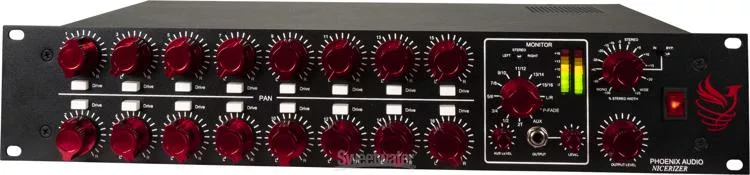
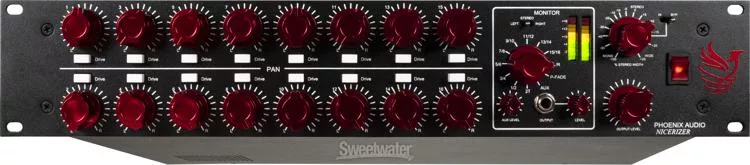
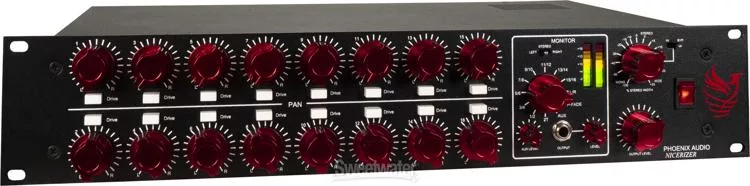
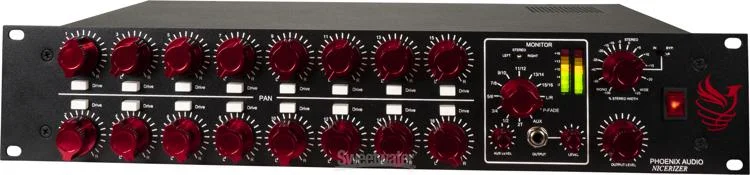
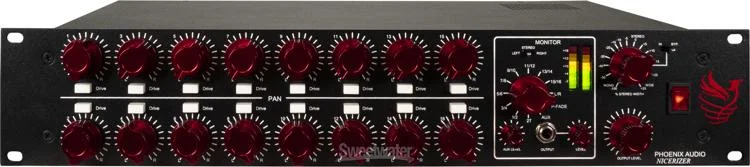
| Content | The immense flexibility of software mixers notwithstanding, there's nothing like the in-your-face punch, articulation, and dimensionality that a quality analog summing mixer can impart to your productions. The Phoenix Audio’s Nicerizer Series summing mixers rock proprietary Class A circuitry and smart features that make them legendary analog tone machines for a digital world. A 16-channel DAW summing mixer in a 2RU 19-inch rackmount chassis, the Nicerizer puts critical elements such as circuit gain staging and panning back into the analog realm where they handily outperform their digital emulations.
Hi-fidelity transformerless input stage
With their Nicerizer summing mixer, Phoenix takes a decidedly modern approach to Class A circuit design. The company's proprietary transformerless input stage delivers the full frequency spectrum with crystal-clear clarity and punch. Transformers tend to slow things down a bit — which can sound amazing in certain cases; but then slew rates take a hit, delivering sluggish transients and limiting your tonal palette.
Driven conservatively, Phoenix Audio's electronically balanced input stage serves up ultra-clear high-fidelity sound. If you're after fatter, more saturated tones, engage the +8dB switch individually on any channel to drive the circuit hotter for a punchy in-your-face sound that only discrete Class A buffer amps can deliver. The Nicerizer captures articulate, full-bodied input signals, allowing you to drive the output stage for an immense range of pure Class A tone, from modern audiophile clarity to vintage-flavored warmth.
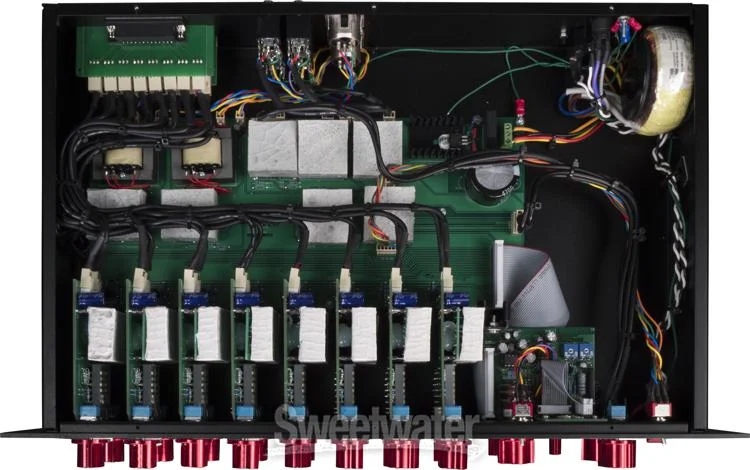
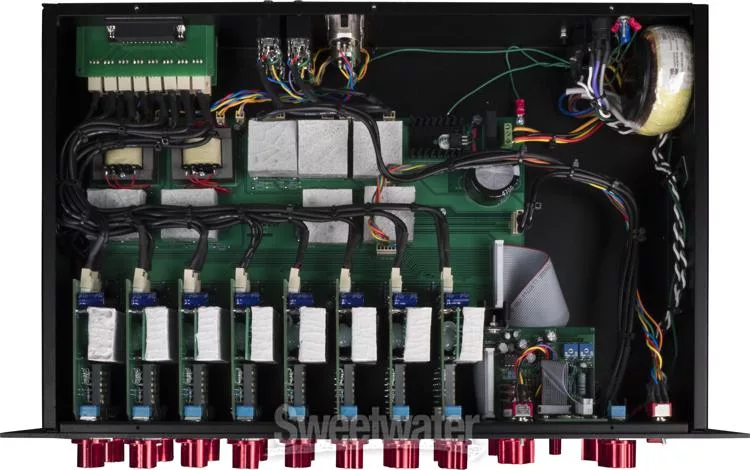
Masterful transformer-balanced output stage
Phoenix Audio couples their custom-wound DB694 output transformer to a fully discrete, proprietary DSOP-2 output amplifier, itself a direct descendant of the renowned TF1 amp that Phoenix chief designer David Rees developed as an upgrade for vintage Neve 80 Series console modules. Outperforming the TF1, the DSOP-2 represents a pinnacle of Class A output circuit design, offering a seamless tonal range from ultra-clean to gorgeously saturated. With its big iron and massive headroom, you can drive the DSOP-2 to taste. Crank the Nicerizer's output stage to elicit beautifully saturated tones; back off for a cleaner high-fidelity sound, or dial up any flavor in-between.
Balanced/unbalanced
If your inputs come from a variety of sources, you're bound to be dealing with both balanced and unbalanced signals. No worries! The Nicerizer’s 16 inputs can accept either — without any of the gain loss all too common with many mixer inputs. This amazingly useful feature lets you easily execute many functions that are fast becoming standard practices, such as looping through guitar pedals or recording MIDI-driven synthesizers in real time while mixing.
The Width control
Once you've used the Nicerizer, you'll realize how valuable its unique control set is. The Width control incorporates elements of mid-side processing to narrow or widen your stereo image with the twist of a knob. If you haven’t used a width control before, trust Sweetwater: you're in for a treat! The Nicerizer's Width control offers a degree of spacial manipulation that can instantly tighten up a sprawling arrangement or unlock hidden dimensions in a mix.
Stereo bus insert
Today, it's quite common while mixing to strap a compressor or other processor across the mix bus, and the Nicerizer's stereo bus insert makes it easy. Monitor punchy, loudness-optimized mixes and get a head start on mastering while you're still mixing.
Independently controlled AUX output
Just before it hits the output transformers, the Nicerizer mults an output signal and routes it to a dedicated front-panel level control. This independently controlled AUX output lets you drive external monitor amps or simply bypass the output stage to send a transformerless sound to your recording device.
2-track Return
Another feature borrowed from large-format consoles is the 2-track Return input that lets you monitor an external output source through the Nicerizer's onboard headphone amplifier. Incredibly convenient, and great for A/B comparisons!
The Monitor Select switch
The Nicerizer 16 Mk2 features a unique Monitor Select switch, which lets you easily monitor single pairs of channels (1–2, 3–4, etc.), in addition to any of the Nicerizer's other stereo ports. Infinitely handy for a variety of workflows, this switch is the mixer's secret weapon, ready for all sorts of creative uses, from individual stem work to comparing mixes to direct comparison of multiple analog sources.
The Monitor Select switch Toggle
Once you’ve chosen which input pair you want to monitor via the Monitor Select switch, the Toggle allows you to monitor either the Left or Right channels in mono on both channels via the headphone amp, or to monitor in stereo. Critical analysis of your audio signals has never been easier.
Flexible LED metering
Following the Monitor Select switch, the Nicerizer's LED meter display gives you constant visual confirmation of your operating levels. Another big-console feature, the flexibility afforded by the metering being selectable for each channel as well as the main outputs makes the Nicerizer's metering setup indispensable for gain management as you finalize your productions.
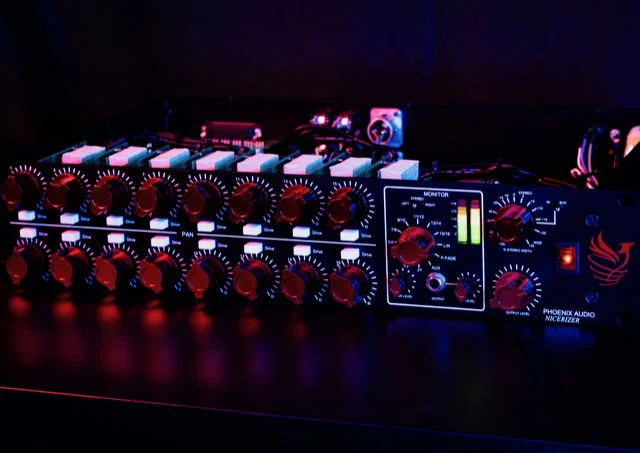
Phoenix Audio Nicerizer Features:
- 16-channel DAW Summing Mixer in a 2RU 19-inch rackmount chassis
- 16 channels of discrete Class A balanced transformerless input stage
- Discrete Class A transformer-balanced DSOP-2 output stage
- Phoenix custom-wired transformers on both outputs
- Individual detented pan controls on each channel
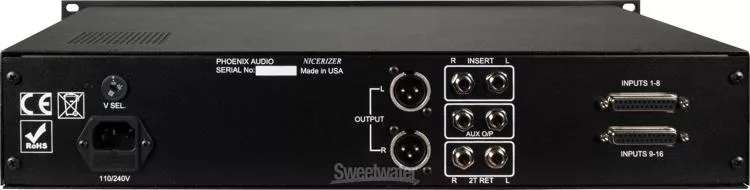
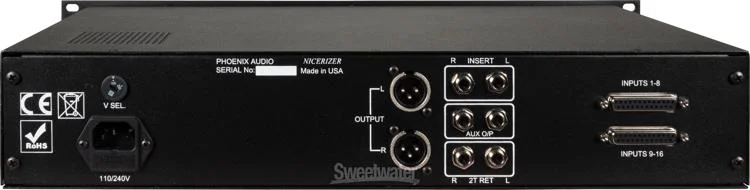
- 2 balanced 8-channel D-sub inputs — can accept balanced or unbalanced input with no -6dB loss
- Unbalanced 1/4-inch TRS insert sends on all Busses, including master Stereo Mix Bus insert
- Drive Technology button on each channel for color & saturation
- Master mix bus output level control
- Stereo LED level monitoring, switchable for each channel and Stereo Mix Bus
- Stereo/Mono External/Headphone monitoring output is switchable to each channel, external input (via 2T Return), AUX and main output (L, R, and Stereo)
- Main Outputs on balanced XLRs
- Unbalanced 1/4-inch TRS jacks for AUX outputs with front-panel level control
- 2-track stereo mono inputs on 1/4-inch TRS balanced jacks
- Bypassable Class A stereo Width control with lossless bass (pannable from mono to 25% Wider)
- Maximum Output Level of +26dB
- Generous headroom available on all channels
- Wired with PTFE silver-plated mil-spec cable
| The Ultimate Desktop Mixer Legendary SSL studio tools redefined and streamlined
To the casual observer SiX looks like any other compact desktop mixer. Look a little closer and like all SSL consoles, SiX reveals a carefully considered feature set that is driven by an obsessive desire for total flexibility, to encompass every creative eventuality. It may be small but SiX is a classic SSL design. It carries the DNA of 40 years of true expertise in creative studio workflow. Listen to SiX and you will experience the impeccable sonic performance that is the hallmark of every SSL console. It is powerful and intuitive. Inspired and rewarding.
SiX is a condensed professional console for use in the studio, in post-production, on stage, and for podcasting. SiX offers big console sound and an impressive set of utility features in a format that is small enough to stick in a bag a go wherever you need it. SiX is stunning value; it offers two recording channels with SuperAnalogueTM mic pres, two band EQ, an essential one knob version of the classic SSL Channel Compressor, a new two-band Channel EQ, inserts and 100mm faders. There is a two-knob version of the legendary G-Series Bus Compressor on the main mix bus and the unique Listen Mic Compressor on the Talkback. In mixdown mode it is a very capable twelve channel summing system that offers analogue detail, depth and width to your mixes.
The SuperAnalogue™ Sound of SSL
SiX is an SSL SuperAnalogue™ design – it gives you the sonic signature of a large format SSL console on your desktop or in your backpack. Its signal path is fully balanced from front to back on everything except the headphone output. It delivers pristine, detailed audio with wide dynamic range, ultra-low noise, ultra-low distortion and superb imaging. If you want to know more about the technical reasons why SSL mixers sound so good read our document.
Two Recording Channels
SiX has two mono channels with SSL SuperAnalogue™ Mic’ Pre’s; these are transparent, fast and have a much wider available gain range than you would typically get on a compact desktop mixer – 66dB of gain compared to the more typical mid-40s or 50dB found in desktop mixers. They have phantom power, 75Hz high pass filter and an independent line-level input which can be switched to instrument level input with high impedance.
Moving down the channel strip we have a brand-new one knob compressor circuit. This design is based on and has the same sound as the classic SSL feed-forward Channel Compressor circuit. It has a program-dependent attack time, a fixed release time and fixed ratio. Simply adjust the threshold, watch the traffic lights flash to see how much compression is happening and rely on the circuit to automatically adjust gain to match input levels. This is a cool-sounding circuit that makes it simple to dial in a consistent level and get signals sitting right in the sweet spot.
Both mono channels have a new two-band SSL EQ that may be independently switched between shelf and bell curves, with different centre frequencies for each type. This approach draws upon the SSL design legacy of specifying response curves and centre frequencies for channel EQ that are immediately intuitively pleasing in their response; these curves and frequencies were selected by our team as the most “musically useful” for a wide range of sources.
SiX has 100mm faders. We spent some time working on alternate fader tapers and settled on a law that gave us the most control over the most useable gain range, making on-stage level control far easier than it would be with a rotary or a 60mm fader as found on other compact mixers.
Each channel has a fully balanced insert point for integrating other signal processors which is after the EQ and Compressor circuits, and like all SSLs the insert send is always active – meaning you can use this as a “dry” record send to your DAW if required.
At the bottom of the mono channels we have an ALTernate input switch which can source 2 extra mono channels from a connector on the rear of the console which can be used at mixdown.
Line Level Heaven
SiX has two stereo input channels with -10/+20 dB trim for line sources such as synthesisers, drum machines, output from soundcards etc. These have their own balance controls and 100mm faders. If only the Left input of a stereo channel is connected (and the right left free) the channel will automatically switch to mono, panned centre.
While SiX might be small it can handle a lot of inputs at mix-down! Using the two mono input and the two stereo input channels gives SiX its name, but we also have two stereo EXTernal inputs (with volume controls in the master section) which can be sent to the mix bus. Include the ALT inputs and we have up to 12 channels that can be summed into the main mix bus.
Master Bus Magic
SiX has a G Series Bus Compressor on the main mix bus. This uses the same circuit design as the legendary SSL Bus Compressor from our larger consoles but with a fixed ratio, attack, and release settings and a more modern quad-VCA chip. The simplified controls make it very easy to get that SSL glue and snap on whatever you push through your master bus. SiX also has a set of inserts on the main mix bus that can be used to bring external processing tools (like SSL Fusion) to your mixdown.
Routing Pro
SiX has a collection of professional routing & monitoring features taken directly from our large format console heritage. It has two Stereo Cue buses (with level and pan controls) for individual artist foldback mixes. The Master Section has main and alternate monitor outputs with a proper monitor source matrix, as well as mono check, dim and cut. The fader channels all have proper PFL and a Mute button that routes the muted signal to a ‘Bus B’. Bus B can be used as a convenient DAW record send but it can also be routed to the monitor matrix. This means that the muted signal can be monitored without it feeding the main mix bus and then switched in to the main mix with the Mute button – perfect for live webcasting because a remote feed can be monitored ‘offline’ and punched in to the broadcast feed. There is a talkback mic’ input with phantom power and SSL’s unique, crunchy Listen Mic Compressor, which of course also serves as a unique processing tool that delivers that classic 1980’s slammed drums sound.
Key Features:
A fully professional condensed console for use in the studio, in post-production, on stage, and for podcasting.
Benchmark SuperAnalogue™ audio performance
Ultra low noise : ultra-low distortion : pristine sound
Stunning Record Path
Two SSL console grade SuperAnalogue mic pre’s
Classic SSL Channel Processing
Essential versions of SSL Channel EQ and Dynamics
The unique Listen Mic Compressor
Nothing slams drums quite like it!
Professional Routing & Monitoring
The hidden versatility of truly professional features
12 Input Summing at Mixdown
12 line level inputs with channel and Master Bus inserts
Legendary Master Bus Compressor
An essential version of the incredible SSL legacy
Completely balanced signal path
Everything except the headphone jack is fully balanced | Add the undeniably vibrant sound of analog summing to your DAW with the SPL MixDream XP 16 x 2 analog summing mixer. Take one of your past projects and mix it through the MixDream XP and you'll hear more depth, enhanced stereo imaging, and noticeably punchier dynamic impact. The Class A design and 60-volt rails in the MixDream XP provide amazing headroom and ultra-low noise, rivaling the sound of full-featured analog consoles. Once you've got your submixes sounding just right, Sweetwater can highly recommend the SPL MixDream XP summing mixer to take your mix over the top.
SPL MixDream XP 16 x 2 Summing Mixer at a Glance:
- Deeper, wider mixes from analog summing
- Premium analog design for top-notch sound
- Expandable for higher channel counts
Deeper, wider mixes from analog summing
While the debate over analog vs. digital summing is not new, most engineers agree that summing your mix through high-quality analog gear sounds awesome. Compared to the exact same mix summed in your DAW, you'll notice that the SPL MixDream XP sums your mix with greater depth and enhanced stereo definition, with an undeniably vibrant quality.
Premium analog design for top-notch sound
SPL designed the MixDream XP summing mixer with 60-volt rails for an outstanding 125dB dynamic range, with a very low noise floor too.The discrete Class A topology was designed to give you essentially the same sound as a high-end mixing console, in a convenient rackmount form factor.
Expandable for higher channel counts
Need more than 16 channels of analog summing? It's easy to expand your summing capabilities with additional MixDream XPs. Just use the expansion inputs to daisy-chain your MixDream XPs, or even mix and match with SPL MixDream model 2384 summing mixers.
SPL MixDream XP 16 x 2 Summing Mixer Features:
- 16-in, 2-out analog summing mixer
- Amazing dynamic range and ultra low noise, thanks to discrete Class A design and 60-volt rails
- Multiple units can be linked for surround operation
- Allows you to achieve an analog vibe that's difficult to create with plug-ins
- Ideal for mixing and mastering applications
| RÉSUMÉ DES FONCTIONNALITÉS
Images de 24, 32, 40 et 48 canaux
Options de canal mono / stéréo A, B, C, D
Mélanges principaux LR et M
8 groupes audio avec panoramique et routage vers LR et M
10 auxiliaires dont un envoi stéréo dédié avec commandes de niveau et de panoramique
2 canaux stéréo multifonctions chacun avec entrées micro et ligne stéréo
2 doubles stéréos supplémentaires fournissent 4 retours stéréo additionnés ou indépendants
Matrice 12 × 4 complète
Double fonctionnalité appropriée pour FoH, mixage de moniteur ou les deux
Enregistrement capable avec des sorties directes de canal
M peut être utilisé pour le mixage centre / sous, la somme mono LR ou le coin d'ingénierie
Entrées externes matricielles avec trims de niveau et capacité d'entrée commune
Les entrées micro du canal stéréo peuvent se croiser dans la matrice pour une alimentation d'ambiance
EQ réactif 4 bandes, 2 balayages
Filtres passe-haut de canal 100Hz
Alimentation fantôme individuelle et commutation de polarité
Compteur intégré avec 11 VU-mètres à bobine mobile éclairés par LED
Canal LED grand angle et compteurs principaux
Compteurs de contrôle stéréo dédiés
Commutation auxiliaire par canal pré / post fader pour une flexibilité totale
Commutateurs pré / post-EQ du panneau avant pour les préférences de l'utilisateur
Coupe le son de tous les faders masters
Faders à double rail de qualité supérieure de 100 mm
Talkback assignable à toutes les sorties, comprend un mode de verrouillage de commutateur de conversation
Oscillateur 1 kHz / générateur de bruit rose avec sortie externe
Surveillance 2 pistes et relecture sur LR
3 prises casque / écouteurs et sorties moniteur locales
Sorties XLR symétrisées électroniquement avec capacité d'entraînement + 26 dBu
Gamme de préamplis 74 dB avec capacité d'entrée +34 dBu pour micro ou ligne
Conception d'ampli micro à très faible bruit
Combiner intégré pour une alimentation de secours redondante
Assemblage de cartes de circuits individuelles avec des pots écroués
Option de liaison d'entrée / sortie de console Sys-Link V2
Douilles de lampe XLR 4 broches - Lampe LED Allen & Heath disponible.
Options de canal mono / stéréo:
A = tous les canaux mono
B = 4 stéréos à droite des masters
C = 4 stéréos à l'extrême droite
D = 8 stéréos à l'extrême droite | Espandibile fino a 32 canali - QCon Pro XS8 + 1 fader motorizzati sensibili al tocco con risoluzione a 10 bitFader LED a 12 segmentiDoppio display LCD retroilluminato 2 × 56 per visualizzare il nome del canale. i valori di controllo. ecc. Per ogni canaleDisplay LED a 12 segmenti che mostra la posizione temporale del progetto in formato SMPTE o BBT - 18 pulsanti assegnabiliRotella jog shuttle per ricerca e controllo velociPulsanti illuminati per ogni canale. inclusi Record Enable. Solo. Mute. Select e Monitor6 pulsanti illuminati tra cui Play. Stop. Rec. Rewind. Fast Forward e LoopPulsante ZOOM illuminato con 4 pulsanti di direzione9 pulsanti funzione MIDI assegnabili illuminatiEspandibile a 32 canali utilizzando 3 unità di espansione QCon XSDue (2) connettori da 1/4 per interruttori a pedale e pedaliClasse compatibile con Windows XP. Vista (32 bit). Windows 7 (32 bit e 64 bit). Windows 8 (32 bit e 64 bit). Windows 10 (32 bit e 64 bit) e Mac OS XConnettività USB 2.0 ad alta velocitàIl driver ICON Quick-Setup è disponibile per Cubase. Nuendo. Reason e Bitwig per la compatibilità plug & play istantaneaBitwig Studio 8-Track DAW è incluso.Mackie Control integrato per tutte le DAW elencate (ad eccezione di ProTools che utilizza il protocollo Mackie HUI)Facile aggiornamento del firmware disponibile tramite connessione USB e software iMapQualità costruttiva superiore e robusto involucro in metallo con porta per blocco Kensington
Dimensioni: Lunghezza 51cm - Profondità 23.5cm - Altezza 57.5cm - Volume 0.068m³
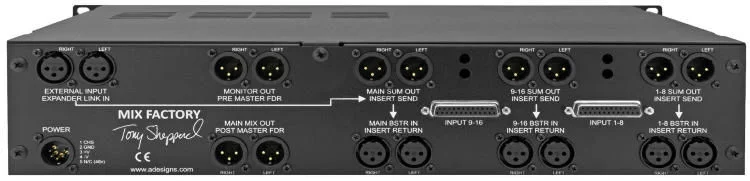
Icon # Qcon Pro X - controller per DAW # Controller Midi / Controller Midi USB # Serie Qcon | The A-Designs Mix Factory takes a fresh approach to analog summing, delivering analog warmth with the depth and imaging needed to make your mixes truly stand out. Mix Factory inputs 16 channels and sums to balanced stereo outputs. All channels are fitted with gain controls, pan pots, and mutes. Two 8-channel groups are provided, each has an insert with mute button, and there is a master insert for all 16 channels. Mix Factory lets you switch between "clean," which bypasses the transformers, to "tonal," which introduces the harmonic enhancement of custom Cinemag output transformers. The Mix Factory is linkable, letting you expand to 64 or more channels. Take your studio to the next level with the A-Designs Mix Factory.
Benefits of the hybrid studio
Producer/engineer Tony Shepperd came up with the idea for Mix Factory, and it was brought to life by noted circuit design wizard Paul Wolff. Mr. Shepperd had been one of the modern engineers who subscribed to the "all-in-the-box" school of digital music production. At some point, however, he came to believe that digital and analog could very well coexist in the contemporary studio in a synergistic union that delivered additional "best-of-both-worlds" sonic benefits. This hybrid approach worked exceptionally well for Tony, taking his mixes to a new level. So much so that other engineers took notice and started asking him for tips. Today, most high-end recording facilities (including Sweetwater Studios) are hybridized in one sense or another. A-Designs' Mix Factory is a smart and cost-effective way to realize the many advantages of this approach.
A-Designs Mix Factory Features:
- 2RU 16-channel analog summing mixer
- 2 x 8-channel Groups
- All channels fitted with gain controls, pan pots, and mutes
- Switchable Cinemag output transformers
- Linkable, for easy studio expansion
- External power supply (included) switches between 120V and 230V
|











Reviews
There are no reviews yet.