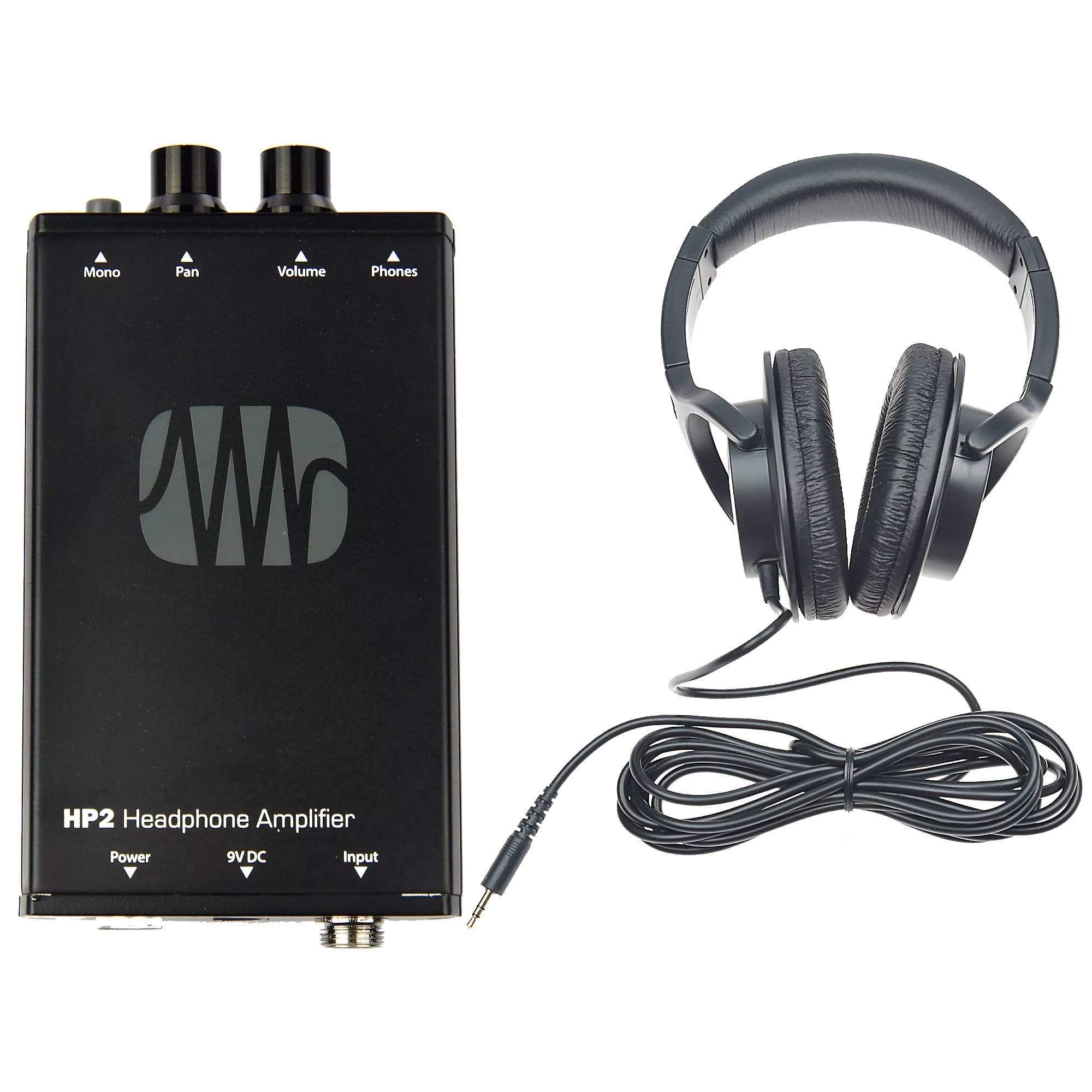
| Content | Designed for musicians and performers who demand mobility without compromising audio quality, the HP2 personal headphone amplifier is a great choice for driving wired in-ear monitors (IEMs), as well as headphones. PreSonus HP-series headphone amplifiers have long been popular for their loud, clean, clear sound and roadworthy built quality. The new HP2 delivers these qualities in an easily affordable, stereo device so you'll hear every note and beat clearly wherever your music takes you. | FEATURES
- World-class, transformer-coupled preamp, compressor, and DI
- Gain: 0 - 66dB in 6dB increments
- Compressor: Single-knob opto-coupler compressor with 2:1 ratio
- Blend: Determines balance of mic and DI inputs
- Instrument gain: 0 - 30dB on instrument input
- 48V phantom power
- Silk: Adds nostalgic warmth and presence when engaged
- Instrument input: Front-panel TRS input and passive-through for Hi-Z sources
- Polarity reverse
- Threshold: When signals exceed threshold level, gain is reduced at a controlled 2:1 ratio with fixed attack and release time constants
- Indicators: Signal presence and clipping on both mic and DI signals, as well as compressor activation.
TECHNICAL SPECIFICATION
Rupert Neve Designs Portico 517: 500 Series Mic Pre / DI / Comp
- Frequency Response: Main Output, no load, -0.2dB @ 10Hz -3dB @ 160kHz
- Noise measured at main output, unweighted, 22Hz - 22kHz, terminated 150 ohm: Gain at unity: better than -100dBu; gain at 66dB: better than -62dBu Equivalent Input Noise: better than -128dBu, noise factor 1.5dB
- Maximum output level from 20Hz to 40kHz: +23dBu
- Total Harmonic Distortion and Noise: @ 1kHz, +20 dBu output: Main Output: Better than 0.001% @ 20Hz, +20 dBu output: Main Output: Better than 0.002% Silk Engaged: Better than 0.2% Second harmonic
- Crosstalk: Measured channel to channel: Better than -90dB @ 15kHz.
- Phantom Power: +48 Volts DC +/- 1%
| Proven reverberation classic for the future
With the VSR 3.2, we happily rely on the proven old mechanical way to create reverberation. Rightly, because the used reverberation spring by AccuBell (formerly Accutronics) creates that magic 60's reverb which is slightly metallic and dense at the same time.
Just like it predecessors, VSR 3.2 has a straight-forward and honest approach: signal in - spring reverb - vintage sound out.
VSR 3.2 is equipped with an equalizer that is exactly adapted to the springs' frequency response. In addition, there are controls to mix the dry and effect signal as well as controls for the input and output level. This way, VSR 3.2 simply exactly does what it was designed to do.
Designed for every situation
Although using a large spring (type 9), VSR 3.2 fits in a 19" housing with one rack unit – minimal space requirements. Thanks to its extremely solid chassis, VSR 3.2 is a reliable vintage-effect that cannot only be used in a controlled studio environment. On the contrary, it also serves fine when being used in straining live situations.
VSR 3.2 grants your sound an elegant touch of "good old times". Its simplicity makes it an unbelievable versatile companion.
Inputs
- 1/4"-jack input front
- unbalanced
- max. input sensitivity: –40 dBu
- impedance: 1 MΩ
- 1/4"-jack input rear (1)
- unbalanced
- max. input sensitivity: 0 dBu
- impedance: 100 kΩ
- 1/4"-jack input rear (2)
- unbalanced
- max. input sensitivity: –20 dBu
- impedance: 10 kΩ
Outputs
- 1/4"-jack output (1)
- unbalanced
- max. output level: 0 dBu
- 1/4"-jack output (2)
- unbalanced
- max. output level: - 20 dBu
Signal-to-Noise Ratio
- direct: > 80 dBu
- effect: > 70 dBu
THD + Noise
Miscellaneous
- power supply: external DC-adapter with 12 V/1000 mA
- dimensions: 19“, 1 HE, ca. 190 mm deep
- weight: 2.5 kg
|
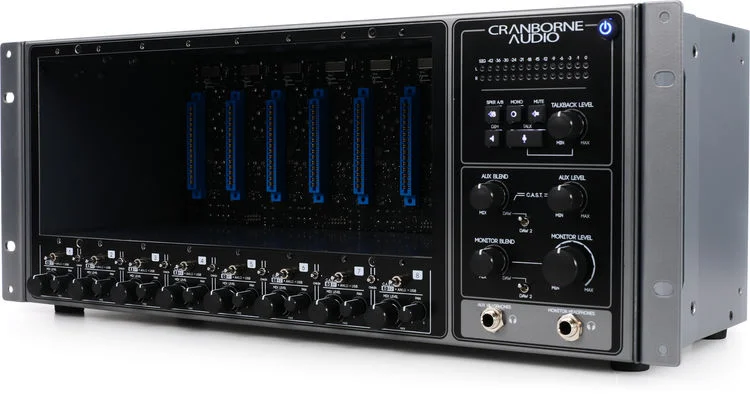
The Cranborne Audio 500R8 is, essentially, a studio in a rack. It’s an 8-slot high-current 500 Series chassis, a 28-in/30-out USB interface, an analog summing mixer, a zero-latency artist mixer, and a monitor controller — everything you need to build your dream hybrid analog/digital studio. The 500R8 is fitted with high-performance AD-DA conversion, reference-grade headphone amplifiers, a reference-quality master clock, and more. In fact, there’s very little you can’t do with the Cranborne Audio 500R8. Configure it to suit your preferred analog flavoring for any source. Pack it with vintage-style 500 Series preamps for recording drums; clean, pristine preamps for vocals; and EQ, compression, and saturation modules when it’s time for mixdown.
USB audio interface
Connect the 500R8 directly to your Mac or PC via USB and utilize the 500R8’s onboard 28-in/30-out USB audio interface for recording and playback directly to and from your digital audio workstation of choice.
Discrete summing mixer
Give your mix the crowning touch of analog character by sending submixes and stems back through your 500 Series modules, into the 500R8’s discrete analog summing mixer, and back into your DAW.
Monitor controller
Use the 500R8’s onboard high-headroom monitor controller to switch between two sets of speakers, toggle mono sum, mute, dim, and talkback facilities while monitoring the peak level of your mix on the high-resolution 28-segment LED meter.
 Shown with optional 500 Series modules Shown with optional 500 Series modules

Audiophile headphone amps and zero-latency artist mixer
Drive any headphones with 500R8’s two reference-grade headphone amplifiers — they have enough power to drive low-impedance ’phones with gobs of headroom and a linear frequency response to below 1Hz! Use the 500R8’s two aux buses to create pristine analog cue mixes that you can blend with DAW playback and send to the talent with zero latency.
World-class conversion and clocking
For the musician who wants to get down to business, it may be hard to get excited about conversion and clocking. But engineers at Sweetwater get to check out the best of them — and we’re amped about these converters. They’re touted as best-in-class and flaunt truly impressive specs such as under .5 picoseconds of jitter. But none of that really matters when you hear the fullness of your stereo image bloom with jaw-dropping sonic clarity.
Connect the 500R8 to your macOS or Windows computer and capture every nuance of your sources with reference-grade AD/DA conversion and world-class internal clocking. Effortlessly pass audio between analog and digital worlds without the digital artifacts that color, cloud, and degrade your recordings. The only coloration you will hear is intentional — your microphone placements, mixing decisions, and the 500 Series modules you’ve chosen to use. And with word clock I/O, you can even share the 500R8’s world-class clocking with the rest of your digital gear.
Ample I/O and configurable front end
The 500R8 has generous I/O to integrate with all of your analog and digital hardware, so you can mix and match your 500 Series modules and find the best combinations during recording and mixing to help create your own signature analog sound. You can even integrate your 19" rack units via the 500R8 s dedicated per-slot TRS insert jacks.
C.A.S.T. away
Spec’d with Cranborne’s innovative C.A.S.T. system, the 500R8 does away with excess cable spaghetti, delivering a cost-effective, low-maintenance, plug-and-play solution by transmitting four channels of balanced analog audio over shielded Cat 5 Ethernet cable directly to the destination of your choice.
Handy source select
Re-patch your 500R8 at a flick of a switch. Dedicated source select switches for each 500 Series slot adjusts signal routing to send analog, C.A.S.T., or USB sources through each of your modules. Unused 500 Series slots? Bypass them using the 500R8’s dedicated slot-bypass switch.
 Shown with optional modules and Cranborne 500ADAT Shown with optional modules and Cranborne 500ADAT
Expandable, in the studio or on the road
When you’re ready for additional 500 Series connectivity, connect your 500R8 with Cranborne Audio’s 500ADAT via ADAT for 16 channels of 500 Series modules. Housed in a 19" 4U rack-mountable rugged steel frame, the 500R8 makes an ideal 500 Series chassis for mobile recording setups. Packed with cool, useful features, the Cranborne Audio 500R8 is one of the more innovative pieces of pro audio gear we’ve seen at Sweetwater. Trust us — you will be impressed.
Cranborne Audio 500R8 8-slot 500 Series Chassis and USB Audio Interface Features:
- 28-in/30-out USB interface, summing mixer, artist mixer, and monitor controller
- Low-latency USB 2.0 interface:
- Compatible with macOS and Windows computers
- ADAT I/O (16x16 channels @ 44.1/48kHz, 8x8 channels @ 88.2/96kHz)
- S/PDIF I/O; 5-pin MIDI I/O
- High-performance A/D conversion:
- Dynamic range: 121dB A-weighted dynamic range, 20Hz–20kHz
- Frequency response: 2.2Hz to >80kHz (-1dB)
- THD+N: <0.00032% (-110dB) @ -4dBFS, 20Hz–40kHz (1kHz, A-weighted)
- Max input level: +24dBu
- High-performance D/A conversion:
- Dynamic range: 121dB A-weighted, 20Hz–20kHz
- Frequency response: <1Hz to >61kHz (-1dB)
- THD+N: <0.0003% (-110.5dB) @ -4dBFS, 20Hz–40kHz (1kHz, A-weighted)
- Max Output Level: +24dBu
- Reference-quality internal master clock:
- Sample rates: 44.1, 48, 88.2, 96, 176.4, and 192kHz; <0.5ps jitter
- Dedicated word clock I/O via BNC
- External sync options using word clock BNC, S/PDIF, or ADAT
- Monitor controller with talkback:
- Speaker A/B switching, mono check, dim, mute, and 28-segment peak meter
- Dedicated talkback input with phantom power, push-to-talk activation, and automatic routing to all headphone and C.A.S.T. facilities
- Easy-access illuminated front panel controls for all monitor controller functions
- Analog summing mixer:
- 8x2 analog summing mixer with +26.5dBu of headroom and dedicated ADC
- Balanced 1/4" jack outputs
- C.A.S.T. link port for increasing Summing Mixer to 16x2 using Cranborne Audio 500ADAT
- Zero-latency Artist Mixer:
- Analog Artist Mixer with per-channel physical level/pan controls and DAW return blend controls
- 2 high-power headphone outputs with independent blend and level controls
- Reference-grade headphone amplifier:
- THD+N: <0.0006% (-104.4dB) @ 20dBu, 1kHz A-weighted, 300 ohm load
- Output wattage (1kHz): 250mW x 2 @ 600 ohms, 650mW x 2 @ 220 ohms, 1.21W x 2 @ 100 ohms, 500mW x 2 @ 32 ohms
- Frequency Response: <1Hz to >70kHz (1dB)
- High-current 8-slot 500 Series rack:
- Per-slot current: 250mA , 2A total for all slots
- XLR inputs, XLR line outputs, and TRS Inserts (pre-ADC) per 500 Series slot
- Module source switching options to send Analog, USB or external C.A.S.T. signals through 500 Series modules
- Per-slot module bypass switches allowing 500R8 to be used without 500 Series modules installed
- C.A.S.T. compatible:
- C.A.S.T. ports per channel for routing analog I/O using passive or active C.A.S.T. breakout boxes via standard Cat 5 cable
- External power supply:
- 24V, 5A external locking power supply for improved analog audio performance and heat dissipation
- Designed and engineered in the UK:
- Each 500R8 is extensively tested by a team of dedicated engineers to ensure reliability and consistency.
| The vintage EQ tones you know & love.
The 551 is the only equalizer for the 500 Series actually designed by Rupert Neve. Featuring 3 bands of EQ inspired by Mr. Neve’s most prized vintage designs, along with custom-wound inductors, transformers and class-A gain blocks, the 551 brings the thick, powerful lows and sweet highs of Rupert’s classics to the 500-Series format.
The “Best-Of” EQ
The 551’s 3-band, custom-tapped inductor EQ was inspired by our favorite elements of Rupert’s vintage EQ designs. The low frequency band is designed to produce a creamy, resonant bass response similar to a vintage 1064 – but unlike the vintage modules, the LF band on the 551 can be used as either a shelf or a peak filter, adding punch, dimension, and control to your low end.
The midrange band is based on that of the 1073, ideal for sweetening vocals and instruments while bringing them forward in a mix, and its proportional “Q” response makes it well-suited for minimizing problematic frequencies. The high frequency band is a hybrid vintage / modern design, blending inductor circuitry with capacitor-based topologies to achieve vintage tones with enhanced control. The High Pass filter is a 12dB/octave design with a fixed 80Hz frequency, and can be used in tandem with the low frequency EQ to add low-end presence without clouding the source material.
As with Rupert’s most prized classic designs, each EQ section uses low-feedback, class-A discrete electronics to prevent low-level artifacts and harshness from detracting from the tonal shaping. However, this new circuit is a decidedly modern design with updated techniques and components that were simply not available 50 years ago, and is definitely not a “clone”.
What Are Inductors?
Inductors are wires wound around a coil that provide a form of frequency-dependant resistance. When they saturate, they bring out beautifully musical harmonics that give your tracks the smooth, polished sound that has made Rupert’s consoles and equipment so desirable for over fifty years. This is what makes them different from capacitor-based EQ designs, which do a great job at surgical equalization. But inductors provide the tone.
While it is certainly possible to create a functioning EQ using off-the-shelf inductors, we choose to use our own custom inductors for the 551. This attention to detail in controlling variables such as the winding and core materials in relation to the surrounding circuitry allows the 551 to capture the vitality and personality of Rupert’s classic designs.
NOISE
- Measured at Main Output, un-weighted, 22Hz-22kHz, source impedance 40 Ohm balanced.
- Better than -102 dBV
FREQUENCY RESPONSE
Main output, no load: +/- 0.1 dBu from 20 Hz to 31.5 kHz, -1 dB @ 120 kHz
MAXIMUM OUTPUT LEVEL
23.25 dBu
TOTAL HARMONIC DISTORTION AND NOISE
- @ 1 kHz, +20 dBu output level, no load: Better than 0.0025%
- @ 20 Hz, +20 dBu output level, no load: 0.13% Typical (2nd and 3rd harmonic)
HIGH PASS FILTER
- -2.7 dB @ 80 Hz
- Slope: 12 dB/Octave
NOISE
- Measured at Main Output, un-weighted, 22 Hz - 22 kHz, source impedance 40 Ohm balanced.
- Better than -94 dBV
FREQUENCY RESPONSE
Main output, no load: +/- 0.25 dBu from 20 Hz to 45 kHz, -2 dB @ 120 kHz
MAXIMUM OUTPUT LEVEL
23 dBu
TOTAL HARMONIC DISTORTION AND NOISE
- @ 1 kHz, +20 dBu output level, no load: Better than 0.009%
- @ 20 Hz, +20 dBu output level, no load: 0.13% Typical (2nd and 3rd harmonic)
POWER REQUIREMENTS
- 120mA on +16VDC
- 110ma on -16VD
| Condition: Item is subject to minor cosmetic imperfections. Packaging may be in poor shape. The item displayed in the images may not be the actual item you receive.
- Converts balanced line level signals to unbalanced
- Stereo signal path with set & forget level control
- Transformer isolated to eliminate hum & buzz
- J-Iso features Jensen™ transformers for optimal signal path
The Radial J-Iso and Pro-Iso are stereo line isolators designed to convert a professional +4dB line level balanced signal to an unbalanced -10dB consumer level device. This enables you to take the balanced output of a mixer and feed a consumer level recorder or audio input on a computer.
J-Iso Part # R800-1025: The J-Iso employs a premium Jensen transformer for optimal signal transfer to minimize distortion and artefact. Full bandwidth performance makes the J-Iso ideal for music production.
The passive design begins with 100% discrete components throughout. A set & forget level control lets you attenuate the input signal to prevent it from overloading the destination device. Output connections include a stereo pair of ¼" connectors, a set of RCAs and a mini 3.5mm (1/8") for interfacing to a mini recorder or lap-top computer. Transformer isolation helps eliminate hum and buzz caused by ground loops while eliminating stray DC currents from flowing.
Construction begins with 14 gauge steel throughout utilizing Radial's unique bookend construction. This creates a protective zone around the connectors and controls for added durability. The steel construction also assists by shielding the transformers from outside magnetic fields. Inside, the J-Iso features an innovative I-beam skeletal insert that makes it virtually impossible to torque the PC board. This reduces potential stress which could cause premature solder joint failure.
Designed for full range applications, the J-Iso combines exceptional signal handling with the type of durability that has made Radial famous. Signal Processors |






Reviews
There are no reviews yet.