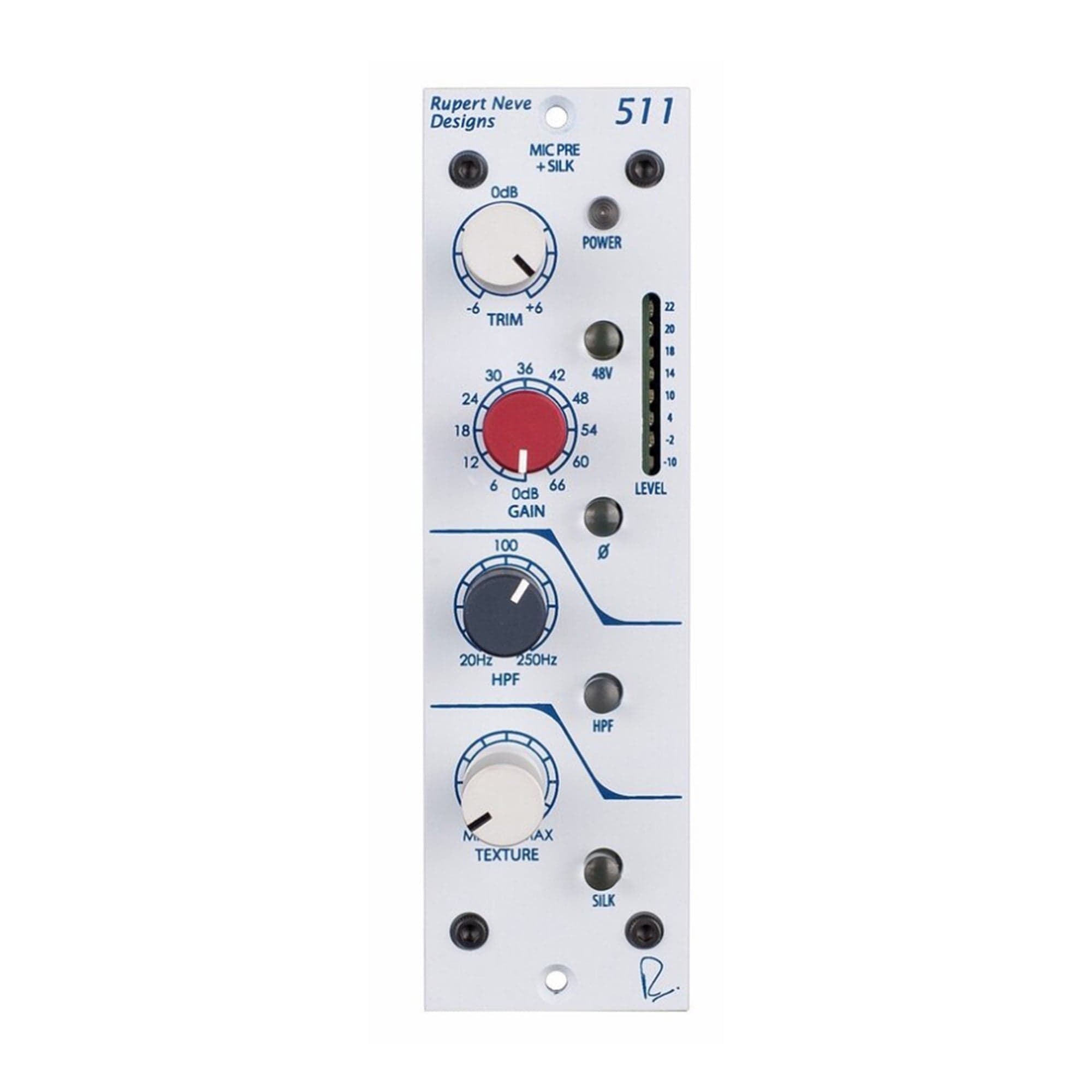
| Content | With a big, bold preamp, a swept high-pass filter and the powerful saturation control of variable Silk, the 511 combines legendary Rupert Neve tone with 500 Series value.
What is Silk?
One of the key features of the 511 is the Silk / Texture control. The Silk circuit was initially developed for the original Portico series mic preamplifiers, and was only a single switch – on or off – that added a specified amount of musical, pleasing harmonic saturation to the unit’s output stage.
Taking this concept one step further, the Texture knob is designed to adjust the actual amount of harmonic content from the source material.
So how does it work? By reducing negative feedback across the output transformer and adjusting this feedback’s frequency response, the Silk / Texture circuit provides the sweet, musical saturation found in Rupert’s legendary vintage designs – but with complete & precise control over the amount of classic tone you want.
NOISE
- Measured at Main Output, un-weighted, 22 Hz - 22 kHz, source impedance 150 Ohm balanced. Noise performance can vary depending on the 500 series and / or interference from stray magnetic fields.
- Unity Gain: Better than -103 dBV
- Gain @ +66 dB: Better than -60 dBV
- Equivalent Input Noise: -125 dB
FREQUENCY RESPONSE
- Main output, no load.
- +/- 0.1 dBu from 10 Hz to 31.5 kHz
- -2.6 dB @ 120 kHz
MAXIMUM OUTPUT LEVEL
+23 dBu
TOTAL HARMONIC DISTORTION AND NOISE, NO SILK
- @ 1 kHz, +20 dBu output level, no load: Better than 0.0025%
- @ 20 Hz, +20 dBu output level, no load: 0.025% Typical (2nd and 3rd harmonic)
TOTAL HARMONIC DISTORTION AND NOISE WITH SILK ENGAGED
- @ 100 Hz, +20 dBu input level, no load.
- TEXTURE @ min: 0.015%, mostly 3rd harmonic typical
- TEXTURE @ max: 2%, mostly 2rd harmonic typical
GAIN
- Unity up to +66 dB in 6 dB steps.
- Trim continuously adjustable from -6 dB to +6 dB.
PHANTOM POWER
Supplied by the 500 series rack power supply. Switch selectable on faceplate.
HIGH PASS FILTER
- Continuously variable swept frequency from 20 Hz to 250 Hz.
- Slope: 12 dB/Octave
POWER REQUIREMENTS
@ +/-16VDC, 100mA | There’s no doubt that when it comes to power, musicians have it bad. Whether it’s modern modeling amplifiers, or vintage synthesizers, bad power is gonna be heard throughout your signal. And it’s everywhere — in homes, on stages, and especially in many rehearsal rooms.
Black Lion Audio has been trusted for years for modifying the best gear and making it even better, and that’s what it took to create the PG-P: taking industry-standard designs, and improving them to the point of peak performance.
After creating an entire lineup of industry-best power conditioners, Black Lion Audio felt it was time to give the world proper portable power. The PG-P might look like a run-of-the-mill surge protector, but in reality it’s a studio-class power conditioner — PG-P doesn’t just provide more noise filtering than other portable conditioners, it provides the same noise filtering found in the majority of the world’s rack-mount power conditioners!
Your gear deserves the best power, and Black Lion Audio took great care in making sure the PG-P delivers just that — thanks to it’s PG-P Filtering Technology. The PG-P is built using premium Panasonic capacitors, due to their superior execution in eliminating high frequency noise that robs equipment of its peak performance. In testing, this has provided an average of 3x the noise filtering of other portable power conditioners at the same price point. Six wall-wart spaced outlets provide studio-grade power on the go; perfect for any musician’s rig!
- PG-P Filtering Technology for an average of 3x the noise reduction of other portable power conditioners
- The same noise filtering found in the majority of rack-mount power conditioners
- 6 wall-wart spaced outlet power conditioner
- Status LEDs for quick power analysis
- High-end Panasonic capacitors to filter out performance-robbing high-frequency noise
- Tour-grade 9ft power cable
- Proper safeguard protection with a power absorption rating of 540 joules
- Recessed feet keep the PG-P from sliding, while still providing mounting options (screw mount, velcro, etc.)
- Rounded corners make for a gentle surface area for smaller power cords.
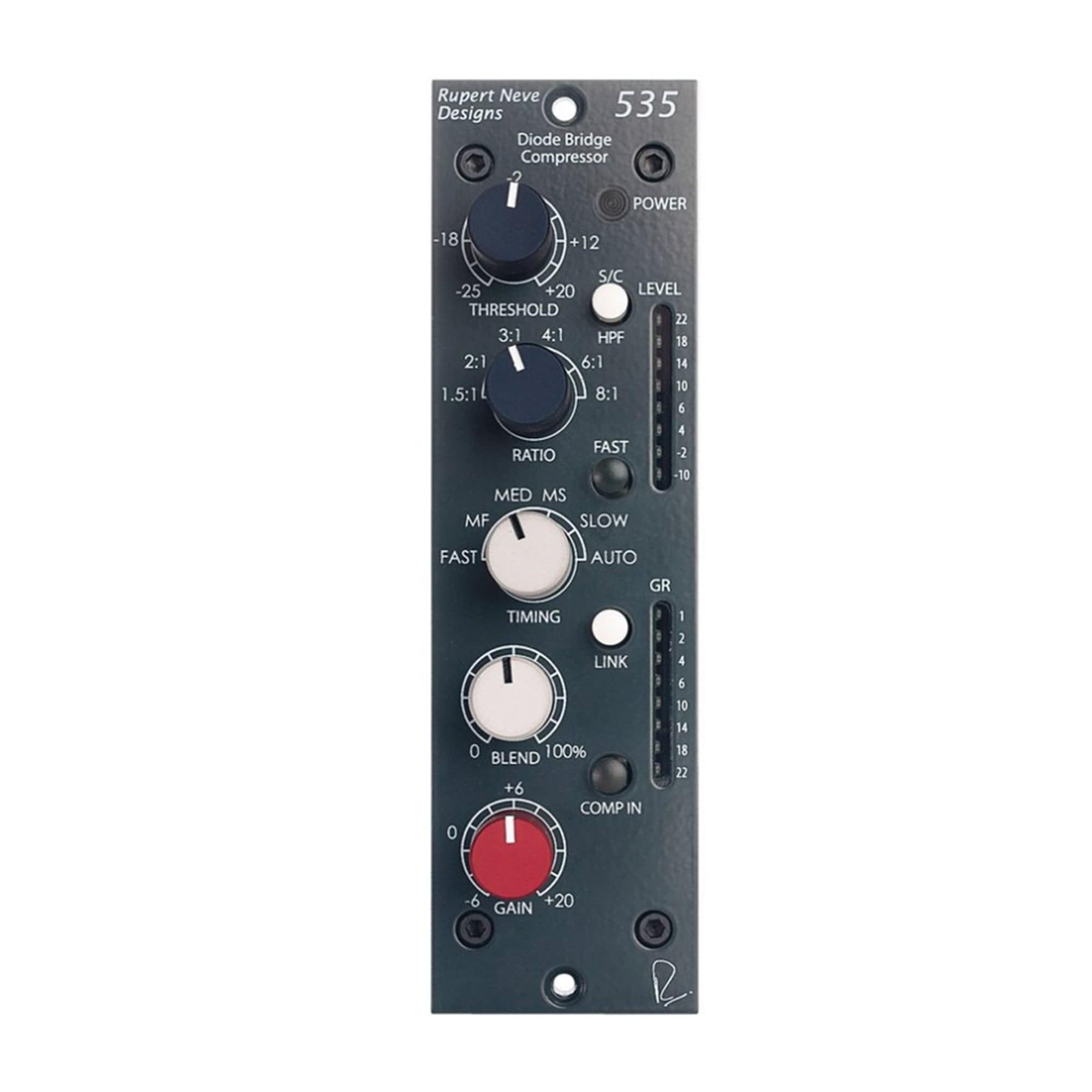
| Originally developed for the dynamics circuit of the acclaimed Shelford Channel, the 535 Diode Bridge Compressor captures the soul of Rupert Neve’s original 2254 compressor while providing modern updates including advanced timing control, significantly lower noise, fully stepped controls throughout, and internal parallel processing capabilities.
What is diode bridge compression?
Where the VCA compressor found in the Master Buss Processor provides unmatched clarity, the weighty, harmonically rich tonality of diode bridge compression can be essential in pushing key sources like vocals, electric guitars, bass and drums to the forefront of a mix.
By understanding the limitations of vintage units like the legendary 2254, painstaking effort was taken to reproduce the unique tone of these classics while improving the noise floor & accuracy, expanding inflexible time constants, adding full wave sidechain detection for improved dynamic response, and widening the range of threshold and ratio controls.
Delivering the powerful sound of these iconic designs with enhanced flexibility for the modern age, the 535 Diode Bridge Compressor is a dynamic tool equipped to make a bold statement on virtually any mix or track.
LINE INPUT TO LINE OUTPUT
- Compressor Bypassed.
- Z source = 40 Ohm Balanced
INPUT IMPEDANCE
10K Ohm
OUTPUT IMPEDANCE
40 Ohm
MAXIMUM INPUT LEVEL
+23.5 dBu
MAXIMUM OUTPUT LEVEL
+23.5 dBu
NOISE
- 22 Hz - 22 kHz BW.
- -101 dBu
FREQUENCY RESPONSE
- 10 Hz - 120 kHz, 30ft Output XLR Cable.
- +/- 0.25 dB
THD+N
- @ 1 kHz @ Maximum Output Level, 22 Hz - 22 kHz BW.
- 0.001%
| Proven reverberation classic for the future
With the VSR 3.2, we happily rely on the proven old mechanical way to create reverberation. Rightly, because the used reverberation spring by AccuBell (formerly Accutronics) creates that magic 60's reverb which is slightly metallic and dense at the same time.
Just like it predecessors, VSR 3.2 has a straight-forward and honest approach: signal in - spring reverb - vintage sound out.
VSR 3.2 is equipped with an equalizer that is exactly adapted to the springs' frequency response. In addition, there are controls to mix the dry and effect signal as well as controls for the input and output level. This way, VSR 3.2 simply exactly does what it was designed to do.
Designed for every situation
Although using a large spring (type 9), VSR 3.2 fits in a 19" housing with one rack unit – minimal space requirements. Thanks to its extremely solid chassis, VSR 3.2 is a reliable vintage-effect that cannot only be used in a controlled studio environment. On the contrary, it also serves fine when being used in straining live situations.
VSR 3.2 grants your sound an elegant touch of "good old times". Its simplicity makes it an unbelievable versatile companion.
Inputs
- 1/4"-jack input front
- unbalanced
- max. input sensitivity: –40 dBu
- impedance: 1 MΩ
- 1/4"-jack input rear (1)
- unbalanced
- max. input sensitivity: 0 dBu
- impedance: 100 kΩ
- 1/4"-jack input rear (2)
- unbalanced
- max. input sensitivity: –20 dBu
- impedance: 10 kΩ
Outputs
- 1/4"-jack output (1)
- unbalanced
- max. output level: 0 dBu
- 1/4"-jack output (2)
- unbalanced
- max. output level: - 20 dBu
Signal-to-Noise Ratio
- direct: > 80 dBu
- effect: > 70 dBu
THD + Noise
Miscellaneous
- power supply: external DC-adapter with 12 V/1000 mA
- dimensions: 19“, 1 HE, ca. 190 mm deep
- weight: 2.5 kg
| FEATURES
- World-class, transformer-coupled preamp, compressor, and DI
- Gain: 0 - 66dB in 6dB increments
- Compressor: Single-knob opto-coupler compressor with 2:1 ratio
- Blend: Determines balance of mic and DI inputs
- Instrument gain: 0 - 30dB on instrument input
- 48V phantom power
- Silk: Adds nostalgic warmth and presence when engaged
- Instrument input: Front-panel TRS input and passive-through for Hi-Z sources
- Polarity reverse
- Threshold: When signals exceed threshold level, gain is reduced at a controlled 2:1 ratio with fixed attack and release time constants
- Indicators: Signal presence and clipping on both mic and DI signals, as well as compressor activation.
TECHNICAL SPECIFICATION
Rupert Neve Designs Portico 517: 500 Series Mic Pre / DI / Comp
- Frequency Response: Main Output, no load, -0.2dB @ 10Hz -3dB @ 160kHz
- Noise measured at main output, unweighted, 22Hz - 22kHz, terminated 150 ohm: Gain at unity: better than -100dBu; gain at 66dB: better than -62dBu Equivalent Input Noise: better than -128dBu, noise factor 1.5dB
- Maximum output level from 20Hz to 40kHz: +23dBu
- Total Harmonic Distortion and Noise: @ 1kHz, +20 dBu output: Main Output: Better than 0.001% @ 20Hz, +20 dBu output: Main Output: Better than 0.002% Silk Engaged: Better than 0.2% Second harmonic
- Crosstalk: Measured channel to channel: Better than -90dB @ 15kHz.
- Phantom Power: +48 Volts DC +/- 1%
| As with ELI’s other signal processors, the Lil FrEQ Equalizer takes a somewhat unique approach to its job. Instead of daisy chaining several equalizers and frequency processors, we combined most of the sound sculpting tools an engineer needs into a compact single rack space box, while still offering the highest performance of any design in its class.
Eight Sections of Processing
There are eight sections of processing – what other EQ offers that? Even better – in addition to a master bypass, each of the Lil FrEQ’s sections features its own dedicated bypass switch, letting you instantly A/B the effect of each section as you adjust and fine-tune them.
HIGH PASS – The High Pass section is a really easy to use sharp filter that cuts all content below one of eight preset frequencies from 30-330 Hz. This filter is very steep and has a special shape that prevents frequencies from thinning out just above the cutoff point. The corner frequency is selected using up/down buttons, and indicated by LEDs that glow softly when the section is bypassed, and brightly when the section is engaged.
HIGH & LOW SHELVING – These two knobs function similarly to the familiar “bass and treble” tone controls found on many consumer audio playback systems; however, these are designed to a much higher performance standard, providing exceptionally smooth and musical boost and cut on the high and low frequencies.
PARAMETRIC EQ – The Lil FrEQ has four sections of fully parametric EQ (LF, Lo Mid, Hi Mid and HF), with each section featuring individual gain, bandwidth (Q) and frequency controls. It may be the cleanest parametric EQ section ever produced, operating below .0007% THD (Total Harmonic Distortion) even at extremely high audio levels. Try finding those specs anywhere else!
DS (DYNAMIC EQ) – The DS section provides the highest performance, easiest to use, and possibly most natural sounding “De-esser” ever built. This powerful tool combines tunable filters with a compressor-like circuit that can help contain and control excessive high frequency content such as sibilants or other sharp transients, especially in the absence of other lower frequency content. It can also function as a one of a kind soft knee High Frequency limiter, which is one of the main things responsible for the Lil FrEQ becoming the go-to vocal EQ for engineers everywhere. It has been used on many acclaimed albums and major live performances all over the world, becoming the “go to” EQ for key tracks like lead vocals, snares, and bass. There are now dozens of hit record vocals that were processed thru the Lil FrEQ.
Frequency Response: 5 Hz to 140 kHz on transformerless inputs and outputs. Transformer output 10Hz to 110 kHz.
Dynamic Range: 120 dB from maximum output (.1% clipping) to minimum output. Greater than 110 dB signal to noise.
Distortion: Ranges between .00056% and .005% depending on mode and settings. DS section has THD < .005%.
I/O: DC coupled inputs and outputs and one transformer coupled output.
Dynamic Time Constraints: Attack is approximately .5 ms. Release .04 sec fixed internally.
Power Consumption: 15 Watts Max.
Metal Chassis: single height 1.75″ high, 10″ deep, 19″ wide. |








Reviews
There are no reviews yet.