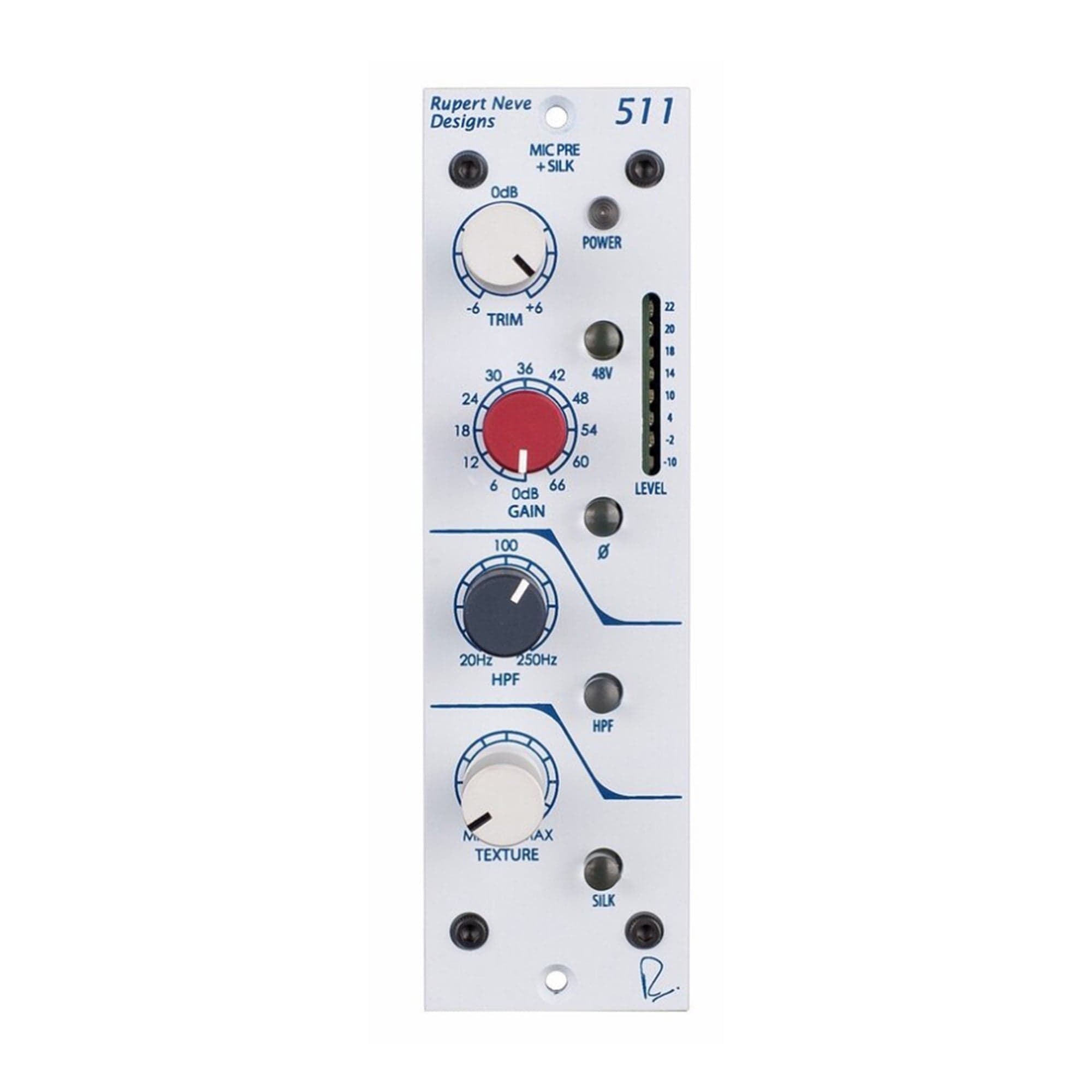
| Content | With a big, bold preamp, a swept high-pass filter and the powerful saturation control of variable Silk, the 511 combines legendary Rupert Neve tone with 500 Series value.
What is Silk?
One of the key features of the 511 is the Silk / Texture control. The Silk circuit was initially developed for the original Portico series mic preamplifiers, and was only a single switch – on or off – that added a specified amount of musical, pleasing harmonic saturation to the unit’s output stage.
Taking this concept one step further, the Texture knob is designed to adjust the actual amount of harmonic content from the source material.
So how does it work? By reducing negative feedback across the output transformer and adjusting this feedback’s frequency response, the Silk / Texture circuit provides the sweet, musical saturation found in Rupert’s legendary vintage designs – but with complete & precise control over the amount of classic tone you want.
NOISE
- Measured at Main Output, un-weighted, 22 Hz - 22 kHz, source impedance 150 Ohm balanced. Noise performance can vary depending on the 500 series and / or interference from stray magnetic fields.
- Unity Gain: Better than -103 dBV
- Gain @ +66 dB: Better than -60 dBV
- Equivalent Input Noise: -125 dB
FREQUENCY RESPONSE
- Main output, no load.
- +/- 0.1 dBu from 10 Hz to 31.5 kHz
- -2.6 dB @ 120 kHz
MAXIMUM OUTPUT LEVEL
+23 dBu
TOTAL HARMONIC DISTORTION AND NOISE, NO SILK
- @ 1 kHz, +20 dBu output level, no load: Better than 0.0025%
- @ 20 Hz, +20 dBu output level, no load: 0.025% Typical (2nd and 3rd harmonic)
TOTAL HARMONIC DISTORTION AND NOISE WITH SILK ENGAGED
- @ 100 Hz, +20 dBu input level, no load.
- TEXTURE @ min: 0.015%, mostly 3rd harmonic typical
- TEXTURE @ max: 2%, mostly 2rd harmonic typical
GAIN
- Unity up to +66 dB in 6 dB steps.
- Trim continuously adjustable from -6 dB to +6 dB.
PHANTOM POWER
Supplied by the 500 series rack power supply. Switch selectable on faceplate.
HIGH PASS FILTER
- Continuously variable swept frequency from 20 Hz to 250 Hz.
- Slope: 12 dB/Octave
POWER REQUIREMENTS
@ +/-16VDC, 100mA |
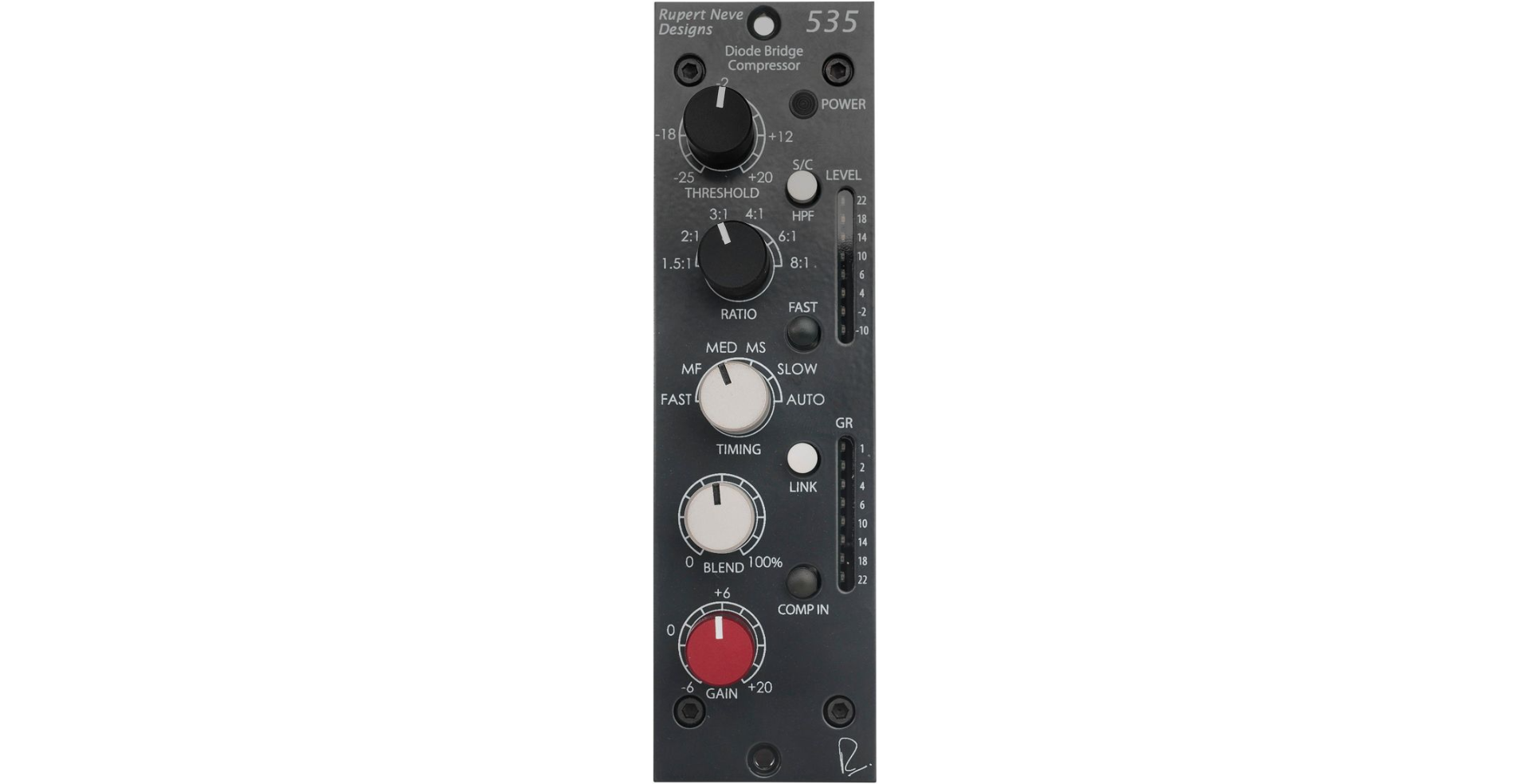
- FAST – Fast Attack (750us), Fast Release (130ms)
- MF – Medium Attack (2.25ms), Fast Release (130ms)
- MED – Medium Attack (2.25ms), Medium Release (400ms)
- MS – Medium Attack (4ms), Slow Release (725ms)
- SLOW – Slow Attack (10ms), Slow Release (1S)
- AUTO – Medium Attack (5ms), Dual Decay Release (T1 500ms, T2 1s)The LINK switch allows the compressor to be linked to another 535 compressor module via a sidechain control voltage. In link mode, the compressor generating the greater sidechain voltage (resulting in higher amounts of compression) will control the compression of both audio signal paths to maintain proper stereo center image while compressing. Note: it is advisable to always audition the unlinked sound as well, to decide if the benefit of a constant stereo center image is worth the potential trade-off of reduced left / right independence in the stereo field.
-
SIDECHAIN HPF
- The S/C HPF switch allows the user to insert a 12dB/octave 150Hz high-pass filter in the compressor sidechain. When this filter is engaged, the compressor will be considerably less responsive to information below 150Hz. For example: if used on a drum kit, the low end of the kick drum would have less proportional effect on the compression than a snare drum or cymbals, since a significant portion of the kick drum’s dynamic energy is focused below 150Hz.
LEVEL AND GAIN REDUCTION METERING
- These two LED meters provide accurate representations of both the output level of the compressor and the amount of gain reduction being applied to the input signal.
| Effective against boredom, supporting creative sound design
A unique team play of spring reverberation, analogue multimode filtering, distortion and VCA, modulated by an ultra fast LFO and an envelope that can be triggered in flexible ways – Retroverb Lancet offers a comprehensive arsenal of many-sided effects for different applications. The spectrum by far surpasses classic reverberation, filter sweeps or overdrive because you are able to tweak and bend any parameter fast and intuitively to your liking.
Retroverb Lancet will change the way you work with effects. It becomes part of your sound engine, fires it up and will end up as essential part of your sonic signature.
Source of effectiveness
We designed Retroverb Lancet in a way that it can perfectly handle signals of any kind: Guitars, basses, synthesizers, organs or microphones. On top of that, Retroverb Lancet allows you to create percussive sounds using its crash function.
Retroverb Lancet is a real jack of all trades with character, suited for adventurous sound designers and tinkerers.
Audio Input
- max. input sensitivity: –32 dBu
- impedance: 1 MΩ
Output
- max. output level: 20 dBu
- impedance: 600 Ω
Trigger- and CV-inputs
- audio trigger
- max. input sensitivity: –32 dBu
- impedance: 1 MΩ
- gate & CRASH
- external cv
Signal-to-Noise Ratio
- direct: > 80 dB
- effect (filter completely open, no reverb): > 75 dB
Spring Tank
- number of springs: 3
- reverbration decay: between 2.75 db and 4.00 s
Filter
- modes: 24-db-lowpass, 24-db-highpass, 12-db-bandpass
- modulations sources: envelope generator, envelope follower, external CV, LFO
LFO
- frequency range: 0.05 Hz … 300 Hz
- waveforms: ramp up, ramp down, square, sine, S&H, envelope generator
Envelope Generator
- modes: AD, ASR
- attack: 1 ms … 10 s
- decay/release: 1 ms … 15 s
Miscellaneous
- power supply: external DC-adapter with 12 V/1000 mA
- dimensions: 26 cm x 14.5 cm x 8 cm (width x depth x height)
- weight: 0.75 kg
Accessories
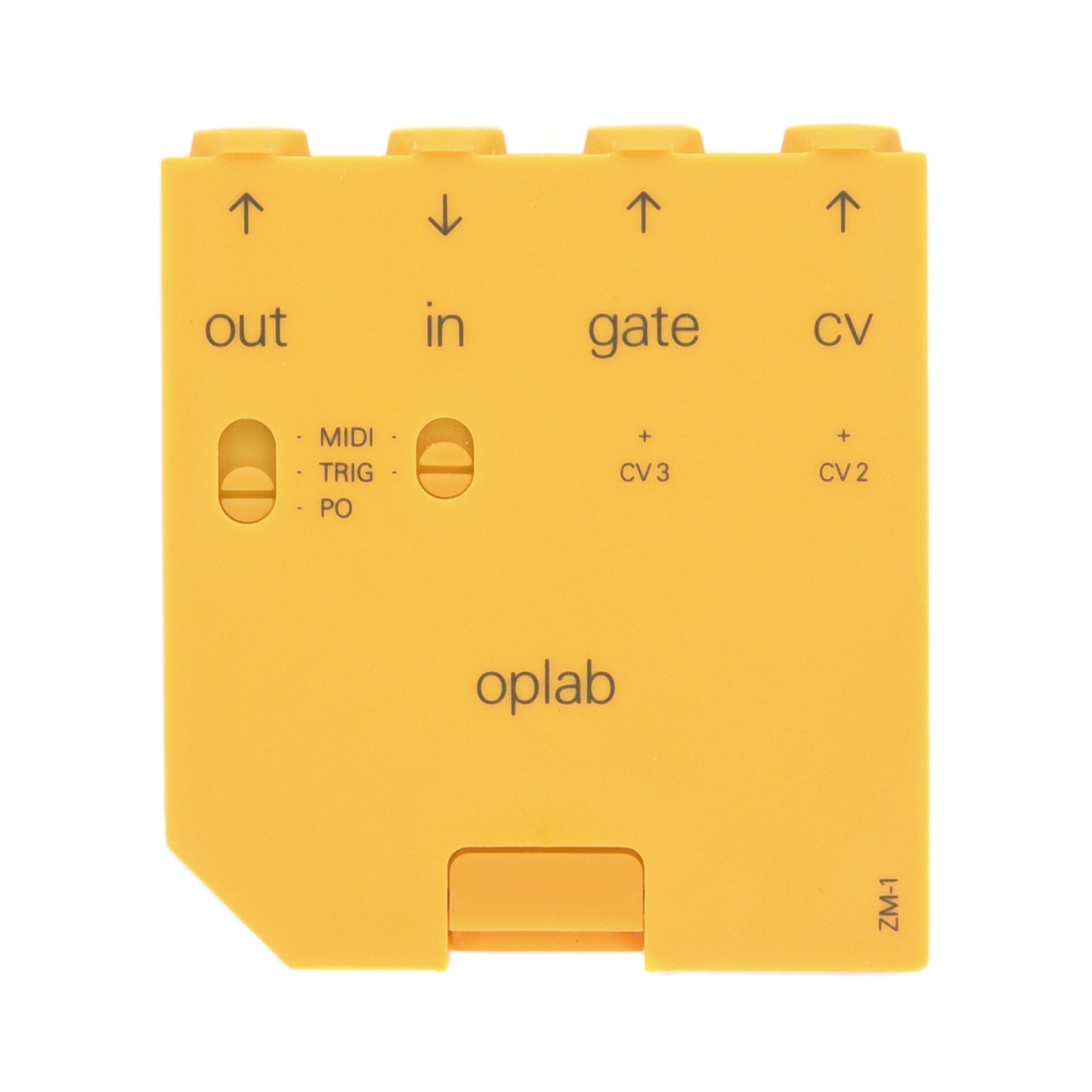
| Imagine having the power and flexibility of the OP-Z sequencer available to any other music equipment. Now you can, with the new oplab module - the magic link between OP-Z and the rest of the world. The oplab module is the first hardware expansion module for OP-Z. once mounted in the back of your OP-Z, you can use it to connect to any equipment using standard cv and gate, such as the pocket operator modular or any other modular system. It features three cv outs and one gate out, all programmable and playable from OP-Z. have your wall of modules sequenced from the palm of your hands. Use the po sync out to unleash the power of your regular pocket operators and have them play in sync with the rest of your setup. Even connect standard midi devices, using midi over 3.5 mm jack or the included midi over din adapter cable. Oplab features both midi in and out ports as well as trig in and out for other synthesizers and sequencers. | Rupert Neve Designs Portico 542 500 Series Tape FX Standard
FEATURES
- Add depth and character to your sound
- Control the mix of pre and post tape signals
- Send signals through "True Tape" circuitry
- Silk circuit, reduces negative feedback, adding harmonic content as needed
- Red Silk accentuates the saturation in the mid and high frequencies
- Use soft clip to tame overly transient material like drums
- Provides +/- 12dB adjustment of level on incoming signal levels
TECHNICAL SPECIFICATION
Rupert Neve Designs Portico 542 500 Series Tape FX
- Line Amp Specifications (Measurements with tape circuit disengaged)
- Noise: Measured at Main Output, un-weighted, 20Hz-22kHz, Input Terminated 40 Ohms.
- Unity Gain Better than -100dBu
- Frequency Response
- Measured at +10dBu, trim at unity.
- Main Output +/- 0.25dB from 5Hz to 60Khz -2dB @ 120KHz
- Maximum Output Level 23.25dBu
- Total Harmonic Distortion and Noise:
- @ 1kHz, +20dBu output level Better than 0.0025% @ 20Hz, +20dBu output level 0.07% Typical (2nd and 3rd harmonic)
- Tape FX Specifications
- Noise:
- Measured at Main Output, un-weighted, 20Hz-22kHz, Input Terminated 40 Ohms.
- Saturation @ minimum Better than -100dBu Saturation @ maximum Better than -100dBu
- Frequency Response:
- 15 IPS, Input @ -0 dBu -3dBu @ 28kHz Saturation @ minimum 0dBu @ 10Hz +5dBu Peak @ 60Hz
- Saturation @ maximum -3dBu @ 20kHz -3dBu @ 12.5Hz +2.4dBu Peak @ 60Hz
- 30 IPS, Input @ -0 dBu -3dBu @ 120kHz Saturation @ minimum -3dBu @ 10Hz +3.15dBu Peak @ 125Hz
- Saturation @ maximum -3dBu @ 100kHz -3dBu @ 12.5Hz
- +1.3dBu Peak @ 110Hz
- Total Harmonic Distortion and Noise
- Refer to sweeps on page10 15 IPS, Input @ -0 dBu 0.4% @ 3kHz to 1% @ 175Hz typical
- Saturation @ minimum Greater than 1% below 175Hz typical
- Saturation @ maximum 1% at 6kHz typical 0.3% @ 1kHz to 3% @ 50Hz typical
- 30 IPS, Input @ -0 dBu 1% at 1kHz typical
- Saturation @ minimum 0.6% @ 400Hz 5% @ 20Hz typical
- Saturation @ maximum 1.5% @ 20kHz to 0.4% @ 1kHz typical 0.4% @ 1kHz to 2 %@ 50Hz typical
- Power requirements:
- Supplied by 500 series rack with 110-125 mA @ +/- 16V DC
| This item is in excellent working condition and barely used.
The ZHA-4 splits a single stereo headphone output into four separate powered 1/8” headphone jacks, each with their own volume and mute control. Perfect for bands, podcasts, productions, and more.
Two AA batteries provide hours of portable power. For longer sessions, connect the USB-C port to a portable battery or plug directly into the wall.
What’s in the Box?
- ZHA-4 Handy Headphone Amplifier
- AA Batteries (x2)
- Stereo Mini Audio Cable (19” / 50cm)
- Quick Guide
Please Note: The item displayed in the images may not be the actual item you receive. |







Reviews
There are no reviews yet.