| Content | A lot of preamps on the market do a good job of raising the volume of microphones and instruments, but many pres today are doing only that: raising the volume. These “super clean” designs often leave the signal exiting the preamp sounding much the same as it did entering it, which ends up requiring a lot of work in post-production to get instruments to wake up and sound big in a mix.
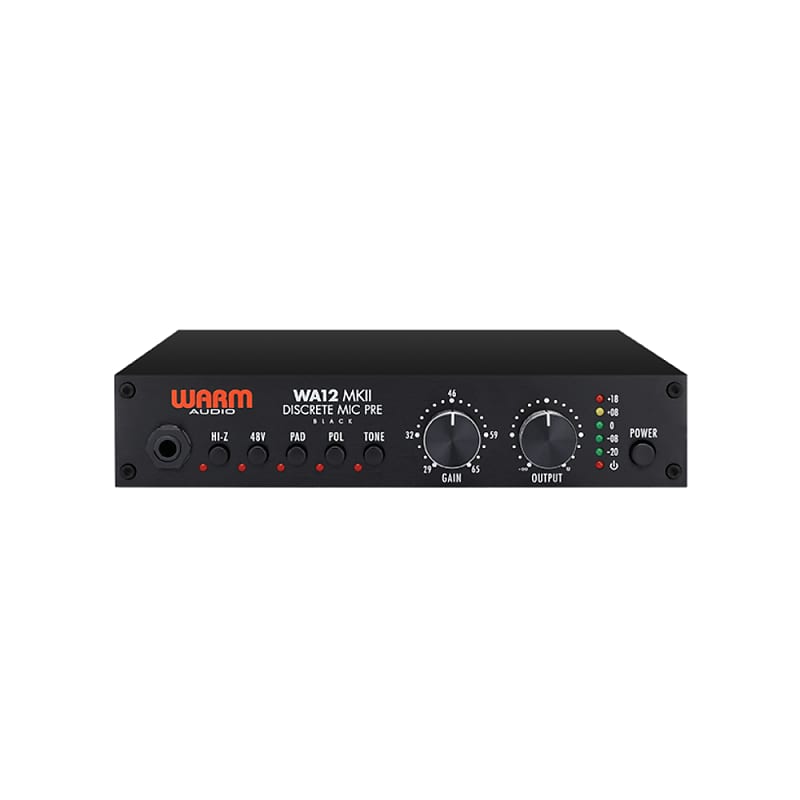
If you’re looking for a preamp to actually improve and shape your signal instead, you will most definitely love the WA12 MKII Black. This preamp is designed to transform the tone of plain instruments and vocals into exciting sounds that can stand on their own - so if your mixes lack depth, struggle to sound alive, or are just missing that professional touch you’ve always wanted, the the WA12 MKII Black is the affordable answer.
The WA12 MKII Black is a completely discrete, high voltage, dual-transformer microphone preamplifier design with high gain (+71dB), high headroom, low noise, and exciting sonic performance – which makes it an ideal choice for all types of recording applications. A high-quality mic preamp is one of the most critical pieces needed to achieve that elusive ‘larger than life’ sound, and the WA12 MKII Black delivers on that promise every single time.
The WA12 MKII Black is based around the X731 discrete op-amp, which is our own reproduction of the classic Melcor 1731 - considered by some to be the warmer predecessor to the modern 2520-style op-amp. The X731 can achieve vibrant, clean and lifelike tones, but it can also be driven into mild saturation at much higher gain levels. While the effects of that saturation can range from subtle to obvious, they always remain very pleasing to the ear, and because it was designed around the X731 the WA12 MKII Black can accept any discrete op-amp on the market that conforms to the +/-16v, 2520 pinout standard.
Our ears played a big part in the process of designing the WA12 MKII Black, and we didn’t stop tweaking until anything we ran through it sounded better. Using CineMag USA transformers and an all-discrete signal path, we ensured that this preamp would have the building blocks to compete with the best-sounding preamps on the market, and we’re very proud to offer such a robust and professional design in a small and affordable package.
- UTILIZES PREMIUM-GRADE INPUT AND OUTPUT TRANSFORMERS FROM CINEMAG USA
- FULLY DISCRETE DESIGN WITH A ROBUST 71DB OF GAIN
- UTILIZES A DISCRETE 6-PIN SOCKETED 1731-STYLE OPAMP, WHICH CAN BE SWAPPED WITH OTHER DESIGNS THAT CONFORM TO THE 6-PIN, 2520 FOOTPRINT +/- 16VDC STANDARD FOR VARYING TONE AND FLAVOR
- 20DB PAD.
- TONE BUTTON - SWITCHES THE INPUT IMPEDANCE FROM 150 TO 600 OHMS AND CHANGES THE TONE OF BOTH THE MIC AND HI-Z INPUTS
- MIC LEVEL BALANCED INPUT: XLR
- 2 MEGOHM TRUE HI-Z INPUT ON THE FRONT PANEL WHICH SENDS THE SIGNAL THROUGH THE ENTIRE CIRCUIT, INCLUDING BOTH CINEMAG TRANSFORMERS AND THE X731 OPAMP - GREAT FOR GUITARS, BASS, KEYS, KEYBOARDS AND ANY INSTRUMENT WITH A 1/4” OUTPUT JACK
- BALANCED OUTPUTS: XLR AND 1/4″/TRS
- 48 VOLT PHANTOM POWER
- LED METER GAIN INDICATION
- OUTPUT ATTENUATION CONTROL (POSITIONED AFTER THE CINEMAG OUTPUT TRANSFORMER) ALLOWS FOR DRIVING THE PREAMP AND TRANSFORMERS INTO SATURATION
- SWITCHABLE 115/230 VOLT IEC POWER INLET
| There’s no doubt that when it comes to power, musicians have it bad. Whether it’s modern modeling amplifiers, or vintage synthesizers, bad power is gonna be heard throughout your signal. And it’s everywhere — in homes, on stages, and especially in many rehearsal rooms.
Black Lion Audio has been trusted for years for modifying the best gear and making it even better, and that’s what it took to create the PG-P: taking industry-standard designs, and improving them to the point of peak performance.
After creating an entire lineup of industry-best power conditioners, Black Lion Audio felt it was time to give the world proper portable power. The PG-P might look like a run-of-the-mill surge protector, but in reality it’s a studio-class power conditioner — PG-P doesn’t just provide more noise filtering than other portable conditioners, it provides the same noise filtering found in the majority of the world’s rack-mount power conditioners!
Your gear deserves the best power, and Black Lion Audio took great care in making sure the PG-P delivers just that — thanks to it’s PG-P Filtering Technology. The PG-P is built using premium Panasonic capacitors, due to their superior execution in eliminating high frequency noise that robs equipment of its peak performance. In testing, this has provided an average of 3x the noise filtering of other portable power conditioners at the same price point. Six wall-wart spaced outlets provide studio-grade power on the go; perfect for any musician’s rig!
- PG-P Filtering Technology for an average of 3x the noise reduction of other portable power conditioners
- The same noise filtering found in the majority of rack-mount power conditioners
- 6 wall-wart spaced outlet power conditioner
- Status LEDs for quick power analysis
- High-end Panasonic capacitors to filter out performance-robbing high-frequency noise
- Tour-grade 9ft power cable
- Proper safeguard protection with a power absorption rating of 540 joules
- Recessed feet keep the PG-P from sliding, while still providing mounting options (screw mount, velcro, etc.)
- Rounded corners make for a gentle surface area for smaller power cords.
| The product that started it all for Empirical Labs. Born of founder Dave Derr’s love of classic compressors like the 1176, LA-2A and Gain Brain (among others), the Distressor incorporates his favorite sonic characteristics of these, along with other unique and interesting features that have made it a staple for audio engineers all over the world. With over 28,000 units in the field, it’s safe to say that the Distressor is one of the best selling high end compressors of all time… if not THE best selling. A prominent recording engineer recently wagered that there probably was not a top 40 record made in the last five years that didn’t have at least one Distressor on it.
Besides providing a wide range of control and a unique feature set, the Distressor offers a warm, vintage sound by using a custom designed gain control circuit. This “warmth” or “vintage sound” has become a major issue in the last few decades, as the super clear and linear digital technology does next to nothing to soften “harsh” sounds, nor emphasize the bass frequencies in music sources. Conversely, older analog tape, vinyl records and tube equipment could not be prevented from coloring the sound, often to the frustration of recording engineers. However, many people now realize that this coloring can be extremely pleasant and musical. Digital technology is often referred to as “cold” and “brittle” among other terms (although we prefer “unforgiving”).
Unique Compression Curves
All eight of the Distressor’s curves are unique and distinctive, from the 1:1 mode that simply warms up signal with low order harmonics without intentional compression, to the “Nuke” setting – a brick wall limiting curve that shines on live drum room mics. Each curve has its own personality and several actually use different circuitry, and are effectively different compressors. Most exceptional is the 10:1 “Opto” ratio which uses separate detector circuitry to emulate the oldest (and valued) “light controlled” devices, such as the LA-2A.
Distortion (Color) Modes
Another large part of the Distressor’s personality and power derive from three modes that color the signal, even without compression. These extended audio modes were designed to allow emulation of some very old and expensive vintage compressors & limiters, and let the Distressor deliver a classic “knee” sound all its own by providing user programmable, warm harmonic distortion. In addition to the basic distortion mode, Distort 2 emphasizes tube-like 2nd order harmonics, while in Distort 3 setting the distortion becomes dominated by 3rd harmonics more closely resembling tape. Two HP filters – one in the audio path, one in the detector path – are also available to help with low frequencies that can cause pumping and breathing.
- Frequency Response – 2 Hz to 160 kHz in clean audio mode (+0, -3 dB). Response is shaped in distortion modes (Dist 2, Dist 3).
- Dynamic Range – 110 dB from max. output to min. output in 1:1 mode. Greater than 100 dB signal to noise in distort 3 mode.
- Distortion – ranges between .02% and 20% depending on distortion mode and release times set on front panel.
- I/O – DC Coupled input and outputs.
- Time Constants – Attack range 50uS – 50mS. Release range .05 sec to 3.5 seconds, normal modes and up to 20 seconds in 10:1 opto mode. Time constants are dependent on ratio.
- Power Consumption – 15 Watts Max.
- Metal Chassis – single height 1.75″ high, 10″ deep, 19″ wide.
- Shipping info – 12.1 lbs mono. Mono box dimensions 22.5″ x 18.5″ x 3 1/4″.
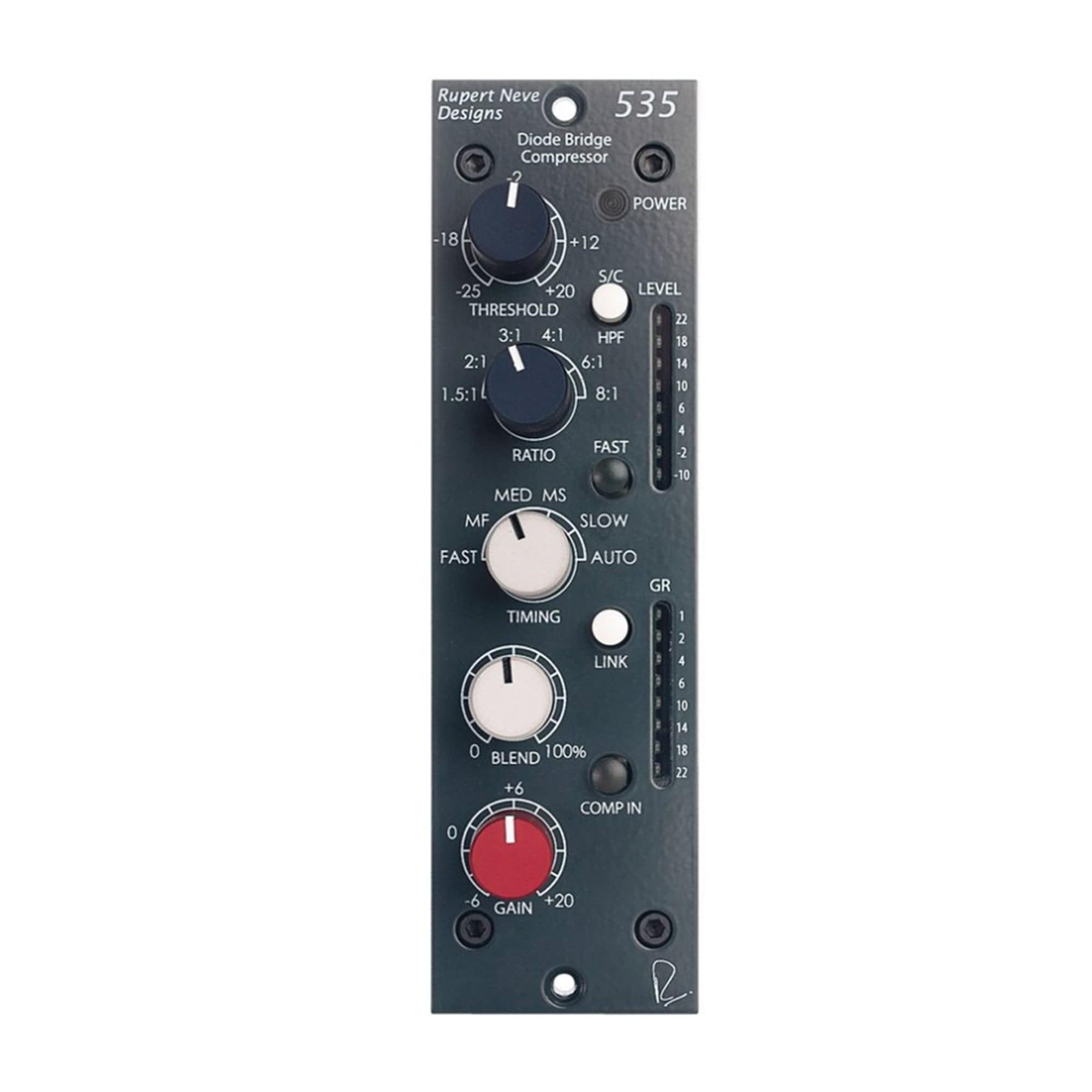
| Originally developed for the dynamics circuit of the acclaimed Shelford Channel, the 535 Diode Bridge Compressor captures the soul of Rupert Neve’s original 2254 compressor while providing modern updates including advanced timing control, significantly lower noise, fully stepped controls throughout, and internal parallel processing capabilities.
What is diode bridge compression?
Where the VCA compressor found in the Master Buss Processor provides unmatched clarity, the weighty, harmonically rich tonality of diode bridge compression can be essential in pushing key sources like vocals, electric guitars, bass and drums to the forefront of a mix.
By understanding the limitations of vintage units like the legendary 2254, painstaking effort was taken to reproduce the unique tone of these classics while improving the noise floor & accuracy, expanding inflexible time constants, adding full wave sidechain detection for improved dynamic response, and widening the range of threshold and ratio controls.
Delivering the powerful sound of these iconic designs with enhanced flexibility for the modern age, the 535 Diode Bridge Compressor is a dynamic tool equipped to make a bold statement on virtually any mix or track.
LINE INPUT TO LINE OUTPUT
- Compressor Bypassed.
- Z source = 40 Ohm Balanced
INPUT IMPEDANCE
10K Ohm
OUTPUT IMPEDANCE
40 Ohm
MAXIMUM INPUT LEVEL
+23.5 dBu
MAXIMUM OUTPUT LEVEL
+23.5 dBu
NOISE
- 22 Hz - 22 kHz BW.
- -101 dBu
FREQUENCY RESPONSE
- 10 Hz - 120 kHz, 30ft Output XLR Cable.
- +/- 0.25 dB
THD+N
- @ 1 kHz @ Maximum Output Level, 22 Hz - 22 kHz BW.
- 0.001%
| Rupert Neve Designs Portico 542 500 Series Tape FX Standard
FEATURES
- Add depth and character to your sound
- Control the mix of pre and post tape signals
- Send signals through "True Tape" circuitry
- Silk circuit, reduces negative feedback, adding harmonic content as needed
- Red Silk accentuates the saturation in the mid and high frequencies
- Use soft clip to tame overly transient material like drums
- Provides +/- 12dB adjustment of level on incoming signal levels
TECHNICAL SPECIFICATION
Rupert Neve Designs Portico 542 500 Series Tape FX
- Line Amp Specifications (Measurements with tape circuit disengaged)
- Noise: Measured at Main Output, un-weighted, 20Hz-22kHz, Input Terminated 40 Ohms.
- Unity Gain Better than -100dBu
- Frequency Response
- Measured at +10dBu, trim at unity.
- Main Output +/- 0.25dB from 5Hz to 60Khz -2dB @ 120KHz
- Maximum Output Level 23.25dBu
- Total Harmonic Distortion and Noise:
- @ 1kHz, +20dBu output level Better than 0.0025% @ 20Hz, +20dBu output level 0.07% Typical (2nd and 3rd harmonic)
- Tape FX Specifications
- Noise:
- Measured at Main Output, un-weighted, 20Hz-22kHz, Input Terminated 40 Ohms.
- Saturation @ minimum Better than -100dBu Saturation @ maximum Better than -100dBu
- Frequency Response:
- 15 IPS, Input @ -0 dBu -3dBu @ 28kHz Saturation @ minimum 0dBu @ 10Hz +5dBu Peak @ 60Hz
- Saturation @ maximum -3dBu @ 20kHz -3dBu @ 12.5Hz +2.4dBu Peak @ 60Hz
- 30 IPS, Input @ -0 dBu -3dBu @ 120kHz Saturation @ minimum -3dBu @ 10Hz +3.15dBu Peak @ 125Hz
- Saturation @ maximum -3dBu @ 100kHz -3dBu @ 12.5Hz
- +1.3dBu Peak @ 110Hz
- Total Harmonic Distortion and Noise
- Refer to sweeps on page10 15 IPS, Input @ -0 dBu 0.4% @ 3kHz to 1% @ 175Hz typical
- Saturation @ minimum Greater than 1% below 175Hz typical
- Saturation @ maximum 1% at 6kHz typical 0.3% @ 1kHz to 3% @ 50Hz typical
- 30 IPS, Input @ -0 dBu 1% at 1kHz typical
- Saturation @ minimum 0.6% @ 400Hz 5% @ 20Hz typical
- Saturation @ maximum 1.5% @ 20kHz to 0.4% @ 1kHz typical 0.4% @ 1kHz to 2 %@ 50Hz typical
- Power requirements:
- Supplied by 500 series rack with 110-125 mA @ +/- 16V DC
| FEATURES
- World-class, transformer-coupled preamp, compressor, and DI
- Gain: 0 - 66dB in 6dB increments
- Compressor: Single-knob opto-coupler compressor with 2:1 ratio
- Blend: Determines balance of mic and DI inputs
- Instrument gain: 0 - 30dB on instrument input
- 48V phantom power
- Silk: Adds nostalgic warmth and presence when engaged
- Instrument input: Front-panel TRS input and passive-through for Hi-Z sources
- Polarity reverse
- Threshold: When signals exceed threshold level, gain is reduced at a controlled 2:1 ratio with fixed attack and release time constants
- Indicators: Signal presence and clipping on both mic and DI signals, as well as compressor activation.
TECHNICAL SPECIFICATION
Rupert Neve Designs Portico 517: 500 Series Mic Pre / DI / Comp
- Frequency Response: Main Output, no load, -0.2dB @ 10Hz -3dB @ 160kHz
- Noise measured at main output, unweighted, 22Hz - 22kHz, terminated 150 ohm: Gain at unity: better than -100dBu; gain at 66dB: better than -62dBu Equivalent Input Noise: better than -128dBu, noise factor 1.5dB
- Maximum output level from 20Hz to 40kHz: +23dBu
- Total Harmonic Distortion and Noise: @ 1kHz, +20 dBu output: Main Output: Better than 0.001% @ 20Hz, +20 dBu output: Main Output: Better than 0.002% Silk Engaged: Better than 0.2% Second harmonic
- Crosstalk: Measured channel to channel: Better than -90dB @ 15kHz.
- Phantom Power: +48 Volts DC +/- 1%
|








Reviews
There are no reviews yet.