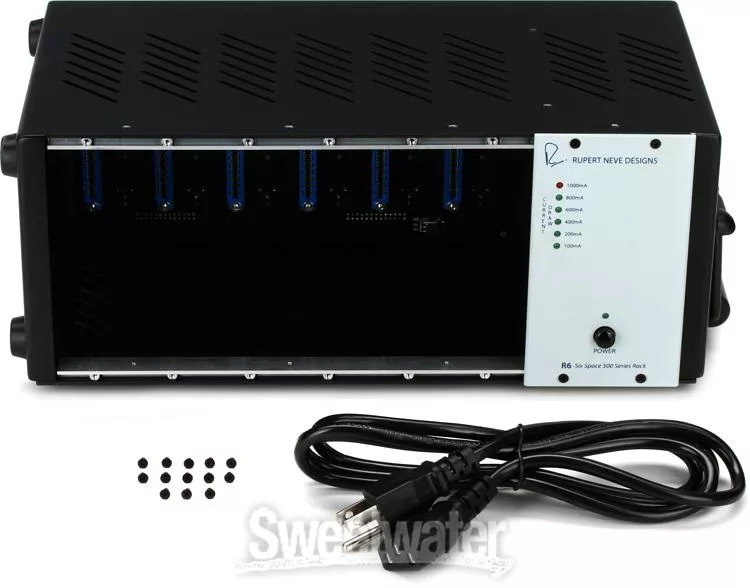
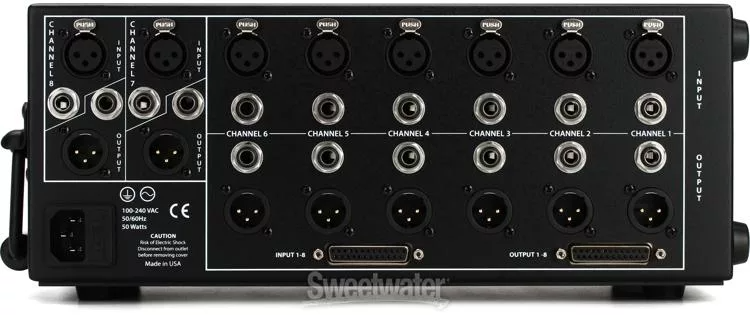
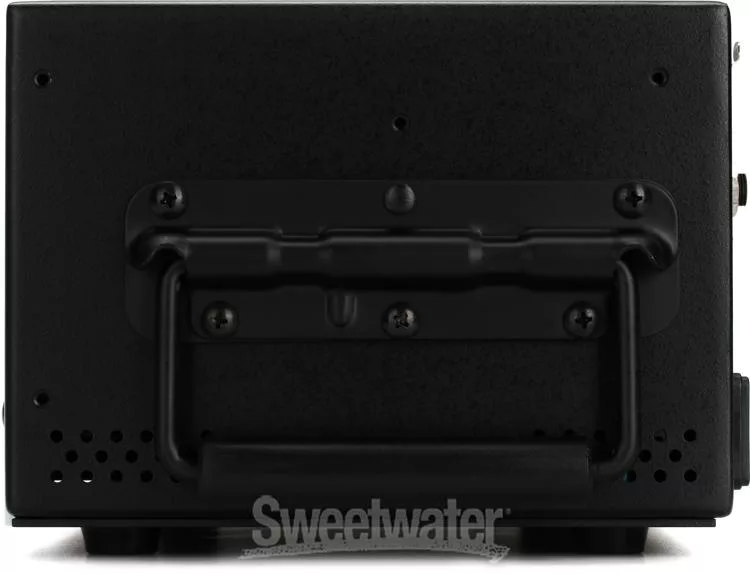
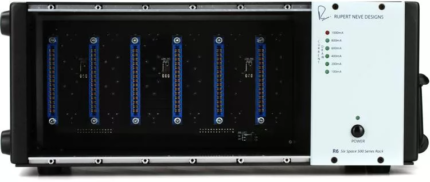
| Content | Rupert Neve Designs R6 500 Series chassis is a 6-space, steel rack enclosure that sports XLR, TRS, and DB-25 I/O to work with any studio setup. To ensure your modules are properly powered, the R6 has 150% of the required current, so you'll never be underpowered. It also has a built-in LED display to show current consumption and a double-shielded internal power supply that won't add any interference or unwanted noise to your signal. Rupert Neve is an audio legend. So you know when he designs a 500 Series chassis, it's top-shelf, all the way. Give your 500 Series modules the pampering they deserve with the Rupert Neve Designs R6 500 Series rack.
Genius in the details
With the Rupert Neve Designs' RND R6, there's genius in the details. The R6's double-shielded internal power supply was meticulously designed to avoid magnetic induction in any of its module slots. The power supply is a Switchmode type, and great care was taken to ensure that the frequencies are considerably outside the audible band. There's an internal jumper configuration that makes it easy to link slots in pairs. It's even fitted with variable-position screw holes that slide to accommodate modules that are slightly out-of-spec, which makes the insertion of modules quick and easy. Trust Sweetwater: when it comes to 500 Series racks, the RND R6 is as good as it gets.
Rupert Neve Designs RND R6 500 Series Rack Features at a Glance:
- Supplies 150% of the required current
- LED current consumption meter displays available current
- XLR, TRS, and DB-25 I/O
- Variable-position screw holes make for quick and easy module insertion
- Double-shielded internal power supply designed to avoid magnetic induction in module slots
- Switchmode PSU with frequencies considerably outside audible band
- Internal jumper configuration lets you link slots in pairs
|
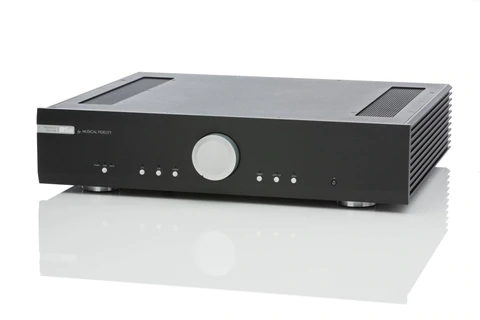
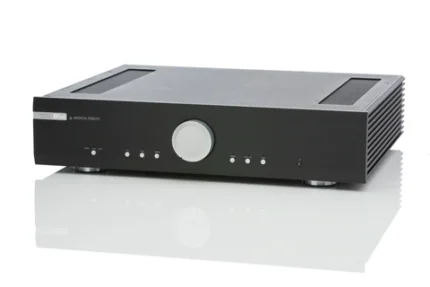
The M5si is a sensational integrated amplifier with exceptional power and clarity.
The M5si is a real high end amplifier. At 150wpc, with high current delivery, it will drive virtually any loudspeaker easily.
Internally the M5si is configured as two independent monoblocs with a separate preamp, but all mounted on one pcb. Its technical performance is about equal to the M6si.
The M5si In Brief
- 150wpc
- Excellent technical performance
- Preamp output
- Unconditional stability, will drive any loudspeaker
- Wide range of useful inputs including asynchronous USB and MM phono
- Excellent hunky build quality
Specifications
Power output: 150 W per channel into 8 ohm
Signal to Noise Ratio: >100 dB ‘A’ - weighted
Frequency Response: +0, –0.1 dB, 10 Hz to 20 kHz
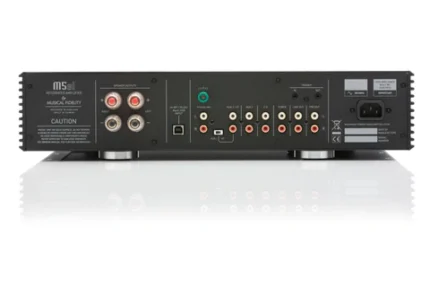
Inputs: 4x Line Level RCA, 1x USB type ‘B’ connector - asynchronous data stream at up to 24-bit/96kHz, 1 x MM phono input, Trigger in
Phono
Sensitivity: 3 mV nominal (MM)
Signal / noise ratio: >70 dB ‘A’-weighted
Input impedance: 50 k ohm (MM)
Frequency response: RIAA/IEC ±0.5 dB 20 Hz-20 kHz
Outputs: Trigger out, Fixed, line level output, Variable, preamp output
Dimensions - WxHxD (mm): 440 x 100 x 405
Weight (unpacked / packed): 14.6 kg/ 18.8 kg
| Rupert Neve Designs' Shelford Channel, over a half century in the making, is the definitive evolution of Mr. Neve's renowned 80 Series channel module technology, updated and refined for the contemporary studio. The Shelford Channel is fitted with Rupert's latest Class A transformer-gain mic preamp, the best-of-the-classics Inductor EQ from the Shelford 5052, a punchy diode-bridge compressor, the alluring analog textures of variable Silk saturation, a state-of-the-art dual-tap transformer output stage with massive headroom, and double the operating voltage of vintage designs. Offering rich tonal options for making audacious statements with your music, along with precision-detented controls for recall, the Shelford Channel delivers the authoritative sonic essence of classic Rupert Neve designs, along with modern versatility.
Input stage and transformer-gain mic pre
Rupert Neve's first new Class A, transformer-gain mic preamplifier in over 40 years makes its debut in the Shelford Channel. Rupert has spec'd this preamp with a direct-coupled transformer input; gain is provided by the custom transformer itself. The proprietary input transformer, and its meticulous integration with the surrounding Class A input amplifiers, plays an outsized role in the Channel's immediately recognizable sonics: punchy and creamy-smooth, with excellent isolation and vanishingly low noise.
The Shelford Channel's front-panel hi-Z instrument input uses the same discrete Class A field-effect transistor with transformer topology as Rupert Neve Designs' acclaimed RNDI; for gain, however, it utilizes the new RN4012 input transformer directly into the mic preamp. This design provides astonishing clarity on hi-Z sources, with substantial low-end weight and silky-smooth high frequencies. The DI also gives you a passive thru output to feed a guitar or bass amp.
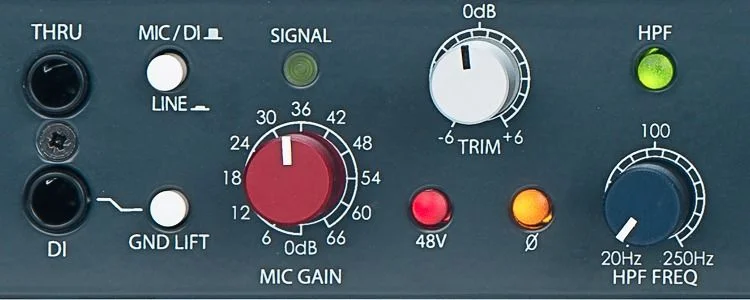
- Mic-DI/Line: switches between microphone/direct injection input and line input
- GND Lift: disconnects the audio signal ground from chassis earth
- Signal LED: green indicates Signal Present; red indicates imminent input stage clipping
- Mic Gain: 12-way precision rotary, controls gain from 0dB to 66dB in 6dB steps
- Trim: rotary switch provides further continuous gain adjustment of +/-6dB
- 48V: switch engages phantom power on the mic input
- Phase: inverts the polarity of the signal path (illuminates when engaged)
- HPF Freq: engages a 12dB/octave highpass filter, variable from 20Hz-250Hz
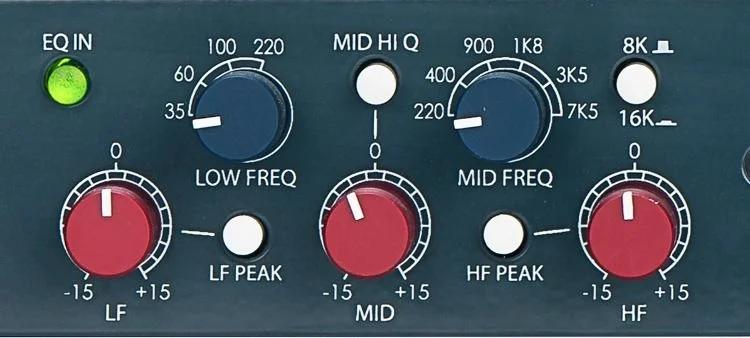
The best-of-the-classics inductor EQ
The Shelford Channel's EQ section is a 3-band, custom-tapped inductor circuit containing Rupert's favorite bands from his vintage equalizer designs. The low-frequency band is primarily based on the 1064 — acclaimed for its creamy, resonant bass. Unlike the 1064, though, the Channel gives you added dimension, punch, and control over your low end by letting you use the LF band as either a peaking or a shelving filter. The midrange band is based on the venerable 1073 and is perfect for sweetening instruments and vocals while nudging them forward in a mix. "Proportional Q" response also makes it ideal for attenuating problem frequencies. The high-frequency band is a hybrid design with the best of vintage and modern attributes. It should be noted that this EQ is in no way a clone; it's a decidedly modern design using components and techniques that simply did not exist in the 1970s — for instance, the use of capacitor-based topologies to achieve sonic richness and enhanced control.
- EQ In: engages all EQ frequency bands except HPF
- LF: adjusts up to 15dB of boost/cut at the selected low frequency
- Low Freq: 4-position rotary switch for selecting LF band corner or center frequency
- LF Peak: selects LF shelving (out) or peaking (in) mode
- Mid Hi Q: selects between a mid-band resonance of 2 (out) or 3.5 (in)
- Mid: adjusts up to 15dB of boost/cut at selected mid frequency
- Mid Freq: 6-position rotary switch selects center frequency of the midband EQ stage
- HF Peak: selects HF shelving (out) or peaking (in) mode
- 8K/16K: selects between an 8kHz (out) or 16kHz (in) center or corner frequency for HF band
- HF: adjusts up to 15dB of boost or cut at selected high frequency
The Super Diode-bridge Compressor
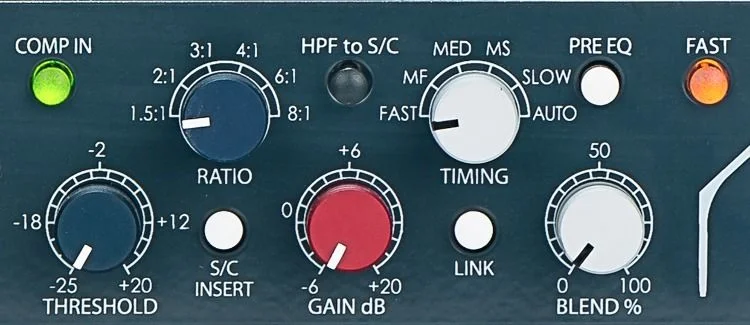
Like the Shelford Channel's inductor EQ and transformer-gain microphone preamp, the diode-bridge compressor/limiter is based on the topologies found in vintage Neve designs such as the 2254. It improves, however, on the early designs by the inclusion of full-wave rectification and a bevy of new control features. Although Rupert's vintage diode-bridge compressors were prized for their warm, punchy response, they were somewhat compromised by imprecise controls, attack-time inflexibility, low headroom, and high noise. The Shelford Channel's Super Diode-bridge Compressor delivers the attitude-packed, "in your face" sound of those classics, but with modern precision and flexibility — which makes it ideal on any source. Full Side-chain and stereo Link features are provided.
- Side Chain Insert Jacks (rear-panel): for fine tuning of compressor operation
- Comp In: engages the Channel's compressor-limiter section
- Threshold: sets level where the compressor "kicks in"
- Ratio: sets compression slope from 1.5:1 (minimal) to 8:1 (heavy)
- SC Insert: inserts rear-panel sidechain insert jacks into sidechain signal path
- HPF to S/C: routes highpass filter into the circuit that compressor uses to determine level
- Gain: for adding make-up gain to compensate for level attenuation lost to compression
- Timing: 6-position rotary adjusts attack/release speed of the compressor
- Link: links the sidechain control of multiple units for ganged or stereo operation
- Pre EQ: changes the order of compressor in the circuit chain
- Blend: mixes the dry and compressed signal for handy parallel compression
- Fast: speeds up both attack and release of the selected compressor time constant
Dual-tap transformer output
The Shelford Channel's output stage serves up the inimitable sound of Rupert Neve's classic designs while providing far more tonal versatility. The dual-tap output for the RN2042 square-core output transformer provides both high- and low-headroom outputs without compromising performance. The high-headroom tap takes advantage of the Shelford's higher-voltage design, delivering a pristine sound without non-linear output-stage coloration at high levels. The low-headroom tap, on the other hand, lets you drive the full voltage range of the Channel to accentuate this non-linear harmonic content — without clipping most pro interfaces. For vocals, drums, guitars, bass, and other instruments, this output lets you hit the transformer's sweet spot, which can inject life into a recorded performance in a way that other effects cannot.
The Silk and Texture controls
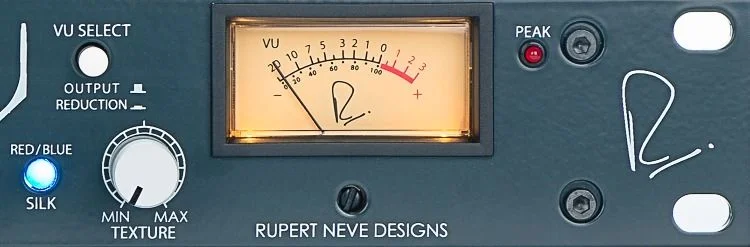
The Shelford Channel is packing a secret weapon the classics never had: its output transformer features the Silk Red/Blue and Texture controls from the Portico II Series that let you tailor the harmonic content and tonality of the output stage. By engaging these controls and sufficiently driving your output, you can dial in delectable 2nd- and 3rd-order harmonic distortion (that's the good kind) and saturation of the output transformer, imbuing your tracks with juicy rich thickness (think: 1073 on steroids) — with no danger of overloading the output stage. The Silk Red mode emphasizes harmonic content generated by the source's high frequencies; Blue mode, conversely, works off the low frequencies. The Texture knob controls the amount of added harmonic content. Disengage Silk, and your output is pristine and modern, while retaining Rupert's bigger-than-life transformer sonic signature.
The magical sound of Neve
Rupert Neve is an audio legend whose electronics designs defined the golden age of analog. Those of us at Sweetwater who have had the privilege of working on a Neve 8078 or its predecessors can attest to the fact that Neve's Series 80 consoles were indeed the pinnacle of hand-wired analog mixing desks. Mr. Neve has remained at the forefront of audio-circuit innovation for over half a century, and his current company, Rupert Neve Designs, continues to advance the state of the art with cutting-edge products that sound incredible and intelligently address the challenges of the digital age.
Rupert Neve Designs Shelford Channel Features:
- The definitive evolution of Rupert Neve's renowned 80 Series channel module technology
- A complete channel strip that delivers the essence of classic designs, along with modern versatility
- Input stage and transformer-gain mic pre
- Front-panel hi-Z direct input
- Best-of-the-classics inductor EQ
- Super Diode-bridge Compressor
- Dual-tap transformer output
- Silk and Texture controls
| In addition to the 100% analog tape emulation circuitry – great for bringing out 3rd-order harmonics – the 542 incorporates a soft-clip circuit that tames the harshest sources and enhances 2nd-order harmonics, variable Silk Red & Blue for an infinite variety of transformer tones, and a blend control to dial in in the perfect amount of saturation.
Transformers Imitating Tape
Unlike digital emulations, the “True Tape” drive circuit works by feeding a custom-designed interstage transformer acting as a “record head”, which in turn is coupled to a correctly-equalized replay amplifier. As the voltage rises on the “record head”, saturation increases, and a soft clip circuit engages at higher levels to round off peak transients. The sound of the tape circuit can be further modified with selectable 15 / 30 IPS modes and a pre/post-tape blend control.
What is Silk?
In addition to the tape circuit, the continuously variable Texture control with Silk Red and Silk Blue modes provides a whole other level of control over the harmonic density and tonality of your tracks & mixes. The Silk Red mode accentuates transformer saturation in the high and high-mid frequencies to amplify the vibrant midrange harmonics associated with Rupert’s vintage equipment, while Silk Blue accentuates saturation of the lows and low-mids to add thickness and weight to any source – especially useful for “thin-sounding” tracks or mixes. Unlike EQ, these Silk & Texture controls saturate the output transformers, and add highly musical harmonics to the source material according to the amount of Texture applied.
Drive the 542 hard, choose your Silk flavor, and crank the Texture knob for a rich, saturated, vintage vibe – or disengage Silk entirely for a more purist, hi-fi tape effect. The choice is yours.
LINE AMP NOISE
- Measurements with tape circuit disengaged. Measured at Main Output, un-weighted, 20 Hz - 22 kHz, Input Terminated 40 Ohm.
- Unity Gain: Better than -100 dBV
FREQUENCY RESPONSE
- Measured at +10 dBu, trim at unity.
- Main Output: +/- 0.25 dB from 5 Hz to 60 kHz, -2 dB @ 120 kHz
MAXIMUM OUTPUT LEVEL
23.25 dBu
TOTAL HARMONIC DISTORTION AND NOISE
- @ 1 kHz, +20 dBu output level: Better than 0.002%
- @ 20 Hz, +20 dBu output level: 0.07% Typical (2nd and 3rd harmonic)
TAPE FX SPECIFICATIONS
NOISE
- Measured at Main Output, un-weighted, 20 Hz - 22 kHz, Input Terminated 40 Ohm.
- Saturation @ minimum: Better than -100 dBu
- Saturation @ maximum: Better than -100 dBu
FREQUENCY RESPONSE
- 15 IPS, Input @ -0 dBu: -3 dBu @ 28 kHz
- Saturation @ minimum: 0 dBu @ 10 Hz
- +5 dBu Peak @ 60 Hz Saturation @ maximum: -3 dBu @ 20 kHz
- -3 dBu @ 12.5 Hz
- +2.4 dBu Peak @ 60 Hz
- 30 IPS, Input @ -0 dBu: -3 dBu @ 120 kHz
- Saturation @ minimum: -3 dBu @ 10 Hz, +3.15 dBu Peak @ 125 Hz
- Saturation @ maximum: -3 dBu @ 100 kHz
- -3 dBu @ 12.5 Hz
- +1.3 dBu Peak @ 110 Hz
TOTAL HARMONIC DISTORTION AND NOISE
15 IPS
- Input @ -0 dBu: 0.4% @ 3 kHz to 1% @ 175 Hz typical Saturation @ minimum: Greater than 1% below 175 Hz typical
- Saturation @ maximum: 1% at 6 kHz typical, 0.3% @ 1 kHz to 3% @ 50 Hz typical
30 IPS
- Input @ -0 dBu: 1% at 1 kHz typical
- Saturation @ minimum: 0.6% @ 400 Hz to 5% @ 20 Hz typical
- Saturation @ maximum: 1.5% @ 20 kHz to 0.4% @ 1 kHz typical, 0.4% @ 1 kHz to 2% @ 50 Hz typical
POWER REQUIREMENTS
Supplied by 500 series rack with 110-125 mA @ +/- 16V DC | The versatile amplifier for powering all your entertainment.
- Enjoy high-fidelity performance with 125 Watts per channel
- Power your bookshelf, floor-standing, in-wall, and in-ceiling speakers
- Stream everything you love with the Sonos app and AirPlay Connect your TV to create the ultimate entertainment system
- Amp is built to last and improve over time
Upgrade your wired speakers
Connect everything from your turntable and stereo to your wired speakers to enjoy vinyl, CDs, stored audio files, and streaming. You can even power outdoor speakers and expand your Sonos system to the backyard.
Amplify your TV experience
Enjoy stereo sound for shows, movies, and video games when you connect Amp to your speakers and TV. Wirelessly add a pair of Sonos One surrounds for immersive home theater.
Designed to keep cool
The rack-mountable design features a specially developed heatsink for optimized airflow and heat management.
Key Specs
Continuous Watts x Channel @ Ohms: 125 x 2 x 8
Input(s): Ethernet, HDMI, RCA
Audio
Continuous Watts x Channel @ Ohms: 125 x 2 x 8
Total Power Handling: 250 watts
Number of Channels: 2.1
Impedance: 8 ohms
Amplifier Class: D
Features
App-Controlled: Yes
Featured Streaming Services: Apple Music, Pandora, Spotify, YouTube
Wi-Fi Built-in: Yes
Dimensions: 2.52" x 8.54" x 8.54"
Weight: 4.6 pounds | Comprised of a rugged, portable chassis with world-class preamp, compressor and DI circuits as well as two channel operation, Vari-phase, Silk and DI/mic blending capabilities, the Portico 5017 is an innovative and powerful tool for recording or live performance.
FREQUENCY RESPONSE
- Main Output, no load.
- -0.2 dB @ 10 Hz
- -3 dB @ 160 kHz
NOISE
- Measured at Main Output, unweighted, 22 Hz - 22 kHz. Terminated 150 Ohm.
- With gain at unity better than -100 dBu
- With gain at 66 dB better than -62 dBu
- Equivalent Input Noise better than -128 dBu
NOISE FACTOR
1.5 dB
HIGH PASS FILTER
80 Hz, 12 dB/Octave Bessel
MAXIMUM OUTPUT LEVEL
Maximum output from 20 Hz to 40 kHz is +23 dBu
TOTAL HARMONIC DISTORTION AND NOISE
- @ 1 kHz, +20 dBu output: Main Output: Better than 0.001%
- @ 20 Hz, +20 dBu output: Main Output: Better than 0.002%
SILK ENGAGED
Better than 0.2% Second harmonic
COMPRESSOR
THRESHOLD
Continuously Variable from -20 dBu to +10 dBu
RATIO
Fixed at 2:1
ATTACK & RELEASE
- FAST MODE: Attack 40ms , Release 40ms
- SLOW MODE: Attack 100ms , Release 350ms
PHANTOM POWER
+48 Volts DC +/- 1%
POWER REQUIREMENTS
12VDC is optimal voltage, but 9-15VDC is acceptable
CURRENT CONSUMPTION
- @ 9VDC Current is 1.3 A typical: Power = 11.7W
- @ 12VDC Current is 1.0 A typical: Power = 12.0 watts
- @ 15VDC Current is 800 mA typical: Power = 12.0 watts
DIMENSIONS
7.5″ (deep) x 6.5″ (wide) x 2″ (high) |








Reviews
There are no reviews yet.