| Content | A lot of preamps on the market do a good job of raising the volume of microphones and instruments, but many pres today are doing only that: raising the volume. These “super clean” designs often leave the signal exiting the preamp sounding much the same as it did entering it, which ends up requiring a lot of work in post-production to get instruments to wake up and sound big in a mix.
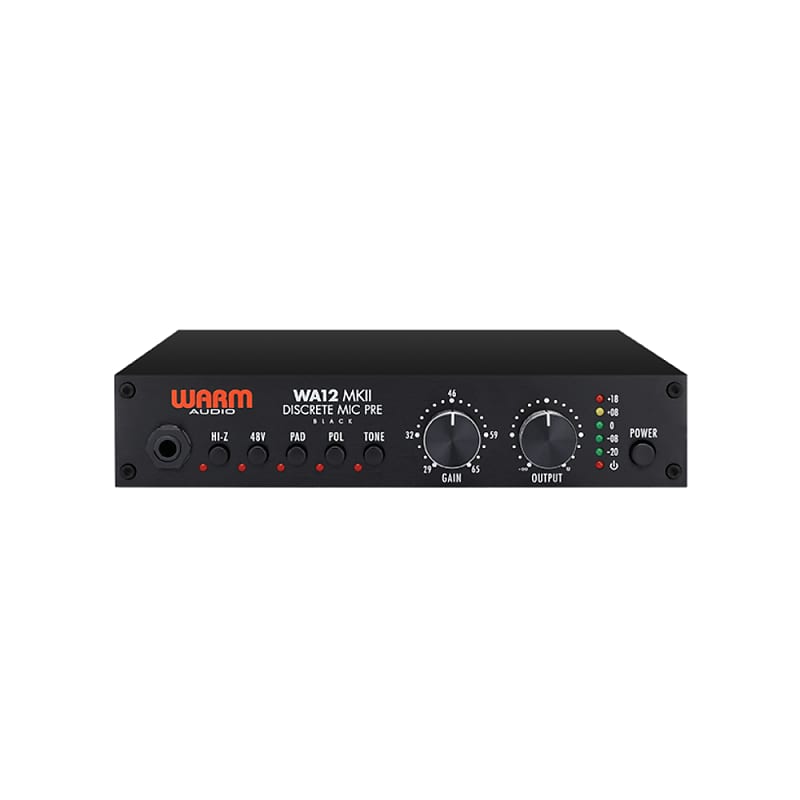
If you’re looking for a preamp to actually improve and shape your signal instead, you will most definitely love the WA12 MKII Black. This preamp is designed to transform the tone of plain instruments and vocals into exciting sounds that can stand on their own - so if your mixes lack depth, struggle to sound alive, or are just missing that professional touch you’ve always wanted, the the WA12 MKII Black is the affordable answer.
The WA12 MKII Black is a completely discrete, high voltage, dual-transformer microphone preamplifier design with high gain (+71dB), high headroom, low noise, and exciting sonic performance – which makes it an ideal choice for all types of recording applications. A high-quality mic preamp is one of the most critical pieces needed to achieve that elusive ‘larger than life’ sound, and the WA12 MKII Black delivers on that promise every single time.
The WA12 MKII Black is based around the X731 discrete op-amp, which is our own reproduction of the classic Melcor 1731 - considered by some to be the warmer predecessor to the modern 2520-style op-amp. The X731 can achieve vibrant, clean and lifelike tones, but it can also be driven into mild saturation at much higher gain levels. While the effects of that saturation can range from subtle to obvious, they always remain very pleasing to the ear, and because it was designed around the X731 the WA12 MKII Black can accept any discrete op-amp on the market that conforms to the +/-16v, 2520 pinout standard.
Our ears played a big part in the process of designing the WA12 MKII Black, and we didn’t stop tweaking until anything we ran through it sounded better. Using CineMag USA transformers and an all-discrete signal path, we ensured that this preamp would have the building blocks to compete with the best-sounding preamps on the market, and we’re very proud to offer such a robust and professional design in a small and affordable package.
- UTILIZES PREMIUM-GRADE INPUT AND OUTPUT TRANSFORMERS FROM CINEMAG USA
- FULLY DISCRETE DESIGN WITH A ROBUST 71DB OF GAIN
- UTILIZES A DISCRETE 6-PIN SOCKETED 1731-STYLE OPAMP, WHICH CAN BE SWAPPED WITH OTHER DESIGNS THAT CONFORM TO THE 6-PIN, 2520 FOOTPRINT +/- 16VDC STANDARD FOR VARYING TONE AND FLAVOR
- 20DB PAD.
- TONE BUTTON - SWITCHES THE INPUT IMPEDANCE FROM 150 TO 600 OHMS AND CHANGES THE TONE OF BOTH THE MIC AND HI-Z INPUTS
- MIC LEVEL BALANCED INPUT: XLR
- 2 MEGOHM TRUE HI-Z INPUT ON THE FRONT PANEL WHICH SENDS THE SIGNAL THROUGH THE ENTIRE CIRCUIT, INCLUDING BOTH CINEMAG TRANSFORMERS AND THE X731 OPAMP - GREAT FOR GUITARS, BASS, KEYS, KEYBOARDS AND ANY INSTRUMENT WITH A 1/4” OUTPUT JACK
- BALANCED OUTPUTS: XLR AND 1/4″/TRS
- 48 VOLT PHANTOM POWER
- LED METER GAIN INDICATION
- OUTPUT ATTENUATION CONTROL (POSITIONED AFTER THE CINEMAG OUTPUT TRANSFORMER) ALLOWS FOR DRIVING THE PREAMP AND TRANSFORMERS INTO SATURATION
- SWITCHABLE 115/230 VOLT IEC POWER INLET
| Proven reverberation classic for the future
With the VSR 3.2, we happily rely on the proven old mechanical way to create reverberation. Rightly, because the used reverberation spring by AccuBell (formerly Accutronics) creates that magic 60's reverb which is slightly metallic and dense at the same time.
Just like it predecessors, VSR 3.2 has a straight-forward and honest approach: signal in - spring reverb - vintage sound out.
VSR 3.2 is equipped with an equalizer that is exactly adapted to the springs' frequency response. In addition, there are controls to mix the dry and effect signal as well as controls for the input and output level. This way, VSR 3.2 simply exactly does what it was designed to do.
Designed for every situation
Although using a large spring (type 9), VSR 3.2 fits in a 19" housing with one rack unit – minimal space requirements. Thanks to its extremely solid chassis, VSR 3.2 is a reliable vintage-effect that cannot only be used in a controlled studio environment. On the contrary, it also serves fine when being used in straining live situations.
VSR 3.2 grants your sound an elegant touch of "good old times". Its simplicity makes it an unbelievable versatile companion.
Inputs
- 1/4"-jack input front
- unbalanced
- max. input sensitivity: –40 dBu
- impedance: 1 MΩ
- 1/4"-jack input rear (1)
- unbalanced
- max. input sensitivity: 0 dBu
- impedance: 100 kΩ
- 1/4"-jack input rear (2)
- unbalanced
- max. input sensitivity: –20 dBu
- impedance: 10 kΩ
Outputs
- 1/4"-jack output (1)
- unbalanced
- max. output level: 0 dBu
- 1/4"-jack output (2)
- unbalanced
- max. output level: - 20 dBu
Signal-to-Noise Ratio
- direct: > 80 dBu
- effect: > 70 dBu
THD + Noise
Miscellaneous
- power supply: external DC-adapter with 12 V/1000 mA
- dimensions: 19“, 1 HE, ca. 190 mm deep
- weight: 2.5 kg
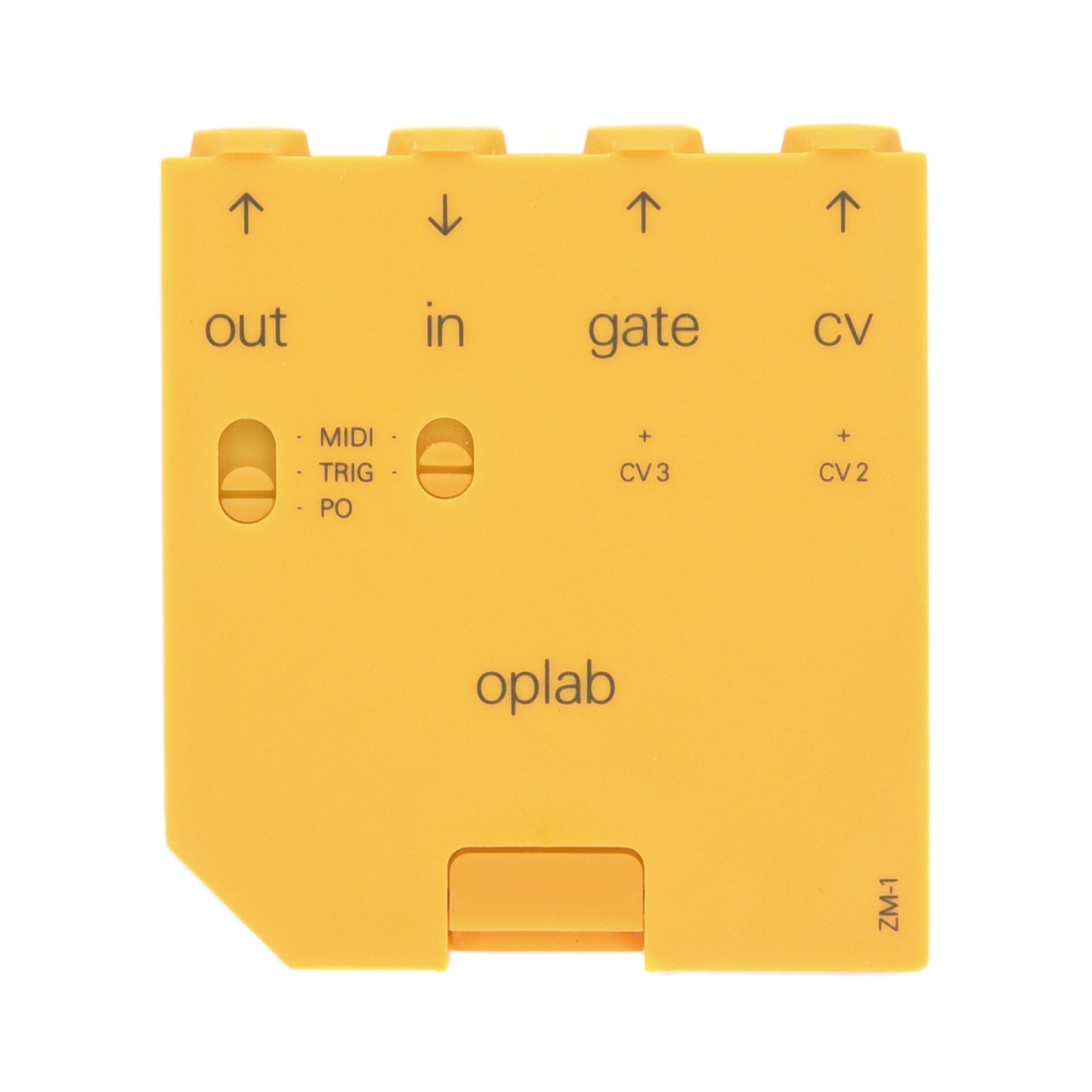
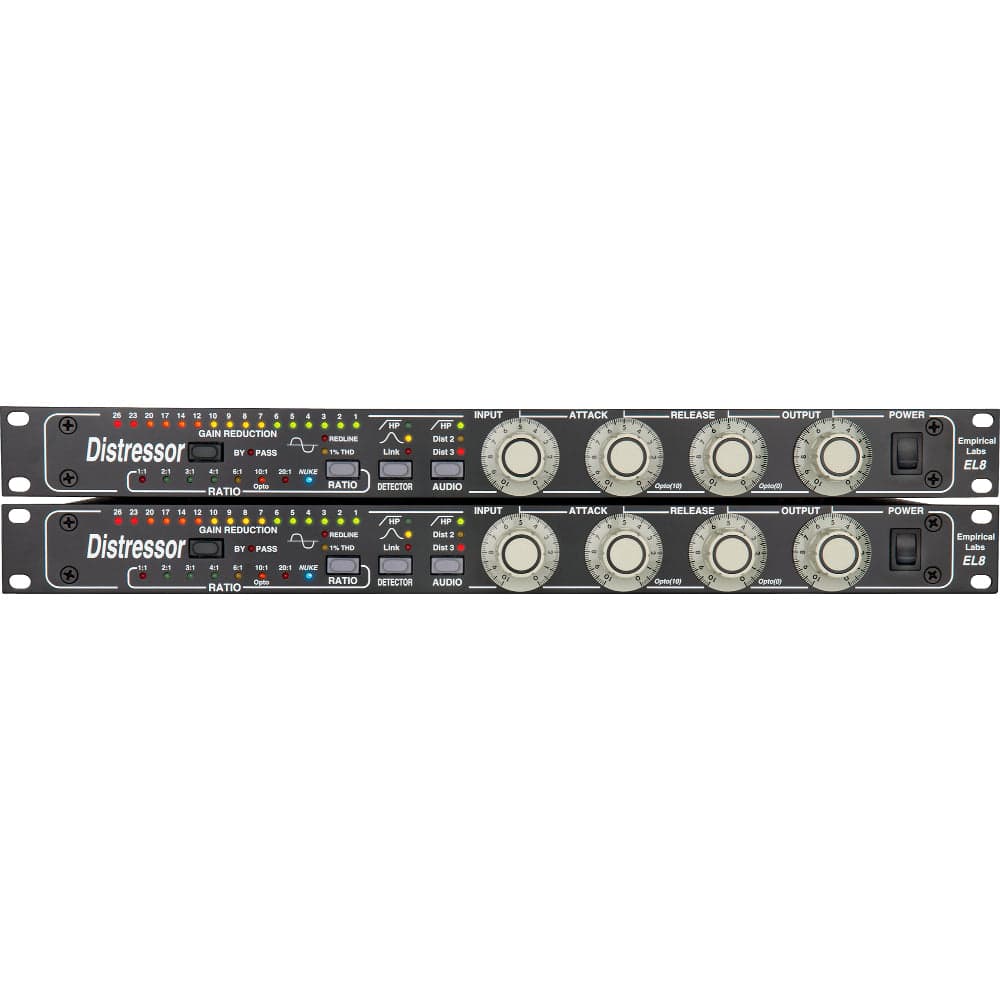
| Imagine having the power and flexibility of the OP-Z sequencer available to any other music equipment. Now you can, with the new oplab module - the magic link between OP-Z and the rest of the world. The oplab module is the first hardware expansion module for OP-Z. once mounted in the back of your OP-Z, you can use it to connect to any equipment using standard cv and gate, such as the pocket operator modular or any other modular system. It features three cv outs and one gate out, all programmable and playable from OP-Z. have your wall of modules sequenced from the palm of your hands. Use the po sync out to unleash the power of your regular pocket operators and have them play in sync with the rest of your setup. Even connect standard midi devices, using midi over 3.5 mm jack or the included midi over din adapter cable. Oplab features both midi in and out ports as well as trig in and out for other synthesizers and sequencers. | The product that started it all for Empirical Labs. Born of founder Dave Derr’s love of classic compressors like the 1176, LA-2A and Gain Brain (among others), the Distressor incorporates his favorite sonic characteristics of these, along with other unique and interesting features that have made it a staple for audio engineers all over the world. With over 28,000 units in the field, it’s safe to say that the Distressor is one of the best selling high end compressors of all time… if not THE best selling. A prominent recording engineer recently wagered that there probably was not a top 40 record made in the last five years that didn’t have at least one Distressor on it.
Besides providing a wide range of control and a unique feature set, the Distressor offers a warm, vintage sound by using a custom designed gain control circuit. This “warmth” or “vintage sound” has become a major issue in the last few decades, as the super clear and linear digital technology does next to nothing to soften “harsh” sounds, nor emphasize the bass frequencies in music sources. Conversely, older analog tape, vinyl records and tube equipment could not be prevented from coloring the sound, often to the frustration of recording engineers. However, many people now realize that this coloring can be extremely pleasant and musical. Digital technology is often referred to as “cold” and “brittle” among other terms (although we prefer “unforgiving”).
Unique Compression Curves
All eight of the Distressor’s curves are unique and distinctive, from the 1:1 mode that simply warms up signal with low order harmonics without intentional compression, to the “Nuke” setting – a brick wall limiting curve that shines on live drum room mics. Each curve has its own personality and several actually use different circuitry, and are effectively different compressors. Most exceptional is the 10:1 “Opto” ratio which uses separate detector circuitry to emulate the oldest (and valued) “light controlled” devices, such as the LA-2A.
Distortion (Color) Modes
Another large part of the Distressor’s personality and power derive from three modes that color the signal, even without compression. These extended audio modes were designed to allow emulation of some very old and expensive vintage compressors & limiters, and let the Distressor deliver a classic “knee” sound all its own by providing user programmable, warm harmonic distortion. In addition to the basic distortion mode, Distort 2 emphasizes tube-like 2nd order harmonics, while in Distort 3 setting the distortion becomes dominated by 3rd harmonics more closely resembling tape. Two HP filters – one in the audio path, one in the detector path – are also available to help with low frequencies that can cause pumping and breathing.
Go Stereo
For many Distressor owners, one is never enough – in fact, one extremely successful engineer has twelve of them! For those who want (at least) a stereo pair, ELI offers the EL8-S, a pair of Distressors that are matched at the factory, and come with the cables you need to lock them together.
- Frequency Response – 2 Hz to 160 kHz in clean audio mode (+0, -3 dB). Response is shaped in distortion modes (Dist 2, Dist 3).
- Dynamic Range – 110 dB from max. output to min. output in 1:1 mode. Greater than 100 dB signal to noise in distort 3 mode.
- Distortion – ranges between .02% and 20% depending on distortion mode and release times set on front panel.
- I/O – DC Coupled input and outputs.
- Time Constants – Attack range 50uS – 50mS. Release range .05 sec to 3.5 seconds, normal modes and up to 20 seconds in 10:1 opto mode. Time constants are dependent on ratio.
- Power Consumption – 15 Watts Max.
- Metal Chassis – single height 1.75″ high, 10″ deep, 19″ wide.
- Shipping info – 24.2 lbs Stereo pair. Stereo Pair box dimensions 22.5″ x 18.5″ x 6 1/4.
| As with ELI’s other signal processors, the Lil FrEQ Equalizer takes a somewhat unique approach to its job. Instead of daisy chaining several equalizers and frequency processors, we combined most of the sound sculpting tools an engineer needs into a compact single rack space box, while still offering the highest performance of any design in its class.
Eight Sections of Processing
There are eight sections of processing – what other EQ offers that? Even better – in addition to a master bypass, each of the Lil FrEQ’s sections features its own dedicated bypass switch, letting you instantly A/B the effect of each section as you adjust and fine-tune them.
HIGH PASS – The High Pass section is a really easy to use sharp filter that cuts all content below one of eight preset frequencies from 30-330 Hz. This filter is very steep and has a special shape that prevents frequencies from thinning out just above the cutoff point. The corner frequency is selected using up/down buttons, and indicated by LEDs that glow softly when the section is bypassed, and brightly when the section is engaged.
HIGH & LOW SHELVING – These two knobs function similarly to the familiar “bass and treble” tone controls found on many consumer audio playback systems; however, these are designed to a much higher performance standard, providing exceptionally smooth and musical boost and cut on the high and low frequencies.
PARAMETRIC EQ – The Lil FrEQ has four sections of fully parametric EQ (LF, Lo Mid, Hi Mid and HF), with each section featuring individual gain, bandwidth (Q) and frequency controls. It may be the cleanest parametric EQ section ever produced, operating below .0007% THD (Total Harmonic Distortion) even at extremely high audio levels. Try finding those specs anywhere else!
DS (DYNAMIC EQ) – The DS section provides the highest performance, easiest to use, and possibly most natural sounding “De-esser” ever built. This powerful tool combines tunable filters with a compressor-like circuit that can help contain and control excessive high frequency content such as sibilants or other sharp transients, especially in the absence of other lower frequency content. It can also function as a one of a kind soft knee High Frequency limiter, which is one of the main things responsible for the Lil FrEQ becoming the go-to vocal EQ for engineers everywhere. It has been used on many acclaimed albums and major live performances all over the world, becoming the “go to” EQ for key tracks like lead vocals, snares, and bass. There are now dozens of hit record vocals that were processed thru the Lil FrEQ.
Frequency Response: 5 Hz to 140 kHz on transformerless inputs and outputs. Transformer output 10Hz to 110 kHz.
Dynamic Range: 120 dB from maximum output (.1% clipping) to minimum output. Greater than 110 dB signal to noise.
Distortion: Ranges between .00056% and .005% depending on mode and settings. DS section has THD < .005%.
I/O: DC coupled inputs and outputs and one transformer coupled output.
Dynamic Time Constraints: Attack is approximately .5 ms. Release .04 sec fixed internally.
Power Consumption: 15 Watts Max.
Metal Chassis: single height 1.75″ high, 10″ deep, 19″ wide. | Rupert Neve Designs Portico 542 500 Series Tape FX Standard
FEATURES
- Add depth and character to your sound
- Control the mix of pre and post tape signals
- Send signals through "True Tape" circuitry
- Silk circuit, reduces negative feedback, adding harmonic content as needed
- Red Silk accentuates the saturation in the mid and high frequencies
- Use soft clip to tame overly transient material like drums
- Provides +/- 12dB adjustment of level on incoming signal levels
TECHNICAL SPECIFICATION
Rupert Neve Designs Portico 542 500 Series Tape FX
- Line Amp Specifications (Measurements with tape circuit disengaged)
- Noise: Measured at Main Output, un-weighted, 20Hz-22kHz, Input Terminated 40 Ohms.
- Unity Gain Better than -100dBu
- Frequency Response
- Measured at +10dBu, trim at unity.
- Main Output +/- 0.25dB from 5Hz to 60Khz -2dB @ 120KHz
- Maximum Output Level 23.25dBu
- Total Harmonic Distortion and Noise:
- @ 1kHz, +20dBu output level Better than 0.0025% @ 20Hz, +20dBu output level 0.07% Typical (2nd and 3rd harmonic)
- Tape FX Specifications
- Noise:
- Measured at Main Output, un-weighted, 20Hz-22kHz, Input Terminated 40 Ohms.
- Saturation @ minimum Better than -100dBu Saturation @ maximum Better than -100dBu
- Frequency Response:
- 15 IPS, Input @ -0 dBu -3dBu @ 28kHz Saturation @ minimum 0dBu @ 10Hz +5dBu Peak @ 60Hz
- Saturation @ maximum -3dBu @ 20kHz -3dBu @ 12.5Hz +2.4dBu Peak @ 60Hz
- 30 IPS, Input @ -0 dBu -3dBu @ 120kHz Saturation @ minimum -3dBu @ 10Hz +3.15dBu Peak @ 125Hz
- Saturation @ maximum -3dBu @ 100kHz -3dBu @ 12.5Hz
- +1.3dBu Peak @ 110Hz
- Total Harmonic Distortion and Noise
- Refer to sweeps on page10 15 IPS, Input @ -0 dBu 0.4% @ 3kHz to 1% @ 175Hz typical
- Saturation @ minimum Greater than 1% below 175Hz typical
- Saturation @ maximum 1% at 6kHz typical 0.3% @ 1kHz to 3% @ 50Hz typical
- 30 IPS, Input @ -0 dBu 1% at 1kHz typical
- Saturation @ minimum 0.6% @ 400Hz 5% @ 20Hz typical
- Saturation @ maximum 1.5% @ 20kHz to 0.4% @ 1kHz typical 0.4% @ 1kHz to 2 %@ 50Hz typical
- Power requirements:
- Supplied by 500 series rack with 110-125 mA @ +/- 16V DC
|







Reviews
There are no reviews yet.